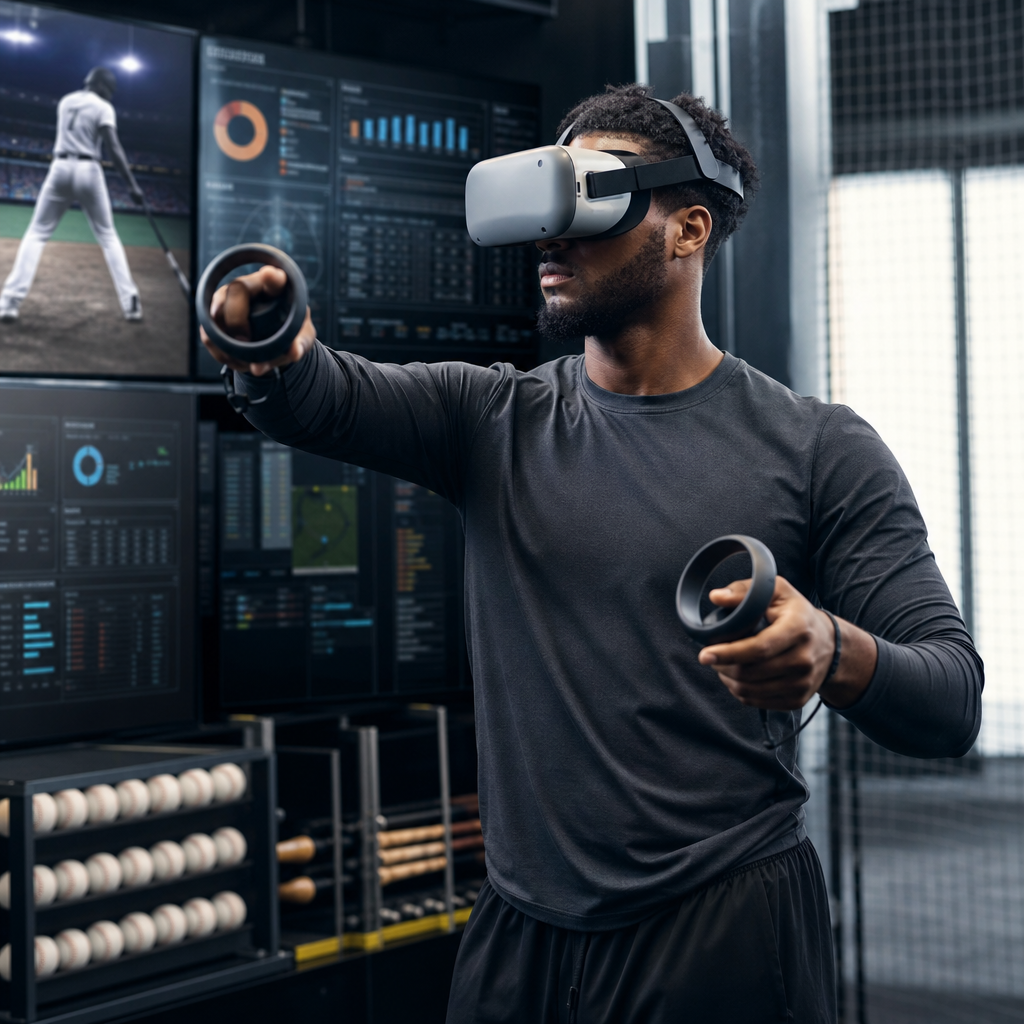
Virtual reality and advanced statistics are reshaping baseball player development, turning what was once a coach’s eye-and-stopwatch process into a measurable, repeatable system built on perception, decision-making, biomechanics, and game context. In baseball, virtual reality means simulated game environments delivered through headsets and motion-tracking systems that let hitters, pitchers, and fielders rehearse situations without physical wear. Stats in this setting means far more than batting average or ERA. It includes swing decisions, pitch tunneling, bat speed, attack angle, chase rate, release consistency, reaction time, visual tracking, and the growing family of models built from Statcast, Hawk-Eye, force plates, and motion-capture data. Together, these tools form the foundation of the future of baseball stats.
I have worked with performance staffs that used video and data separately, and the biggest change in recent years is not simply more information. It is integration. A hitter can now face a digital clone of Friday’s opposing starter in the morning, review his swing decision map by noon, and adjust training based on objective measures before first pitch. That matters because baseball development is constrained by limited reps, injury risk, and the speed of modern competition. Organizations need better ways to train recognition, quantify skill growth, and connect practice to on-field outcomes. This hub article explains where baseball statistics are heading, how virtual reality fits into that shift, what teams are already measuring, and which ideas will define player development over the next decade.
Why the Future of Baseball Stats Starts With Better Questions
The future of baseball stats is not about replacing traditional numbers; it is about asking sharper questions. Instead of asking whether a hitter is “hot,” teams ask whether he is recognizing spin earlier, making better swing decisions in two-strike counts, or matching his bat path to pitch plane more consistently. Instead of asking whether a pitcher allowed hard contact, analysts ask whether his release height drifted, whether his fastball shape changed, or whether his sequencing made his slider play up. Better questions create better training plans, and virtual reality helps answer them because it captures the decision environment, not just the result.
This shift mirrors baseball’s larger move from outcome stats to process stats. Batting average tells you what happened. Swing decisions and contact quality help explain why. On-base percentage, slugging percentage, wOBA, and expected stats such as xwOBA improved evaluation by weighting events properly, but player development departments needed even more granular measures. They now care about time-to-contact windows, visual occlusion tolerance, take accuracy, heat-map discipline, and pitch-type recognition under fatigue. These are the kinds of metrics that can change a player’s trajectory before the box score does.
For readers exploring the broader Statistics and Record-Breaking Moments topic, this page serves as the central guide to the future of baseball stats. Related articles in this subtopic should naturally branch into Statcast metrics, record-era context, predictive models, biomechanics, and the use of data in scouting and coaching. The hub matters because no single metric explains development in isolation. The new era is built on layered evidence: what the player saw, what choice he made, how his body moved, what contact he produced, and how often that process holds up against elite competition.
How Virtual Reality Changes Baseball Training
Virtual reality improves baseball training by creating high-volume, game-like repetitions without the physical cost of full batting practice or live bullpen exposure. A hitter can stand in against a realistic 95 mph fastball from a pitcher with a difficult release slot and train pitch recognition repeatedly, even on a recovery day. A catcher can rehearse receiving shapes and pitch tracking. An infielder can work pre-pitch reads and first-step decisions. The key advantage is representative learning: the brain practices the same perceptual cues it will need in competition.
Several professional and college programs already use platforms such as WIN Reality and custom in-house simulation systems. Their value is strongest in training approach, recognition, and timing windows. VR does not perfectly replicate the weight of the bat or the exact feel of collision, so it is not a replacement for cage work or live at-bats. It is a supplement with a specific purpose. In practice, the best programs use VR to preview opposing pitchers, reinforce zone discipline, and accelerate return-to-play for athletes who need mental reps before full physical intensity.
The underlying reason VR belongs in player development is simple: baseball decisions happen fast. A 95 mph fastball reaches home plate in roughly four-tenths of a second, and a hitter must identify location and likely movement much earlier than that to commit on time. If technology can improve pick-up, anticipation, and inhibition of bad swings, it can directly improve performance. That is why future baseball stats increasingly include cognitive and perceptual measures alongside classic performance indicators.
The Metrics That Matter Most in the New Development Model
The best development metrics are actionable, stable enough to track, and closely tied to skill. In hitting, that usually means swing decision quality, contact quality, and bat movement patterns. Swing decision quality includes chase rate, in-zone swing rate, take accuracy, and miss rate by pitch type and zone. Contact quality includes exit velocity, launch angle, hard-hit rate, sweet-spot rate, and expected weighted outcomes. Bat movement patterns include bat speed, attack angle, time to contact, and connection scores derived from motion systems. These metrics work together: a hitter who swings at better pitches often produces better contact, but only if his mechanics let him get on plane consistently.
Pitching has its own stack of priorities. Velocity still matters, but shape and deception often matter almost as much. Vertical break, horizontal movement, spin efficiency, induced vertical break, extension, release variance, and seam effects all influence pitch quality. Then come command metrics, such as location consistency, edge percentage, first-pitch strike rate, and miss target dispersion. The most advanced departments also monitor fatigue indicators through workload tracking, force-plate asymmetries, and changes in arm action.
| Development Area | Key Metrics | Why It Matters |
|---|---|---|
| Hitting Decisions | Chase rate, in-zone swing rate, take accuracy | Measures whether the hitter is choosing pitches he can damage |
| Hitting Contact | Exit velocity, launch angle, hard-hit rate, xwOBA | Shows quality of contact beyond simple batting average |
| Bat Movement | Bat speed, attack angle, time to contact | Connects mechanics to game outcomes |
| Pitch Quality | Velocity, induced vertical break, spin efficiency, extension | Explains why pitches miss bats or draw weak contact |
| Pitch Command | Release consistency, target dispersion, edge rate | Separates raw stuff from repeatable execution |
| Perception | Reaction time, pitch recognition, visual tracking scores | Captures skills that develop before visible box-score gains |
One lesson from working with these metrics is that context matters. Bat speed is useful, but more speed is not always better if the hitter loses adjustability. A sweeper with elite horizontal break is valuable, but only if the pitcher can pair it with a fastball that creates tunneling pressure. Metrics must describe a player’s actual task. The future of baseball stats therefore depends on model design that respects role, count, opponent quality, handedness, and game situation rather than forcing every player into one benchmark.
From Box Score to Biomechanics: The Expanding Data Stack
Baseball’s data stack has expanded from manually scored events to a layered system of tracking and biomechanical capture. Statcast normalized public discussion around exit velocity, launch angle, sprint speed, and catch probability. Hawk-Eye added higher-resolution ball and player tracking. Kinatrax, markerless motion capture, high-speed video, and wearable sensors gave teams access to kinematic sequences, joint angles, segment speeds, and movement efficiency. Force plates measure how athletes create and transfer force. Eye-tracking and VR platforms add decision and visual behavior data. Each layer answers a different part of the same question: how does this player create performance?
That integration is the real frontier. A hitter’s slump may look like poor contact in the game log, but the root cause could be earlier commitment against breaking balls, reduced pelvic rotation speed, or simple fatigue reducing lower-half force production. A pitcher’s declining whiff rate may stem from a flatter fastball shape, inconsistent release, or predictable usage patterns. Teams that connect these data sources well can intervene earlier and more precisely. They do not wait for a month of bad outcomes if process markers already show deterioration.
This is also why the future of baseball stats is not only about public leaderboards. Public metrics are valuable, but internal models are becoming more important because they reflect each organization’s training philosophy and technology stack. One club may emphasize bat path adaptability; another may focus on decision quality against velocity at the top of the zone. The common thread is that useful stats must translate into a coaching action. If a number does not change training, roster decisions, or health management, it has limited developmental value.
How Teams Use VR and Data in Daily Player Development
In daily operations, VR and advanced stats are most effective when they are built into routines rather than treated as novelty tools. A common hitter workflow starts with scouting information on the upcoming pitcher, followed by a short VR session that replicates release point, pitch mix, and likely attack zones. After that, the player reviews individualized focus points: perhaps laying off sliders below the zone or preparing earlier for elevated velocity. Cage work then reinforces the game plan physically. After competition, the staff compares intent and execution using swing decisions, contact maps, and video.
Pitchers use similar loops. Before a start, they may review hitter tendencies, then throw bullpen work while tracking release metrics and movement profiles through systems like Rapsodo or TrackMan. If the data shows the fastball lost ride or the cutter backed up, adjustments happen immediately, not days later. During rehab, VR allows a pitcher or hitter to maintain decision-making reps when total throwing or swinging volume must be restricted. That has practical value because layoff periods often disrupt timing and visual calibration even when physical healing is progressing well.
At the amateur level, adoption is growing because the tools are becoming cheaper and easier to interpret. College programs increasingly use portable bat sensors, affordable pitch tracking, and standardized video capture. The best staffs avoid drowning players in dashboards. They choose a few anchor metrics, explain them in plain language, and revisit them consistently. That communication piece is crucial. Players improve when they understand what a metric represents, what “good” looks like for their role, and what drill or routine can move it in the right direction.
Limitations, Risks, and What Smart Programs Do Differently
Virtual reality and advanced stats are powerful, but neither is magic. VR can improve recognition and preparation, yet it cannot fully reproduce live at-bat stress, exact bat-ball feedback, or the chaos of in-game adjustment. Data can reveal patterns, but bad models, poor camera calibration, or weak sample sizes can mislead coaches. I have seen programs create confusion by tracking every available number without deciding which ones truly mattered. Information overload is a real performance risk, especially for younger players who need clarity more than complexity.
There are also organizational challenges. Departments sometimes speak different languages: analysts describe variance and expected outcomes, while coaches speak in feels and cues. The strongest player development systems bridge that gap. They translate metrics into coaching language, validate findings with video and athlete feedback, and avoid making permanent judgments from temporary noise. They also test whether training gains transfer to competition. If a hitter improves in VR but still chases the same breaking ball in games, the intervention needs refinement.
Privacy, health data governance, and competitive secrecy will matter more as tracking expands. Teams are collecting increasingly sensitive performance information, from biomechanical signatures to recovery markers. Clear consent, secure storage, and responsible use are not optional. The next generation of baseball stats will be judged not only by predictive power but by whether organizations handle player data ethically and communicate findings honestly. Trust remains the foundation of any development system.
What the Next Decade of Baseball Stats Will Look Like
Over the next decade, baseball stats will become more individualized, more predictive, and more tightly linked to training design. Expect models that estimate swing decisions by context, not just aggregate rate; pitcher evaluations that account for arsenal interaction rather than isolated pitch grades; and development dashboards that combine biomechanics, workload, and decision quality into one risk-performance view. AI-assisted video tagging, automated scouting summaries, and more realistic VR environments will reduce manual workload and increase the speed of feedback.
We will also see broader use of digital twins, where a player’s movement, tendencies, and outcomes are modeled closely enough to test training scenarios before applying them in the field. That does not mean baseball becomes fully automated. Coaching judgment will matter even more because the best staffs will know when to trust the model, when to challenge it, and how to tailor it to the athlete in front of them. Human development is rarely linear, and the future of baseball stats belongs to organizations that combine measurement with perspective.
For anyone following Statistics and Record-Breaking Moments, this hub should frame the subtopic clearly: the future of baseball stats is not just better record-keeping. It is better decision-making. Virtual reality gives players realistic reps in controlled settings. Modern metrics explain skill at a deeper level than the box score ever could. Biomechanics and tracking systems connect movement to outcomes. Used together, they help teams develop players faster, prepare more intelligently, and protect health while pursuing performance. The takeaway is straightforward: learn the new metrics, understand how VR fits the training environment, and keep connecting data to real baseball actions. If you are building out your knowledge of this subtopic, use this page as your starting point and explore each branch in detail.
Frequently Asked Questions
1. How are virtual reality and advanced stats changing baseball player development?
Virtual reality and advanced statistics are moving baseball development away from a process based mostly on observation and repetition and toward one built on measurement, feedback, and game-specific training. In a traditional setting, coaches often relied on experience, video review, and on-field drills to evaluate a player’s progress. Those methods still matter, but VR and modern data tools add a new layer: they let teams quantify how a player sees the game, reacts to it, and adapts under pressure.
With virtual reality, players can step into simulated game environments that closely mimic real at-bats, pitch sequences, defensive reads, and situational decisions. A hitter can face a digital version of an opposing pitcher and work on recognizing pitch type, release point, and trajectory without taking live swings. A pitcher can rehearse attack plans against different hitter profiles. A fielder can practice first-step reactions, route efficiency, and decision-making in a repeatable setting. Because these reps do not require full physical exertion, players can train more often without the wear and tear that comes with live competition.
Advanced stats make those VR sessions far more valuable by showing what is actually improving. Instead of focusing only on outcomes like batting average or ERA, teams can track decision quality, swing timing, chase rate, contact point, pitch recognition accuracy, reaction time, and movement efficiency. This shifts development from “take more reps” to “take the right reps and measure the results.” The result is a more personalized, evidence-based development model that helps players improve skills that are often difficult to isolate in standard practice.
2. What kinds of statistics matter most in a VR-based player development program?
In this environment, the most useful statistics are process-oriented metrics rather than simple box score results. Traditional stats such as batting average, home runs, or wins can describe performance, but they do not always explain why a player is succeeding or struggling. VR-based development is especially powerful because it focuses on the building blocks of performance, and those are the numbers teams want to study.
For hitters, key metrics may include swing decision rate, chase rate on pitches outside the zone, take rate on strikes, time to decision, pitch recognition accuracy, expected contact quality, and bat-path efficiency. These measurements help coaches determine whether a player is seeing the ball well, identifying spin early enough, and making disciplined decisions instead of guessing. A hitter who is still getting out in games may actually be making better swing decisions, which is often a strong sign that future performance will improve.
For pitchers, relevant statistics can include release consistency, command by zone, pitch tunneling quality, sequencing effectiveness, shape consistency, and how often a pitch profile creates weak contact or deception in simulated settings. VR can also help pitchers test different game plans and immediately measure how those plans affect hitter behavior. For fielders, teams may examine reaction time, jump quality, route efficiency, transfer speed, decision-making under pressure, and positioning outcomes based on batted-ball tendencies.
What makes these stats especially valuable is context. Numbers mean more when tied to a specific skill and a specific game situation. A player is not just being told to “improve.” Instead, the development staff can identify exactly where the breakdown occurs, create a targeted drill inside a VR environment, and then measure whether the intervention is working over time.
3. Can virtual reality really improve performance on the field, or is it mainly a supplement to traditional training?
Virtual reality is best understood as a high-value supplement rather than a full replacement for traditional baseball training. It cannot fully recreate the physical demands of hitting a live 95-mile-per-hour fastball, fielding a hard ground ball, or managing fatigue across a long season. However, it can dramatically improve the mental, visual, and decision-making parts of performance, and those parts are often what separate average players from advanced ones.
One of VR’s biggest strengths is that it allows players to train perception and anticipation in a realistic, repeatable way. A hitter can face the same pitch type or the same pitcher profile dozens of times in a controlled environment until recognition improves. A catcher can work through pitch-calling scenarios based on count, hitter tendency, and game state. An infielder can rehearse reads off the bat and sharpen choices on double-play feeds or slow rollers. These are real baseball skills, and they benefit from repetition just like mechanics do.
The reason VR translates to the field is that baseball is heavily dependent on seeing, deciding, and reacting in very small windows of time. If a player can recognize spin earlier, identify a pitch sooner, or process game context more efficiently, that player has a better chance of making a successful move in a real game. The strongest development programs combine VR with cage work, strength training, biomechanics analysis, video, and live competition. In that combined model, VR becomes a bridge between film study and live action, helping players convert information into instinct.
So the short answer is yes: VR can improve real performance, especially in areas tied to pitch recognition, timing, situational awareness, and cognitive speed. But its greatest value comes when it is integrated into a broader player development system rather than used in isolation.
4. How do teams use virtual reality and data to personalize training for individual players?
Personalization is where virtual reality and advanced stats become especially powerful. Not every player struggles for the same reason, and not every improvement plan should look the same. Two hitters might both be slumping, but one may be chasing breaking balls below the zone while the other is simply late on velocity. Two pitchers may both have command issues, but one may be drifting mechanically while the other is missing because of poor sequencing choices. VR and data help teams separate symptoms from causes.
Teams begin by building a detailed player profile using game data, video, biomechanical measurements, and performance trends. That profile might show, for example, that a hitter struggles against left-handed fastballs at the top of the zone, expands the strike zone when behind in the count, or makes weaker swing decisions with runners in scoring position. A VR training plan can then be designed around those exact situations, allowing the player to rehearse the moments that matter most instead of taking generic reps.
The same applies to pitchers and defenders. A pitcher may use VR to practice attacking a specific lineup with a better sequence mix, or to repeat mechanics while monitoring release-point consistency. A center fielder might work on route decisions against particular contact profiles based on spray charts and ball-flight models. Because the technology can capture and compare performance over time, coaches can see whether the player is truly improving in the target area or just getting comfortable in practice.
This individualized feedback loop is one of the biggest shifts in modern development. Rather than giving every player the same drills, teams can prescribe training based on actual evidence. That makes practice more efficient, more relevant, and more likely to create lasting game performance. It also helps players buy in, because they can see exactly what the training is addressing and how it connects to their results.
5. What are the biggest benefits and limitations of using VR and stats in baseball development?
The biggest benefits are efficiency, repeatability, specificity, and reduced physical stress. VR allows players to experience game-like situations without needing a full field, a live opponent, or the same level of physical recovery that normal practice requires. That means more quality reps in less time. Because the environment can be controlled, coaches can isolate precise situations, such as two-strike pitch recognition, bullpen sequencing, or first-step defensive reactions, and repeat them until improvement becomes measurable.
Advanced statistics add clarity to that work. They help development staffs move beyond vague instruction and identify exactly what is happening beneath the surface. Instead of saying a hitter “looks off,” coaches can point to slower decision times, poorer swing decisions against certain pitch shapes, or reduced contact quality in specific zones. Instead of saying a pitcher “needs better command,” they can analyze where misses are occurring, how release characteristics are changing, and whether hitters are reading certain pitches too early. This makes communication sharper and training more productive.
That said, there are important limitations. VR is only as useful as the quality of the simulation and the way it is integrated into the training plan. If the visuals, timing, or scenarios are unrealistic, the transfer to game performance may be limited. Data also needs interpretation. A large volume of statistics can overwhelm players and coaches if the information is not filtered into practical action steps. More numbers do not automatically mean better development.
There is also the human factor. Confidence, adaptability, competitiveness, and feel still matter in baseball, and no technology fully replaces live play, coaching intuition, or the emotional challenge of real competition. The best organizations do not treat VR and stats as magic solutions. They treat them as tools that enhance expert coaching, sharpen player awareness, and make development more intentional. Used that way, they represent a major step forward in how baseball talent is built.