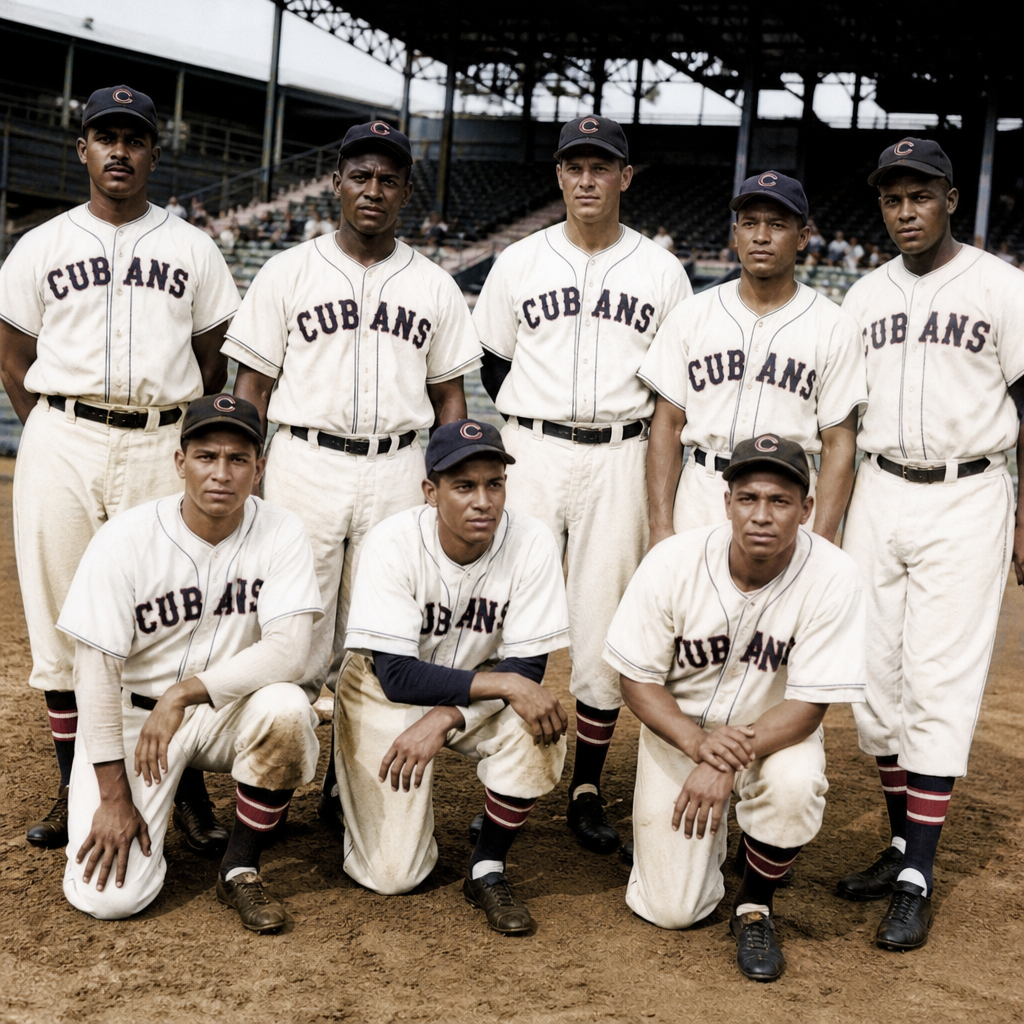
The New York Cubans occupy a singular place in baseball history because they connected the Negro Leagues, Caribbean baseball, and the broader story of Latin American stars long before Major League Baseball integrated. Founded in 1935 by Alex Pompez, the club was more than a New York franchise with a distinctive name. It was a cultural bridge that brought Cuban, Puerto Rican, Dominican, Venezuelan, and Black American talent onto the same rosters, in the same dugouts, and before the same audiences in Harlem, the Bronx, and across the East Coast. When people study famous baseball teams, the New York Cubans deserve attention not only for winning games but for reshaping how baseball talent moved across borders.
To understand the New York Cubans, it helps to define the setting. The Negro Leagues were a network of Black professional baseball leagues and independent clubs operating during segregation, especially from the 1920s through the 1940s. Negro Leagues teams included powerhouses such as the Kansas City Monarchs, Homestead Grays, Pittsburgh Crawfords, Newark Eagles, and Philadelphia Stars. Within that landscape, the New York Cubans stood out for their bilingual identity and international recruiting model. They played in the Negro National League and later the Negro American League, while also maintaining deep links to winter ball in Cuba and other Caribbean circuits.
This matters because the team anticipated the global baseball economy that fans now take for granted. Today, front offices aggressively scout Santo Domingo, San Juan, Caracas, and Havana’s baseball legacy abroad. The New York Cubans were doing a version of that ninety years ago. I have always found that once you dig into box scores, ownership records, and player movement, the Cubans look less like a novelty and more like a prototype. They proved that elite baseball existed outside the segregated major leagues and that Latin American players were central, not peripheral, to the sport’s highest levels of competition. As a hub for Negro Leagues teams, this article places the Cubans in that wider history and shows why they remain essential to any serious map of famous baseball teams.
Origins of the New York Cubans and Alex Pompez’s vision
The New York Cubans were established by Alejandro “Alex” Pompez, a Harlem businessman, gambling figure, and baseball executive whose influence stretched from New York to Havana. Pompez understood two realities better than most owners. First, segregation excluded extraordinary Black and Afro-Latino players from the majors. Second, New York contained a large audience ready to support baseball that reflected Caribbean culture as well as Black urban life. He built the club to serve both markets.
The team played many home dates at Dyckman Oval in Upper Manhattan and also appeared at the Polo Grounds and other venues. Their style, branding, and roster composition made them memorable. While some Negro Leagues teams drew primarily from specific American regions, the Cubans leaned into transnational recruitment. Pompez used relationships in Cuba and the United States to sign players who could thrive in multiple baseball worlds. That approach helped the franchise survive financially because it could draw crowds from exhibitions, league play, and winter baseball connections.
Pompez later became a scout for the New York Giants and was instrumental in signing talent such as Monte Irvin and Minnie Miñoso into organized baseball after integration advanced. That later work sometimes overshadows what he built with the Cubans. In practical terms, the New York Cubans were his proof of concept: a well-run club could identify overlooked talent, market it intelligently, and win against elite competition.
The New York Cubans as a gateway for Latin American baseball talent
The most important fact about the New York Cubans is simple: they were one of the clearest entry points for Latin American stars in the Negro Leagues. Many players from Cuba and elsewhere in the Caribbean faced a complicated racial landscape. In some contexts they were accepted as Latin players; in others, they were classified within America’s Black-white color line and barred from the major leagues. The Cubans gave those players a professional home where their ability, not official segregation, determined opportunity.
That role made the team historically significant beyond its win-loss record. The club demonstrated that Afro-Cuban and other Afro-Latin players were essential contributors at the highest professional level available to them. Martín Dihigo, often cited by historians as one of the most versatile players ever, passed through the organization’s orbit and symbolized this transnational excellence. Minnie Miñoso, who would later become an MLB star and Hall of Fame inductee, also played for the New York Cubans early in his career. So did Luis Tiant Sr., an outstanding pitcher whose son later became a major league ace. These names are not trivia. They are evidence that the Cubans were a pipeline of genuine star power.
The team also helped normalize multilingual clubhouses. Players moved between Spanish and English, between U.S. league schedules and Caribbean winter seasons, and between different expectations about race and status. Modern organizations spend heavily on cultural assimilation programs and bilingual coaching. The Cubans were managing those realities in the 1930s and 1940s with far fewer resources.
Where the Cubans fit among Negro Leagues teams
As a hub within the Negro Leagues teams subtopic, the New York Cubans are best understood in comparison with other major clubs. The Monarchs became synonymous with sustained excellence and innovation. The Homestead Grays had Josh Gibson and Buck Leonard, setting a standard for dominance. The Newark Eagles combined business acumen and championship ambition under Effa and Abe Manley. The Cubans belonged in that conversation because they offered a different model: an international roster strategy paired with strong urban market positioning.
They were not always the most stable franchise, and Negro Leagues schedules themselves were often fluid because of travel demands, uneven finances, and barnstorming opportunities. Yet instability should not be mistaken for insignificance. Baseball historians evaluate Negro Leagues teams using league titles, championship appearances, player quality, attendance draw, and cultural impact. By those measures, the Cubans rank high. They won the Negro League World Series in 1947, defeating the Cleveland Buckeyes in five games. That championship gave the organization a signature achievement at a pivotal time, just months after Jackie Robinson broke the major league color barrier.
For readers exploring famous baseball teams, this is the key takeaway: the Cubans were not a side note to the better known Black franchises. They were one of the clubs that defined what Negro Leagues baseball could look like when scouting crossed national boundaries.
Roster strength, playing style, and notable stars
The New York Cubans were built on speed, athleticism, tactical flexibility, and deep pitching. Their best clubs looked modern in the sense that they valued versatility and run prevention as much as star hitting. Miñoso brought explosive energy, line-drive contact, range, and baserunning pressure. Luis Tiant Sr. offered frontline pitching with command and poise. Players such as Francisco Coimbre, Tetelo Vargas, and others linked the Cubans to the broader Caribbean talent web, even when seasons overlapped and roster continuity shifted.
One reason the club has been underrated is record fragmentation. Negro Leagues statistics were not preserved with the consistency of major league ledgers, though research by Seamheads and work recognized by Major League Baseball have improved the historical record. Even with incomplete data, the scouting descriptions, newspaper accounts, and surviving box scores tell a consistent story. The Cubans fielded legitimate professionals who could defend, run, throw, and compete against any Black club in North America.
| Figure | Role | Why he matters to the New York Cubans story |
|---|---|---|
| Alex Pompez | Owner and executive | Built the franchise and created a durable scouting bridge between New York and the Caribbean |
| Minnie Miñoso | Outfielder and third baseman | Began with the Cubans before becoming one of the first great Afro-Latino stars in integrated major league baseball |
| Luis Tiant Sr. | Pitcher | Anchored championship-level clubs and represented the strength of Cuban pitching talent in the Negro Leagues |
| Martín Dihigo | Two-way legend | Embodied the cross-border excellence that gave the team and its network historic stature |
In plain terms, the Cubans played a sharp, aggressive brand of baseball. They could manufacture runs, exploit defensive mistakes, and pressure opponents with athletic lineups. Against stronger power-hitting teams, that adaptability mattered.
The 1947 championship and what it proved
The defining season in franchise history came in 1947. The New York Cubans captured the Negro National League pennant and then won the Negro League World Series against the Cleveland Buckeyes. The series result mattered for more than a trophy. It confirmed that the Cubans were not merely an entertaining multicultural team; they were champions at the top of Black professional baseball.
That title also arrived during baseball’s most dramatic transition year. Robinson had integrated the Brooklyn Dodgers, and organized baseball was beginning to raid Negro Leagues rosters for elite talent without preserving Negro Leagues business structures. In that unstable moment, the Cubans showed the depth that remained in Black baseball. Their championship roster reflected years of scouting and player development across racial and national boundaries.
When historians evaluate whether a team was truly great, they ask whether it won when conditions were hardest. In 1947, travel remained demanding, league economics were fragile, and player movement was accelerating. The Cubans still finished the job. That is why the championship remains the cleanest answer to anyone asking whether the New York Cubans belong among the most important Negro Leagues teams.
Cultural impact in New York, Harlem, and the Caribbean diaspora
The New York Cubans mattered because they represented people who rarely saw themselves centered in mainstream baseball. In Harlem and other New York neighborhoods, the club offered Black and Latino fans a team that mirrored the city’s diversity. Game days brought together languages, musical influences, foodways, and social networks that crossed national lines. Baseball was the anchor, but community identity was part of the draw.
That visibility challenged simplistic versions of baseball history. Too often, the story is told as if Black baseball and Latin American baseball developed on separate tracks until integration. The Cubans prove otherwise. Afro-Cuban players, Black American stars, and Caribbean migrants were already building a shared baseball culture in the 1930s and 1940s. The club functioned as evidence that the sport’s racial history cannot be reduced to a binary alone.
This is also why the team matters within a broader famous baseball teams collection. The Cubans help connect multiple articles and reader interests: Negro Leagues teams, Latin American baseball history, pre-integration New York sports, and the origins of international scouting. Few teams sit at the intersection of all four topics so clearly.
Legacy, historical recognition, and why the Cubans still matter
The New York Cubans declined as integration drained the Negro Leagues of stars and revenue, but their legacy expanded over time. MLB’s formal recognition of Negro Leagues records as major league records helped validate what researchers and families had long argued: these teams played top-tier professional baseball. That recognition does not erase missing statistics or uneven documentation, yet it strengthens the case for studying clubs like the Cubans with the same seriousness given to any historic franchise.
Today, the Cubans matter for three reasons. First, they remind fans that baseball globalization did not begin with modern academies. Second, they show how segregation distorted talent pipelines while failing to suppress excellence. Third, they offer a model for understanding Negro Leagues teams as interconnected institutions rather than isolated curiosities. If you are building knowledge of famous baseball teams, start here, then continue through the Monarchs, Grays, Eagles, Crawfords, and Stars. The full picture becomes clearer when the New York Cubans are placed at the center of the conversation, where they belong.
Frequently Asked Questions
Who were the New York Cubans, and why are they so important in baseball history?
The New York Cubans were a Negro Leagues team founded in 1935 by Alex Pompez, and they hold a uniquely important place in baseball history because they linked multiple baseball worlds that are often discussed separately. They were based in New York, competed in Black professional baseball, and drew heavily from Cuban and other Latin American talent at a time when Major League Baseball still enforced segregation. That made the club far more than a team with an international flair. It became a working example of how baseball talent, culture, and opportunity flowed across borders long before organized white baseball opened its doors to nonwhite players.
The team’s significance also comes from its roster construction and its symbolism. The New York Cubans brought together Cuban, Puerto Rican, Dominican, Venezuelan, and Black American players in the same clubhouse and on the same field. In doing so, they showed that high-level professional baseball in the United States was already multinational and multicultural before Jackie Robinson broke MLB’s color barrier in 1947. Their story helps correct the mistaken idea that integration began only when Major League Baseball changed. In reality, teams like the New York Cubans had already been proving for years that top-level baseball talent transcended race, language, and national origin.
They were also highly competitive. The club won the Negro World Series in 1947, a major achievement that underscored their quality as a championship organization, not just a cultural curiosity. For historians, fans, and anyone interested in the broader development of the game, the New York Cubans matter because they reveal how deeply connected the histories of the Negro Leagues, Caribbean baseball, and Latin American baseball really were.
How did the New York Cubans serve as a bridge between the Negro Leagues and Latin American baseball?
The New York Cubans served as a bridge in both practical and cultural ways. On the practical side, they created professional opportunities for Latin American players who were barred from Major League Baseball because of race or skin color but were talented enough to play at the highest levels. Many players moved between winter leagues in Cuba or elsewhere in the Caribbean and summer competition in the Negro Leagues, and the New York Cubans became one of the most visible organizations to facilitate that movement. They helped normalize the idea that a player’s baseball life could be transnational, shaped by multiple leagues, countries, and audiences.
Culturally, the team reflected the multilingual and multiethnic reality of Black baseball in the Americas. Spanish-speaking players and English-speaking Black American players shared lineups, travel, and game strategy. That exchange mattered. It exposed fans in New York and beyond to styles of play, baseball traditions, and personalities rooted in Cuba and the wider Caribbean. At the same time, it gave Latin American players experience competing in the intense environment of the Negro Leagues, where the level of play was exceptionally strong and the travel schedule demanding.
The New York Cubans also helped demonstrate that baseball integration was not simply an American domestic issue. It was part of a larger story involving migration, race, empire, labor, and sport throughout the hemisphere. By bringing together players from different backgrounds under one banner, the club highlighted how baseball had already become international in practice, even if mainstream white institutions in the United States were slow to acknowledge it. That is why the team remains such a powerful symbol of cross-cultural exchange in baseball history.
Who was Alex Pompez, and what role did he play in the success of the New York Cubans?
Alex Pompez was the founder and driving force behind the New York Cubans, and his role in the team’s history was foundational. A key baseball executive, businessman, and talent evaluator, Pompez understood both the business of Black baseball and the deep reservoir of talent in Cuba and across Latin America. When he founded the team in 1935, he was not simply creating another franchise. He was building an organization that could compete on the field while also appealing to New York’s diverse audiences, including Afro-Cuban and broader Latin American communities.
Pompez had a remarkable eye for players and a sophisticated understanding of baseball networks that crossed national boundaries. He recruited talent from Cuba and elsewhere in the Caribbean while also working within the established world of the Negro Leagues. That ability to connect different baseball circuits was one of his greatest strengths. He recognized early that elite players existed outside Major League Baseball’s segregated structure and that a club built around that truth could be both competitive and culturally meaningful.
His influence extended beyond team ownership. Pompez became one of the most important figures in identifying and promoting Black and Latin American talent during an era of exclusion. Later in life, he also worked as a scout after the color line in Major League Baseball began to fall, further proving how central he was to the transition from segregated baseball to a more integrated professional game. In the story of the New York Cubans, Pompez stands out as the architect of a team that reflected the complexity, richness, and international character of Black baseball.
What kinds of players appeared on the New York Cubans roster?
The New York Cubans roster was notable for its range of talent and its diversity of backgrounds. While the team’s name emphasized its Cuban identity, its players came from a broader mix of places and communities, including Cuba, Puerto Rico, the Dominican Republic, Venezuela, and the United States. Many were Black or Afro-Latin players who faced exclusion from Major League Baseball despite possessing clear major-league-caliber ability. Others were Black American stars whose presence reinforced the team’s place within the highest levels of Negro Leagues competition.
This mixture made the club historically distinctive. It was one thing for a team to sign a few international players; it was another to build an identity around the blending of Latin American and Black American baseball talent. The New York Cubans embodied that model. Their roster often included players shaped by different baseball cultures, training systems, and linguistic backgrounds, yet they competed together successfully. That speaks to both the adaptability of the players and the cosmopolitan character of Negro Leagues baseball, which was often more open and more international than many mainstream narratives suggest.
The team featured standout figures such as Minnie Miñoso, Luis Tiant Sr., and Martín Dihigo in connection with its broader baseball orbit and legacy, though many players associated with the Cubans moved through overlapping Negro Leagues and Caribbean circuits over time. What matters most is that the roster represented a pathway for elite Latin American talent well before Major League Baseball offered equitable opportunity. In that sense, the New York Cubans were not only a team but also a showcase for players whose careers reveal how much great baseball existed outside MLB’s segregated system.
Why does the legacy of the New York Cubans still matter today?
The legacy of the New York Cubans still matters because the team helps modern fans understand baseball history in a fuller and more accurate way. Too often, baseball’s past is told through a narrow Major League lens, with integration treated as a single turning point beginning in 1947. The New York Cubans remind us that the game was already richly interconnected across racial, national, and linguistic lines long before that date. Their existence complicates and improves the story by showing that Black baseball and Latin American baseball were central, not peripheral, to the sport’s development.
The team also matters because it highlights the contributions of players who navigated multiple forms of exclusion. Many of the athletes associated with the New York Cubans were denied opportunities because of both race and nationality, yet they built extraordinary careers in the Negro Leagues and in Caribbean baseball. Remembering the New York Cubans means recognizing those players not as footnotes, but as stars who helped shape professional baseball in the Americas. Their experience also sheds light on broader themes of migration, identity, and community in sports history.
Finally, the New York Cubans remain relevant because their story speaks directly to conversations about representation, historical memory, and the global nature of baseball. Today, Latin American players are central to Major League Baseball, and multicultural clubhouses are a normal part of the sport. The New York Cubans were living that reality decades earlier, under much more difficult circumstances. Their history deserves attention not only as a chapter of Negro Leagues history, but as an essential part of the story of how baseball became the international game people recognize today.