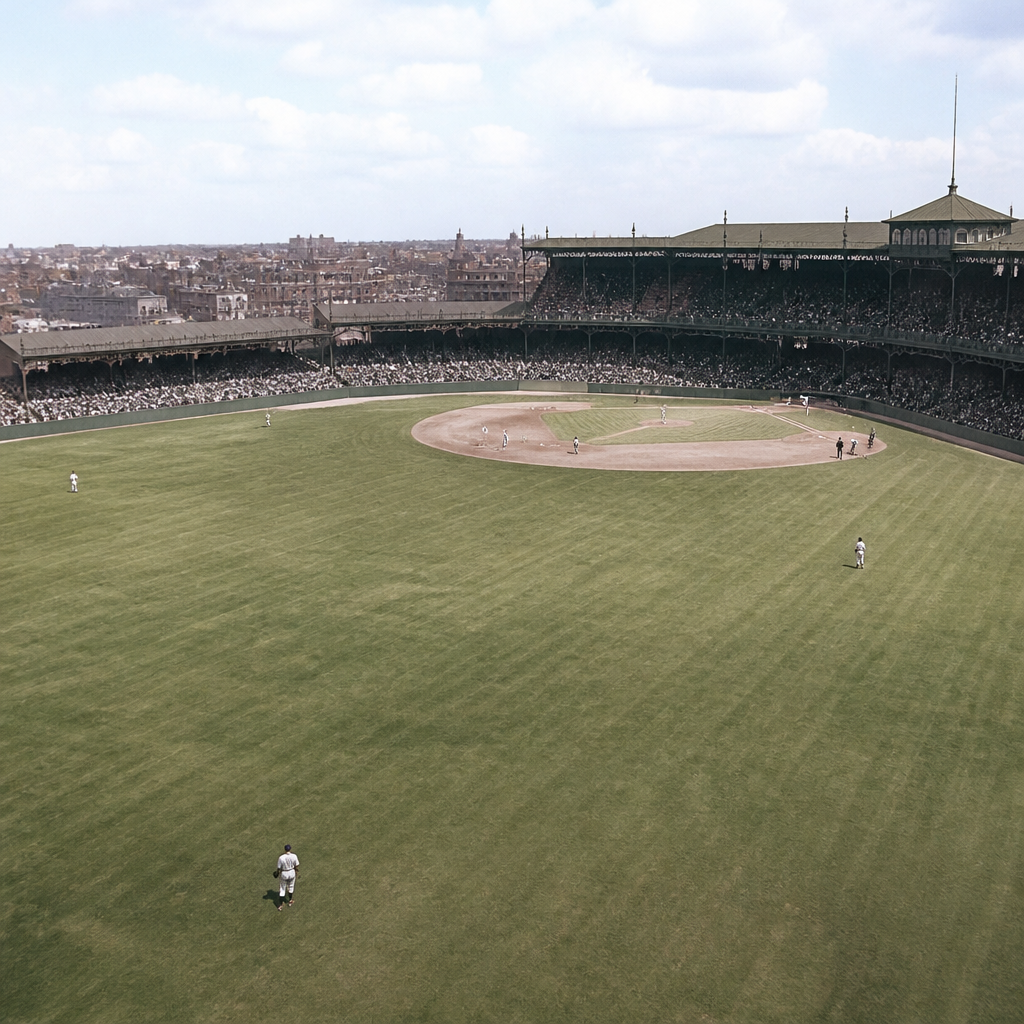
The Deadball Era ballparks were not just backdrops for early baseball; they were active forces that shaped strategy, player value, scoring patterns, and the statistical record. In baseball history, the Deadball Era generally refers to the period from roughly 1900 through 1919, though some historians stretch the boundaries slightly earlier or later depending on rule changes, equipment standards, and the impact of World War I. The term “deadball” describes a game environment in which baseballs were softer, scuffed, and reused, home runs were rare, and teams relied on speed, bunting, hit-and-run plays, stolen bases, and aggressive baserunning. Just as important, the ballparks themselves were enormous by modern standards, with deep alleys, quirky angles, high walls, and asymmetrical dimensions that turned many well-struck balls into long outs or extra-base chases instead of home runs.
When I study Deadball Era ballparks, the first lesson is simple: field geometry changed baseball behavior. A center field that stretched well past 450 feet, power alleys that reached 400 or more, and uneven outfield surfaces rewarded line drives, placement hitting, and speed more than pure loft. Teams built rosters accordingly. Outfielders needed range rather than only arm strength. Pitchers could challenge hitters differently because a fly ball was less dangerous than it would later become. Infields often played on rough, inconsistent surfaces, and that fact further encouraged bunts and pressure tactics. Statistics from the era make the most sense only when read through the physical environments in which they were produced.
This matters because fans often compare players across eras without adjusting for context. A slugger who hit eight home runs in 1908 may have displayed tremendous power in parks where many modern warning-track drives would have died in an outfielder’s glove. A .300 hitter in that environment may have built his average through bunts, infield hits, and gap shots rolling for triples in cavernous parks. Understanding Deadball Era ballparks helps explain why inside-the-park home runs were more common, why triples mattered so much, why strikeout and walk patterns looked different, and why legendary stars such as Honus Wagner, Ty Cobb, Tris Speaker, and Eddie Collins were so valuable. For anyone exploring baseball eras, this hub is the place to understand how huge outfields shaped the game from the ground up.
What made Deadball Era ballparks different
Deadball Era ballparks were generally larger, less standardized, and more irregular than later parks. Many were built on constrained urban lots, yet their playing fields still often featured extreme dimensions because stadium design was not yet optimized around the home run. Polo Grounds in New York famously had short foul lines but a vast center field, creating a strange offensive profile. Forbes Field in Pittsburgh opened in 1909 with expansive alleys that favored triples and outfield defense. Detroit’s Bennett Park and later Navin Field, Boston’s Huntington Avenue Grounds, and Chicago’s South Side Park each presented distinct dimensions and conditions that changed outcomes. There was no universal blueprint.
The playing surface mattered as much as the fences. Grass quality varied, drainage was inconsistent, and warning tracks were not standardized. Outfield walls could angle unexpectedly, and temporary ropes or distant markers sometimes defined boundaries in ways that look foreign today. Grounds crews worked hard, but maintenance technology was limited. A ball hit into a gap could carom strangely, slow in thick grass, or skip past a fielder on an uneven patch. Those conditions are one reason triples flourished. They also explain why official scorers and contemporary writers focused so heavily on speed, judgment, and “taking the extra base,” skills that were amplified by giant outfields.
One more difference is often overlooked: visibility and structure. Early steel-and-concrete parks such as Forbes Field and Shibe Park improved capacity and durability, but many venues still had shadows, awkward backdrops, and idiosyncratic seating alignments. Hitters faced more than pitchers; they dealt with changing light and less predictable sightlines. In practical terms, Deadball Era ballparks were local ecosystems. Teams knew their home fields intimately and exploited them. Visiting clubs had to learn how the ball carried, where corners kicked, and how much ground outfielders needed to cover. Home-field advantage was physical, not just psychological.
How huge outfields shaped offensive strategy
Large outfields pushed offenses toward what later became known as “inside baseball.” The aim was not to wait for a three-run homer, because that weapon barely existed as a repeatable strategy. Instead, managers sought incremental advantages: a bunt to move a runner, a steal to create pressure, a hit-and-run to open holes, and a slash into the alleys for multiple bases. Because outfielders had so much territory to defend, hitters were taught to use the whole field. Slashing line drives between fielders was often more valuable than trying to lift the ball over distant fences.
Triples were especially important. In modern baseball, triples are rare because parks are smaller, outfield positioning is more advanced, and wall rebounds are more predictable. During the Deadball Era, a well-placed drive to deep center or a distant alley could turn immediately into a three-base hit if the outfielder had a long recovery route. Tris Speaker built part of his legend on gap power and elite baserunning in spacious parks. Ty Cobb weaponized bunts, liners, and speed, forcing defenders to rush throws and stretching singles into doubles. These were not stylistic quirks. They were rational responses to the dimensions in front of them.
Managers also used the sacrifice bunt far more often because one run had outsized value in low-scoring conditions. The logic was straightforward: if games routinely ended 2-1 or 3-2, advancing a runner ninety feet materially improved win probability. The same principle encouraged double steals, squeeze bunts, and first-to-third aggression on singles. I have often found that modern readers underestimate how much giant parks changed risk calculations. In a low-homer environment, playing for one run was not timid; it was efficient baseball shaped by architecture.
How giant parks influenced pitching and defense
Pitchers in the Deadball Era worked in conditions that encouraged contact management. A fly ball was dangerous if it split the outfielders, but ordinary airborne contact did not carry the same home-run threat it would in later decades. That allowed pitchers to challenge hitters more directly, especially when they trusted the range of their outfield. Complete games were common not only because pitcher usage was different, but also because staffs were built around durability, control, and weak contact rather than maximum velocity in short bursts. The park gave pitchers a margin for error on deep flies while punishing them if they allowed too many sharp liners into the gaps.
Defensively, center fielders became premium assets. Tris Speaker is the classic case: his positioning, first step, and route efficiency let him turn cavernous grass into an advantage. On many clubs, corner outfielders also needed real range because left and right fields could be unusually deep. Infielders were under constant pressure from bunts, chops, and hurried throws generated by speed-first offenses. Catchers had to manage the running game relentlessly. In a deadball park, team defense was not an accessory to pitching. It was part of the run-prevention engine.
| Ballpark feature | Strategic effect | Statistical result |
|---|---|---|
| Deep center field and alleys | Hitters aimed for gaps; outfielders played for range | More triples, fewer over-the-fence home runs |
| Uneven, expansive outfield surfaces | Baserunners took extra bases aggressively | Higher value for speed and inside-the-park plays |
| Low-scoring run environment | Managers used bunts, steals, and hit-and-run plays | More sacrifice hits and stolen-base attempts |
| Limited standardization between parks | Teams tailored tactics to home conditions | Stronger park-specific statistical profiles |
The table captures the core relationship: dimensions changed tactical choices, and those choices changed statistical output. That is why defensive metrics for this era are difficult to compare cleanly with modern numbers. Even when retrospective systems like Total Zone help, they are estimating performance in parks where exact batted-ball data do not exist. Still, the broad truth is clear. Bigger parks elevated the importance of range, positioning, and relay execution in ways the box score only partially records.
Why Deadball Era statistics look so different
Deadball Era statistics can appear modest or strange to modern fans because the environment suppressed home runs and emphasized forms of value that today receive less attention. League home-run leaders sometimes finished with totals that would not rank near the top ten in a current season. Meanwhile, triples, sacrifice hits, stolen bases, and batting average occupied a larger share of the conversation. In 1908, for example, the National League leader in home runs hit only 10, while run scoring across the majors remained relatively low. Those outcomes were shaped by ball construction, pitcher behavior, foul-strike rules, and field dimensions working together.
Park effects are essential here. A hitter’s raw totals cannot be read at face value without knowing his home field. The Polo Grounds could produce odd splits because balls down the lines might leave the park while deep drives to center stayed in play. Forbes Field routinely rewarded line-drive hitters and punished ordinary fly-ball power. Shibe Park, opened in 1909, was considered modern, yet still reflected era conditions that limited home-run output compared with later livelier-ball settings. When historians use OPS+, ERA+, or park-adjusted estimates from Baseball-Reference and FanGraphs, they are trying to restore context that the raw record hides.
This is also why comparing Deadball Era stars to later sluggers requires care. Home run totals alone understate power; slugging percentage alone can miss the practical value of triples and stretch baserunning. A player who drove balls into far alleys, took extra bases, and pressured defenders may have created more offense than a superficial stat line suggests. The smartest way to read the era is to combine adjusted metrics with eyewitness accounts and park knowledge. Numbers matter, but in this era, dimensions are part of the numbers.
Famous parks and players that define the era
Several iconic ballparks demonstrate how space shaped baseball. The Polo Grounds is the most famous contradiction: inviting down the lines, enormous to center, and strategically bizarre. Hitters had to understand not just distance but direction. Forbes Field became a symbol of spacious, elegant baseball, where line drives and speed played beautifully. Detroit’s early parks reflected Ty Cobb’s strengths, giving him room to bunt, slash, and run. Cleveland’s League Park and Boston’s Huntington Avenue Grounds similarly rewarded smart contact and athletic coverage rather than pure home-run hunting.
Players became legends by mastering these environments. Ty Cobb turned ball-in-play pressure into an offensive system. Tris Speaker’s outfield defense and gap hitting fit huge parks perfectly. Honus Wagner combined strength, speed, and baseball intelligence in a way that translated across conditions, but he too benefited from an era that valued extra bases taken on the ground and through the alleys. Eddie Collins thrived through speed, bunting skill, and situational precision. Even pitchers such as Walter Johnson and Christy Mathewson should be understood partly through their park context: dominant talent, yes, but also masters of an environment where suppressing hard contact was everything.
If you are building out a broader understanding of baseball eras, these parks and players are the essential entry points for the Deadball world. They connect equipment, rules, strategy, and statistical interpretation into one coherent picture. Later changes, especially the cleaner baseball, stricter spitball rules after 1920, and the rise of home-run-centered stars like Babe Ruth, make the contrast even sharper. The Deadball Era was not merely baseball before power. It was baseball organized around space.
How this hub connects the Deadball Era subtopic
As a hub within the larger Baseball Eras topic, this page frames the major questions every Deadball Era article should answer. What exactly defines the era? How did park dimensions interact with the ball itself? Why were triples, bunts, and steals so central? Which players best fit the conditions, and which parks created the strongest local effects? Each of those questions deserves its own deeper treatment, but the unifying answer is that giant outfields altered the cost and reward of every baseball action. Strategy, roster construction, scoring patterns, and historical memory all flowed from that reality.
For readers moving deeper into this subtopic, the next logical areas are Deadball Era rules and equipment, famous teams and pennant races, superstar player profiles, and the transition into the live-ball period after 1920. When those articles are connected back to park design, the era becomes far easier to understand. The stadium was not scenery. It was a competitive variable as real as the pitcher on the mound or the runner on first.
Deadball Era ballparks explain why early twentieth-century baseball looked, felt, and measured differently from the game that followed. Their huge outfields reduced routine home-run power, increased the value of range and speed, and pushed managers toward bunts, steals, hit-and-run plays, and relentless baserunning pressure. They also complicate statistical analysis, because raw totals from 1900 to 1919 are inseparable from the environments that produced them. Once you factor in park dimensions, many seemingly modest stat lines reveal exceptional skill.
The central takeaway is clear: space was strategy. In these ballparks, a deep drive often became a chase instead of a souvenir, and that single difference reshaped player development, tactical choices, and historical reputations. Stars such as Ty Cobb, Tris Speaker, Honus Wagner, Eddie Collins, Walter Johnson, and Christy Mathewson did not simply play during the Deadball Era; they mastered the demands created by its fields. Understanding those demands is the key to understanding the era itself.
Use this hub as your starting point for every Deadball Era question. Explore the parks, the rules, the players, and the transition to the live-ball game with dimensions in mind, and the statistics will begin to make sense. When you study baseball eras through the shape of the field, the Deadball Era becomes not distant or primitive, but brilliantly logical.
Frequently Asked Questions
What made Deadball Era ballparks so different from modern baseball stadiums?
Deadball Era ballparks were dramatically different from most modern parks because they often featured enormous outfields, irregular field dimensions, deep power alleys, and quirky architectural constraints that directly influenced how the game was played. Many early stadiums were built on cramped or oddly shaped city lots, which meant outfield walls could angle sharply, stretch far into center field, or create unusual caroms that fielders and hitters had to learn. It was not uncommon for center fields to reach well beyond 450 feet, and in some parks they stretched past 500 feet. By comparison, modern parks are generally more standardized in the areas that matter most strategically, especially in the gaps and to center.
These vast spaces reduced the frequency of home runs and rewarded a different kind of offense. Instead of building lineups around sluggers trying to clear the fence, teams prioritized contact hitting, speed, bunting, hit-and-run tactics, aggressive baserunning, and the ability to place the ball into open grass. In other words, the dimensions of the parks did not merely affect isolated plays; they shaped roster construction and managerial philosophy. A batter who could drive line drives into deep alleys, leg out triples, and force hurried defensive plays often had more practical value than a hitter whose power would have been more useful in a smaller stadium.
Fielding was also affected in major ways. Outfielders needed exceptional range, strong instincts, and stamina because they had far more territory to cover than most modern outfielders do. Defensive mistakes could be especially costly because a ball hit into a large gap might roll for a long time, allowing runners to take extra bases. As a result, Deadball Era ballparks were not passive settings. They were active environments that helped determine what skills mattered, how runs were created, and why the statistics of the era look so different from later periods in baseball history.
How did huge outfields change offensive strategy during the Deadball Era?
Huge outfields pushed teams toward a style of offense built on pressure, precision, and motion rather than brute force. Because it was much harder to hit the ball over distant fences, clubs had to manufacture runs through singles, bunts, stolen bases, sacrifice hits, hit-and-run plays, and aggressive advancement on balls in play. Managers knew that waiting for a three-run homer was rarely realistic in that environment, so they designed offenses around creating small advantages and forcing defenses into mistakes.
One major effect of large outfields was the increased value of speed. A fast runner could turn a routine hit into a double, stretch a double into a triple, or score from first on a ball that found the gap. In a park with massive dimensions, outfielders had to chase balls over longer distances, and that gave baserunners more opportunities to take extra bases. Even if a batter did not have elite power, driving the ball into open space could be highly productive. Triples, in particular, were more common and more strategically important than they are in the modern game because expansive outfields made them achievable on well-placed contact.
Large parks also elevated the importance of ball placement. Hitters who could punch the ball through infield holes or flare it into shallow and mid-depth outfield grass had real value, but so did those who could split fielders in the gaps. This was one reason batting styles often emphasized contact and control. The game rewarded players who could adapt to the geometry of the park, read defensive positioning, and force hurried throws. In that sense, offensive strategy in the Deadball Era was less about one swing changing the scoreboard and more about stringing together events, taking the extra base, and using the park itself as a tool.
Why were home runs so rare in the Deadball Era, and were big ballparks the only reason?
Home runs were rare in the Deadball Era partly because of the huge dimensions of many ballparks, but the size of the parks was only one factor in a broader low-scoring environment. Deep fences certainly mattered: a ball that might be a home run in a modern stadium could be just a long out or an extra-base hit in a park with a 460-foot or 500-foot center field. However, to understand the scarcity of home runs, it is important to look beyond dimensions alone.
The baseball itself played a major role. During much of the Deadball Era, balls were softer, less lively, and often remained in use for long stretches during a game. They became scuffed, discolored, and misshapen, which reduced carry and made them harder for hitters to drive with authority. Pitchers also had greater freedom to manipulate the ball through legal and semi-legal means, including spitballs and other doctored pitches, making solid contact more difficult. On top of that, hitting philosophy had not yet fully shifted toward the uppercut, pull-power approach that later became associated with the live-ball game. Many hitters were trained to chop down, make contact, move runners, and use the whole field.
When those factors combined with oversized outfields, the result was a game in which inside-the-park home runs, triples, and run manufacturing were often more realistic than clearing the fence. So while big ballparks were an essential part of the story, they worked alongside equipment standards, pitching practices, strategic norms, and the general condition of the baseball to suppress home run totals. That is why interpreting Deadball Era power numbers requires context. A modest home run total in that era does not necessarily indicate a lack of strength; it often reflects the run environment that players were forced to navigate.
How did these ballparks affect player value and the kinds of athletes teams wanted?
Deadball Era ballparks strongly influenced which players were considered most valuable because the physical environment rewarded a very specific athletic profile. Teams placed a premium on players who could run well, make consistent contact, bunt effectively, steal bases, and cover large amounts of ground defensively. In huge outfields, speed was not a luxury; it was a competitive advantage on both sides of the ball. A fast outfielder could cut off extra-base hits and save runs, while a fast baserunner could create runs that slower players could not.
That environment often made gap hitters, line-drive batsmen, and tactically disciplined players more useful than one-dimensional sluggers. A hitter who could spray the ball into spacious alleys, avoid strikeouts, and pressure defenders through movement fit naturally into the era’s style. Likewise, infielders with reliable hands and quick decision-making were essential because close, low-scoring games frequently hinged on bunt defenses, force plays, and the ability to convert small chances into outs. Catchers also carried added strategic importance because controlling the running game was central in an era that emphasized stolen bases and aggressive advancement.
The parks also affected how star players were perceived historically. Some athletes developed reputations as great all-around contributors not simply because of abstract talent, but because their skill sets aligned perfectly with the demands of the era’s parks and strategies. Conversely, a player whose strengths were geared more toward over-the-fence power may have been less impactful than he would have been in a later generation. This is one reason historians and analysts must be careful when comparing players across eras. Deadball Era ballparks did not just shape outcomes; they shaped the very definition of baseball value.
How should fans interpret Deadball Era statistics when ballparks had such a major influence?
Deadball Era statistics should always be read with environmental context in mind because the ballparks, equipment, and strategic norms of the time created a run-scoring landscape that differs sharply from the modern game. Raw totals such as home runs, slugging percentage, and even batting average can be misleading if they are viewed without considering park dimensions and era conditions. A hitter with only a handful of home runs might still have been one of the league’s most dangerous offensive players if he produced doubles, triples, stolen bases, and constant pressure in a low-scoring setting.
Large outfields especially complicate modern assumptions about power and productivity. In many Deadball parks, deep drives stayed in play, creating more opportunities for triples and inside-the-park home runs while suppressing conventional home run counts. That means some offensive value was redistributed rather than erased. Likewise, pitchers benefited from expansive dimensions that turned would-be home runs into outs, but they also had to defend more balls in play that became doubles or triples in the gaps. Defensive ability, park familiarity, and team speed all played a larger role in shaping statistical results than many casual readers realize.
The best way to interpret the numbers is to compare players to their contemporaries and to consider the conditions under which they played. Era-adjusted analysis, park effects, league averages, and historical context are essential tools. Rather than asking why a Deadball Era player did not produce like a modern slugger, a better question is how well he performed relative to the strategic and physical realities of his own time. Once that context is applied, the statistics become far more meaningful, and the enormous influence of Deadball Era ballparks comes clearly into view.