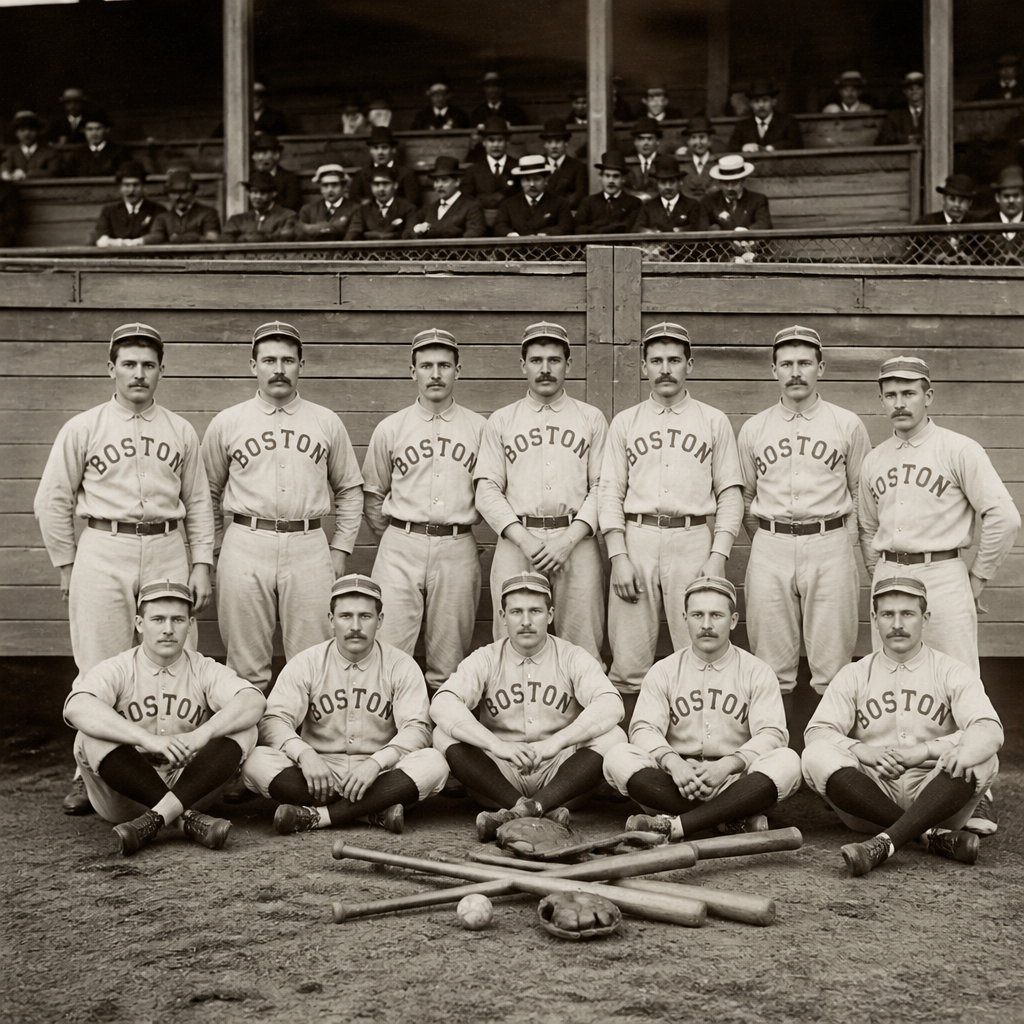
The Boston Beaneaters were one of baseball’s first dynasties, yet modern fans rarely place them beside the Yankees, Cardinals, or Athletics when discussing the sport’s greatest teams. In the 1890s, however, the Beaneaters stood at the center of the National League, winning pennants, developing elite talent, and shaping how professional baseball operated during a formative decade. Any serious look at famous baseball teams must include them, because the history of 19th-century clubs is incomplete without Boston’s sustained dominance and organizational influence.
The club that became the Beaneaters originated in 1871 with the Boston Red Stockings, one of the foundational franchises of major league baseball. Team names changed over time, as was common in the era, but continuity mattered more than branding. By the 1890s, “Beaneaters” had attached itself to Boston in newspapers and public speech, and the nickname reflected both local identity and the rough, colorful naming traditions of early baseball culture. This was not a novelty club. It was a mature, highly successful organization with established leadership, a loyal following, and championship expectations.
Understanding the Beaneaters also requires understanding the baseball world they ruled. The National League of the 1890s played a different game from the modern major leagues: schedules were grueling, travel was uncomfortable, fields were inconsistent, and rules were still evolving. Pitchers worked enormous innings totals. Position players bunted, hit behind runners, and played through injuries that would sideline modern athletes for weeks. Front offices were smaller, scouting was less formal, and roster control often came through the reserve system rather than open competition for talent. Within that environment, Boston distinguished itself through stability, depth, and baseball intelligence.
This article serves as a hub for 19th-century clubs by placing the Beaneaters in the broader landscape of early professional baseball. Their story connects directly to the rise of powerhouse teams in Chicago, Baltimore, New York, Cleveland, and Pittsburgh, and to the transition from loose early competition into a more organized major league structure. If you want to understand how baseball became a national institution, why certain strategies dominated before the live-ball era, and how the first true dynasties were built, the Beaneaters are an essential starting point. They were forgotten by casual memory, not by the historical record.
Why the Boston Beaneaters dominated the National League
Boston’s power in the 1890s came from a combination of roster quality, continuity, and tactical sophistication. The Beaneaters won National League pennants in 1891, 1892, 1893, 1897, and 1898, an extraordinary run in a decade crowded with strong clubs. This was not a single lucky season powered by one superstar. It was a repeatable model built around top-line pitching, excellent infield defense, productive contact hitting, and veteran leadership. In my experience studying 19th-century clubs, the teams that lasted were the ones that balanced stars with durability, and Boston did that better than almost anyone.
Manager Frank Selee deserves special attention. Selee was one of the sharpest baseball minds of his generation, known for disciplined teams, intelligent lineup construction, and a strong grasp of player development. He did not manage with theatrics. He managed with structure. That mattered in a period when teams could unravel over travel fatigue, personality clashes, or weak fielding. Boston under Selee was usually steady, fundamentally sound, and strategically prepared. Historians often focus on star players first, but in the 1890s, strong management could be the difference between a contender and a club that drifted toward the second division.
The roster featured Hall of Fame talent and high-end contributors throughout the decade. Hugh Duffy was one of the game’s premier hitters and remains famous for his .440 batting average in 1894, still the highest single-season mark in major league history. Tommy McCarthy brought all-around skill and baseball intelligence. Bobby Lowe provided infield quality and offensive value. Herman Long was a standout shortstop with range suited to the demanding surfaces of the era. On the mound, Kid Nichols was the franchise anchor, combining workload, control, and longevity at a level almost impossible to imagine today.
Context matters when evaluating those names. Offensive numbers exploded in some 1890s seasons due to rule changes, mound distance adjustments, and fluctuating playing conditions. That means raw batting average or run totals can mislead if taken alone. What separates Boston is that it excelled relative to its competition over multiple environments. The Beaneaters could win in higher-scoring years and lower-scoring years. They succeeded before and after major changes such as the 1893 move of the pitcher’s box to a mound sixty feet six inches from home plate. Adaptability is one hallmark of a true dynasty.
Key seasons, rivals, and defining achievements
The 1891 pennant established Boston as the league’s standard. The team finished first by a wide margin, showing superior balance rather than dependence on one phase of the game. In 1892, the National League used a split-season format, with first-half and second-half winners meeting in a postseason series. Boston won both halves, making the championship series unnecessary and underscoring its superiority. In practical terms, the Beaneaters were so clearly the best club that the league’s experiment could not create suspense.
The 1893 season tested every club because of the pitching distance change, one of the most consequential rules adjustments in baseball history. Moving pitchers farther from hitters was expected to increase offense, and it did. Boston adapted quickly, winning another pennant as teams recalibrated strategy. That adaptability reflected smart roster construction. Clubs with only one formula struggled; Boston had hitters who could capitalize on more hittable pitching and pitchers who could survive in a less forgiving environment. When a team thrives through structural change, that tells you its success is rooted deeper than routine momentum.
By 1897 and 1898, Boston proved its staying power. Many 19th-century clubs rose fast and collapsed just as quickly due to financial instability, ownership mistakes, or aging rosters. The Beaneaters instead retooled and remained elite. Those later pennants also came in a crowded competitive field that included dangerous clubs from Baltimore, Cincinnati, Cleveland, and New York. This is one reason the Beaneaters deserve more respect than they usually receive: their dominance was not confined to one short peak. They remained a championship benchmark across most of a decade.
Several rivalries helped define the era. The Baltimore Orioles, led by Ned Hanlon, were perhaps the Beaneaters’ most important strategic rivals. Baltimore became famous for aggressive baserunning, hit-and-run execution, and relentless pressure, often grouped under what later writers called “inside baseball.” Boston matched skill with discipline and depth. Games between the clubs were not just contests for standings; they were clashes between two of the smartest organizations in the sport. For anyone exploring 19th-century clubs, Boston and Baltimore form a necessary pairing because each helps explain the other.
| Season | Result | Why It Mattered |
|---|---|---|
| 1891 | National League pennant | Confirmed Boston as the league’s strongest complete team |
| 1892 | Won both split-season halves | Made the championship series unnecessary and proved overwhelming superiority |
| 1893 | National League pennant | Showed Boston could adapt immediately to the new pitching distance |
| 1897 | National League pennant | Demonstrated long-term staying power rather than a brief peak |
| 1898 | National League pennant | Cemented the Beaneaters as the decade’s defining National League power |
Star players, style of play, and how Boston fit the 19th-century game
Kid Nichols was the Beaneaters’ cornerstone and one of the greatest pitchers in baseball history. He won 30 or more games seven times, finished with 361 career victories, and did so while handling workloads that modern pitchers never approach. Nichols succeeded through command, resilience, and the ability to read hitters rather than relying only on overpowering velocity. In the 1890s, an ace was expected to finish what he started, recover quickly, and remain effective across months of rough travel. Nichols met that standard better than almost anyone in his era.
Hugh Duffy and Tommy McCarthy gave Boston an elite offensive core. Duffy’s 1894 season remains the statistical headline, but he was more than one number. He hit for average, drove the ball with authority for his time, and played capable outfield defense. McCarthy, also a Hall of Famer, was praised for judgment, situational awareness, and tactical execution. Together they represented a style that 19th-century contenders needed: not just hard hitting, but complete baseball. They could advance runners, exploit defensive mistakes, and manufacture scoring chances in an age before home-run-centered offense.
Boston’s infield also mattered enormously. Bobby Lowe was one of the best second basemen of the century and became the first player in major league history credited with four home runs in one game, doing so in 1894. Herman Long’s range at shortstop was valuable on uneven fields where clean chances could become awkward hops in an instant. Third baseman and catcher contributions shifted over time, but the larger point is that Boston defended well enough to support heavy pitching workloads. In that era, poor fielding could destroy a pennant chase faster than a weak bench.
Compared with other famous 19th-century clubs, the Beaneaters combined traits that were often separated elsewhere. The early Chicago White Stockings were foundational winners. The St. Louis Browns of the American Association built a major empire in the 1880s. The Baltimore Orioles mastered pressure tactics in the mid-1890s. The Cleveland Spiders, before collapse, assembled dazzling talent. Boston’s distinction is balance across years: elite pitching, advanced management, strong defense, and top-tier hitting sustained at once. That makes the Beaneaters an ideal hub subject for understanding the wider 19th-century baseball landscape.
Legacy, historical importance, and where to go next
The Beaneaters’ long-term legacy reaches beyond their pennants. They helped establish Boston as one of baseball’s central cities well before the American League’s Red Sox existed. The organizational line from the old Red Stockings through the Beaneaters and later the Braves ties directly into the evolution of franchise identity in professional sports. They also showed that dynasties did not begin in the 1920s or with radio fame. Baseball had repeat champions much earlier, built through smart management, player retention, and competitive adaptation in a tougher operating environment than many modern fans realize.
They are forgotten partly because 19th-century history is harder to package. Team names shifted, leagues folded, rules changed, and statistics require context. There is no World Series title attached to the Beaneaters’ best years because the modern postseason system had not yet settled into place. Even so, historians and serious researchers consistently rank them among the premier clubs of their century. When I review pennant races, roster quality, and managerial impact from the era, Boston appears again and again as a reference point. Other teams are measured against what the Beaneaters sustained.
As a hub for 19th-century clubs, this page points naturally toward deeper reading on the Baltimore Orioles, Chicago White Stockings, St. Louis Browns, Cleveland Spiders, New York Giants, and early Pittsburgh champions. Each reveals a different piece of the century’s baseball puzzle: league competition, tactical innovation, labor control, schedule demands, and regional fandom. The Beaneaters connect these themes better than most teams because they lasted, adapted, and won across changing conditions. Study them first, and the rest of 19th-century baseball becomes easier to understand in proper context.
The simplest takeaway is clear: the Boston Beaneaters were not a historical footnote but a foundational baseball power. They ruled the National League in the 1890s, developed Hall of Fame talent, thrived under major rule changes, and set standards that later dynasties would follow in more publicized eras. If you are building a serious understanding of famous baseball teams, start with Boston’s forgotten champions, then branch into the other great 19th-century clubs linked through this subtopic. The deeper you go, the clearer it becomes that early baseball was rich, competitive, and far more sophisticated than its faded reputation suggests.
Frequently Asked Questions
Why were the Boston Beaneaters so important to baseball in the 1890s?
The Boston Beaneaters were important because they were one of the defining powers of 19th-century professional baseball and helped establish what sustained excellence looked like in the National League. During the 1890s, they were not simply a good club that had a brief run of success; they were a model franchise in a decade when the sport was still stabilizing its rules, business practices, and competitive structure. Boston won multiple National League pennants in that era and consistently fielded teams loaded with impact players, giving them the kind of long-term dominance that modern fans usually associate with later dynasties.
Their significance also goes beyond championships. The Beaneaters played at a time when baseball was evolving from a rougher, more regionally rooted game into a more organized major professional sport. Strong clubs like Boston helped define competitive standards, roster building, and fan expectations. They demonstrated the value of deep pitching, star position players, and continuity within the organization. In many ways, they were one of the first examples of a franchise that combined talent, winning, and reputation into a lasting baseball identity.
When historians discuss the foundations of the National League, the Beaneaters belong near the center of the conversation. They were not a novelty or a footnote. They were one of the league’s flagship teams during a formative period, and omitting them from discussions of baseball’s early great powers creates a distorted view of how the sport developed.
How dominant were the Boston Beaneaters compared to other famous baseball dynasties?
For their time, the Beaneaters were absolutely comparable to the most respected dynasties in baseball history. While comparing teams across eras is never perfect, the best way to understand Boston’s standing is to look at how often they finished at or near the top of the National League and how consistently they remained relevant in pennant races. In the 1890s, they were one of the era’s benchmark franchises, much the way the Yankees later became in the American League or the Cardinals did over several stretches of the 20th century.
What makes the Beaneaters especially impressive is that they dominated in a period with different travel conditions, looser infrastructure, and a sport that lacked many of the comforts and systems of modern baseball. Success required resilience, roster depth, and adaptability. Boston managed all three. Their repeated pennant-winning seasons were not accidents; they reflected an organization that knew how to assemble and maintain top-level talent over time.
The reason they are not always mentioned alongside better-known dynasties has less to do with their actual performance and more to do with historical distance. The further baseball moves from the 19th century, the easier it becomes for fans to focus only on teams they can connect to radio, film, television, or modern statistics. But if dynasty means repeated championships, star talent, league influence, and a commanding presence over a meaningful stretch of years, then the Beaneaters clearly qualify. They were one of baseball’s first true powerhouse clubs.
Who were the key stars that made the Beaneaters such a strong team?
The Beaneaters were powered by a remarkable collection of talent, and that concentration of elite players is one of the main reasons they deserve to be remembered as a dynasty. Among the biggest names was Kid Nichols, one of the greatest pitchers in baseball history. Nichols was the kind of foundational ace around whom a franchise could build an era of success. In the 1890s, pitchers carried enormous workloads, and Nichols delivered both durability and excellence, making him central to Boston’s rise and sustained power.
Boston also featured standout offensive and defensive stars such as Hugh Duffy, Tommy McCarthy, and Bobby Lowe. Duffy was one of the best hitters of the era and remains a major figure in discussions of 19th-century batting greatness. McCarthy contributed speed, intelligence, and all-around play, while Lowe added infield stability and offensive production. Together, they gave the Beaneaters more than isolated star power; they gave the team balance. This was a roster with pitching strength, batting skill, defensive reliability, and experienced baseball instincts.
That mix mattered because 19th-century baseball often demanded versatility and toughness from players. Teams could not rely on the specialized bullpen roles, expansive farm systems, or advanced medical support that define the modern game. The Beaneaters succeeded because they had high-end performers who could carry heavy responsibilities while still producing at elite levels. Their roster was one of the strongest in the sport, and its top names are a major reason Boston stood above much of the league throughout the decade.
Why are the Boston Beaneaters often overlooked today?
The Beaneaters are often overlooked because they belong to a part of baseball history that many modern fans encounter only in passing. The 1890s can feel distant, both culturally and statistically, especially compared to the live-ball era, the rise of the Yankees, the integration era, or the television age. Teams from the 19th century rarely benefit from the same storytelling machinery that keeps later dynasties alive in the public imagination. There is less widely known footage, fewer household-name narratives, and a general tendency to treat early baseball as primitive rather than foundational.
Name recognition also plays a role. “Boston Beaneaters” does not connect as instantly with modern audiences as franchise names that carried cleanly into the 20th and 21st centuries. Because baseball teams changed names, leagues shifted, and the sport itself evolved rapidly, the continuity can be harder for casual fans to follow. As a result, even accomplished clubs like the Beaneaters can seem disconnected from the mainstream history people think they already know.
Another factor is how baseball history is often taught. The conversation tends to leap from the earliest origins of the game to more modern milestones, leaving little room for a deep appreciation of dominant 19th-century teams. That creates a gap in public memory. Yet once you look at the National League’s competitive landscape in the 1890s, the Beaneaters immediately re-emerge as a major force. Their relative obscurity says more about historical emphasis than about their actual importance. They were not marginal figures; they were central actors in one of baseball’s most formative decades.
What is the Beaneaters’ legacy in the broader history of famous baseball teams?
The Beaneaters’ legacy is that of an early blueprint for sustained baseball greatness. They showed that a franchise could build a lasting identity around winning, star players, organizational stability, and league-wide relevance. In that sense, they were a precursor to many of the clubs later celebrated as baseball institutions. Their success helped define what it meant to be a powerhouse before the World Series era fully reshaped championship culture and before modern media created national legends out of dominant teams.
They also matter because they help complete the story of how baseball’s hierarchy was formed. The sport did not begin with the better-remembered dynasties of the 20th century. Before those clubs took over the national imagination, teams like the Beaneaters were establishing patterns of excellence and shaping the competitive culture of the National League. They helped demonstrate that professional baseball could support long-term contenders and recognizable stars, both of which were crucial to the game’s growth and popularity.
For anyone studying famous baseball teams seriously, the Beaneaters should be viewed as one of the sport’s foundational elite franchises. Their place in history is not just local or nostalgic. It is structural. They were one of the clubs that helped turn major league baseball into a durable, prestige-driven competition where dynasties mattered. Remembering them restores an essential chapter of baseball history and places the 1890s where they belong: not on the margins, but near the center of the game’s early greatness.