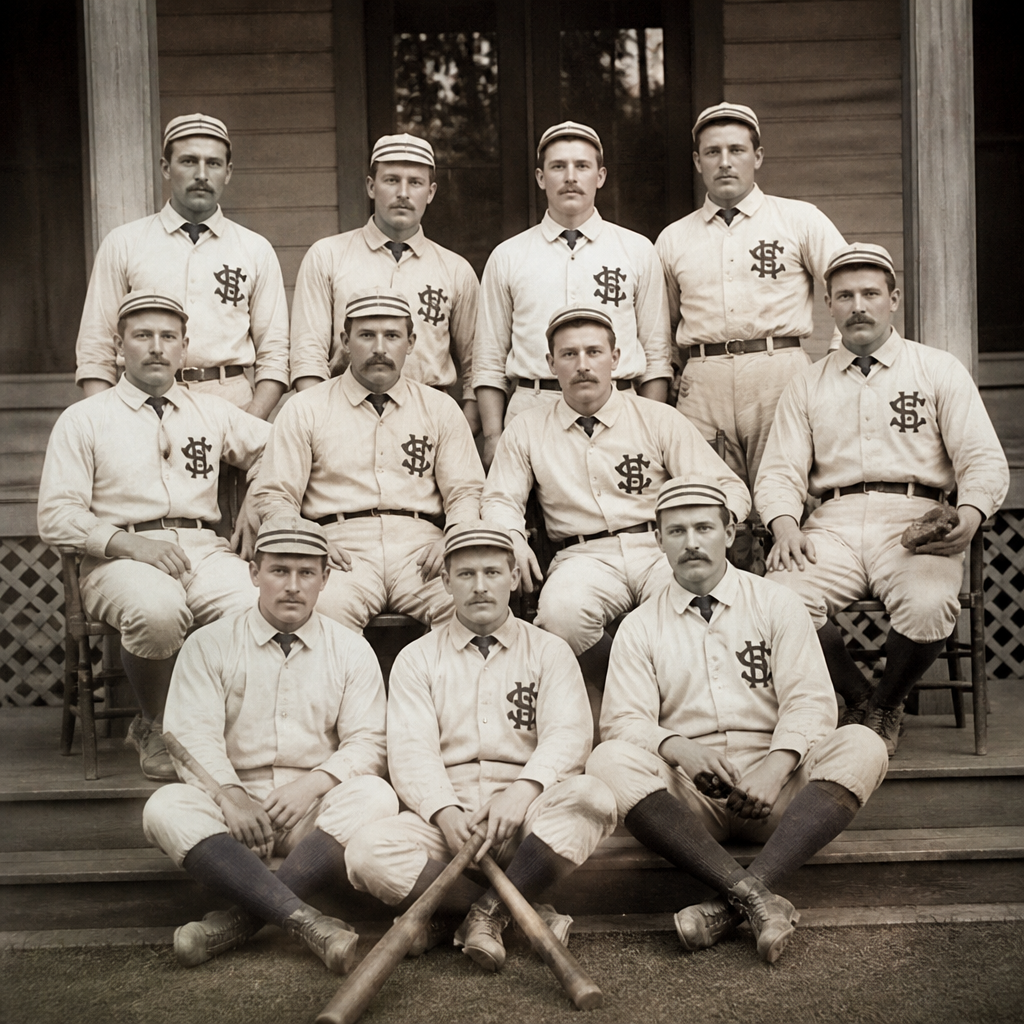
The Chicago White Stockings of the 1880s stand at the center of any serious discussion of 19th-century clubs, because they combined sustained winning, star power, tactical innovation, and league-shaping influence long before modern baseball looked familiar. In this era, “White Stockings” refers to Chicago’s National League club, the franchise that later evolved into the Cubs, and the 1880s mark its greatest nineteenth-century peak under first baseman-manager Cap Anson. A dynasty, in baseball terms, is not just a team that wins once or twice; it is a club that controls its league over multiple seasons, sets standards other organizations copy, and leaves a lasting institutional mark. Chicago did all three. They won five National League pennants in the decade, regularly led the circuit in attendance and offense, and became the model of disciplined, commercially successful professional baseball.
This team also matters because the 1880s were a hinge point for the sport itself. Professional baseball was still establishing stable schedules, travel routines, roster construction, and business practices. Rules differed sharply from the modern game. Pitchers threw from flatter ground, gloves were primitive, foul balls did not count as strikes at first, and strategy relied heavily on contact hitting, baserunning pressure, and error exploitation. In that environment, clubs that could combine organizational consistency with elite talent gained an outsized advantage. Chicago did exactly that. When I study nineteenth-century clubs, Chicago is always the clearest example of how a well-run operation could dominate before farm systems, radio revenues, or expansive scouting networks existed.
As a hub for 19th-century clubs, this article uses the White Stockings as the anchor point for understanding the period more broadly. Their rise connects to the National League’s early consolidation, to rival powers such as Providence, Boston, and the St. Louis Browns, and to the transition from loosely structured professional competition into something recognizably major league. Their story includes brilliance and contradiction. Anson was one of the era’s most accomplished baseball minds and hitters, but he also played a notorious role in enforcing racial exclusion. Any complete account of famous baseball teams from this century must hold both truths together. Chicago’s dynasty was real, influential, and historically important, but it existed within the rough edges, inequities, and improvisations of early professional sport.
Why the White Stockings became the defining National League club of the decade
Chicago entered the 1880s with advantages that many nineteenth-century clubs could not match: a large city, an established fan base, experienced ownership, and the drawing power of Cap Anson. The National League, founded in 1876, had already weathered instability, folding teams, and uneven finances. By the early 1880s, survival favored clubs that could travel reliably, enforce contracts, and attract paying crowds. Chicago’s home market helped, but market size alone did not create a dynasty. The club paired financial strength with continuity on the field. Anson served as the team’s strategic center, balancing his role as superstar first baseman with responsibilities that today would be split among a manager, captain, and baseball operations staff.
The White Stockings won National League pennants in 1880, 1881, 1882, 1885, and 1886. That run matters because nineteenth-century standings were often compressed by shorter schedules and uneven roster depth, making repeat first-place finishes difficult. Chicago’s consistency came from assembling a core that could outscore opponents, handle the grind of railroad travel, and avoid the internal chaos that wrecked many early clubs. Their roster included infield stars like Ned Williamson and Fred Pfeffer, catcher King Kelly for part of the run, outfielders like George Gore, and top pitchers including Larry Corcoran and later John Clarkson. These were not interchangeable names; they were among the era’s most accomplished players, and Chicago kept enough of them together long enough to turn talent into a genuine cycle of dominance.
Compared with other notable 19th-century clubs, Chicago’s edge was breadth. Providence had the extraordinary Charles Radbourn and a title in 1884, Boston Beaneaters later built their own powerhouse, and the American Association’s St. Louis Browns were formidable under Chris von der Ahe and Charlie Comiskey. Yet Chicago’s 1880s profile is unusually complete: winning record, star roster, managerial stability, commercial visibility, and influence on how clubs operated. For readers exploring 19th-century teams as a category, the White Stockings are the practical starting point because they show how elite baseball organizations emerged before the modern major leagues fully matured.
Cap Anson’s central role on the field, on the bench, and in the clubhouse
Cap Anson was the engine of the dynasty. Statistically, he was one of the nineteenth century’s premier batsmen, finishing his career with more than 3,000 hits by standard historical accounting and capturing multiple batting titles. In the 1880s, he was already a feared middle-of-the-order hitter, known for line-drive contact, run production, and unusual durability. In plain terms, Anson did what every great franchise cornerstone does: he gave his club a dependable offensive advantage every year. At first base he was steady by the standards of the time, an important point in an era when fielding conditions were rough and clean defensive play saved runs that today might be routine.
His managerial value was just as significant. Player-managers were common in the nineteenth century, but few handled the role with Anson’s force. He set lineups, enforced discipline, directed in-game tactics, and shaped the team’s identity. Contemporary baseball depended heavily on situational judgment because bench staffs were small and scouting systems were informal. Anson’s clubs generally played smart, aggressive baseball: pressure on the bases, productive contact, and careful use of pitchers. He understood that in a game with high error rates and inconsistent equipment, forcing defenders to make plays often produced offense more reliably than waiting for extra-base hits alone.
Any honest assessment must also address Anson’s racism. He is widely associated with refusals to take the field against Black players such as Moses Fleetwood Walker, and his standing in the game helped normalize exclusionary practices that hardened into the color line. This is not a side note. It is part of his baseball legacy and part of the environment in which the White Stockings operated. Historians can recognize Anson’s brilliance as a hitter and leader while stating clearly that his influence on segregation damaged the sport profoundly. For a hub on nineteenth-century clubs, that dual reality is essential context because baseball history in this period includes both institutional growth and institutional exclusion.
The roster architecture behind Chicago’s pennants
Dynasties are built on depth, and Chicago’s supporting cast made Anson’s leadership meaningful. Ned Williamson gave the club infield power and versatility. He remains famous for his 27 home runs in 1884, a total aided by the short right-field dimensions of Chicago’s Lakefront Park but still remarkable for the period. Fred Pfeffer was one of the decade’s best second basemen, combining range, intelligence, and enough offense to strengthen the lineup from top to bottom. George Gore brought speed and on-base ability in the outfield. King Kelly, though later more strongly associated with Boston, was a magnetic all-around performer whose baserunning and improvisational instincts fit the rough-edged style of the era.
Pitching depth separated champions from contenders. Larry Corcoran was among the first true star pitchers of the National League, noted for workload, deception, and command. John Clarkson, acquired from Worcester, became even more important. He won 53 games in 1885 and 36 in 1889, numbers that reflect the nineteenth-century expectation that elite pitchers work constantly. Modern readers should not compare those totals directly to modern rotations; the structure of pitching staffs was completely different. The key point is that Chicago secured top-end arms and rode them hard, while also fielding enough offense and defense to turn individual brilliance into pennants.
| Season | Result | Key figures | Why it mattered |
|---|---|---|---|
| 1880 | National League pennant | Cap Anson, Larry Corcoran | Confirmed Chicago as the league’s strongest all-around club |
| 1881 | National League pennant | Anson, Williamson, Gore | Showed the 1880 title was not a one-year spike |
| 1882 | National League pennant | Anson, Corcoran, Pfeffer | Completed a rare three-peat in a volatile early league |
| 1885 | Pennant; postseason series tie dispute | Anson, Clarkson, Kelly | Highlighted Chicago’s clash with St. Louis for national supremacy |
| 1886 | Pennant; lost postseason series | Anson, Clarkson, Williamson | Marked the club’s final peak as a true 1880s powerhouse |
What I find most instructive about this roster is how modern its logic feels despite primitive conditions. Chicago blended star concentration with role balance. They had table setters, run producers, athletic fielders, and durable pitchers. They also benefited from player retention at a time when league competition and contract disputes often scattered talent. If you are comparing famous 19th-century teams, ask a simple question: did the club have impact players at multiple positions and enough continuity to convert skill into repeated first-place finishes? Chicago passes that test decisively.
How the White Stockings played and why their style worked in the 1880s
Nineteenth-century baseball rewarded relentless pressure. Fields were uneven, gloves offered limited protection, and official scoring credited errors generously by modern standards. The White Stockings exploited those conditions better than most rivals. Their offense emphasized bat control, advancing runners, and putting fielders under strain. They stole bases aggressively in the broad contemporary sense of opportunistic advancement, took extra bases on hits, and forced hurried throws. This was not small ball in a timid sense; it was calculated offense designed for the actual run environment of the 1880s.
Defensively, Chicago valued steadiness in the infield and enough athleticism in the outfield to cover large spaces. Pitchers of the era also functioned differently. Before the overhand revolution was complete and before modern bullpen specialization, starters needed endurance above all else. Chicago’s ability to pair workhorse pitchers with competent team defense reduced the chaos that often dragged down less organized clubs. The result was a team that could win in multiple ways: slugging bursts in favorable parks, grinding rallies on the road, and low-scoring contests anchored by frontline pitching.
Their ballparks also influenced outcomes. Lakefront Park became notorious for unusual dimensions, especially a short right field that inflated certain batting numbers, including Williamson’s home run total in 1884. Serious history should note that context without dismissing performance. Every era has park effects, and strong teams exploit their environment. Chicago did. More importantly, they also won away from home and across multiple seasons, which confirms that their success was structural rather than accidental.
Rivals, postseason disputes, and Chicago’s place among 19th-century clubs
To understand the White Stockings as a hub topic, place them in conversation with their rivals. In the National League, Providence and Boston offered the strongest periodic resistance. Providence’s 1884 title, driven by Old Hoss Radbourn’s legendary workload, showed how one transcendent pitcher could overwhelm a season. Boston, especially later in the decade, built a deeper long-term contender. In the American Association, the St. Louis Browns were Chicago’s most important foil. Managed by Charlie Comiskey and backed by owner Chris von der Ahe, St. Louis won four straight Association pennants from 1885 through 1888 and challenged National League claims of superiority.
The postseason meetings between Chicago and St. Louis in 1885 and 1886 are especially important because they prefigure the World Series while revealing how informal championship claims still were. The 1885 series ended in dispute, with arguments over rules, gate receipts, and whether a tied game should count. The 1886 series was won by St. Louis, a result that damaged Chicago’s bid to be seen as the unquestioned national champion even after another league pennant. These series matter for baseball history because they show the sport moving toward interleague championship structures while still lacking the standardization fans now take for granted.
Among 19th-century clubs, then, Chicago’s case rests not on perfection but on cumulative force. They were not unbeatable, and their claim to total supremacy was challenged. Yet no other club of the early to mid-1880s matched their blend of repeat league titles, recognizable stars, tactical discipline, and urban visibility. If the broader subtopic is “19th-Century Clubs,” Chicago is the hub because their story connects competitive history, business history, rules evolution, and social history in one franchise.
The dynasty’s legacy in baseball history
The White Stockings left three lasting legacies. First, they helped define what a professional baseball powerhouse looked like: stable management, a star core, city-level support, and repeated first-place results. Second, they linked the early National League to the later Cubs identity, making them foundational to one of the oldest continuous franchises in American sports. Third, they illustrate how baseball’s growth carried both achievement and injustice. The same club that advanced professional standards also existed within, and in Anson’s case helped intensify, exclusionary practices that narrowed the sport’s possibilities.
For readers building knowledge of famous baseball teams, the practical lesson is clear. Start with Chicago when studying nineteenth-century clubs, then branch outward to Providence for pitching dominance, the St. Louis Browns for American Association power, and the Boston Beaneaters for sustained excellence later in the century. That pathway makes sense because the White Stockings sit at the crossroads of the era’s biggest themes: league consolidation, superstar influence, tactical adaptation, and the uneven moral landscape of early professional baseball.
In the end, the Chicago White Stockings of the 1880s were an early dynasty in every meaningful sense. They won repeatedly, shaped the league around them, and supplied a roster full of players who mattered beyond a single season. They also remind us that baseball history becomes more useful, not less, when it is examined in full. Study their pennants, their strategy, their rivals, and their contradictions, and you understand not only one great team but the architecture of nineteenth-century baseball itself. If you are exploring famous baseball teams, use this club as your entry point into the entire world of 19th-century clubs.
Frequently Asked Questions
Who were the Chicago White Stockings of the 1880s, and why are they so important in baseball history?
The Chicago White Stockings were Chicago’s National League club in the nineteenth century, the franchise that later evolved into today’s Chicago Cubs. In the 1880s, they became one of baseball’s defining powers, and for many historians they represent one of the clearest early examples of a true baseball dynasty. Their importance comes from more than just winning pennants. They brought together sustained success, elite individual talent, tactical sophistication, and organizational influence at a time when professional baseball was still establishing its identity.
What makes the White Stockings especially significant is that they dominated in an era before the modern game fully took shape. Rules, schedules, player roles, and strategies were all still developing, yet Chicago consistently found ways to outperform rivals. The club became a model of how a top professional team could be built and managed. Their success helped define standards for the National League, and their star players gave the sport some of its earliest household names.
Their 1880s peak also matters because it linked baseball’s rough early decades to the more recognizable structure of the modern major leagues. When people study how baseball evolved from a loosely organized nineteenth-century pastime into a more disciplined professional sport, the White Stockings are central to that story. They were not just a good team in an old era; they were one of the teams that helped shape the era itself.
Why is Cap Anson so closely associated with the White Stockings’ dynasty?
Cap Anson is inseparable from the White Stockings’ rise because he was both their star first baseman and their field leader, serving as the central figure in the club’s identity throughout the decade. He was one of the game’s biggest stars, a prolific hitter, and one of the most influential baseball men of the nineteenth century. On the field, Anson was known for consistency, durability, and offensive production at a time when those qualities could anchor an entire club. As a manager, he helped impose order, discipline, and strategic coherence on a team expected to contend every season.
Anson’s influence went beyond statistics. In the nineteenth century, the role of a player-manager carried enormous practical importance. He was not just setting a lineup card; he was shaping style of play, managing personalities, and helping establish standards of professionalism. Under Anson, Chicago became known for smart baseball as much as talented baseball. The White Stockings were repeatedly in the championship conversation because they had a leader who could combine star-level performance with day-to-day authority.
That said, Anson’s legacy is complicated. He is rightly remembered as one of the foundational figures in early professional baseball, but he is also associated with the enforcement of baseball’s color line, making him a deeply controversial figure in the sport’s history. Any serious discussion of his place in the White Stockings dynasty has to acknowledge both sides: he was indispensable to Chicago’s success and stature, and he was also part of one of the game’s most damaging historical injustices. That complexity is part of why he remains such a central figure in baseball history.
What made the White Stockings a dynasty in the 1880s rather than simply a strong team?
A dynasty is defined by sustained excellence over time, and the White Stockings clearly fit that description in the 1880s. They did not just have one memorable season or a brief spike of success. They repeatedly finished at or near the top of the National League, won multiple pennants, and established themselves as the club others measured themselves against. In a period when travel was difficult, rosters were less stable, and the professional game was still maturing, that kind of consistency was especially impressive.
Chicago’s claim to dynasty status also rests on how complete the club was. They had star players, certainly, but they also had depth, tactical awareness, and the ability to adapt as the sport evolved. Their teams featured strong pitching for the era, reliable defense, and lineups capable of manufacturing runs in ways that suited nineteenth-century baseball. They understood that winning in that period often required more than raw power or individual brilliance. It demanded execution, flexibility, and a sharp grasp of game situations.
Just as important, the White Stockings helped shape the competitive culture of the National League. A dynasty influences its environment, and Chicago did exactly that. Rivals had to find ways to match their standards, whether in roster construction, preparation, or style of play. Their dominance was not accidental and it was not isolated. It was repeated, recognizable, and influential, which is exactly what separates a dynasty from a merely successful club.
How did the White Stockings play, and what tactical innovations or strengths set them apart?
The White Stockings excelled in a style of baseball that reflected the realities of the nineteenth century while also pushing the sport forward. This was not the modern power game built around home runs and specialized bullpens. Success depended heavily on contact hitting, aggressive baserunning, situational awareness, and defensive reliability. Chicago thrived because it was exceptionally good at turning these elements into a consistent winning formula.
One of their biggest strengths was tactical intelligence. Clubs of the era had to think carefully about how to create runs, especially in lower-scoring environments and under evolving rules. Chicago’s players were known for alert baserunning, disciplined hitting approaches, and an understanding of positioning and execution that gave them an edge. Their pitchers and fielders also worked within a game that demanded resilience and adaptability, since pitching usage and defensive conditions were far different from what fans know today.
The White Stockings also stood out because they were ahead of many rivals in professionalism and organization. That may sound simple, but in nineteenth-century baseball it could be decisive. Teams that prepared well, played under steady leadership, and maintained strategic discipline often separated themselves from less organized competition. Chicago’s success suggests they were not simply more talented than everyone else; they were often better managed and better prepared. That combination of skill and structure is a major reason historians view them as one of the sport’s earliest great powerhouses.
How does the legacy of the 1880s White Stockings connect to the modern Chicago Cubs and to baseball as a whole?
The most direct connection is franchise continuity. The White Stockings of the 1880s were the National League club in Chicago that later became known as the Cubs, so their achievements are part of the same organizational lineage. When people discuss the deep history of the Cubs, they are not only talking about Wrigley Field, the twentieth century, or the modern era. They are also talking about this foundational nineteenth-century team that established Chicago as one of baseball’s most important cities from very early on.
Beyond franchise history, the White Stockings’ legacy reaches into baseball’s broader development. They helped define what elite professional baseball could look like before the sport’s modern systems were fully in place. Their winning tradition, star-driven appeal, and league-level influence contributed to the National League’s legitimacy and growth. They showed that a club could become not just a local attraction but a durable standard-bearer for the sport.
At the same time, their legacy reflects baseball’s contradictions. The White Stockings are remembered for excellence, innovation, and historical importance, but their era also included exclusionary practices and unfinished professional structures that shaped the game in troubling ways. That is why they remain so compelling to study. They were foundational to baseball’s growth, yet they also reveal the complexities of the game’s early history. For modern fans of the Cubs and students of baseball alike, the 1880s White Stockings represent both the roots of a famous franchise and a critical chapter in the making of Major League Baseball.