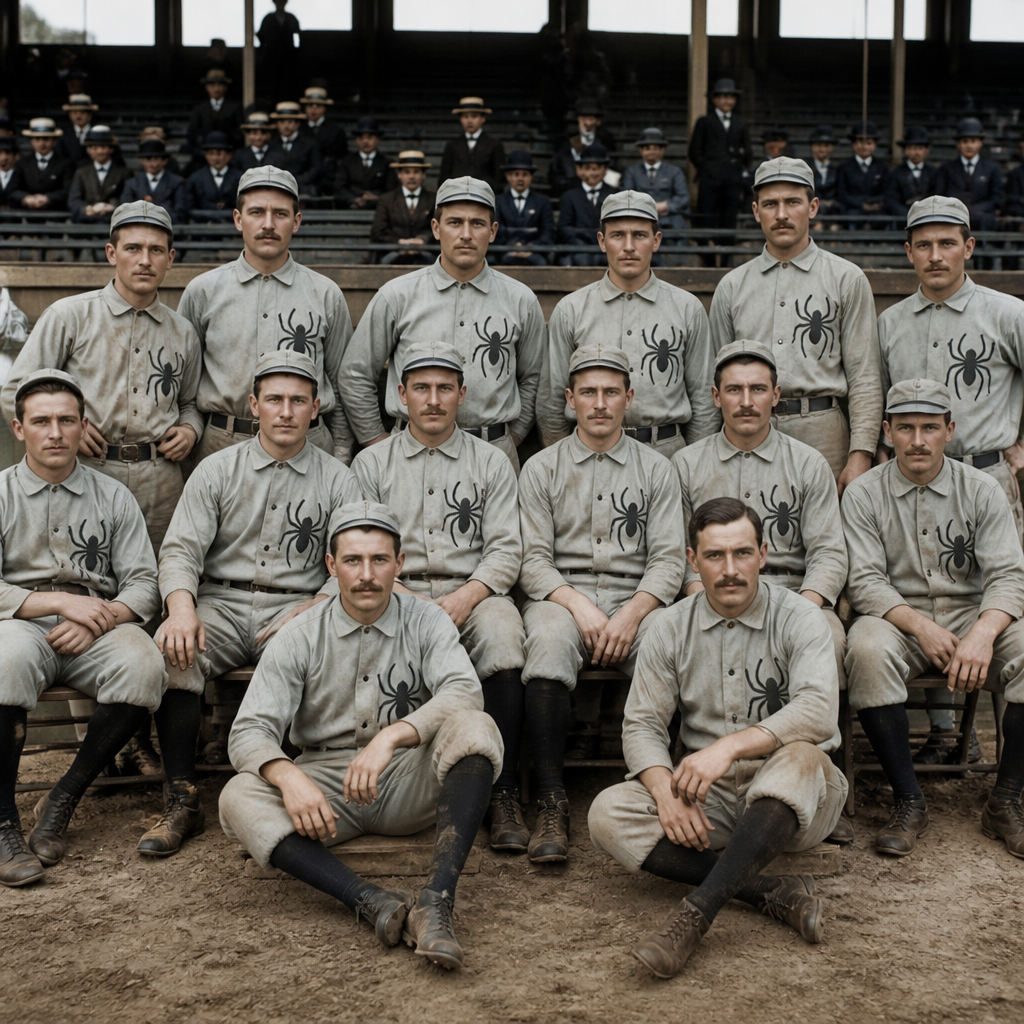
The Cleveland Spiders occupy a singular place in baseball history because they were not merely a bad club; they were the most extreme example of how ownership abuse, league instability, and 19th-century roster rules could turn a recent contender into the sport’s most infamous team. In discussions of famous baseball teams, the 1899 Spiders are the cautionary case every historian returns to, yet the story makes sense only when placed inside the broader world of 19th-century clubs. That world included volatile leagues, rail travel, primitive scouting, uneven ballparks, and owners who often treated teams as movable assets rather than civic institutions. Understanding the Spiders means understanding terms such as syndicate ownership, player-contract control, the reserve system, and franchise contraction. Syndicate ownership meant one ownership group controlled more than one club, creating obvious conflicts of interest. Player-contract control gave owners enormous leverage in moving talent. Contraction reduced the number of National League teams after financial stress thinned attendance and weakened weaker markets. I have spent years working through old sporting papers, league records, and club transaction logs, and the pattern is unmistakable: Cleveland’s collapse was not an accident of poor luck. It was the predictable outcome of incentives that rewarded stripping one roster to strengthen another. As a hub for 19th-century clubs, this article traces the Spiders from competitive respectability in the 1890s to their catastrophic 20-134 finish in 1899, while also showing how their fate connects to other foundational teams from the era. Their story matters because it explains how baseball learned, painfully, that competitive integrity is not a decorative ideal. It is the condition that makes the sport believable.
The 19th-Century Baseball Landscape That Made the Spiders Possible
To modern fans, the 1899 Cleveland Spiders can look like an impossible outlier, but the late 19th century produced exactly the environment in which such a disaster could happen. Professional baseball was still defining its business structure. The National League had survived challenges from rival circuits, including the American Association and the Players’ League, but survival did not mean stability. Clubs folded, leagues reorganized, and player movement depended less on free negotiation than on owners trading contract rights. Team identities were also less fixed than they are now. Cities gained or lost clubs quickly, and fan loyalty had to compete with economic downturns, uneven scheduling, and stadium conditions that varied wildly. In that context, strong ownership mattered as much as on-field talent.
Cleveland entered major league baseball in 1887 as part of the American Association before moving into the National League in 1889. The Spiders soon became one of the stronger clubs of the 1890s. They were not an expansion-level novelty drifting toward irrelevance. They had star players, a capable baseball operation by the standards of the day, and real moments of prominence. Their rise mirrored the broader pattern of ambitious 19th-century clubs in cities trying to establish themselves as serious baseball markets. Teams such as the Baltimore Orioles, Boston Beaneaters, Brooklyn Bridegrooms, and Cincinnati Reds all operated in this same turbulent ecosystem, where a smart manager and a handful of stars could change the standings quickly.
The league, however, tolerated practices that undermined fair competition. The most important for Cleveland was syndicate ownership. By the 1890s, some owners held interests in multiple clubs. This arrangement invited abuse because an owner could direct talent toward the team with better gate receipts or championship prospects. In a healthy league, that conflict would be prohibited. In the National League of the 1890s, it was tolerated until the consequences became too embarrassing to ignore.
From Strong Club to Serious Contender in the 1890s
Before they became a historical punchline, the Spiders were genuinely good. Cleveland finished second in the National League in 1895 and won the Temple Cup, a postseason series between the first- and second-place clubs, by defeating the Baltimore Orioles. While the Temple Cup never carried the prestige later associated with the World Series, it still mattered in its moment and signaled that Cleveland belonged among the era’s best teams. The roster featured Hall of Fame talent, most notably pitcher Cy Young, whose command, durability, and innovation made him one of the defining players of the century. Jesse Burkett, another Hall of Famer, gave the club elite hitting and speed. Bobby Wallace, before becoming a legendary shortstop elsewhere, also passed through this Cleveland core.
What made the Spiders dangerous was balance. They could pitch, they could defend, and they had lineup depth compared with many rivals. In an era when complete games were standard and pitching staffs leaned heavily on ace workloads, having a pitcher like Young dramatically raised a club’s floor. Cleveland’s best teams also benefited from player continuity. That mattered in a century when rosters often churned and travel exhausted teams. The Spiders were known enough, and successful enough, that no informed observer in the mid-1890s would have predicted they were heading toward the worst record in major league history.
Their trajectory also shows why hub coverage of 19th-century clubs cannot focus only on champions. Teams such as the Spiders help explain the era’s structural pressures more clearly than dynasties do. A champion can mask league flaws because winning smooths over dysfunction. Cleveland’s arc reveals the opposite. Once the incentives changed, a competitive club could be dismantled with startling speed.
Syndicate Ownership and the Transfer of Talent to St. Louis
The central fact of the 1899 Cleveland Spiders story is that owners Frank and Stanley Robison controlled both Cleveland and the St. Louis Browns, who soon became known as the Perfectos and later the Cardinals. The Robisons concluded that St. Louis offered the stronger business opportunity. It was a larger market, and the owners believed a winner there would produce better returns than a winner in Cleveland. Because league rules permitted this conflict, they shifted Cleveland’s best players to St. Louis. This was not a subtle rebalancing move. It was a raid.
Cy Young, Jesse Burkett, and Bobby Wallace went to St. Louis, along with other useful contributors. Cleveland was left with replacement-level talent, untested players, and veterans who were no longer impact performers. Contemporary coverage recognized what was happening. Fans did too. Attendance suffered because the public understood the competitive fraud. The team that had represented Cleveland only a few years earlier had effectively been hollowed out to feed another franchise owned by the same people.
The practical effect was severe on every level. A weak team loses games, but a deliberately weakened team also loses morale, gate revenue, and home-field credibility. Opponents drew larger crowds hosting Cleveland than Cleveland drew itself. In some cases, visiting teams preferred to shift games to their own parks because they could make more money there. That warped the schedule further and forced the Spiders onto exhausting road trips. The team was bad because of roster stripping, and the roster stripping became even more destructive because it wrecked the club’s home business model.
| Factor | What Happened | Why It Mattered |
|---|---|---|
| Ownership structure | The Robisons controlled Cleveland and St. Louis | Created a direct incentive to favor one roster over the other |
| Talent transfer | Stars like Cy Young and Jesse Burkett were moved to St. Louis | Turned Cleveland from competitive to noncompetitive almost overnight |
| Attendance collapse | Fans stopped supporting a stripped roster | Reduced revenue and made home dates less attractive |
| Schedule distortion | Many games were shifted to opponents’ parks | Forced Cleveland into a crushing travel burden |
| League response | National League tolerated the arrangement too long | Damaged credibility and accelerated future reform |
The 1899 Season: Why the Spiders Went 20-134
The final record, 20 wins and 134 losses, remains the benchmark for baseball futility because it combined poor talent, terrible logistics, and organizational neglect. Cleveland’s winning percentage of .130 is still the worst in major league history. The raw record alone is stunning, but the road split tells the deeper story. The Spiders finished 11-101 away from home, a total shaped by both weakness and circumstance. They played only 42 home games because so many scheduled dates were transferred elsewhere. By comparison, clubs typically expected far more home opportunities, not only for competitive balance but also for financial survival.
Baseball in 1899 was demanding even for competent teams. Travel was by rail, rest was inconsistent, and roster depth was thin. For a stripped club, extended road swings were brutal. Players dealt with fatigue, unfamiliar lodging, and little reason to believe management cared about fielding a respectable product. Losing on that scale can become self-reinforcing. Pitchers are overworked because games get out of hand. Fielders press and make mistakes. Hitters chase offense because they know runs will be scarce. Managers cycle through options that are not major league quality. The Spiders were trapped in that spiral almost from the start.
The numbers show complete collapse. Cleveland allowed far more runs than it scored, struggled to prevent big innings, and offered minimal resistance against stronger lineups. Yet this was not simply the natural result of one talent-poor roster. It was engineered. That distinction is why the 1899 Spiders remain more infamous than many other last-place clubs. They were not merely overmatched. They were abandoned by design.
How the Spiders Compare With Other 19th-Century Clubs
As a hub for 19th-century clubs, the Spiders belong alongside several better-known or more successful teams that define the era. The Baltimore Orioles of the 1890s, managed by Ned Hanlon, represented the cutting edge of aggressive, strategic baseball. The Boston Beaneaters were a powerhouse built on pitching and deep rosters. The Brooklyn Bridegrooms and later Superbas reflected how club identity could evolve while remaining competitive. The Cincinnati Reds and Louisville Colonels show how mid-tier franchises navigated unstable economics. The St. Louis Browns of the American Association earlier in the century demonstrated that sustained success was possible even before the modern major league shape fully settled.
What separates Cleveland is not that it was the weakest franchise the century ever produced. Several 19th-century teams struggled badly or disappeared. What separates the Spiders is the clarity of cause. Their collapse maps directly to ownership behavior more cleanly than almost any other case. That makes them indispensable in any serious discussion of early baseball governance. If you are building internal coverage around famous baseball teams, Cleveland connects naturally to pages on Cy Young, the Temple Cup, National League contraction, the Robison brothers, and the St. Louis franchise’s early history. It also serves as a bridge between team biography and league evolution, because the Spiders’ disaster influenced what baseball would no longer tolerate.
The Aftermath: Contraction, Legacy, and Lessons for Baseball
After the 1899 season, the National League reduced from twelve teams to eight. Cleveland, along with franchises in Baltimore, Louisville, and Washington, was eliminated. Contraction was driven by finances and league politics, but the Spiders’ fiasco strengthened the case that the circuit needed reform. Multi-club ownership in its 1890s form had proved corrosive. Competitive legitimacy could not survive when owners treated one roster as a farm for another major league club. The American League’s rise soon after, beginning as a serious major rival in 1901, also reflected dissatisfaction with National League management and business practices.
The legacy of the Spiders is therefore larger than one ugly record. They illustrate why leagues need conflict-of-interest rules, schedule protections, and mechanisms that preserve local trust. Fans will endure rebuilding if they believe a team is trying honestly to improve. What they reject, in Cleveland’s 1899 case and in any era, is intentional degradation. That is why the Spiders still appear whenever baseball historians debate the worst team ever. Their record is memorable, but the breach of faith is the real reason they endure.
For readers exploring 19th-century clubs, the Cleveland Spiders are the essential warning story. They began the decade as a credible National League team with elite players, reached contender status, and even captured the Temple Cup. Then syndicate ownership redirected their stars to St. Louis, attendance collapsed, the schedule turned hostile, and the club stumbled to 20-134, the lowest point in major league history. No account of famous baseball teams is complete without them because they explain how business structure shapes what happens on the field. They also remind us that early baseball was not quaint chaos; it was a proving ground where the sport learned costly lessons about fairness, incentives, and public trust. If you are mapping the full world of 19th-century clubs, start with the Spiders, then follow the connections outward to Baltimore, Boston, Brooklyn, Cincinnati, Louisville, and St. Louis. The era becomes far easier to understand once you see why Cleveland fell so far, so fast, and why baseball never forgot it.
Frequently Asked Questions
Why are the 1899 Cleveland Spiders considered the most infamous team in baseball history?
The 1899 Cleveland Spiders are remembered not simply because they were bad, but because they became the most dramatic example of a baseball team being hollowed out by ownership manipulation. Their final record of 20 wins and 134 losses remains the worst in Major League Baseball history by winning percentage for a modern major league season of that length, and the circumstances behind it made the collapse even more shocking. This was not a naturally weak expansion club or a franchise slowly declining over time. Cleveland had recently been competitive and had featured respected talent, which makes the sudden plunge especially striking.
The key reason historians keep returning to the Spiders is that their story exposes deeper structural problems in late-19th-century baseball. Their owners, the Robison brothers, also purchased the St. Louis franchise and then shifted most of Cleveland’s best players to St. Louis. In an era before modern rules on ownership conflicts, revenue sharing, roster protections, or strong league oversight, that kind of talent drain could happen with little resistance. The result was a major league club left with a stripped roster, terrible on-field results, collapsing attendance, and a schedule so lopsided that it became almost absurd. The Spiders became infamous because they were not merely losers; they were a vivid warning about what happens when competitive integrity is ignored.
How did ownership of both Cleveland and St. Louis lead to the Spiders’ collapse?
The Spiders’ downfall is impossible to understand without understanding syndicate ownership, the practice in which one ownership group controlled more than one club. The Robison brothers owned the Cleveland Spiders and then acquired the St. Louis franchise before the 1899 season. St. Louis was viewed as the more promising business opportunity, in part because of market size and long-term financial potential. Once the owners had control of both clubs, they treated Cleveland as the lesser property and transferred much of the Spiders’ best talent to St. Louis.
That player movement was devastating. Stars and valuable contributors who should have formed the core of Cleveland’s roster were reassigned, leaving the Spiders with a patchwork club that had little chance to compete over a full season. In today’s game, that kind of move would trigger immediate league intervention, but baseball in the 1890s operated under looser and far less balanced rules. The league lacked the enforcement mechanisms and governance culture that later became standard. So what happened in Cleveland was not an accident or just a case of bad management; it was a direct result of owners being allowed to place one franchise’s interests above another’s. That is why the Spiders are so often used as a textbook example in discussions of ownership ethics and league structure.
Were the 1899 Spiders truly that bad on the field, or were outside factors responsible for their record?
The honest answer is both. The Spiders were undeniably poor on the field, but their historically awful record cannot be separated from the conditions surrounding the team. Once Cleveland’s roster was gutted, the club lacked the pitching depth, defensive consistency, lineup strength, and overall experience needed to survive in the National League. A weak roster alone can produce a terrible season, but the Spiders also faced compounding problems that made a bad situation even worse.
One of the biggest outside factors was attendance. Because the team was so uncompetitive, fans stopped showing up in Cleveland. Visiting clubs recognized that playing in front of tiny crowds meant lower gate receipts, so many games scheduled for Cleveland were moved to opponents’ parks. That forced the Spiders into an extreme road-heavy existence. They ended up playing an astonishing number of away games, which deepened player fatigue, disrupted routine, and exposed a fragile roster to constant travel in an era when travel was far more difficult than it is today. So yes, the team was bad in baseball terms, but the final record was also shaped by financial realities, weak league governance, and the brutal logistics of 19th-century scheduling. Their season was the product of competitive failure and institutional failure at the same time.
How does the Spiders’ story reflect the larger problems of 19th-century baseball?
The Spiders matter historically because their collapse was not an isolated oddity; it reflected broader instability across professional baseball in the 19th century. The sport was still defining its business model, league structure, player control systems, and standards for franchise operation. Teams folded, relocated, changed leagues, and dealt with uneven finances in ways that would be almost unthinkable in the modern game. Ownership practices were inconsistent, rules were still evolving, and the balance between competition and business interests was far less settled than it would become in the 20th century.
In that environment, a club like Cleveland could go from contender to catastrophe with startling speed. The reserve system limited player freedom, owners exercised enormous control over roster movement, and the league did not yet have robust safeguards against clear conflicts of interest. At the same time, gate receipts mattered immensely, so poor attendance could directly affect scheduling decisions and franchise viability. The Spiders therefore serve as a case study in how fragile a team’s fate could be when the sport lacked centralized protections. Their notoriety endures because they reveal the messy realities behind the romantic image of early baseball. The 1899 season was not just a sporting embarrassment; it was a window into a formative and unstable period in baseball history.
Why does the 1899 Cleveland Spiders team still matter to baseball historians and fans today?
The 1899 Spiders still matter because they represent one of the clearest lessons in baseball history about competitive integrity. Their season is often cited whenever people discuss whether leagues must regulate ownership, enforce fairness, and protect fans from cynical roster manipulation. Even more than a century later, the Spiders remain a benchmark for dysfunction because their failure was so complete and so preventable. Historians value the team not only for the record books, but for what the story reveals about power, economics, and governance in professional sports.
For fans, the Spiders endure because the story is dramatic and easy to grasp: a recent contender was effectively dismantled by its own owners and left to endure a nightmare season that has never been matched. For historians, the value is deeper. The Spiders help explain why baseball eventually moved away from syndicate ownership and toward stronger league oversight. They also provide important context for understanding how early professional baseball evolved from a loose, often chaotic collection of clubs into a more stable major league system. In other words, the Spiders are not remembered only because they lost; they are remembered because their collapse helped define what baseball could no longer allow.