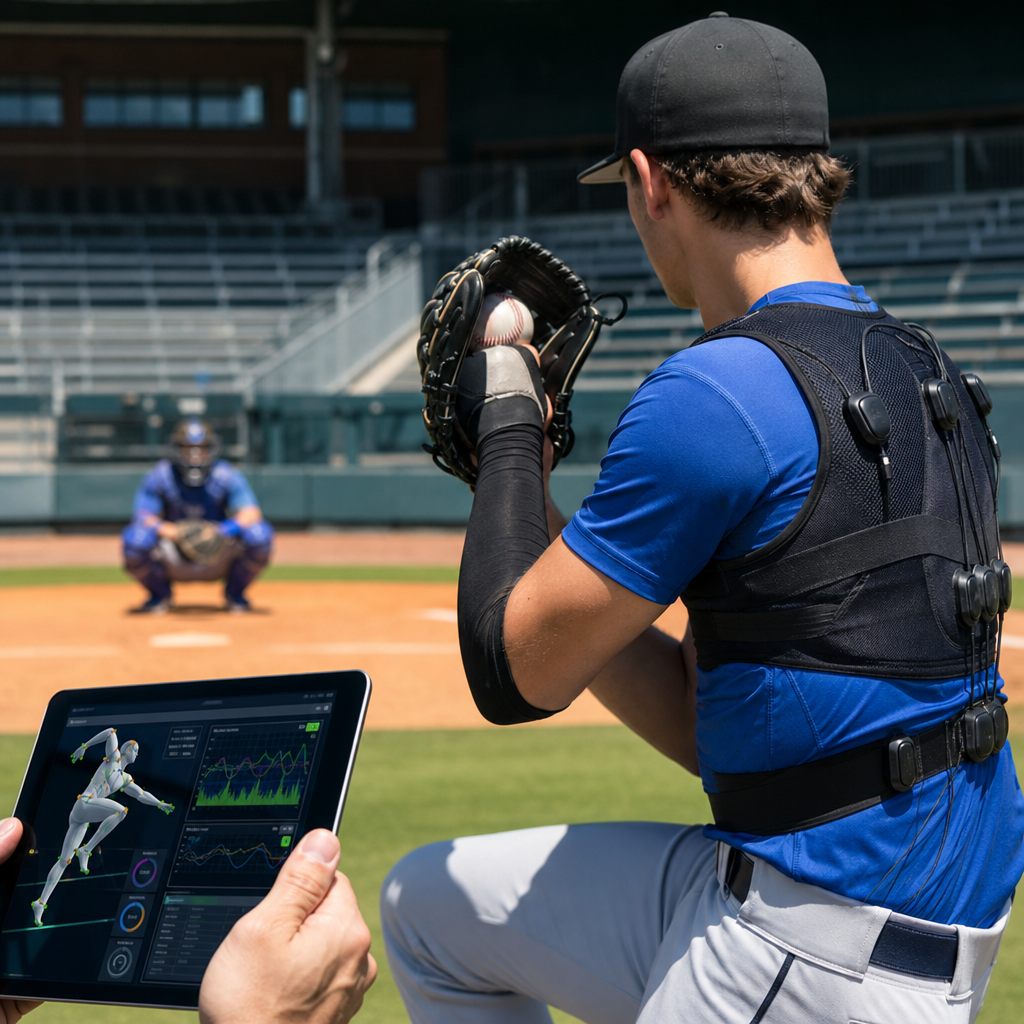
Biometrics in baseball is changing how teams measure skill, prevent injury, and project future performance, making it one of the most important developments in the future of baseball stats. In simple terms, biometrics refers to measurable physical and physiological data, including heart rate variability, sleep quality, joint torque, muscle activation, reaction time, visual tracking, and movement efficiency. For decades, baseball analysis centered on box score numbers such as batting average, runs batted in, earned run average, and strikeouts. Then came modern analytics, which expanded the conversation with metrics like OPS, WAR, spin rate, launch angle, and expected weighted on-base average. Now the game is moving into a third phase, where the body itself becomes a source of competitive information.
This matters because baseball performance is not created only by outcomes on the field. It is built from physical readiness, mechanical repeatability, fatigue management, recovery capacity, and neuromuscular precision. I have worked with performance staffs and player development departments long enough to see a clear pattern: two players can post similar stat lines while arriving there through very different physical states. One may be healthy, efficient, and sustainable. The other may be compensating for reduced hip mobility, shoulder fatigue, or poor sleep. Traditional statistics show what happened. Biometric data helps explain why it happened and whether it is likely to continue.
As a hub for the future of baseball stats, this article connects player tracking, wearable technology, biomechanics, injury forecasting, and decision-making. It also frames how front offices, coaches, and athletes use biometric signals alongside established baseball metrics rather than treating them as replacements. The key idea is straightforward: the next era of baseball analysis will reward organizations that can translate human performance data into better development plans, smarter in-game choices, and more accurate projections without losing sight of privacy, context, and competitive ethics.
What Biometrics Means in Baseball Analysis
Biometrics in baseball means collecting physical and physiological measurements that describe how a player moves, recovers, and responds to stress. Some of this information comes from wearables such as WHOOP bands, Catapult systems, Motus sleeves, force plates, and heart rate monitors. Some comes from motion capture labs using markerless systems, high-speed cameras, and kinematic sequencing models. Some comes from vision testing, cognitive reaction platforms, and regular screening for mobility, asymmetry, and strength output.
The practical goal is not data collection for its own sake. Teams want actionable signals. A pitcher’s elbow torque trend may indicate rising injury risk before velocity drops. A hitter’s bat speed and rotational acceleration may reveal that a mechanical tweak is working even before results show up in slugging percentage. A catcher’s recovery score after a night game and cross-country flight may influence workload the next day. These are not speculative uses. Clubs across Major League Baseball already integrate biomechanics labs, force-plate testing, and workload management into player development and medical operations.
Baseball is especially suited to biometric analysis because so much of the sport depends on repeatable movement under accumulated fatigue. Pitching is a high-stress rotational act with narrow margins for error. Hitting requires elite timing and visual processing against velocities that now routinely reach the upper 90s. Fielding depends on reaction speed, first-step explosiveness, and body control. When organizations can quantify the inputs behind those actions, they gain an advantage that standard stat lines alone cannot provide.
How Biometrics Extends Traditional Baseball Statistics
The future of baseball stats is not a battle between old-school numbers and body data. It is an integration problem. Traditional and advanced metrics still matter because they describe game outcomes. Biometrics adds leading indicators. A useful way to think about it is that batting average and on-base percentage are lagging measures, while visual acuity, swing decision time, and lower-body force production can function as early signals of change.
Consider a power hitter whose exit velocity has dipped by two miles per hour over three weeks. The game stats alone suggest reduced contact quality, but not the cause. Biometric review might show declining vertical force output on force plates, reduced torso rotation speed, and poor sleep consistency during a heavy travel period. That combination gives coaches a clearer intervention path than simply telling the player to swing harder. Likewise, if a pitcher’s command worsens, motion capture may reveal subtle changes in stride length, trunk tilt, or shoulder rotation timing that explain the missed locations.
This is where baseball metrics become more predictive. Statcast already measures pitch velocity, spin efficiency, release point, sprint speed, jump, and route efficiency. Biometric tools deepen that picture by connecting external outputs to internal conditions. Teams can ask better questions: Is the velocity jump sustainable? Is the altered arm slot a strategic adjustment or a fatigue response? Is a breakout real, or is the player redlining physically in a way that creates future downside? Those are central questions for forecasting, roster value, and contract decisions.
Core Biometric Categories Teams Track
Most baseball organizations group biometric information into a few major categories: workload, movement quality, recovery, and readiness. Workload includes pitch counts, high-intensity throws, accelerations, decelerations, and cumulative stress markers. Movement quality covers mechanics, asymmetries, mobility, joint angles, and sequencing efficiency. Recovery includes sleep duration, resting heart rate, heart rate variability, soft tissue status, and inflammatory responses where testing is available. Readiness combines several inputs to estimate whether a player is prepared for peak output on a given day.
| Category | Common Measurements | Baseball Use Case |
|---|---|---|
| Workload | Pitch volume, throw intensity, sprint count, acute-to-chronic load | Manage fatigue and reduce overuse risk |
| Movement | Joint kinematics, force-plate output, asymmetry scores, arm slot consistency | Refine mechanics and spot breakdowns early |
| Recovery | Sleep hours, heart rate variability, resting heart rate, soreness reports | Guide rest, travel recovery, and training adjustments |
| Readiness | Reaction time, jump tests, grip strength, wellness questionnaires | Support lineup, bullpen, and workload decisions |
The most effective departments do not isolate these categories. They combine them. A lower readiness score paired with degraded movement metrics is more meaningful than either signal alone. In my experience, the best performance teams also resist the temptation to overreact to a single day of noisy data. Baseball schedules are long, travel is draining, and bodies fluctuate. Trend lines matter more than isolated readings.
Pitching, Hitting, and Fielding Applications
Pitchers are the clearest example of biometric value because their workloads are both measurable and risky. Research from the American Sports Medicine Institute has long emphasized the stress that pitching places on the shoulder and elbow, and teams now use high-speed video, wearable sensors, and force plates to understand how that stress is distributed. If a pitcher is generating velocity with poor lower-half force production, the arm may absorb more of the burden. That can affect both performance and durability. Biometric analysis helps coaches improve kinetic chain efficiency rather than focusing only on radar gun readings.
Hitters benefit in different ways. Bat sensors and motion capture systems can measure bat speed, attack angle, time to contact, rotational acceleration, and hand path efficiency. Eye-tracking tools can test pitch recognition and visual timing. If a player struggles against high fastballs, the answer might not be a vague mechanical flaw. It may be a measurable issue involving posture at launch, visual pickup, or delayed decision speed. That specificity changes coaching from general instruction to targeted intervention.
Fielders and baserunners are also part of the biometric future. Sprint mechanics, deceleration control, hamstring load, lateral reaction, and first-step explosiveness all influence defense and stolen base value. Outfield route efficiency from tracking systems becomes more powerful when paired with lower-body readiness scores and fatigue markers. A center fielder may still appear healthy, but if deceleration metrics and asymmetry data are trending poorly, the club can adjust workload before a soft tissue injury occurs.
Injury Prevention, Rehabilitation, and Workload Management
One of the strongest arguments for biometrics in baseball is injury prevention. Injuries cannot be eliminated, and anyone claiming otherwise is overselling the science. Baseball injuries result from many interacting variables, including anatomy, prior history, tissue capacity, schedule density, mechanics, and plain bad luck. Still, biometric monitoring improves the odds of early detection. It gives medical and performance staffs objective evidence that an athlete may be drifting toward a danger zone.
Pitching workload offers a practical example. Teams no longer rely only on inning totals. They examine stress by pitch type, high-effort throws, recovery between outings, and changes in mechanics. A reliever who throws fifteen max-effort pitches on consecutive days may carry more risk than a starter with a lower-intensity side session and five innings of efficient work. Similar logic applies to position players returning from oblique, hamstring, or shoulder injuries. Force-plate data, sprint profiles, and rotational testing can show whether the player has regained functional capacity, not just whether pain has subsided.
Rehabilitation is another area where biometrics provides direct value. Progress can be measured with repeatable standards rather than feel alone. If a hitter coming back from a wrist injury has restored grip strength but still shows reduced bat acceleration, the return timeline may need adjustment. If a pitcher’s bullpen velocity is back but trunk rotation sequencing remains altered, the risk of compensation is still present. Objective markers make return-to-play decisions more defensible and often safer.
Limits, Ethics, and the Competitive Reality
Biometric data is powerful, but it has limits. First, not every metric is equally valid or reliable. Some wearables generate useful trend data, while others produce noisy information that looks scientific without changing decisions. Second, context is everything. A lower heart rate variability score might reflect poor sleep, illness, travel stress, or normal individual variation. It should not trigger a rigid response without human interpretation. Third, baseball players are not machines. Confidence, game planning, pain tolerance, and adaptation still matter.
Privacy is the other major issue. Biometric data can reveal sensitive health information, and players have legitimate concerns about how clubs may use it in arbitration, contract negotiations, or roster decisions. The Joint Drug Agreement and collective bargaining structures have shown how carefully player data must be governed. Biometric programs work best when athletes understand what is being collected, why it matters, who can access it, and how it will and will not be used. Trust determines adoption. Without trust, players may withhold effort, avoid devices, or question every recommendation.
The competitive reality is that not every team will use biometrics equally well. Buying technology is easy. Building a system that connects analysts, coaches, strength staff, medical staff, and players is much harder. Organizations that succeed usually speak a shared language. They translate complex measurements into decisions a pitcher, hitter, or manager can apply immediately. That communication gap is where many expensive systems fail.
Where the Future of Baseball Stats Is Headed
The future of baseball stats will combine outcomes, tracking, and biometrics into unified player models. Instead of treating performance analysis, biomechanics, and sports medicine as separate departments, leading clubs are already merging them into one decision loop. A prospect evaluation may include bat-to-ball skill, chase rate, swing speed, vision testing, and recovery consistency. A pitching model may blend Stuff+, command traits, elbow torque history, force-plate output, and mechanical repeatability. The value lies in the connections.
Expect the next wave to center on better prediction and better personalization. Machine learning models will improve at identifying which biometric changes actually precede slumps, velocity gains, or injury events. Individual baselines will matter more than league averages because athletes respond differently to the same workload. On the player side, development plans will become more customized. Rather than giving every hitter the same mobility routine or every pitcher the same throwing progression, staffs will prescribe interventions based on each athlete’s measurable needs and responses.
For fans, this shift means baseball statistics will become more explanatory as well as descriptive. The most useful future metrics will not just say a player got worse or better. They will help explain whether that change came from skill growth, altered mechanics, accumulated fatigue, improved recovery, or physical decline. That makes biometrics more than a side topic. It is the connective tissue linking modern analytics to human performance.
Biometrics in baseball represents the next major expansion of player analysis because it captures the physical drivers behind production, durability, and development. Traditional numbers still describe results, and advanced metrics still sharpen evaluation, but biometric data adds the missing layer of readiness, movement quality, and recovery status. When teams use those signals well, they make better training decisions, more accurate forecasts, and safer return-to-play calls.
The central lesson is balance. Biometric tools are most valuable when they support coaching judgment rather than replace it, when they are grounded in validated methods, and when players trust the process. The organizations that gain the most will be the ones that connect force plates, wearables, motion capture, and tracking data to real baseball questions: Can this pitcher stay healthy? Is this swing change working? Is this slump skill-related or fatigue-related? Those are the questions that define the future of baseball stats.
If you are building a deeper understanding of statistics and record-breaking moments, start with biometrics as the hub concept. It explains how the game is moving from recording outcomes to understanding causes, and that shift will shape scouting, player development, injury prevention, and contract value for years to come. Follow that path into related topics such as Statcast evolution, injury analytics, projection systems, and the next generation of baseball performance models.
Frequently Asked Questions
What does biometrics mean in baseball, and how is it different from traditional stats?
In baseball, biometrics refers to measurable physical and physiological data that helps explain how a player’s body is performing, recovering, and responding to the demands of the game. This can include heart rate variability, sleep quality, joint torque, muscle activation, reaction time, visual tracking, movement efficiency, hydration status, and other indicators tied to performance and health. Traditional baseball analysis has long focused on outcome-based numbers such as batting average, home runs, RBIs, ERA, and even more advanced metrics like OPS, WAR, and exit velocity. Those numbers tell teams what happened on the field. Biometrics helps explain why it happened and what may happen next.
That difference is what makes biometrics such a major shift in player analysis. A hitter’s slump, for example, may not be fully understood through box score data alone. Biometric readings might show slower reaction times, poor sleep, reduced rotational power, or signs of fatigue that are affecting swing decisions and bat speed. For a pitcher, declining command may be linked to changes in shoulder stress, lower-body force production, or recovery markers rather than a simple loss of confidence or poor mechanics. In other words, biometrics gives coaches and analysts a much deeper layer of context.
It also moves baseball analysis closer to prediction and prevention. Traditional stats often require a sample of games before trends become obvious. Biometric data can reveal changes much earlier, sometimes before the player’s production visibly drops. That early warning capability is one reason teams increasingly see biometrics as part of the future of baseball stats. It does not replace conventional metrics, but it adds a powerful new dimension that connects performance, health, mechanics, and long-term projection.
How are teams using biometric data to improve player performance?
Teams use biometric data to build more individualized, precise development plans for players at every level of the organization. Rather than treating training as a one-size-fits-all process, clubs can look at how each athlete’s body moves, recovers, and responds under game-like stress. For hitters, this might involve tracking visual processing speed, swing sequencing, muscle activation patterns, and fatigue levels to improve timing and decision-making at the plate. For pitchers, teams may monitor arm stress, lower-body force generation, mobility, and recovery markers to sharpen mechanics and maintain velocity over a full season.
One of the biggest advantages is that biometrics helps turn coaching from reactive to proactive. If a player’s movement efficiency declines or recovery data suggests accumulated fatigue, coaches can adjust workload, sleep routines, strength sessions, bullpen intensity, or even travel-day preparation before a performance drop becomes obvious. Instead of waiting for poor results in games, teams can intervene earlier with evidence-based changes. That kind of responsiveness is especially valuable in a sport with a long schedule and repeated high-stress movements.
Biometrics is also being used alongside video, motion capture, and traditional analytics to create a fuller performance picture. A player may have strong surface-level results, but biometric trends could indicate growing physical strain that puts future performance at risk. On the other hand, a struggling player may show encouraging underlying markers such as improved reaction time, better rotational efficiency, or stronger recovery patterns, suggesting a turnaround could be close. In that sense, biometric analysis helps organizations make better decisions not just about training, but also about lineup usage, development timelines, and player evaluation overall.
Can biometrics really help prevent injuries in baseball?
Yes, injury prevention is one of the most important and most practical uses of biometrics in baseball. The sport places repetitive stress on the body, especially for pitchers, catchers, and position players who throw frequently, sprint, rotate violently, and endure a long season with limited recovery windows. Biometric tools can identify patterns that suggest elevated injury risk before a player feels pain or misses time. This includes monitoring joint torque, asymmetries in movement, muscle fatigue, declining recovery metrics, and changes in mechanics that may increase stress on vulnerable areas such as the elbow, shoulder, hip, hamstring, or lower back.
For pitchers in particular, this is a major breakthrough. Teams can analyze how much stress each pitch type places on the arm, how fatigue changes delivery patterns, and whether recovery markers are trending in the wrong direction between outings. If a pitcher’s mechanics become less efficient or his workload exceeds what his recovery data supports, coaches and medical staff can reduce volume, alter training, or make mechanical adjustments. That does not guarantee an injury will be avoided, but it significantly improves the odds of catching problems early instead of reacting after damage is already done.
Still, it is important to understand that biometrics is not a crystal ball. Injury prevention in baseball is complex because injuries are influenced by genetics, workload history, mechanics, conditioning, sleep, stress, and simple randomness. Biometric data works best as part of a larger performance and medical strategy, not as a standalone solution. When interpreted correctly, however, it gives teams a much better chance to manage risk intelligently, preserve player health, and reduce the kinds of breakdowns that can derail seasons and careers.
What kinds of biometric measurements matter most for hitters and pitchers?
The most important biometric measurements depend on the player’s role, position, and physical profile, but several categories consistently matter across baseball. For hitters, reaction time and visual tracking are especially valuable because hitting is fundamentally about processing information quickly and making precise motor decisions under extreme time pressure. Teams also pay close attention to rotational power, movement efficiency, muscle activation, balance, and fatigue indicators, since a swing depends on coordinated sequencing from the ground up. Sleep quality and recovery metrics matter as well, because even small declines can affect timing, pitch recognition, and decision-making at the plate.
For pitchers, arm-related stress markers are a major focus. Joint torque, shoulder and elbow load, force production, stride efficiency, trunk rotation, and lower-body contribution all help teams understand how effectively a pitcher is generating velocity and command while managing stress. Recovery-based measurements such as heart rate variability, sleep quality, soreness reporting, and neuromuscular readiness are also critical because a pitcher’s ability to bounce back between outings is often as important as the outing itself. A small shift in recovery or mechanics can be an early sign that performance or health is about to change.
What makes these measurements so valuable is not just the raw numbers, but how they trend over time. A single reading may not mean much on its own. But if a hitter’s visual tracking dips during a slump, or a pitcher’s arm stress rises as his lower-body force drops, teams gain actionable insight into what is driving results. The best organizations look for patterns, baselines, and deviations rather than isolated data points. That approach helps separate meaningful signals from noise and makes biometrics a practical tool rather than just a collection of gadgets and dashboards.
Will biometrics become a standard part of the future of baseball stats?
Biometrics is very likely to become a standard part of baseball analysis because it fills a gap that traditional and even advanced stats cannot fully address. Baseball has already embraced data in many forms, from box score metrics to Statcast measurements such as launch angle, spin rate, and sprint speed. The next step is understanding the athlete behind those numbers more directly. Biometrics helps teams connect visible performance to internal readiness, movement quality, and physiological strain. That makes it incredibly valuable for player development, injury management, scouting, and long-term projection.
As technology improves, biometric collection is becoming more practical, more accurate, and easier to integrate into daily routines. Wearables, motion-capture systems, force plates, vision training tools, and recovery monitoring platforms are giving teams a more complete picture of their players than ever before. Front offices and coaching staffs increasingly want to know not just how hard a player throws or how fast he runs, but how sustainable those traits are, how they change under fatigue, and how likely they are to improve or decline. Biometrics directly supports those questions.
That said, widespread adoption will also depend on trust, privacy, and interpretation. Players need confidence that their data will be used responsibly and not unfairly against them in contract or roster decisions. Teams also need experts who can turn data into meaningful action rather than drowning in information. Assuming the sport continues to address those issues, biometrics is poised to become one of the defining tools in the future of baseball stats. It offers something every organization wants: a smarter way to understand performance before it shows up in the box score.