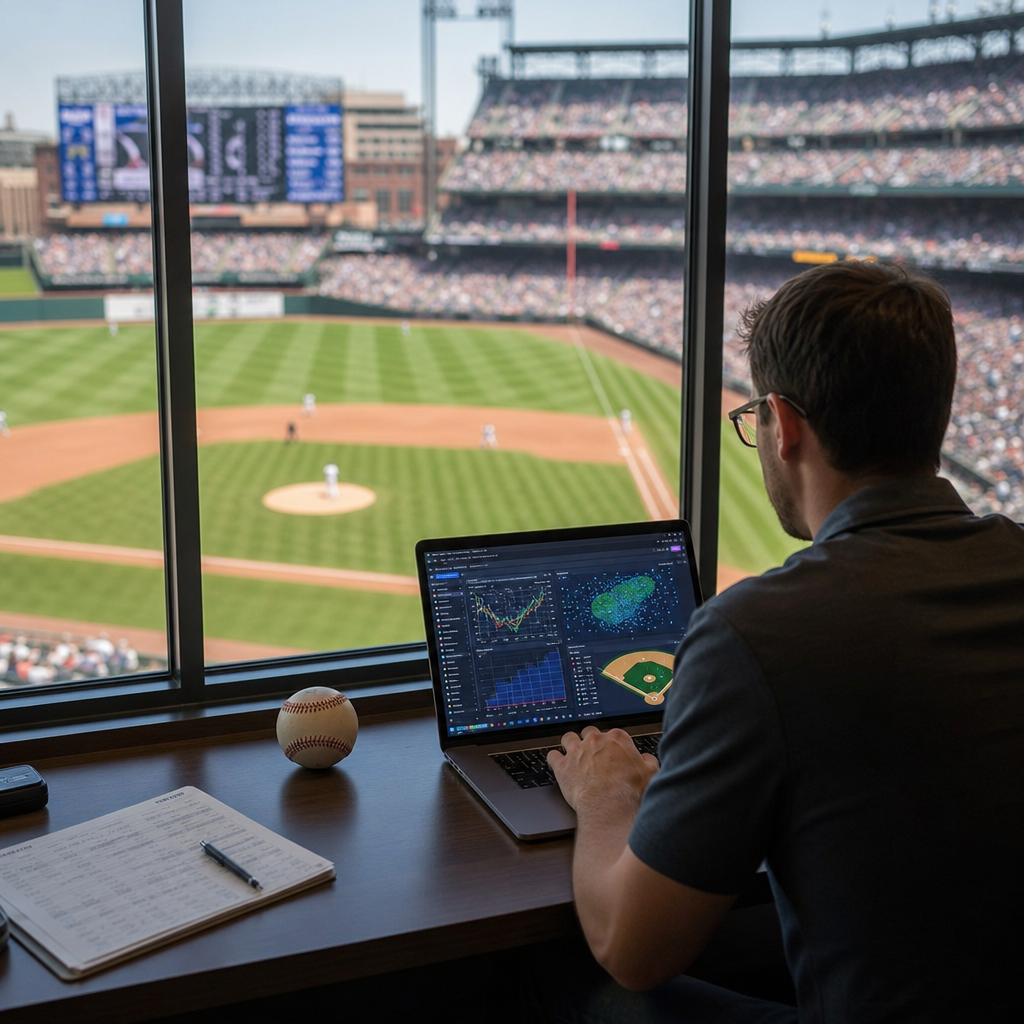
Artificial intelligence is changing baseball statistics from a backward-looking record of what happened into a forward-looking system for explaining why it happened and what is likely to happen next. In baseball, statistics have always mattered because the sport is built on discrete events: every pitch, swing, batted ball, catch, and baserunning decision can be logged, compared, and valued. Artificial intelligence adds a new layer by finding patterns across millions of data points that traditional scorekeeping and even advanced analytics often miss. For teams, broadcasters, sportsbooks, fantasy players, and fans, the future of baseball stats is no longer just about bigger databases. It is about smarter interpretation, faster decisions, and more precise evaluation.
When people talk about artificial intelligence in baseball, they usually mean machine learning models trained on large collections of historical and real-time data. That data comes from sources such as Statcast, Hawk-Eye tracking, biomechanical assessments, medical histories, weather feeds, scouting reports, and video. A model can use those inputs to estimate pitch quality, project player aging curves, identify defensive positioning advantages, or flag injury risk. Baseball operations departments have used predictive systems for years, but the scope is widening. Front offices now connect model outputs to player development, in-game strategy, roster construction, contract valuation, and amateur scouting. The result is a new statistical language that combines classic measures like batting average and ERA with expected outcomes, probabilistic forecasts, and movement-based classifications.
This matters because modern baseball creates more information than any person can manually process. A single major league game can generate thousands of tracked coordinates and timing events, and a full season produces an enormous behavioral archive. I have worked with baseball data pipelines long enough to know that the challenge is not collecting information. The challenge is deciding which signals are real, which are noisy, and which actually improve decisions. Artificial intelligence helps answer those questions when it is used carefully. It can separate a pitcher’s repeatable changeup shape from a one-game anomaly, or show that a hitter’s apparent slump is really bad luck on hard-hit balls. At the same time, it can mislead if teams trust opaque models without testing them against baseball context.
As the hub for the future of baseball stats, this article explains where AI is reshaping measurement, what new metrics are emerging, how teams are applying them, and where the limits remain. It also connects the broader story of baseball records and statistical milestones to a coming era in which achievements may be defined less by simple totals and more by quality, efficiency, durability, and situational value.
From box scores to predictive systems
Baseball statistics began with straightforward counting categories: hits, runs, RBIs, wins, errors, and batting average. Sabermetrics expanded that framework with concepts such as on-base percentage, slugging percentage, OPS, FIP, wRC+, WAR, and run expectancy. Those advances improved decision-making because they better matched how runs are created and prevented. Artificial intelligence does not replace sabermetrics. It extends it by modeling interactions that linear formulas cannot fully capture. Instead of asking only how often a hitter reaches base, teams can ask how that hitter performs against specific pitch shapes, release points, count sequences, and defensive alignments under different weather conditions.
The shift became possible as tracking technology matured. MLB’s Statcast platform, introduced league-wide in the middle of the 2010s, popularized measurements such as exit velocity, launch angle, sprint speed, route efficiency, and pitch spin. Hawk-Eye camera systems expanded that tracking depth, capturing full-body and ball-flight information at a much higher level. Once those streams were standardized, AI models could classify pitches more accurately, estimate catch probability more realistically, and detect subtle mechanical changes before traditional scouting would notice them. A four-seam fastball, for example, is no longer judged simply by velocity. Teams evaluate induced vertical break, horizontal movement, extension, release height, seam effects, command profile, and how that combination plays against a specific batter’s swing path.
One practical result is that statistics increasingly describe process rather than only outcome. Expected batting average and expected slugging estimate what should have happened based on contact quality. Stuff models estimate how nasty a pitch is independent of defense. Framing metrics estimate how many runs a catcher saves by receiving pitches in a way that influences umpire calls. These are AI-adjacent developments because they rely on large-scale pattern recognition and probabilistic modeling. They also change conversations about performance. If a pitcher allows three home runs on poorly located fastballs, the old box score and the new model agree. If he allows three bloop hits on well-executed pitches, the model provides a more useful explanation.
How AI creates the next generation of baseball metrics
The next generation of baseball metrics will be built around probability distributions, contextual baselines, and individualized comparisons. Instead of one league-average benchmark, AI can build player-specific baselines that account for body type, age, mechanics, role, and environment. For hitters, that means better swing decisions metrics, more precise contact models, and clearer separation between approach problems and random variation. For pitchers, it means movement profiles, tunneling scores, command maps, and fatigue indicators that update continuously instead of monthly or yearly.
Teams already use model families that answer direct baseball questions. What is the probability this pitch type will generate a whiff in a 1-2 count? Which infield alignment cuts the batting average on this hitter’s pulled ground balls most effectively? How much value does a catcher add by blocking borderline breaking balls with runners on base? Which minor league pitchers have major league traits hidden by poor surface stats? AI excels here because it can compare thousands of similar game states and weight the variables appropriately. A human analyst can recognize patterns. A trained model can score them at scale.
The most important future metrics will likely blend physical tools with tactical application. A hitter’s raw bat speed matters, but the game value lies in when he deploys it, on which pitch planes, and with how much zone coverage. A pitcher’s spin rate matters less than whether the shape pairs with a sweeper or splitter and whether command allows those offerings to tunnel. This is why models are moving toward integrated scores rather than isolated measurements.
| Stat area | Traditional measure | AI-enhanced future measure | Why it matters |
|---|---|---|---|
| Hitting | Batting average | Contact quality plus swing decision profile | Separates luck from repeatable skill |
| Pitching | ERA | Pitch shape, command, and outcome expectancy model | Shows true effectiveness before results stabilize |
| Defense | Errors | Range, route, reaction, and conversion probability | Values difficult plays that box scores ignore |
| Baserunning | Stolen bases | Jump quality, lead optimization, and advancement value | Measures total running impact, not just steals |
| Durability | Games played | Workload stress and injury-risk forecast | Improves roster planning and player protection |
These measures will not eliminate debate. They will shift it. Analysts will argue less about whether a player is good and more about which model best captures his specific type of value. That is a healthier argument, because it is closer to the game on the field.
Player development, scouting, and injury forecasting
Some of the biggest gains from AI will happen long before major league games start. In player development, organizations use high-speed video, force plates, motion capture, and pitch design labs to understand how a player moves and where improvement is realistic. AI helps link those physical measurements to performance outcomes. If a prospect adds shoulder external rotation, changes wrist position at contact, or alters mound direction, models can estimate whether those changes are likely to improve velocity, bat path efficiency, or command. Development becomes more individualized because the system compares the player to similar movement profiles rather than forcing everyone into one template.
Scouting is changing as well. Traditional scouts still matter because makeup, competitiveness, and adaptability remain hard to quantify. But AI can surface players who deserve more attention. A college pitcher with ordinary ERA but exceptional vertical approach angle and release deception may project better than his results suggest. A low-level minor league hitter with elite swing decisions against breaking balls may have a hidden major league trait. Several organizations, including the Dodgers, Rays, Astros, and Guardians, built competitive advantages in part by identifying undervalued skills before the market fully priced them in.
Injury forecasting is the most sensitive and potentially transformative area. Teams use workload models, kinematic markers, recovery data, and medical trends to estimate risk, especially for pitchers. No model can predict injuries with certainty, and responsible clubs treat these systems as decision support, not diagnosis. Still, they can identify dangerous spikes in effort, reduced arm speed, altered release consistency, or compensation patterns that often precede problems. That changes statistics too. Durability may soon be tracked not only by innings pitched but by cumulative stress, high-effort pitches, recovery quality, and resilience under schedule density.
Game strategy, broadcasting, and fan understanding
Artificial intelligence is also transforming how baseball is explained to the public. Broadcasts increasingly use predictive graphics, matchup probabilities, defensive positioning maps, and swing-path breakdowns that were once internal team tools. The best versions make the game clearer, not more confusing. Instead of drowning viewers in decimal-heavy metrics, they answer obvious questions: Why did the catcher set up there? Why does this fastball miss bats even at average velocity? Why was the outfielder shaded a few steps toward left-center? AI-generated insights work when they translate complexity into plain baseball language.
In-game strategy will become more adaptive as models update in real time. Managers already receive matchup information, but future systems will better account for fatigue, weather shifts, umpire zones, and defensive substitutions. Consider a late-inning plate appearance with runners on second and third. An AI model can combine historical run expectancy, pitcher command under pressure, batter swing aggression by zone, and current movement quality to suggest the highest-value pitch mix. That does not mean the dugout will blindly follow the screen. It means strategic choices will be informed by a deeper evidence base.
For fans, the future of baseball stats should be more accessible than many people fear. Good statistical design removes clutter. It tells a clearer story about skill, context, and probability. The likely outcome is not a sport ruled by robots, but a sport in which smarter statistics help more people understand what they are seeing.
Limits, ethics, and the future of records
AI will improve baseball statistics, but it will not make them perfect. Models are only as good as their inputs, assumptions, and validation. Tracking systems can miss context. Historical data may encode outdated strategies. Small samples still distort conclusions, especially for young players, relievers, and role-based specialists. There is also a risk of false precision. A projection that says a player has a 27.4 percent chance to homer is not truth; it is an estimate with uncertainty. The best analysts communicate confidence ranges and explain what could change.
There are ethical questions too. If teams gather detailed biometric data, who owns it? How should it affect contracts, arbitration, and free agency? Could players be unfairly labeled injury risks by incomplete models? Baseball will need clearer standards around consent, privacy, and competitive use. The league, union, and clubs all have incentives to define those boundaries before technology outruns policy.
Records and milestones may also be viewed differently in the years ahead. Traditional totals will always matter because baseball history is built on counting stats. But AI will push more nuanced definitions of greatness. A season with fewer home runs but exceptional expected production against elite velocity may be understood more richly than a raw total alone suggests. A pitcher’s legacy may include not just strikeouts and ERA titles, but dominance of pitch shapes, command efficiency, and durability under modern workload constraints. This does not diminish records. It gives them context.
The future of baseball stats is not just more numbers. It is better questions, sharper answers, and fairer evaluation. Artificial intelligence can reveal hidden skill, improve player health decisions, strengthen development plans, and help fans see the sport with more clarity. The organizations that thrive will be the ones that combine model quality with baseball judgment, communication, and humility. If you follow statistics and record-breaking moments, this is the hub to watch, because every major trend in the next era of baseball analysis will start here: turning data into understanding, and understanding into smarter baseball.
Frequently Asked Questions
How is artificial intelligence changing baseball statistics compared with traditional analytics?
Traditional baseball statistics were designed to describe outcomes. They told teams, players, and fans what already happened: batting average, ERA, RBIs, and even more advanced metrics like OPS or WAR summarize performance after the fact. Artificial intelligence changes that framework by shifting analysis from simple description toward explanation and prediction. Instead of only recording that a hitter grounded out or that a pitcher gave up hard contact, AI can analyze the pitch type, release point, spin rate, bat path, swing decision, defensive positioning, runner speed, weather conditions, and game context all at once to identify why the play unfolded the way it did.
This matters because baseball produces enormous amounts of structured and semi-structured data. Every pitch, swing, batted ball, throw, and movement on the field can now be measured by modern tracking systems. AI models can process millions of these events and uncover subtle relationships that human analysts or conventional statistical methods might miss. For example, AI can detect that a pitcher’s fastball is effective not just because of velocity, but because its movement profile pairs unusually well with a slider released from the same arm slot. In the same way, it can recognize that a hitter performs better against certain pitch tunnels or in counts where the pitcher’s sequencing becomes more predictable.
In practical terms, AI is turning baseball statistics into a more dynamic decision-making system. Teams are no longer limited to evaluating who performed well in the past. They can estimate which mechanics are sustainable, which trends signal future improvement or decline, and which tactical choices are most likely to succeed in the next game or even the next pitch. That is the real shift: statistics are becoming less like a historical archive and more like an intelligent operating system for player development, game strategy, and roster construction.
What kinds of baseball data does AI use to make better predictions?
AI works best when it has access to rich, detailed data, and baseball now provides exactly that. At the most basic level, AI uses familiar event data such as balls, strikes, hits, outs, walks, and home runs. But its real power comes from combining those results with high-resolution tracking and contextual information. Pitch-tracking systems capture velocity, spin rate, spin axis, vertical and horizontal break, extension, release height, and exact location in the strike zone. Bat and ball tracking can measure exit velocity, launch angle, spray direction, bat speed, attack angle, and contact quality. Fielding and baserunning systems add reaction times, route efficiency, acceleration, top speed, jump quality, throw velocity, and positioning.
Context is just as important as raw measurements. AI models can factor in inning, score, count, handedness matchups, defensive alignment, park dimensions, altitude, weather, fatigue, travel schedules, and even how a pitcher’s stuff changes from the first inning to the sixth. This allows the model to understand that not all .300 batting averages or 95 mph fastballs are the same. One result may be built on sustainable skill, while another may be driven by luck, ballpark effects, or favorable matchups that are unlikely to last.
Another major advantage is that AI can combine different data types at once. Video, biomechanical information, medical history, and scouting reports can all be layered together with traditional statistics. That means a model might not only predict whether a player is likely to improve, but also identify the specific mechanical adjustment or physical trend behind that projection. In baseball, where success often depends on tiny margins, this ability to synthesize many forms of information is what makes AI especially valuable.
Can artificial intelligence actually predict future player performance accurately?
AI can improve forecasts of player performance, but it does not eliminate uncertainty. Baseball remains a sport full of randomness, small sample distortions, injuries, and psychological variables that are difficult to measure perfectly. What AI does exceptionally well is increase the quality of probability-based forecasts. Rather than declaring with certainty that a player will hit 30 home runs or post a 2.90 ERA, AI can estimate a likely range of outcomes and explain which underlying factors are pushing that range higher or lower.
For hitters, AI can look beyond surface numbers to evaluate contact quality, swing decisions, zone coverage, bat speed, pitch recognition, and how those traits match up against different pitcher archetypes. For pitchers, it can assess whether current results align with the underlying shape and quality of their arsenal. A pitcher with mediocre results but elite movement and deception might be a breakout candidate, while another with a strong ERA but weak contact management indicators could be at risk of regression. These are areas where AI often outperforms simpler models because it can account for interaction effects across many variables at once.
That said, the best use of AI in baseball is not as a crystal ball, but as a more intelligent forecasting tool. Teams use it to improve decisions around contracts, trades, player development plans, defensive alignment, injury prevention, and in-game tactics. Good AI models help organizations ask better questions: Is a young hitter’s improvement real? Is a veteran’s velocity loss meaningful or temporary? Which pitch mix gives a starter the best chance against this lineup? The forecasts become most valuable when they are paired with human judgment from coaches, scouts, and analysts who understand the limits of the model as well as its strengths.
How does AI help teams understand why something happened, not just what happened?
This is one of the most important developments in modern baseball analysis. Traditional stat lines often flatten complex events into simple outcomes. A flyout is a flyout, a strikeout is a strikeout, and a single is a single. But those results can come from very different processes. AI helps teams unpack the chain of causes behind each event by connecting mechanics, decisions, context, and physical execution. It can show whether a hitter got out because of poor swing timing, a pitcher’s deceptive release, an unfavorable count, a suboptimal launch angle, or a defender who was perfectly positioned.
For example, a batter may be slumping even though his expected contact quality remains strong. AI can flag that his outcomes are worse than the underlying process, suggesting bad luck rather than true decline. On the other hand, if the model detects slower bat speed, worse chase decisions, and weaker contact against high fastballs, it can point to a more substantive issue that coaches need to address. The same idea applies to pitching. A pitcher’s strikeout rate might drop, but AI can isolate whether the problem is reduced extension, flatter pitch shape, less effective sequencing, or simply tougher opponents over a short stretch.
This explanatory power makes baseball statistics more actionable. Teams do not just want to know that performance changed; they want to know what lever to pull next. AI can identify patterns that suggest a player should alter a pitch mix, adjust a defensive starting position, refine footwork, or attack different zones against specific hitters. In that sense, AI is helping baseball move from passive measurement to active diagnosis. The statistic is no longer the endpoint of analysis. It becomes the starting point for understanding cause, making corrections, and projecting what might happen next.
Will artificial intelligence replace scouts, coaches, and traditional baseball knowledge?
No, and the most successful organizations generally treat AI as an enhancement to human expertise rather than a replacement for it. Baseball decisions involve more than numerical optimization. Scouts evaluate body language, competitiveness, adaptability, and projectability. Coaches understand how to communicate adjustments in ways a player can actually apply. Front-office leaders weigh clubhouse fit, development environment, financial considerations, and long-term organizational goals. AI is powerful, but it is still a tool, and tools are most effective when used by people who understand the game deeply.
What AI does exceptionally well is process scale and complexity. It can analyze far more data, far more quickly, than any human staff could on its own. It can surface hidden patterns, identify inefficiencies, and challenge assumptions that may be based on habit or limited sample sizes. But human experts remain essential for interpretation. A model might suggest that a prospect’s pitch characteristics resemble those of successful major league relievers, yet a scout or pitching coach may notice the player has unusual athleticism or a feel for a changeup that indicates starter potential. Those kinds of judgments still matter.
The future of baseball statistics is likely to belong to organizations that integrate both worlds effectively. AI can provide sharper forecasts, richer explanations, and more precise recommendations, while scouts and coaches provide context, communication, and real-world decision-making. When those perspectives are aligned, teams gain a much fuller picture of performance and potential. So the real story is not machines replacing baseball people. It is baseball knowledge becoming more informed, more precise, and more forward-looking because artificial intelligence is now part of the conversation.