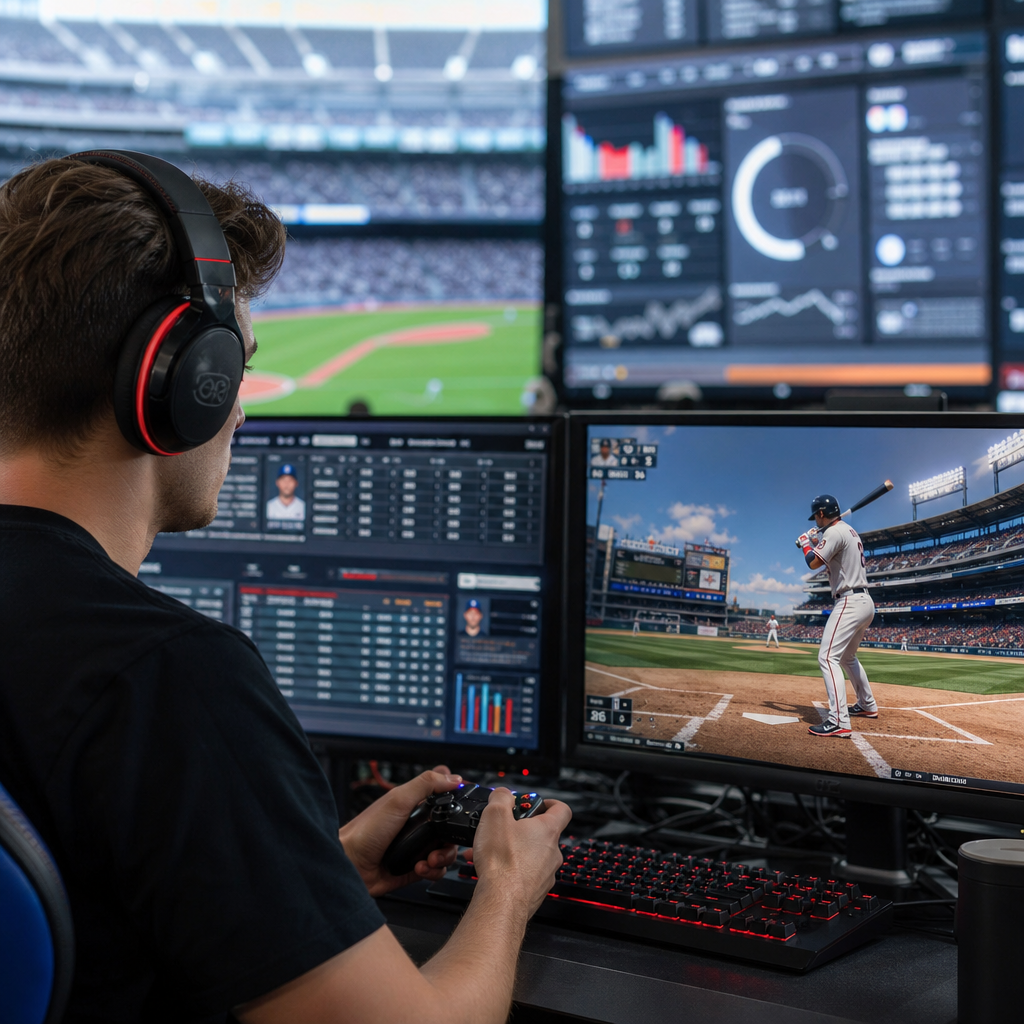
Baseball has always been a numbers game, but the rise of eSports has changed how those numbers are collected, modeled, visualized, and understood. The intersection of gaming and stats is no longer a novelty reserved for streamers or simulation enthusiasts; it is becoming a practical framework for scouting, coaching, fan engagement, and the future of baseball analytics. When people talk about baseball statistics today, they usually mean a blend of traditional measures like batting average and ERA with newer indicators such as exit velocity, launch angle, expected weighted on-base average, and pitch movement profiles. eSports adds another layer: real-time decision modeling, game-engine simulation, input tracking, reaction analysis, and digital environments where strategy can be tested at scale.
I have worked with baseball data dashboards and competitive gaming communities, and the overlap is more substantial than many assume. Both cultures obsess over marginal gains. Both rely on frame-level analysis, probability, and pattern recognition. Both increasingly use machine learning tools to identify tendencies that the naked eye misses. This matters because the future of baseball stats will not be shaped only by front offices and tracking hardware. It will also be shaped by gaming engines, player behavior models, audience expectations for interactive data, and a generation that learned strategy through digital competition before entering clubhouses, broadcast booths, and analytics departments.
As a hub within the broader subject of statistics and record-breaking moments, this article explains how gaming technologies are influencing baseball metrics, why simulation literacy is becoming valuable, and which statistical categories are likely to define the next era. It also clarifies an important distinction: eSports is not replacing baseball analysis. Instead, it is accelerating how baseball information is tested, taught, and consumed. If you want to understand the future of baseball stats, you need to understand where data collection meets simulation, where virtual competition meets physical performance, and how both are changing the way excellence is measured.
Why eSports principles fit baseball so naturally
Baseball and competitive gaming share a deep structural similarity: both are turn-based in critical moments, highly situational, and rich in repeatable events. A pitcher versus hitter sequence resembles a high-level competitive game interaction because every choice creates a counterchoice. Pitch selection, location, timing disruption, and defensive alignment can all be modeled as decision trees. In eSports, analysts review map control, cooldown usage, and opponent tendencies. In baseball, analysts review count leverage, chase zones, release points, and swing decisions. The logic is different in form but similar in function.
This similarity matters because gaming has normalized the use of live overlays, instant replay clips, predictive win models, and player telemetry. Baseball already uses many of these tools, but eSports has pushed expectations further. Younger fans do not just want a box score after the game. They want interactive pitch maps, bat path visuals, probability updates, alternate broadcast views, and immediate context around every matchup. Statcast, Hawk-Eye tracking, and biomechanical systems such as KinaTrax have made that possible, but gaming culture has made it expected.
There is also a training crossover. In gaming, reaction time, pattern recognition, and decision speed are measurable. In baseball, those same qualities affect swing decisions, jump reads, and pitch sequencing. Teams cannot reduce athletic performance to controller inputs, but they can borrow testing methods from digital competition. Vision training, virtual reality batting practice, and pitch-recognition software all benefit from a gaming mindset: isolate variables, create repeatable reps, and measure improvement over time. That approach is shaping which baseball stats become important, because what gets trained consistently is what gets quantified consistently.
The evolution from box score stats to immersive tracking data
For decades, baseball conversation centered on traditional statistics: batting average, home runs, RBIs, wins, saves, and ERA. Those numbers still carry historical meaning, but they explain outcomes more than underlying skill. The modern shift began with play-by-play databases and advanced metrics from analysts associated with sabermetrics, then accelerated when MLB implemented league-wide tracking systems. PITCHf/x introduced precise pitch locations and movement. Statcast expanded the picture by measuring exit velocity, launch angle, sprint speed, catch probability, route efficiency, and arm strength. Hawk-Eye cameras then improved tracking detail across the field.
eSports pushes this evolution further by making people comfortable with dense data layers. In a competitive game, viewers routinely parse damage per minute, economy rates, vision scores, and positional heat maps. Baseball is moving toward an equivalent experience. Instead of asking only whether a hitter got a hit, analysts ask whether he made an optimal swing decision, whether his attack angle matched the pitch plane, and whether his contact quality supports future production. Instead of asking only whether a pitcher allowed runs, analysts ask how his seam-shifted wake, induced vertical break, extension, and tunneling influenced hitter behavior.
The practical result is a more predictive statistical environment. Batting average can swing on luck over small samples; hard-hit rate and expected statistics often stabilize faster. ERA can be distorted by defense and sequencing; strikeout rate, walk rate, whiff percentage, and expected ERA often reveal skill more clearly. The future of baseball stats is therefore less about replacing old numbers outright and more about contextualizing them with richer signal data. Gaming helps by giving audiences a reference point for layered dashboards and performance indicators that update in real time.
How simulation is changing player development and forecasting
Simulation is where the relationship between eSports and baseball becomes most useful. Baseball organizations already use projection systems such as ZiPS, Steamer, and PECOTA to estimate future performance. Those models rely on historical comparables, aging curves, and component statistics. Gaming adds a different kind of simulation literacy: using digital environments to test scenarios repeatedly and adjust strategy based on feedback loops. In practical terms, that means more organizations are interested in virtual pitch recognition tools, digital twins for biomechanics, and scenario-based game planning.
I have seen how simulation changes the conversation during analysis sessions. Instead of debating a hitter’s slump in general terms, coaches can examine whether his timing against high-ride fastballs is slipping, whether his swing decisions against glove-side sweepers have worsened, and whether a virtual training module can recreate that exact challenge. Instead of speaking vaguely about a reliever “losing deception,” analysts can compare release consistency, movement variance, and batter tracking responses across hundreds of pitches. That is a gaming-style feedback loop applied to baseball.
| Area | Traditional measure | Emerging measure | Why it matters |
|---|---|---|---|
| Hitting | Batting average | Expected batting average, hard-hit rate | Separates contact quality from short-term luck |
| Power | Home runs | Barrel rate, average exit velocity | Shows sustainable power skill before results peak |
| Pitching | ERA | xERA, whiff rate, chase rate | Explains run prevention drivers more accurately |
| Defense | Fielding percentage | Outs above average, jump, route efficiency | Captures range and reaction, not only errors |
| Baserunning | Stolen bases | Sprint speed, lead quality, extra-base taken rate | Measures pressure and efficiency, not just attempts |
Forecasting will also become more individualized. Older models grouped players by broad historical patterns. Newer approaches can incorporate biomechanics, workload histories, bat tracking, and environmental factors. That does not mean forecasts become perfect. Baseball remains volatile, and injuries can overwhelm any model. But the direction is clear: the most useful future baseball stats will be dynamic, scenario-sensitive, and tied to development plans rather than static labels.
Fan engagement, streaming culture, and the new language of stats
eSports has influenced not just analysis but presentation. Baseball broadcasts increasingly borrow the visual grammar of gaming: split-screen reactions, live probability graphics, player-specific overlays, and second-screen companion content. This matters because a statistic only becomes culturally powerful when people can understand it quickly. On-base percentage took time to gain mainstream traction not because it lacked value, but because presentation lagged. Today, if a broadcast shows a hitter’s chase rate, hot zones, expected slugging on middle-in fastballs, and recent bat speed trend in a clear graphic, the number becomes accessible.
Streaming culture also changes how fans learn. Many younger viewers are comfortable watching creators explain mechanics live, annotate clips, and compare data side by side. Baseball media is responding with interactive tools from Baseball Savant, FanGraphs, Brooks Baseball archives, and proprietary team models shared selectively through broadcasts. The result is a fan base that can discuss spin efficiency, platoon splits, leverage index, and framing value with far more fluency than previous generations. That expanded literacy raises the ceiling for which baseball stats can matter in public discourse.
There is a commercial dimension as well. Sports video games and competitive baseball titles train users to think in ratings, tendencies, and matchup optimization. A fan who spends hours adjusting lineups based on contact ratings and pitch repertoires is primed to appreciate real concepts like weighted runs created plus, times-through-the-order penalty, and expected slugging against specific pitch shapes. In that sense, gaming acts as an onboarding system for advanced baseball stats. It makes abstract analytics intuitive through repeated interactive use.
The future of baseball stats: what will matter most next
Several categories are positioned to define the next phase of baseball analytics. First is bat tracking. MLB has already begun expanding public conversation around bat speed, attack angle, squared-up rate, and swing path efficiency. These measurements help explain why two hitters with similar strength produce different outcomes. Second is biomechanical workload data. Expect deeper integration of elbow stress estimates, kinetic chain efficiency, recovery markers, and fatigue-adjusted performance models, especially for pitchers. Third is decision-quality metrics, which evaluate not just whether a player succeeded, but whether the choice itself was sound given count, location, movement, and game state.
Fourth is context-rich defense. Outs Above Average was a major leap, yet it is still only part of the picture. Future defensive stats will better account for pre-pitch positioning, first-step efficiency, throw setup, and relay decision quality. Fifth is adaptive game theory. Teams already optimize based on matchup data, but future stats will increasingly quantify deception, predictability, and sequencing quality. A pitcher’s arsenal will not be judged only by velocity and movement, but by how each pitch changes hitter expectations over time.
Most importantly, the future of baseball stats will connect process to coaching. The best numbers are not just descriptive or predictive; they are actionable. If a stat cannot help a player adjust posture, timing, pitch usage, route path, or preparation, its practical value is limited. That is where the gaming influence is strongest. Competitive games thrive on feedback that is immediate and usable. Baseball is moving in that direction, and the organizations that translate complex data into clear player actions will gain the biggest edge.
Limits, risks, and how to use emerging stats responsibly
More data does not automatically mean better judgment. One of the biggest mistakes I see is treating every new metric as objective truth without asking how it was built, what sample size it needs, and what blind spots it carries. Expected statistics depend on model assumptions. Tracking systems can differ slightly in calibration. Public metrics may lag behind private team data. A hitter may intentionally trade contact for damage in a way that raises strikeouts but improves overall run value. A pitcher may underperform his shape models because command, health, or confidence has eroded. Context still matters.
There is also a human risk. If baseball adopts a gaming-style obsession with optimization without limits, players can be reduced to dashboards. That is poor analysis. Good analysts integrate quantitative evidence with scouting, biomechanics, psychology, and communication. The best teams I have studied do not use numbers to end debate; they use numbers to sharpen the right debate. They also recognize that not every athlete responds well to the same level of data exposure. Some want movement charts and bat path reports. Others need one cue, one clip, and one adjustment.
Privacy and fairness will matter more in the coming years. As wearable technology, vision testing, and biomechanics tracking expand, leagues and clubs will need clear rules around consent, data ownership, and competitive use. Baseball has standards in areas such as replay review and equipment regulation; data governance needs the same seriousness. The future of baseball stats will be exciting only if it remains credible, transparent, and useful to players as well as teams and fans.
eSports and baseball now meet at the most important point in modern sports: the translation of complex information into better decisions. That intersection is shaping the future of baseball stats through simulation, richer tracking, interactive presentation, and more individualized performance models. Traditional numbers still matter because they connect today’s game to its history, but they no longer stand alone. The most valuable baseball statistics now explain process, forecast performance, and guide improvement.
For a hub focused on the future of baseball stats, the main takeaway is simple. Watch the categories that reveal how and why events happen: bat tracking, pitch shape, decision quality, biomechanics, contextual defense, and adaptive sequencing. Learn the tools that surface those signals, from Statcast and Baseball Savant to projection systems and video-based analysis platforms. And remember that gaming’s greatest contribution is not entertainment alone. It is a culture of measurable iteration that baseball can apply without losing its human core.
If you are building knowledge in statistics and record-breaking moments, use this page as your starting point, then explore deeper articles on advanced hitting metrics, pitching models, defensive analytics, and projection systems. The future of baseball stats is already here, and understanding it now will make every game, every trend, and every record easier to read.
Frequently Asked Questions
How are eSports influencing the way baseball statistics are collected and analyzed?
eSports are influencing baseball analytics by accelerating the use of real-time data collection, simulation-based modeling, and interactive performance tracking. In competitive gaming, every action can be logged, measured, and reviewed instantly. That mindset has carried over into baseball, where teams now rely on high-speed cameras, motion-capture systems, bat sensors, wearable technology, and advanced tracking platforms to collect detailed information on pitch movement, swing paths, reaction times, defensive positioning, and decision-making patterns. Instead of focusing only on traditional numbers such as batting average, RBI, or ERA, analysts can now study how a player creates those outcomes at a much deeper level.
The eSports influence also shows up in how data is processed and presented. Gaming environments are built around dashboards, visual overlays, heat maps, and rapid feedback loops, and baseball organizations have adopted many of those same tools. Coaches and analysts can break down a hitter’s timing against velocity, compare virtual scenarios, and review pitch sequencing in ways that are far more dynamic than older box-score methods. This makes statistics more actionable. Rather than simply saying a pitcher had a strong outing, teams can identify exactly which release point changes improved command or which pitch mix generated weak contact. In that sense, eSports have helped baseball move from static record-keeping to a more adaptive, predictive, and performance-oriented approach to numbers.
Why does baseball fit so naturally with the data-driven culture of eSports?
Baseball and eSports align naturally because both revolve around measurable events, pattern recognition, strategic adjustments, and repeatable performance analysis. Baseball has long been known as a numbers game because each pitch, plate appearance, and defensive play can be isolated and evaluated. eSports operate with a similar logic, where players and teams study mechanics, tendencies, efficiency, response time, and situational outcomes to gain an edge. That shared dependence on precise information makes the connection especially strong.
Another reason the fit works so well is that both baseball and gaming reward small advantages discovered through data. In baseball, a marginal improvement in launch angle consistency, chase rate, or pitch tunneling can change the outcome of a season. In eSports, slight upgrades in timing, map awareness, or input efficiency can decide matches. Both worlds value film review, analytics departments, and scenario testing. As a result, baseball has become more open to ideas that are already standard in gaming, including live data feedback, predictive simulations, and visually rich statistical interfaces. This overlap is not just cultural; it is operational. The same analytical habits that help gamers optimize performance are now helping baseball organizations identify talent, refine player development, and communicate strategy more clearly.
Can gaming simulations actually help with baseball scouting and player development?
Yes, gaming simulations can play a meaningful role in both scouting and player development, especially when they are used as supplements to live evaluation rather than replacements for it. Modern baseball simulations can model pitch locations, hitter tendencies, defensive reactions, and situational outcomes with increasing sophistication. That allows coaches and scouts to test how players respond to specific scenarios, evaluate decision-making under pressure, and examine potential strengths or weaknesses that may not be obvious in a small live sample. For example, a prospect’s reaction to high velocity, breaking-ball recognition, or situational approach can be studied in a controlled digital environment and compared across many repetitions.
For development, simulations are particularly valuable because they provide safe, repeatable, and measurable training conditions. Hitters can practice pitch recognition without accumulating physical wear. Pitchers can explore sequencing strategies and location plans based on modeled opponent tendencies. Catchers and fielders can rehearse game situations through virtual decision trees that mirror actual competition. This is where the influence of eSports becomes practical: gaming systems are built to track inputs, outcomes, and adaptations over time, which makes them useful for identifying how athletes learn and improve. While no simulation can fully replicate the emotional pressure, physical fatigue, or unpredictability of a real baseball game, these tools can sharpen preparation, speed up feedback, and add a layer of analytical insight that supports better scouting and smarter coaching.
How is the intersection of eSports and baseball changing fan engagement?
The intersection of eSports and baseball is changing fan engagement by making statistics more interactive, visual, and participatory. Traditionally, many baseball fans consumed stats through newspaper box scores, broadcast commentary, or postgame summaries. Today, influenced by gaming culture, fans increasingly expect live dashboards, advanced visualizations, player ratings, predictive tools, and second-screen experiences that let them explore the game in real time. This shift turns statistics from passive information into an active part of the entertainment experience.
Fantasy sports, baseball video games, live simulations, and streaming platforms have all contributed to this change. Fans are no longer just asking who got a hit or who earned a win; they want to know exit velocity, spin rate, expected batting average, pitch usage trends, and matchup probabilities. Gaming has trained audiences to understand performance metrics as part of the story, and baseball has benefited from that shift. Younger fans in particular often enter the sport through interactive platforms where roster-building, simulation, and stat comparison are central to the experience. That means eSports-style presentation can help baseball feel more accessible and more personalized. It gives fans more ways to connect with players, strategies, and outcomes, while also expanding the audience for advanced analytics beyond traditional stat enthusiasts.
What does the future of baseball analytics look like as eSports continue to evolve?
The future of baseball analytics is likely to become more immersive, predictive, and integrated across every level of the sport. As eSports continue to evolve, baseball will probably adopt even more tools centered on real-time modeling, machine learning, virtual training, and interactive decision support. Front offices may rely on increasingly sophisticated simulations to project player development, optimize lineups, manage in-game strategy, and assess injury risk. Coaches will have faster access to custom reports that combine biomechanics, performance trends, and opponent data into practical recommendations. Players may train in mixed-reality environments that blend physical reps with game-like digital scenarios.
Just as important, the language of analytics will continue to change. The influence of gaming is pushing baseball data away from isolated spreadsheets and toward systems that are easier to visualize and apply. That means more intuitive heat maps, player archetype models, probability-based decision tools, and feedback loops that can be understood by coaches, athletes, executives, broadcasters, and fans alike. Traditional statistics such as batting average and ERA will still matter as familiar reference points, but they will increasingly sit alongside advanced measures that explain context, process, and projection. In the long run, the intersection of eSports and baseball is not simply about making the sport feel more modern. It is about building a smarter framework for understanding performance, improving player outcomes, and connecting numbers to action in ways that are more precise and more useful than ever before.