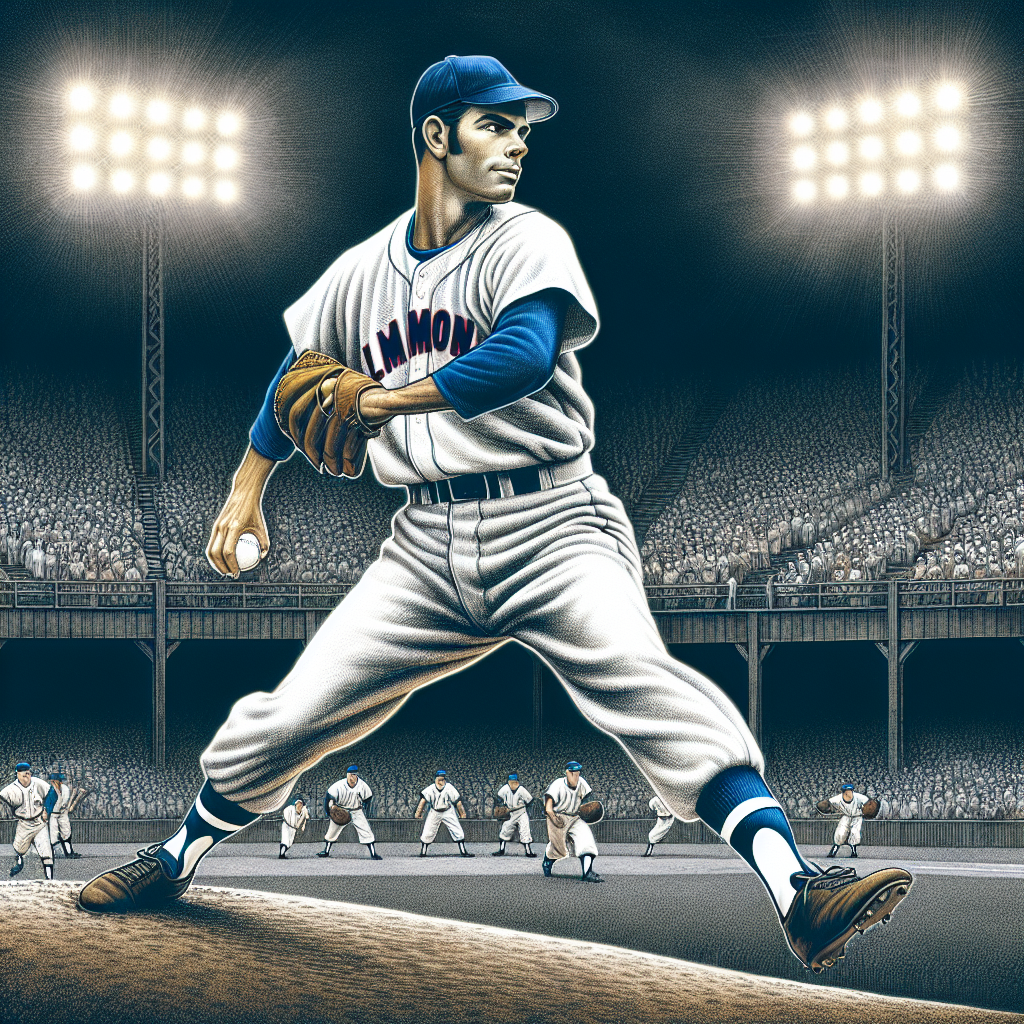
Sandy Koufax, a name synonymous with baseball greatness, is one of the most revered pitchers in the history of Major League Baseball (MLB). Born on December 30, 1935, in Brooklyn, New York, Koufax’s journey in baseball began unassumingly enough. What followed, however, was a career marked by astounding statistics, record-breaking performances, and a dominance on the mound that left both fans and competitors in awe. Throughout the 1960s, particularly in the latter half of the decade, Koufax established himself as an unyielding force for the Los Angeles Dodgers, capturing numerous accolades and etching his name permanently into the annals of baseball history.
Despite battling chronic arm pain, Sandy Koufax’s perseverance and sheer talent allowed him to deliver some of the most memorable performances in baseball history. His legacy is much more than the Cy Young Awards or the no-hitters; it’s in the way he played the game with unparalleled intensity and dignity. Koufax’s story is one of extraordinary talent that was nurtured through unrelenting dedication and a mastery of the game’s fundamentals.
In this article, we will delve deep into Sandy Koufax’s dominant seasons and explore the statistics and record-breaking moments that encapsulated his career. We’ll analyze his standout performances, his pivotal role in shaping the Dodgers’ legacy, and the indelible mark he left on baseball. Join us as we unravel the tale of a pitcher who didn’t just play the game but transformed it.
The Early Years and Breakthrough
Koufax’s MLB career commenced in 1955 when he joined the Brooklyn Dodgers. Although he showed glimpses of his potential, it wasn’t until 1961 that Koufax truly began to shine. Under the guidance of pitching coach Joe Becker, Koufax revamped his pitching mechanics, which led to more consistent control and effectiveness on the mound.
By 1961, this transformation was starting to pay off. Koufax finished that season with an 18-13 record and struck out 269 batters, a new Dodgers record at the time. This marked the beginning of a period of dominance that would last for the better part of the next six years. His breakout moment came on June 30, 1962, when he pitched his first no-hitter against the New York Mets. This was not a fluke; it was a signal to the rest of the league that a new pitching juggernaut had emerged.
Koufax’s control improved significantly during this period. He began to dominate hitters with a fastball that seemed to explode out of his hand and a curveball that baffled many. His success was not just about raw talent; it was about the ability to adapt, learn, and perfect his craft. With each passing season, Koufax got better at anticipating the hitting tendencies of opponents, making him increasingly difficult to beat.
Koufax didn’t just break records; he shattered them. His prowess on the mound started drawing comparisons to some of the greatest pitchers of all time. As he continued to improve, it became clear that Sandy Koufax was no ordinary pitcher—he was something special, someone who would go on to define an era of baseball.
The Pinnacle of Perfection: 1963-1965
If the early 1960s were the setup, the years 1963 to 1965 were the slam dunk of Sandy Koufax’s career. In 1963, Koufax achieved what many consider one of the greatest pitching seasons in the history of baseball. He finished the season with a 25-5 record, a 1.88 ERA, and an astounding 306 strikeouts. His control and ability to dominate hitters were unparalleled, earning him the National League MVP award and his first Cy Young Award.
The 1963 season was also highlighted by an iconic performance in the World Series against the New York Yankees. Koufax struck out 15 batters in Game 1, a performance that set the tone for the Dodgers’ sweep of the Yankees to win the championship. His dominance in that season wasn’t a one-off but a prelude to even greater achievements.
1964 saw Koufax continue his level of excellence. Despite suffering from an arthritis condition that would eventually shorten his career, Koufax pitched remarkably well, finishing the season with a 19-5 record and a 1.74 ERA. His statistics continued to astonish both fans and analysts alike. But it was in 1965 that Koufax achieved another level of legendary status.
In 1965, Koufax threw his fourth no-hitter, which included a perfect game against the Chicago Cubs on September 9. He ended that season with a 26-8 win-loss record, a 2.04 ERA, and 382 strikeouts, surpassing Bob Feller’s 1946 record for most strikeouts in a season. His performances earned him his second Cy Young Award in three years. The 1965 World Series was another theater where Koufax showcased his greatness, pitching three games—including a shutout in Game 7—despite severe pain in his pitching arm.

The Legendary Closing Years: 1966
As Sandy Koufax entered the 1966 season, many wondered if he could maintain the incredible form he had displayed over the previous few years. Not one to disappoint, Koufax delivered yet another outstanding season, further cementing his legacy. He posted a 27-9 record, a 1.73 ERA, and 317 strikeouts, earning his third and final Cy Young Award.
His performance in 1966 was nothing short of remarkable given the circumstances. Koufax was battling chronic arthritis, which had worsened with time. Yet, his resolve and competitive spirit saw him rise above these challenges to deliver unforgettable performances. The pain he endured was captured in many anecdotes and stories from that time, but Koufax never allowed it to overshadow his commitment to excellence.
One of the most poignant moments of the 1966 season was when Koufax threw 27 complete games, showcasing not just his talent but also his extraordinary endurance and mental toughness. His ability to consistently throw strikes and out-think hitters was a testament to his skill and understanding of the game. By the end of the 1966 season, Koufax had firmly established himself as not just a great pitcher, but one of the all-time greats in MLB history.
Despite the heightened challenges, Koufax maintained his standard of excellence until the very end of his career. The decisions he made on the mound were always strategic, aimed at outsmarting batters and winning games. His performance in the 1966 season epitomized his career—a blend of skill, intellect, and an unwavering desire to be the best.
Retirement and Impact
Following the 1966 season, Sandy Koufax made the difficult decision to retire from baseball at the age of 30 due to his chronic arthritis condition. The announcement shocked the baseball world, as Koufax was at the peak of his career. However, the decision was also seen as a testament to his prudence and understanding of his physical limitations.
His retirement didn’t diminish his legacy; if anything, it enhanced it. Koufax’s career statistics remained jaw-dropping: 2,396 strikeouts, a 165-87 record, a 2.76 ERA, and four no-hitters, including one perfect game. These numbers only tell part of the story. Koufax’s sheer dominance during his peak years left an indelible impact on the game and inspired countless young pitchers to follow in his footsteps.
Koufax’s influence extended beyond the diamond as well. He became a role model for many aspiring athletes, not just in baseball but across all sports. His demeanor, professionalism, and commitment to excellence marked him as a true ambassador for the game. Even today, decades after his final pitch, Koufax’s legacy serves as a benchmark for greatness. Any pitcher who aspires to reach the pinnacle of their profession often finds themselves compared to the extraordinary standards Koufax set.
His post-retirement years saw Koufax contribute to the game in various capacities, including as a coach and advisor. Despite stepping away from the limelight, he continued to share his knowledge and passion for the sport, demonstrating his enduring commitment to baseball. Sandy Koufax’s career may have been brief, but its impact was profound and lasting, ensuring that his legacy would endure for generations.
Conclusion
Sandy Koufax’s career is a remarkable chapter in the history of baseball, filled with extraordinary achievements, statistics, and record-breaking moments that continue to inspire and captivate fans and players alike. From his early struggles and eventual breakthrough to his era of dominance and his prudent retirement, Koufax’s journey through baseball exemplifies what it means to be a true athlete and competitor.
His remarkable achievements, including multiple Cy Young Awards, MVP honors, and no-hitters, are a testament to his skill, determination, and tactical intelligence on the field. Whether calculated through his staggering strikeout numbers or the countless games he single-handedly turned in his team’s favor, Koufax’s impact on the game is immeasurable. His legacy is not just recorded in the statistics but in the memories of those who witnessed his greatness and the stories passed down through generations of baseball fans.
For young pitchers, Sandy Koufax remains the gold standard—a paragon of pitching excellence. His ability to adapt, improve, and utterly dominate opposing batters is something every young athlete aspires to. Koufax’s career serves as a constant reminder that greatness in sports isn’t just about raw talent but also about resilience, intelligence, and an unyielding pursuit of perfection.
Looking back at Sandy Koufax’s career, it’s clear that he didn’t just play the game—he transformed it. His name is forever enshrined in baseball lore as a symbol of excellence and an embodiment of the sport’s highest ideals. Koufax’s dominant seasons, characterized by jaw-dropping statistics and unforgettable moments, ensure that he will always be remembered as one of the greatest to ever grace the diamond.
Frequently Asked Questions
1. What made Sandy Koufax such a dominant pitcher during his peak seasons?
Sandy Koufax’s dominance on the mound was largely characterized by his exceptional pitching skills combined with his fierce competitiveness. One of the key aspects was his fastball, which was not only incredibly fast but also featured late movement, making it extremely difficult for batters to predict and hit. His curveball was a thing of beauty, often described as having a “12 to 6 drop,” meaning it would start high and drop sharply, akin to falling off a table. This curveball could leave batters swinging at air, and paired with his pinpoint control, it became a nearly unhittable pitch. Koufax had an ability to maintain his composure under pressure, often performing his best in critical games. His work ethic and dedication to mastering his craft were noted by teammates and competitors alike. During his peak years, minimal injuries enabled him to maintain a high volume of innings pitched, further solidifying his impact on the game. His adjustment in his windup mechanics in the early 1960s, developing a longer stride which improved his balance and timing, also contributed to his success. All these factors combined to create a pitcher who was often said to own the mound whenever he took it, leaving batters feeling overmatched and fans mesmerized.
2. Which seasons were considered the peak of Sandy Koufax’s career?
Sandy Koufax’s career peak is generally considered to be from 1961 to 1966, with the latter half of the 1960s being particularly dominant. However, the most defining seasons were between 1963 and 1965. In 1963, Koufax earned the Cy Young Award and the National League MVP after posting a 25-5 record with a 1.88 ERA and 306 strikeouts. The 1965 season was equally stellar, as he again won the Cy Young Award with a 26-8 record, a 2.04 ERA, while achieving 382 strikeouts, which was a major league record at the time. Koufax threw four no-hitters in his career, including a perfect game in 1965. His relentless performance in the World Series games during these years, where he often pitched on short rest and still delivered lights-out performances, highlighted his durability and competitive spirit. The 1966 season further illustrated his dominance as he achieved a 27-9 record with a 1.73 ERA before retiring prematurely after the season due to arthritis in his left elbow. These seasons were the culmination of techniques he perfected over time, showcasing a pitcher who was not just in peak physical form but also mentally unrivaled on the diamond.
3. How did Sandy Koufax’s pitching style contribute to his effectiveness on the mound?
Sandy Koufax’s pitching style was a blend of speed, precision, and deceptiveness, which played critical roles in his effectiveness. His high leg kick was not just a stylistic choice but a method of generating more power and speed through increased torque and balance. The leg lift helped hide the ball longer, further complicating matters for batters trying to get a read on his pitches. Koufax’s fastball, often clocked in the mid to high 90s, was particularly effective due to its late life and movement, making it hard for hitters to make solid contact. Coupled with his fastball was his devastating curveball—often called the “Koufax curve”—which would sharply dip just as it reached the plate. This curveball was delivered with the same arm speed as his fastball, further deceiving hitters. His willingness to focus endlessly on mechanics and his tireless commitment to practice meant he could throw these pitches with exceptional control. The precision with which Koufax could place his pitches allowed him to work the corners of the strike zone effectively, always keeping hitters guessing. His adaptability also came into play as he learned to pitch smarter, understanding hitters’ weaknesses and targeting them. Koufax’s style was not just physically demanding; it required a tremendous mental acuity that elevated him above his peers.
4. How did Sandy Koufax’s approach to dealing with pressure differ from other pitchers of his era?
Sandy Koufax excelled in handling pressure situations, a trait that set him apart from many other pitchers of his era. One of his greatest strengths was his calm demeanor and focus. Koufax approached pressure situations with an intense concentration level, which allowed him to remain composed irrespective of the stakes. His fierce competitiveness motivated him to elevate his performance when the game was on the line. Koufax was known for his ability to pitch his best during crucial games and in the postseason, demonstrated by his remarkable World Series performances. Instead of shying away from pressure, Koufax confronted it head-on, using it as a catalyst to showcase his best abilities. This mindset was underpinned by meticulous preparation; Koufax often studied hitters and analyzed their weaknesses in detail, giving him the confidence to execute pitches even when the margin for error was razor-thin. His teammates and coaches noted that Koufax thrived in the high-stakes atmosphere, often becoming more focused and efficient as the intensity increased. Moreover, his ability to perform under pressure was also noted in his postseason record, including his unforgettable 1965 World Series performances, where he pitched a shutout on two days’ rest in Game 7. This unyielding mindset in the face of pressure contributed significantly to his success and reputation as one of the most clutch pitchers in baseball history.
5. Why did Sandy Koufax retire at the height of his career?
Sandy Koufax’s decision to retire at the height of his career in 1966 was primarily driven by health concerns, specifically arthritis in his left elbow. Despite coming off one of his best seasons, where he achieved a career-high 27 wins and a stunning 1.73 ERA, the pain and potential damage to his arm were major factors that influenced his decision to end his career prematurely. During his final seasons, the pain in his pitching elbow was slowly becoming unbearable, affecting not only his ability to pitch but also his day-to-day life. He underwent regular treatments to manage the condition, including cortisone shots and painkillers, which allowed him to continue playing at his peak but also raised concerns about his long-term health. Koufax, known for his intelligent approach to baseball and life, likely weighed the potential risks of further injury or disability and decided that it was in his best interest to retire while still healthy. Retiring at just 30 years old, Koufax left the game at the pinnacle of his performance, a decision that underscored his pragmatic yet impactful approach to his career. While fans and the baseball community lamented the loss, Koufax’s decision remains a testament to his understanding of personal limits and the importance of long-term well-being over short-term gains.