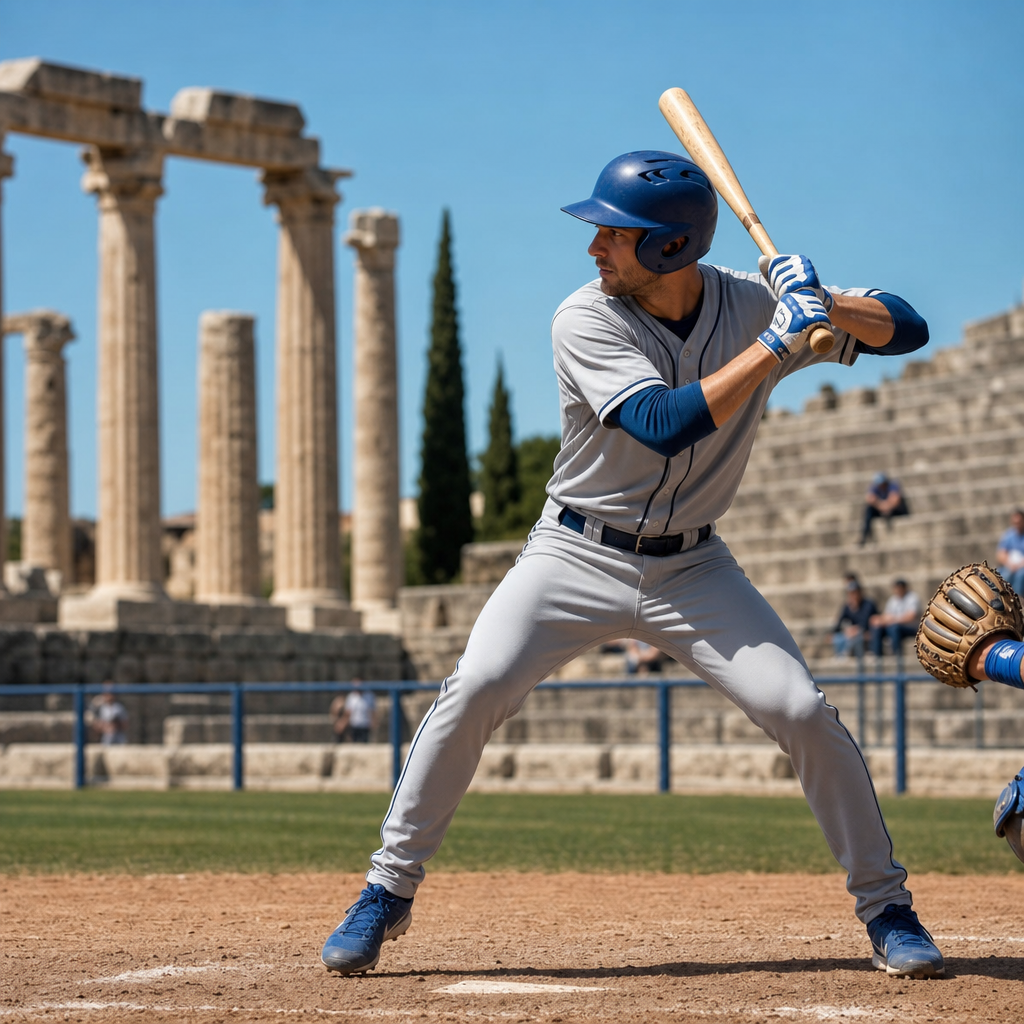
Greek baseball sits at an unusual crossroads of sport, mythology, migration, and modern development. The phrase can mean several things at once: the search for ball-and-bat games in ancient Greece, the organized baseball programs built in contemporary Greece, and the broader story of how a sport strongly associated with the Americas finds a home in the eastern Mediterranean. As a hub within International Baseball, this Miscellaneous page connects those threads and gives readers a reliable starting point for deeper exploration.
To define the subject clearly, ancient Greece did not play baseball in the modern codified sense. There was no equivalent of nine innings, ninety-foot basepaths, or the strike zone described in the Official Baseball Rules. What ancient Greece did have was a rich athletic culture, formalized competition at Panhellenic festivals, and documented ball games such as episkyros and phaininda that reveal how Greeks used throwing, catching, strategy, and teamwork in sport. When people ask whether baseball came from the ancient Olympics, the accurate answer is no, but the comparison matters because it shows how human societies repeatedly invent bat, ball, and fielding contests from shared physical instincts.
The modern side of Greek baseball matters for different reasons. Greece is a small baseball nation, yet its history includes federation building, diaspora involvement, Olympic visibility tied to Athens 2004, youth development challenges, and repeated efforts to sustain facilities, coaching, and league structures after periods of decline. I have worked with international baseball content long enough to see the same pattern in emerging countries: one major event creates awareness, but long-term survival depends on fields, equipment pipelines, trained coaches, and regular competition. Greece illustrates that reality especially well.
This article covers the full landscape under Greek baseball Miscellaneous: ancient precedents, Olympic misconceptions, the rise of the modern federation, the effect of the 2004 Olympic cycle, current participation issues, key institutions, and the questions readers usually ask about whether baseball has a future in Greece. The goal is simple. If you want one page that explains how Greek baseball evolved from historical curiosity to a modern, if still developing, sporting project, this is the foundation.
Ancient Greece, the Olympics, and the Roots Question
The first question most readers ask is whether baseball has roots in ancient Greece. Strictly speaking, it does not. Baseball emerged through a much later chain of bat-and-ball games, especially British antecedents such as rounders and town ball variants, before codification in the United States during the nineteenth century. Ancient Greek athletics were organized around events like stadion footraces, wrestling, boxing, pankration, discus, javelin, chariot racing, and the pentathlon. None of the canonical Olympic events resembled baseball in formal structure.
Still, the comparison persists because ancient Greek sources describe ball play in ways that feel familiar to modern sports fans. Episkyros was a team game involving a marked field and attempts to force the opposing side backward. Phaininda emphasized deception, passing, and quick reactions. Harpaston, better attested in Roman contexts, may have developed from Greek influences and involved seizing or carrying a ball amid active contest. These were not batting games, but they show that organized ball competition occupied a legitimate place in Mediterranean athletic life.
The best way to frame the relationship is this: ancient Greece contributed to the idea that sport could be systematized, celebrated publicly, and tied to civic identity. Baseball did not descend directly from Olympic Greece, yet Greek athletic culture helps explain why later audiences are eager to connect the two. For publishers covering International Baseball, that distinction is essential. It protects historical accuracy while acknowledging why “Greek baseball” attracts curiosity in the first place.
How Modern Baseball Reached Greece
Modern baseball arrived in Greece through global circulation rather than ancient continuity. The strongest channels were the Greek diaspora, American cultural influence, military presence in parts of Europe, and international federation outreach. Like baseball in Italy and the Netherlands, the sport in Greece depended on people who had either played abroad or encountered the game through transnational communities. The Greek American connection was especially important, because communities in the United States already understood baseball as part of daily life and could transfer knowledge, equipment, and enthusiasm back to Greece.
Organizing any emerging baseball market requires more than introducing the rules. In practice, you need diamonds or adaptable fields, catchers’ gear, bats that meet competition standards, scorekeeping know-how, and coaches capable of teaching throwing mechanics safely. When I evaluate developing baseball countries, I look first at whether local organizers solved those basic infrastructure problems. Greece made progress in phases, often tied to institutional support before major tournaments. Baseball and softball governance developed through national federation structures, with the Hellenic Baseball and Softball Federation playing a central role in recognition, competition, and international participation.
Because baseball had no deep domestic tradition, Greek organizers often leaned on concentrated recruitment rather than broad grassroots saturation. That meant drawing from expatriates, dual nationals, and athletes from adjacent sports while trying to establish local youth bases. This is common in emerging federations. It can raise the competitive level quickly, but it also creates a fragile ecosystem if school programs and regional leagues do not grow behind the national team.
Athens 2004 and the High-Water Mark
The single most important moment in modern Greek baseball was the lead-up to the 2004 Summer Olympics in Athens. Baseball was on the Olympic program from 1992 through 2008, and host-nation status created a rare window for investment. Greece built facilities, assembled teams, increased media exposure, and gained a level of international visibility that would have been difficult under normal conditions. For any small baseball nation, hosting a multi-sport event changes the economics: government attention rises, sponsors become easier to approach, and administrators can justify spending on venues and training.
That period also exposed the structural challenge beneath the momentum. Olympic preparation can accelerate elite performance faster than it builds a self-sustaining domestic base. Greece fielded teams with significant help from players of Greek heritage developed abroad, especially in the United States. From a competitive standpoint, that strategy made sense. International baseball frequently uses eligibility rules that allow heritage players to strengthen national rosters. Israel, Italy, Great Britain, and several Caribbean nations have all used diaspora talent in important tournaments. The tradeoff is that roster strength can outpace local participation.
The Athens baseball venues symbolized both ambition and vulnerability. They proved Greece could stage the sport professionally, yet post-Games utilization became the central issue. This is a recurring Olympic lesson across sports: a venue is not a development plan by itself. Without league play, coaching education, maintenance budgets, and regular public access, baseball infrastructure can become underused quickly. Greece’s baseball story after 2004 cannot be understood without that reality.
The Core Challenges Facing Greek Baseball
Greek baseball has always faced a practical question: how do you sustain a specialized sport in a country where football, basketball, and volleyball dominate attention, participation, and municipal resources? The answer is difficult because baseball demands dedicated space and a technical learning curve. A basketball court can support casual play immediately. A baseball field requires orientation, fencing considerations, mound and base setup, and enough players to make game situations meaningful.
Another obstacle is coaching density. In countries with mature baseball cultures, children absorb the game through parents, schools, local clubs, television, and neighborhood play. In Greece, many beginners encounter baseball only through a club organizer or a promotional event. That puts enormous weight on the first coach. If that coach understands throwing progression, hitting fundamentals, and age-appropriate drills, retention improves. If not, beginners struggle and leave. I have seen this repeatedly in developing programs: the sport grows or shrinks based on a handful of capable instructors.
| Challenge | Why It Matters | Typical Greek Impact | Best Response |
|---|---|---|---|
| Limited facilities | Baseball needs safe, marked playing space | Clubs rely on shared or adapted venues | Secure municipal partnerships and multiuse field designs |
| Small player pool | Teams need enough athletes for regular competition | League depth fluctuates season to season | Prioritize school recruitment and U12/U15 retention |
| Coaching shortages | Skill instruction is technical and cumulative | Development depends on few trained leaders | Run certification clinics with WBSC-aligned methods |
| Equipment costs | Gloves, bats, helmets, and catcher gear are expensive | Entry barriers deter new clubs | Create shared gear banks and diaspora donation channels |
| Post-event decline | Major events create spikes but not permanence | Olympic visibility faded after 2004 | Link elite teams to year-round local programming |
Governance has also mattered. Changes in national sports administration, federation recognition, and the merger or redistribution of responsibilities can either stabilize a niche sport or interrupt momentum. Greece has experienced these pressures, including periods when baseball and softball structures had to fight for institutional continuity. In a small ecosystem, every administrative disruption has outsized effects on scheduling, licensing, and athlete trust.
National Teams, Diaspora Talent, and International Competition
For Greece, the national team has often been the public face of baseball. That is understandable. International competition provides visibility that domestic leagues rarely receive, especially in countries where mainstream media only cover baseball during major events. Greek national teams have historically relied on a mix of locally developed players and athletes from the diaspora who qualify through heritage. This approach is not a shortcut in the pejorative sense; it is a standard development mechanism in world baseball, especially when federations are trying to remain competitive while building local pathways.
The important nuance is how diaspora participation is used. At its best, it raises standards, introduces professional habits, and gives younger local players direct examples of advanced preparation. A heritage player with college or professional experience can improve bullpen structure, defensive communication, scouting discipline, and strength routines simply by being in camp. At its worst, diaspora-heavy selection can leave domestic athletes feeling peripheral if there is no parallel investment in local leagues. The healthiest model combines both. Italy has shown this balance effectively over time, and Greece has often aimed for a similar outcome on a smaller scale.
Internationally, Greece has operated below the top tier of global baseball powers, but that does not make its results meaningless. In Europe, progress is measured by sustained federation activity, age-group participation, qualification attempts, and the ability to field coherent teams over multiple cycles. For readers looking at Miscellaneous topics, this matters because national-team baseball in smaller countries is often less about immediate medals and more about institutional proof of life.
Where Greek Baseball Stands Now and What Comes Next
So, is baseball popular in Greece today? Not by the standards of football or basketball, and not even by the standards of Europe’s strongest baseball countries such as Italy and the Netherlands. But “not popular” is not the same as “nonexistent.” Greece remains part of the international baseball map through federation activity, club-level efforts, and periodic national-team engagement. The sport survives because committed organizers keep rebuilding participation from the ground up.
The clearest path forward is local, not symbolic. Greek baseball needs recurring youth sessions, school demonstrations, municipal partnerships, and simple competition formats that reduce travel and roster strain. Tee-ball and coach-pitch are often more valuable than pushing too early toward full-diamond adult play. A child who learns to throw properly, track a fly ball, and enjoy game rhythm at age eight is more important to long-term growth than a one-off exhibition aimed at adults. This is the same conclusion development officers reach in nearly every emerging baseball country.
Technology can help. Affordable radar apps, video breakdown on phones, and shared coaching resources make instruction easier than it was during the pre-2004 era. International partnerships can help too, especially with European clubs, Greek diaspora communities, and governing bodies that provide clinics and equipment support. The lesson from Greece is not that baseball failed. The lesson is that baseball in nontraditional markets grows only when ambition is matched by patient repetition.
For readers using this sub-pillar hub, Greek baseball offers more than a niche historical curiosity. It shows how a sport travels, how myths about ancient origins can obscure richer truths, and how modern federations succeed or struggle based on infrastructure rather than headlines. If you are exploring International Baseball, use Greece as a case study in both possibility and constraint. Follow the related articles in this Miscellaneous cluster, compare Greece with other emerging programs, and you will understand the global game more clearly.
Frequently Asked Questions
Was there really a form of baseball in ancient Greece?
Not in the modern sense of baseball, with diamond-shaped fields, innings, pitchers, and organized batting orders. Ancient Greece did have several ball games, and that is often where the confusion begins. Writers and historians sometimes point to games such as episkyros, phaininda, or other athletic pastimes involving balls, movement, and teams. However, these activities were not baseball as we understand it today. They were generally closer to running, throwing, or contact-based ball games than to a bat-and-ball sport built around striking a pitched ball and circling bases.
That said, the comparison is still useful. When people search for “Greek baseball,” they are often trying to understand whether the ancient Greek world had any precursor to later bat-and-ball traditions. The best answer is that ancient Greece had a rich culture of athletics and play, but there is no direct historical line showing that baseball came from a Greek game. Instead, ancient Greek sport matters here because it provides cultural context: Greece has long valued organized competition, public athletics, and the storytelling power of sport. Those traditions make the idea of baseball in Greece feel less foreign than it might at first seem, even if the modern game itself developed elsewhere.
How did baseball become established in modern Greece?
Modern baseball in Greece developed mainly through international influence rather than continuous local tradition. The sport entered the country through a mix of migration, expatriate communities, military and diplomatic contact, and international sports development programs. Like many sports strongly associated with the Americas, baseball spread through people as much as through institutions. Coaches, players, and organizers helped introduce the rules, equipment, and training methods needed to turn casual interest into formal participation.
A major turning point came in the early 2000s, especially around the period leading up to the 2004 Athens Olympics. Hosting the Olympic Games created a practical reason to invest in baseball facilities, organizational structures, and national team preparation. Greece fielded teams, built venues, and briefly gained a much higher profile in the international baseball world. During that period, the sport benefited from increased visibility and more serious administrative attention than it had previously received.
Still, baseball in Greece has faced ongoing challenges. It has had to compete with deeply rooted national favorites such as football and basketball, both of which dominate attention, participation, media coverage, and sponsorship. Baseball also requires specialized equipment, suitable fields, and trained coaches, which can be difficult to sustain without a large player base. As a result, the growth of Greek baseball has often been uneven. There have been moments of strong momentum followed by periods of reduced support. Even so, the sport has not disappeared. It continues through clubs, youth efforts, international ties, and the work of dedicated organizers who see long-term potential in the game.
What role did the Olympics play in the story of Greek baseball?
The Olympics played an outsized role in shaping baseball’s public profile in Greece. Because Athens hosted the 2004 Olympic Games, Greece had a unique reason to develop the sport more seriously than it otherwise might have. Olympic preparation brought funding, facilities, staffing, and international attention. For many Greeks, this was the first time baseball appeared not as an obscure foreign pastime, but as a legitimate organized sport with national relevance. The Olympics effectively accelerated baseball’s development by compressing years of infrastructure-building into a shorter period.
This Olympic connection also gave “Greek baseball” an especially interesting symbolic dimension. Greece is the birthplace of the ancient Olympic tradition, while baseball is often treated as a distinctly American cultural export. When baseball appeared in Athens as part of the modern Olympic movement, it linked those two worlds in a memorable way. That is one reason the topic attracts curiosity: it brings together ancient sporting heritage and a globalized modern game.
However, the Olympic boost did not automatically guarantee permanent domestic popularity. Once the Games ended, baseball in Greece had to survive on regular structures rather than event-driven excitement. That transition proved difficult. Maintaining fields, keeping federations active, funding competition, and attracting new players all require sustained support. So while the Olympics were crucial in putting baseball on the Greek sporting map, they were only one chapter in the story. Their true legacy lies in the foundation they created and in the lasting evidence that baseball could be organized, played, and internationally represented in Greece.
Why is Greek baseball considered part of a broader international baseball story?
Greek baseball makes the most sense when viewed through the lens of international baseball rather than only national sports history. Baseball is no longer confined to a few traditional powerhouses. It has spread through migration, diaspora networks, global tournaments, development programs, and media exposure. Greece reflects that pattern especially well. The sport there has been shaped by cross-border relationships, including players with Greek heritage abroad, foreign coaches, international governing bodies, and multinational competition. In other words, Greek baseball is not just a local curiosity; it is an example of how baseball adapts when it enters new cultural settings.
This broader perspective matters because Greece occupies an unusual geographic and cultural position. It sits at the meeting point of Europe, the Mediterranean, and wider global exchange. That makes it a compelling case study in how sports travel. Baseball in Greece is not simply copied from another country; it is interpreted through Greek institutions, local athletic culture, and practical realities on the ground. The result may look different from baseball cultures in the United States, Japan, the Caribbean, or Latin America, but that difference is part of the international game’s richness.
For readers, this means Greek baseball can serve as a gateway topic. It opens questions about Olympic sport, diaspora identity, youth development, infrastructure, and the challenges faced by emerging baseball nations. It also shows that baseball’s history is not only about major leagues and famous national teams. It is also about smaller programs building the sport from the ground up and finding ways to make it meaningful in places where it has little historical footprint.
What is the current outlook for baseball in Greece?
The outlook for baseball in Greece is best described as challenging but not without promise. The sport remains relatively small compared with Greece’s major athletic institutions, and it does not enjoy the mass popularity, commercial support, or cultural visibility of football or basketball. That means every stage of development matters: recruiting children, training coaches, securing fields, organizing leagues, and keeping administrative structures stable. In a smaller baseball country, even modest gains can be significant, while setbacks can have a large impact.
Despite those realities, there are good reasons for cautious optimism. Baseball has a global support system that did not exist on the same scale in earlier decades. International federations, digital coaching resources, streaming access, and cross-border partnerships can all help smaller national programs remain connected to the sport’s wider ecosystem. Greece can also draw from diaspora communities and heritage links, which may strengthen national team pathways and raise competitive standards. For a developing baseball nation, those connections are often extremely valuable.
Perhaps the most important factor is persistence. Baseball in Greece is unlikely to grow through a single dramatic breakthrough. More often, progress comes through steady local commitment: one youth program, one club, one trained coach, one successful tournament at a time. If that work continues, Greek baseball can maintain a meaningful place within the international game. It may never dominate the national sports landscape, but it does not need to in order to matter. Its importance lies in showing how a global sport can take root in unexpected places and build a distinct identity over time.