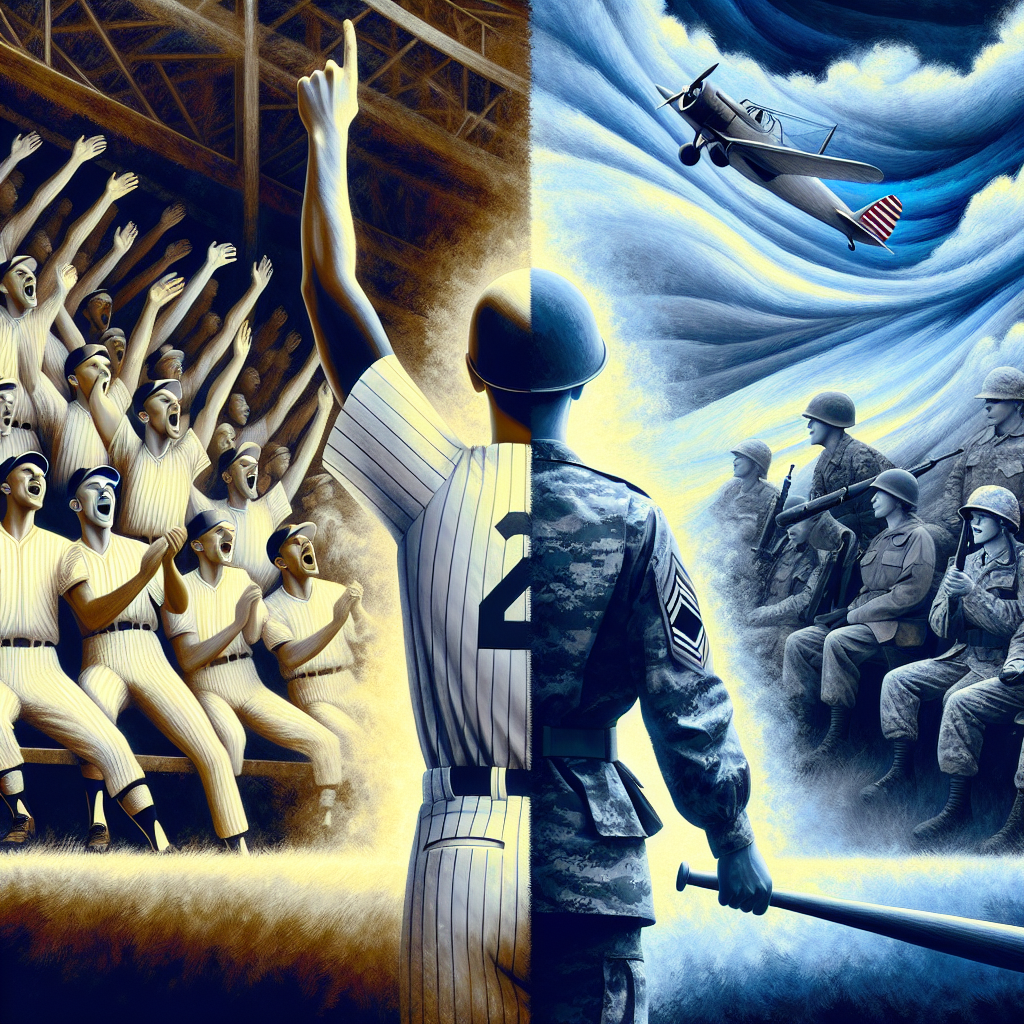
Baseball, the quintessential American pastime, isn’t just a game of bats and balls, innings, and statistics. Beyond the diamond, it has become a close-up lens through which we can view changing societal values, national identity, and the interplay of sport and service. As the shuffling of cards and the crack of the bat signal the start of a new season, there rings through the decades a story as profound as victory itself: baseball stars leaving behind the roar of the crowd to answer the call of duty.
This narrative is woven from the experiences of players who willingly traded their uniforms for military fatigues, embodying a broader definition of heroism that stretches beyond sport. It’s a tale that captures hearts during times of peace and galvanizes spirits in times of war, beautifully illustrating the patriotic and communal virtues embedded within both activities.
The involvement of baseball players in military service provides a unique junction between athletics and national service. It speaks to issues of sacrifice, pride, and the dual responsibilities these individuals embraced. This juxtaposition of two realms—Baseball and the military—offers insights not only into the character of these athletes but also into the cultural backdrop against which their stories unfold. Baseball and military service converging is a remarkable narrative where the drama on the field reflects the drama off it, framing an essential dialogue about what constitutes a hero.
Babe Ruth’s Anthem: Patriotic Underpinnings
Even before players enlisted more formally for military services, baseball had long been entwined with American patriotism, an undercurrent carried out by icons like Babe Ruth. Although Babe Ruth never served in the military, his spirit served as a rallying cry during hard times. The “Sultan of Swat” influenced the American society beyond the ballpark with his larger-than-life persona and fervent support for troops, showing that heroism isn’t just about being on the battlefront but also championing causes at home.
Ruth’s involvement in various war bond drives during World War I and later in World War II set an example of using celebrity for advocacy. He helped raise substantial funds for America’s war effort. His countless appearances and overtures to troops situated a frame of patriotism in the sport, embedding an enduring image of unity that fans and players have emulated through the ages.
He championed the soldier from a distance, using his unparalleled influence for the greater good. While not every baseball player would have the chance to march overseas, Ruth’s legacy forged a pathway of service combined with stardom, making valuable contributions on the home front. It was a badge of honor, an unwritten pact exemplified by players who followed in his oversized footsteps.
When Duty Calls: The Second World War Impact
The onset of World War II marked an unprecedented period where the threads of baseball and military service tangled deeply. Many players voluntarily enlisted or were drafted, driven by patriotic duty at a time when the nation was on the brink of global turmoil. Stars like Ted Williams, Bob Feller, Joe DiMaggio, and Hank Greenberg put their careers on hold to serve their country, casting their baseball legend status aside for something more profound and defining.
Ted Williams, a notable example, halted his illustrious career for three years to serve as a Navy pilot, and later in the Korean War, echoing Churchillian tenacity on and off the field. His decision was emblematic of the depth of character, a hero both in khakis and Red Sox’s white.
Players’ absence from the field resonated a dual effect: showcasing respect for military service while heightening the sport’s symbolic value. Baseball became a vessel of hope, a thread of normalcy, and a reminder of the sacrifices shared by men in uniform and athletes on the field. This era immortalized the convergence of patriotic narratives, ultimately shaping baseball’s soul.
A Link Beyond Conflict: The Korean and Vietnam Wars
As the mid-century war drums receded post-World War II, the Korean and Vietnam Wars emerged, intertwining with baseball’s legacy differently. The urgency compelling players to enlist was not as pronounced, yet figures such as Ted Williams returned to service, reinforcing continuity and linking generations through common values of courage and integrity.
The Vietnam War, in particular, demonstrated a complex social shift. Players like Al Bumbry who served distinguished tours and returned to the sport illustrated an evolving relationship between public figures and military service. Bumbry’s battlefield experiences informed his sportsmanship, embodying resilience and strength, which he carried back to the Orioles, earning the nickname “Gunner” for his exemplary service.
Such individuals represented changing social perceptions, where public consensus around military involvement was more contentious. Despite these tensions, the notion of service preceding sports thrived, piecing together a mosaic of sacrifice that transcended mere recruitment citations and became sewn into baseball’s broader cultural fabric.
Changing Roles: Modernism and the Aftermath of Conflicts
Moving into more modern times, the role of baseball players in military service has evolved with society. As nations entered the age of relative peace and new forms of heroism emerged on digital frontiers, athletes’ participation morphed to more symbolic demonstrations of respect and homage. Players today often participate in community service, military honor events, and carry out philanthropic efforts, maintaining the sport’s connection to service but through different avenues.
Instances like post-9/11, where players such as Tom Glavine and John Franco famously wielded flags and took part in relief efforts, demonstrate a nuanced continuity of service, where the heroism of yesteryears is reflected in gestures that heal and unite communities in times of crisis.
While direct military enlistment by players has become less prevalent, the ethos of commitment hasn’t wavered, reflecting the modern athlete’s role. The public sphere acknowledges these contributions through celebratory military-focused games and initiatives that honor past and present service members, knitting contemporary relevance into enduring traditions.
Legacy and Lessons: A Reflective Dialogue
Within this culture of dual dedication, we draw timeless lessons that frame baseball as a historical and social artifact. Such stories invite reflection on courage, resolve, versatility, and the multiplicitous definition of heroism that continues echoing across yet another century.
Baseball mirrors society’s changing values, evolving economic and political landscapes, and its growing complexity while steadfastly illuminating heroic frontiers—binding wartime stories into communal consciousness. Threading these narratives into a shared cultural lexicon not only celebrates athletes as heroes within sport but also in their pivotal moments of sacrifice and public service.
These dialogues help us remember that the bond between sports and military service goes beyond mere individual fame—it is an expression of community and national ideals. As we reminisce about the impacts these players had, their stories remain beacons of light instilling patriotism, humility, and camaraderie for current and future generations.
Conclusion
The interaction between baseball stars and their military service reflects a narrative rich with sacrifice, social impact, and evolving definitions of heroism. Relating these stories unveils an intricate relationship where love for the game and a call to duty represent a broader ethos—a badge of honor symbolized by the American spirit.
From the early days where icons like Babe Ruth stirred patriotism within their celebrity roles to the complex modern landscape depicted by players addressing societal issues from their platforms, the intersection of baseball and military service has taken many forms, each deepening the sport’s historical intrigue.
Acknowledging these contributions, their honors, and the stories left as legacies ensures that baseball remains an enduring symbol of American society. As the game evolves, so too does our understanding of its heroes, past and present, honoring them not only through memory but also through tangible action that benefits society, inspiring new waves of athletes to serve their communities in myriad ways.
In the field of dreams, where the players meet to showcase athletic feats, the grains of history form their diamond, where tales of sacrifice, heroism, and service reverberate forever. It is there that we find the heart of baseball—not just a game but a profound narrative intricately binding sport, society, and service, celebrating and continuously redefining what it truly means to be a hero.