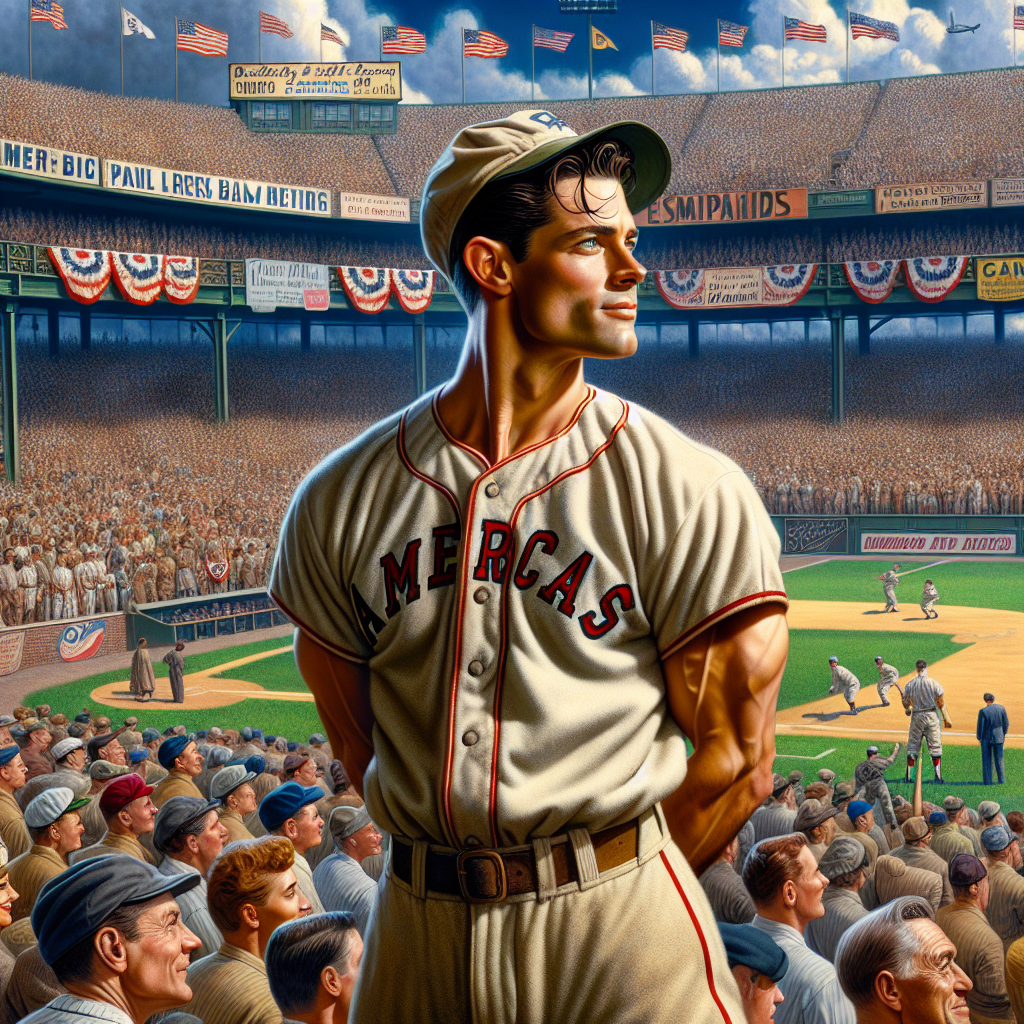
Joe DiMaggio, a name synonymous with grace, talent, and the American spirit, remains a towering figure in the annals of baseball history. Born Giuseppe Paolo DiMaggio Jr. in 1914 to Italian immigrants in California, DiMaggio’s meteoric rise from the son of a fisherman to a national icon is a story ripe with themes of determination and resilience. It is a testament to how an athlete can inspire and uplift a nation, particularly during its most trying times. As a New York Yankee, DiMaggio’s prowess on the field was unmatched, epitomized by his 56-game hitting streak which still stands as a Major League Baseball record. However, DiMaggio’s legacy extends beyond his athletic achievements; it is intricately tied to a pivotal era in American history, namely World War II. The war reshaped society’s dynamics, and DiMaggio’s response to these societal changes is a focal point of his enduring influence.
During the early 1940s, America found itself embroiled in World War II, a conflict that demanded the involvement of every fabric of its society. This period saw a surge of patriotism as individuals from various walks of life answered the call to serve their country. DiMaggio, like many of his fellow baseball players, put his career on hold to join the military, serving as an Air Force sergeant. This decision was emblematic of the era’s ethos, where personal sacrifices were made for the greater good. DiMaggio became a symbol of hope and fortitude, uplifting the American spirit during this challenging time.
The impact of Joe DiMaggio on both America’s pastime and the nation’s morale during wartime cannot be overstated. DiMaggio’s athletic grace coupled with his humble demeanor made him a symbol of constancy and perseverance, revered by millions. His story is a reflection of the broader narrative of American resilience, where sports and society intersected to forge paths of unity and strength.
DiMaggio’s Baseball Legacy: A Beacon of Excellence
Joe DiMaggio’s baseball career is characterized by extraordinary talent and era-defining achievements. The core of DiMaggio’s legacy lies in his remarkable consistency and unparalleled skill on the baseball diamond. Joining the New York Yankees in 1936, DiMaggio quickly established himself as a powerhouse within professional baseball, mesmerizing fans with his fluid style and commanding presence. Over 13 seasons, he earned nine World Series victories with the Yankees, illustrating a legacy of success that few other teams or players could replicate.
DiMaggio’s famous 56-game hitting streak in 1941, a record that remains unbroken, exemplifies his excellence and determination. This streak captivated the nation’s attention and even now stands as a testament to his persistence and extraordinary ability to perform under pressure. At a time when America was on the brink of entering a global conflict, DiMaggio offered a source of inspiration, showcasing the sort of consistency and brilliance that many would come to associate with the American spirit.
Beyond statistical accomplishments, DiMaggio’s influence on baseball transcended mere numbers; he expanded the game’s reach and popularity. His style, elegance, and sportsmanship drew numerous fans to the sport, further embedding baseball into the fabric of American culture. DiMaggio’s tenure with the Yankees coincided with a golden era of baseball, a time when the sport was fundamentally shifting into a national pastime capable of uniting diverse audiences. Through his professional triumphs, DiMaggio effectively elevated both his team and the entire league to new heights.
World War II: DiMaggio Answers the Call
As the world plunged into the throes of World War II, the role of sports and athletes underwent significant alterations. Baseball, while immensely popular, was not immune to the societal changes wrought by the war. Athletes like Joe DiMaggio, alongside many others, faced the reality of enlisting and contributing to the war effort, realizing that playing baseball was secondary to national service. In 1943, DiMaggio left his promising baseball career to enlist in the United States Army Air Forces, marking a turning point in both his life and the nation’s narrative.
Serving as a physical fitness instructor in California, Hawaii, and eventually the Atlantic Coast, DiMaggio’s enlistment resonated deeply across a nation in need of morale-boosting figures. Rather than making headlines on the field, DiMaggio’s service inspired and rallied spirits among both those at home and soldiers abroad. His commitment signaled a vital message: that even the most celebrated champions understood the responsibility and solemnity of the national cause.
This service period allowed DiMaggio to contribute to the war effort while maintaining a visible presence in the public eye, helping ground America’s collective narrative in values of sacrifice and dedication. Although not directly engaged in combat, his decision to step away from the game reverberated as a significant, symbolic act. For many Americans, particularly fans, DiMaggio’s militar career juxtaposed the country’s desires for peace with the real-time challenges of global warfare.
The War’s Effect on Baseball and Society
World War II dramatically reshaped both baseball and American society. With many prominent players, including Joe DiMaggio, Ted Williams, and Bob Feller, leaving their teams to serve in the military, the sport faced uncertain times. Despite these challenges, baseball persisted as a significant cultural touchstone, often serving as a reminder of normalcy amidst the chaos of war. In this context, the phrase “keeping the home fires burning” became more than just a saying; it was a philosophy embraced by Americans eager to maintain their cultural identity and leisure habits against a backdrop of global turmoil.
The war initiated significant changes within the sport itself, prompting the rise of replacement players and altering league dynamics. Still, attendance at games persisted, buoyed by the nationalistic fervor and the desire for distraction from the grim realities of war. The sport absorbed the ethos of the era, with military themes weaving into ceremonies and public events pertaining to baseball.
Furthermore, baseball became a critical avenue for war bond drives, raising significant funds for the war effort. The relationship between baseball and society, thus, strengthened growing cultural ties between leisure, national pride, and collective responsibility. Joe DiMaggio, as a renowned figure within this landscape, epitomized the harmony between individual sports achievements and contributions to the collective American ethos.
DiMaggio’s Return: A Symbol of Post-War Resilience
Joe DiMaggio’s return to baseball after fulfilling his military duty was met with national anticipation and heralded as a sign of renewed hope. His comeback in 1946 symbolized a shift for many Americans, signaling a return to peacetime and a reclaiming of normalcy disrupted by the war. Upon returning to the Yankees, DiMaggio reinstated himself as a cornerstone of the team, quickly demonstrating the skill and leadership that endeared him to fans pre-war.
DiMaggio’s post-war career strengthened his legacy, further cementing him as a symbol of American endurance. Leading the Yankees to additional World Series championships in 1947, 1949, 1950, and 1951, he resumed his dominance on the field. This period pivotal not just for DiMaggio but for the returning soldiers and a weary populace striving to rebuild its identity and livelihood after the devastation of global conflict.
His return underscored baseball’s role as a salve for societal wounds, highlighting how sports could unify, inspire, and elevate a nation emerging from adversity. For DiMaggio, the balance between renewed professional success and personal dignity became evident in his demeanor and achievements, bridging the gap between wartime and peacetime America.
The Enduring Impact of DiMaggio’s Legacy
Today, Joe DiMaggio stands as a towering symbol of America’s enduring spirit, embodying the values of perseverance and excellence that transcend mere athletic achievement. His impact extends beyond statistical records or individual accolades; DiMaggio fostered a connection between baseball and society that emphasized unity, hope, and resilience in times of uncertainty. The narrative of DiMaggio’s career serves as more than a sports story; it is an educational template illustrating how individuals can inspire and navigate societal changes amidst intense challenges.
Beyond his time on the field, DiMaggio’s influence permeated American popular culture, showcased by his appearances in song lyrics, literature, and public sentiment. These references allude to the resonance of his character, transcending the sport to become a symbol of post-war recovery and national pride. DiMaggio’s story continues to inspire athletes and non-athletes alike, offering lessons in managing complexities through grace, both on and off the field.
DiMaggio’s unparalleled baseball achievements and his broader cultural significance exemplify American resilience in the face of historical turbulence. His life’s work and legacy provide insight into the reciprocal relationship between sports figures and societal dynamics, highlighting the power of sporting icons to shape moral and communal landscapes. As society continues to evolve, DiMaggio’s spirit endures as a beacon, bridging generations through his legacy of excellence and service.
Conclusion: In the pantheon of baseball history, Joe DiMaggio’s legacy remains incomparable due to its uniqueness in blending sporting brilliance with resilience amid societal challenges. As the bridge between baseball and American culture, DiMaggio’s life and career symbolize constancy and inspiration, especially during periods of tumultuous change. His iconic status and the admiration bestowed upon him serve as reminders of the potential for sports to transcend mere entertainment; in DiMaggio’s case, fostering hope, unity, and societal cohesion during war and in peacetime. DiMaggio’s narrative remains a testament to personal sacrifice for the greater good, underscoring the timeless capacity for sports figures to resonate far beyond the playing field.