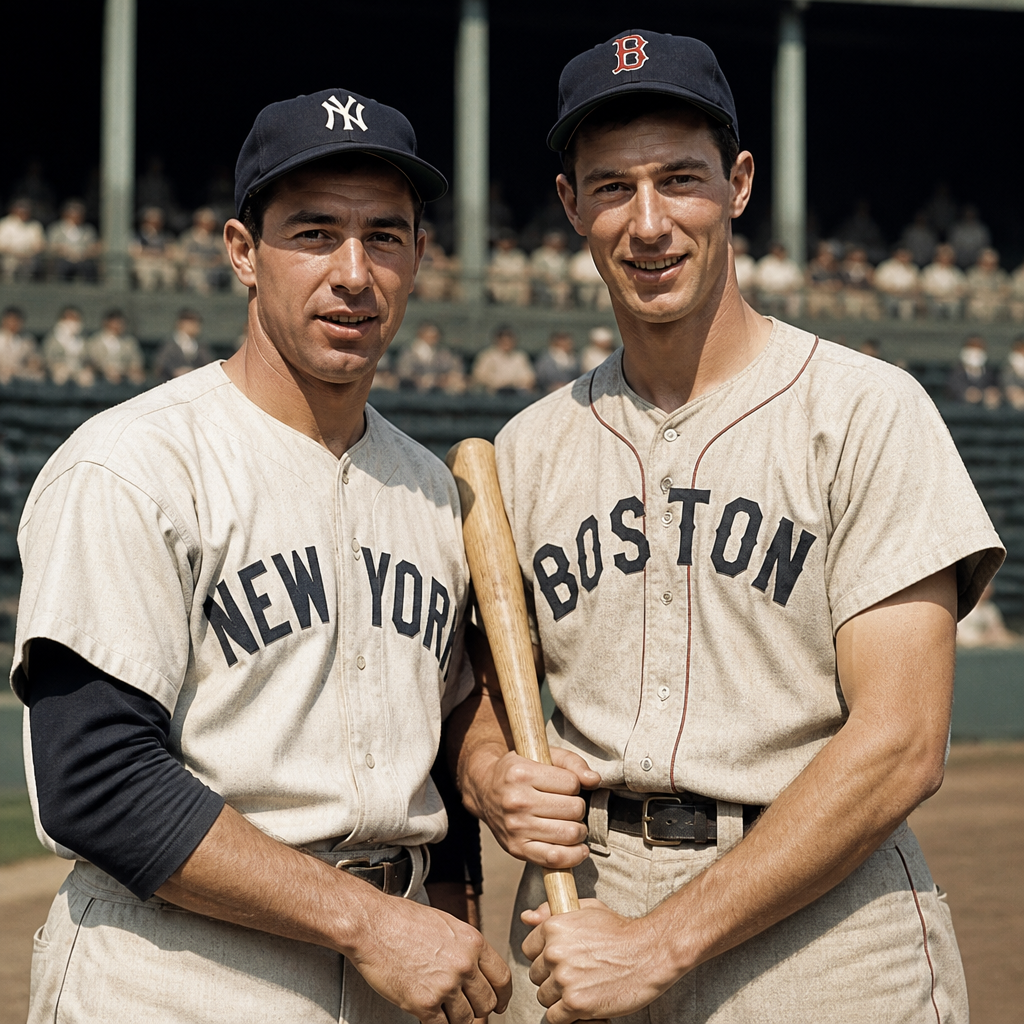
Baseball in 1941 sits at the hinge of American history, a season suspended between peacetime routine and global upheaval, and no year better captures the Live-Ball and Golden Age than the one defined by Joe DiMaggio, Ted Williams, and the last full summer before the United States entered World War II. The Live-Ball era generally begins around 1920, when rule enforcement, cleaner baseballs, and strategic change shifted the sport away from dead-ball bunting and toward power, higher scoring, and star-centered offense. The Golden Age overlaps that transformation, usually referring to the interwar decades when Babe Ruth, Lou Gehrig, DiMaggio, Williams, Bob Feller, Hank Greenberg, and a deep cast of Hall of Famers turned Major League Baseball into the country’s dominant spectator sport. I have always found 1941 the best gateway season for understanding this whole period because nearly every major theme is visible at once: offensive brilliance, evolving pitching, pennant races, radio fame, newspaper saturation, and the looming disruption of military service.
For readers exploring Baseball Eras, this hub matters because 1941 was not an isolated masterpiece. It was the culmination of trends that started in the 1920s and would be interrupted, but not erased, by war. The season produced two achievements that still anchor baseball memory: DiMaggio’s 56-game hitting streak for the New York Yankees and Williams’s .406 batting average for the Boston Red Sox, the last .400 average in either league. Yet the year also included a dominant season from pitcher Mort Cooper, another monster campaign from Feller, the Brooklyn Dodgers winning the National League, and a World Series that reflected the era’s balance between established dynasties and rising challengers. To understand 1941 is to understand how modern baseball language—slugging, streaks, star power, consistency, run production, pennant pressure—became central to the game’s identity.
This article serves as a hub for the Live-Ball and Golden Age by connecting the season’s headline feats to larger developments: how offense changed after 1920, why center-field stars became symbols of excellence, how wartime pressures hovered over clubhouses, and what records from 1941 still mean when viewed through later analytics. If you are building a broader picture of baseball history, 1941 is the season where narrative and evidence line up perfectly.
Why 1941 stands at the center of the Live-Ball and Golden Age
By 1941, the offensive revolution that began after World War I had matured. Teams still used sacrifice bunts and hit-and-run plays, but the defining logic of elite clubs was no longer simply advancing runners one base at a time. The best organizations built lineups around extra-base power, plate coverage, and relentless contact. Yankee Stadium had already hosted Ruth and Gehrig; now it showcased DiMaggio at the peak of his grace. Fenway Park gave Williams a difficult but rewarding offensive environment, especially with the Green Monster turning hard contact into doubles. The league context matters: American League teams scored 4.68 runs per game in 1941, while National League teams scored 4.55, figures well above dead-ball norms and representative of the durable run-scoring habits of the era.
The season also highlights how baseball fame worked before television dominance. Radio broadcasts, syndicated columns, and wire-service reporting made daily performance feel national. DiMaggio’s hitting streak became a serial drama consumed one box score at a time. Williams’s pursuit of .400 became a debate about pressure, sportsmanship, and statistical purity. In my experience studying era hubs, 1941 works so well because its stories were documented obsessively enough for modern readers to follow almost day by day, yet the game still retained older textures: day games, overnight train travel, wool uniforms, larger rosters of role players remembered mainly by local fans, and front offices still operating without the statistical departments that shape decisions today.
Another reason 1941 belongs at the center of this subtopic is competitive quality. The Yankees won 101 games and the American League pennant by 17 games, but they did so in a league loaded with talent. Boston won 84 and finished second. Cleveland had Feller and excellent pitching depth. Detroit remained dangerous after its 1940 pennant. In the National League, the Dodgers won 100 games and held off the Cardinals, who won 97. This was not a soft environment inflated by weak opposition. It was a mature, high-talent baseball ecosystem, one that rewarded completeness more than one-dimensional strength.
Joe DiMaggio’s 56-game hitting streak and what made it possible
DiMaggio’s 56-game hitting streak, from May 15 through July 16, remains one of the sport’s most difficult records to challenge because it required both extraordinary skill and perfect day-to-day resilience. During the streak, DiMaggio hit .408 and recorded 91 hits, combining elite bat control with enough authority to prevent pitchers from simply nibbling. He was not a slap hitter surviving on infield singles. He drove the ball with force, handled premium velocity for the time, and punished mistakes to all fields. When I review the streak game logs, what stands out is not luck but the variety of ways he collected hits: line drives to left-center, doubles in gaps, shots through the infield, and performance under the burden of constant public attention.
DiMaggio’s mechanics helped. He had exceptional balance, a compact move to the ball, and unusual poise for a right-handed hitter facing clubs increasingly determined to pitch around him. He also benefited from the broader Live-Ball environment, where harder baseballs, better maintained fields, and a culture that prized aggressive hitting supported sustained offense. Still, context does not diminish the feat. Many great hitters played under the same conditions and never came close. The closest modern comparisons often collapse under travel fatigue, bullpen specialization, defensive shifts of later eras, or simple variance. The streak survives because all baseball records that depend on daily repetition are vulnerable to one hard-luck night, and DiMaggio avoided that for nearly two months.
| 1941 Achievement | Player | Team | Why it still matters |
|---|---|---|---|
| 56-game hitting streak | Joe DiMaggio | New York Yankees | Longest hitting streak in MLB history; combines consistency, durability, and pressure performance |
| .406 batting average | Ted Williams | Boston Red Sox | Last .400 season in the majors; benchmark for pure hitting excellence |
| 101 wins | New York Yankees | American League | Shows the era’s deepest dynasty still operating at peak efficiency |
| 100 wins | Brooklyn Dodgers | National League | Marks the rise of a major NL power before wartime roster disruption |
The streak’s place in baseball history is larger than the raw number. It crystallized the idea that the everyday player, not only the home run king, could dominate headlines through consistency. Ruth had embodied spectacle; DiMaggio embodied relentless polish. That distinction matters within the Golden Age, because by 1941 fans had learned to admire not just isolated thunder but sustained excellence over a long schedule.
Ted Williams, .406, and the high standard of complete hitting
If DiMaggio represented continuity, Williams represented offensive perfection. He finished 1941 with a .406 batting average, a .553 on-base percentage, and a .735 slugging percentage while leading the American League in runs, home runs, walks, and total bases. By modern measurement, his OPS of 1.287 is one of the greatest ever produced. The famous detail, repeated because it deserves to be repeated, is that Williams entered the final day at .39955—rounded to .400—but refused to sit out a doubleheader. He went 6-for-8 and raised the average above the threshold beyond dispute. That decision remains one of the clearest examples of competitive integrity in sports history.
Williams mattered not only because he hit .400, but because he explained hitting better than almost any superstar before him. He thought in terms of strike-zone management, pitch selection, and damage on contact. Long before data departments charted swing decisions, Williams approached at-bats with an organized theory. He wanted a pitch he could drive, understood the value of walks, and treated batting average as one result of disciplined process rather than a mystical gift. His later book, The Science of Hitting, codified ideas that now sound strikingly modern.
There is a useful tension between DiMaggio and Williams that makes 1941 such a powerful hub year. DiMaggio won the Most Valuable Player Award, largely because the Yankees dominated the standings and because the streak became a national event. Williams, however, was arguably the more productive hitter by a significant margin. This distinction helps readers understand an important Golden Age truth: contemporaries valued pennant impact, narrative force, and visible clutch reputation alongside rate statistics. Modern analysis may prefer Williams’s total offensive contribution, but both perspectives are historically valid if presented honestly.
For anyone studying the Live-Ball era, Williams is the bridge between old and new evaluation. Traditional observers praised his average and power. Modern analysts see one of the greatest combinations of patience and slugging in baseball history. In that sense, 1941 does not just preserve a famous batting line; it teaches how baseball thinking evolved.
The pennant races, the World Series, and the stars around the stars
The Yankees’ championship often flattens the rest of the 1941 landscape, but the season was rich beyond its two headline icons. New York’s 101-53 record reflected depth as much as stardom. Charlie Keller, Tommy Henrich, Bill Dickey, Phil Rizzuto, Red Ruffing, Lefty Gomez, and Spud Chandler all played important roles. Chandler in particular was superb, going 10-3 with a 1.64 ERA in limited innings, while Ruffing anchored the rotation. The Yankees were not merely riding DiMaggio’s fame; they were a fully built machine with offense, pitching, defense, and championship familiarity.
In the National League, Brooklyn’s 100-54 finish signaled a major breakthrough. Managed by Leo Durocher, the Dodgers blended speed, personality, and strong run prevention. Dolph Camilli won the NL MVP after hitting 34 home runs and driving in 120 runs. Pete Reiser, one of the era’s most gifted and tragic talents, hit .343 and played with fearless aggression that thrilled fans and shortened his prime. Whitlow Wyatt won 22 games, and Kirby Higbe added another 22. Brooklyn then met New York in the World Series, creating a city-versus-city matchup loaded with atmosphere.
The Yankees won the Series in five games, but the contest was tighter than the result suggests. Three games were decided by one run. Mickey Owen’s dropped third strike in Game 4 became the defining mistake, extending an inning the Dodgers should have escaped and helping trigger a Yankee comeback. It remains one of the most famous defensive lapses in postseason history because it happened on the biggest stage and because it fit the era’s unforgiving narrative style: one play could define a player in public memory for decades.
Elsewhere, the 1941 season featured ace-level pitching from Mort Cooper of St. Louis, who went 22-8 with a 1.78 ERA and won the National League MVP, a reminder that pitchers could still seize the sport’s highest individual honors in an offense-friendly age. Feller, meanwhile, struck out 260 batters for Cleveland and remained baseball’s hardest thrower. Hank Greenberg returned after military service in 1941 only to be called back again after Pearl Harbor, symbolizing how abruptly baseball’s continuity would soon be broken.
1941 in wartime context and why the season marks the end of an era
Baseball in 1941 unfolded under the shadow of war even before December 7. Europe was already engulfed in conflict, conscription had begun in the United States under the Selective Training and Service Act of 1940, and players, executives, and fans understood that military obligations could reshape rosters at any moment. Attendance remained strong because baseball offered routine, civic identity, and emotional relief, but the backdrop had changed. Newspapers covered pennant races beside war dispatches. Ballplayers discussed draft status. Owners began considering what depleted talent pools might mean for 1942 and beyond.
After Pearl Harbor, commissioner Kenesaw Mountain Landis and President Franklin D. Roosevelt would help keep the game going, most famously through Roosevelt’s “Green Light Letter” in January 1942 encouraging baseball to continue for morale and recreation. That decision belongs more fully to the wartime seasons that followed, but 1941 is where the transition is felt most sharply. It is the last season of the Golden Age untouched by full American mobilization. Reading the statistics now, you can see a final snapshot of normal competitive continuity before hundreds of major and minor leaguers entered service.
That is why 1941 matters beyond nostalgia. It is both a peak and a border. It showcases the fully developed Live-Ball style—power, disciplined hitting, deeper lineups, celebrated stars—while also closing the first great modern chapter of baseball history. From this hub, readers can move outward to connected topics across the Baseball Eras map: Ruth and the 1920s offensive revolution, Gehrig and Yankee continuity, National League contenders of the 1930s, wartime baseball from 1942 to 1945, and the postwar transition toward integration and a new national landscape. Start with 1941, then follow those paths, because no other season explains the Live-Ball and Golden Age with equal clarity, drama, and historical weight.
Frequently Asked Questions
Why is the 1941 baseball season considered so important in American history?
The 1941 baseball season stands out because it sits at a remarkable crossroads between sport and national history. On the field, it delivered two of the most iconic individual performances ever seen: Joe DiMaggio’s 56-game hitting streak and Ted Williams’s .406 batting average, the last time a major leaguer finished a season above .400. Off the field, it unfolded during the final full summer before the United States entered World War II after the attack on Pearl Harbor in December. That timing gives the season a unique emotional weight. It represents a last extended moment of normalcy, routine, and peacetime leisure before the war reshaped everyday life, professional sports, and the lives of players and fans alike.
It is also important within baseball history because it reflects the maturity of the Live-Ball era and the Golden Age of the sport. By 1941, baseball had fully evolved away from the low-scoring, small-ball style of the dead-ball years and into a game driven by harder contact, more home runs, bigger offensive numbers, and nationally celebrated stars. Radio coverage, newspaper columns, and the growth of mass culture helped turn players into household names. In that environment, DiMaggio and Williams did not simply have great seasons; they became symbols of excellence at a moment when Americans were looking for continuity and inspiration in an increasingly uncertain world.
What made Joe DiMaggio’s 56-game hitting streak in 1941 so extraordinary?
DiMaggio’s 56-game hitting streak is extraordinary because it combined elite skill, day-to-day consistency, and enormous pressure in a way that remains almost impossible to replicate. From May 15 to July 16, 1941, DiMaggio recorded at least one hit in 56 straight games, breaking George Sisler’s previous American League record of 41 and pushing far beyond what most observers believed achievable. Hitting safely in even a handful of consecutive games requires timing, health, favorable matchups, and luck. Extending that across nearly two months against major league pitching is a different level entirely.
What makes the streak even more impressive is that DiMaggio was not merely slapping singles to keep it alive. He was an all-around offensive force, hitting for average and power while anchoring the New York Yankees lineup. Opposing teams knew exactly what was at stake, newspapers tracked every game, and the public followed along with mounting anticipation. In modern terms, the streak became a national event before modern television saturation even existed. Each game added pressure, yet DiMaggio kept delivering. The streak’s endurance as a record is part of its mystique. Many great hitters have come and gone since 1941, but no one has surpassed 56, which reinforces the sense that the achievement belongs in a category of its own.
Why is Ted Williams’s .406 batting average in 1941 still talked about so much?
Ted Williams’s .406 average remains one of baseball’s defining milestones because it marks the last time a player finished a full major league season batting over .400. That benchmark has long represented one of the purest tests of hitting excellence. To reach it over an entire season requires not only talent but also extraordinary command of the strike zone, the ability to make consistent hard contact, and the mental discipline to withstand slumps, pressure, and constant public attention. Williams did all of that while playing in an era full of elite pitchers and under the growing scrutiny that accompanied his chase of the number.
Part of the legend comes from how he finished the season. Rather than sit out a doubleheader on the final day to preserve his average above .400, Williams chose to play, wanting to earn the mark without compromise. He went 6-for-8 and raised his average from .39955 to .406. That decision has become central to his reputation: fiercely competitive, deeply proud, and committed to doing things the hard way. It also reflects why Williams is so often described as one of the greatest pure hitters in baseball history. His 1941 season was not just statistically impressive; it embodied a standard of offensive mastery that later generations still measure themselves against.
How did the 1941 season reflect the Live-Ball era and baseball’s Golden Age?
The 1941 season is a near-perfect snapshot of the Live-Ball era because it showcases the offensive environment, star power, and changing style of play that had defined baseball since around 1920. The Live-Ball era emerged after rule enforcement changes, cleaner baseballs, and broader strategic shifts encouraged harder hitting and reduced the dominance of dead-ball tactics like bunting, stealing at all costs, and scratch-run manufacturing. By 1941, those changes were fully visible. Fans expected big innings, extra-base hits, and headline performances from sluggers and complete hitters, not just low-scoring tactical duels.
At the same time, 1941 also fits squarely within what many historians call baseball’s Golden Age. The sport occupied a central place in American culture, and its leading players were national celebrities. The Yankees remained a powerhouse, Williams was redefining offensive excellence in Boston, and newspapers treated pennant races and personal records as front-page drama. Radio helped carry the game into homes across the country, deepening baseball’s reach and turning individual feats into shared national experiences. In that sense, 1941 was not just another season with great statistics. It was a moment when the sport’s style, popularity, and mythology all converged at once.
How did World War II affect the meaning of the 1941 baseball season?
World War II gives the 1941 season much of its emotional and historical resonance because fans now look back on it as the last full baseball season before America entered the conflict. During the spring and summer, the United States had not yet formally joined the war, even though global events were impossible to ignore. That made baseball both an escape and a reassurance. Ballparks, box scores, pennant races, and everyday routines offered a sense of continuity at a time when the world felt increasingly unstable. In retrospect, the season seems suspended between two eras: the confidence of peacetime America and the sacrifice that wartime would soon demand.
Once the United States entered the war in December 1941, baseball changed quickly. Many players left for military service, rosters were altered, and the sport had to redefine its role in a country mobilized for war. That transformation makes the achievements of DiMaggio, Williams, and others from 1941 feel even more vivid. They belong to a final uninterrupted chapter before the war touched every part of American life, including professional sports. For historians and fans, that context elevates the season beyond statistics. It becomes a cultural landmark, a reminder of how baseball can preserve the atmosphere of a nation on the brink of historic change.