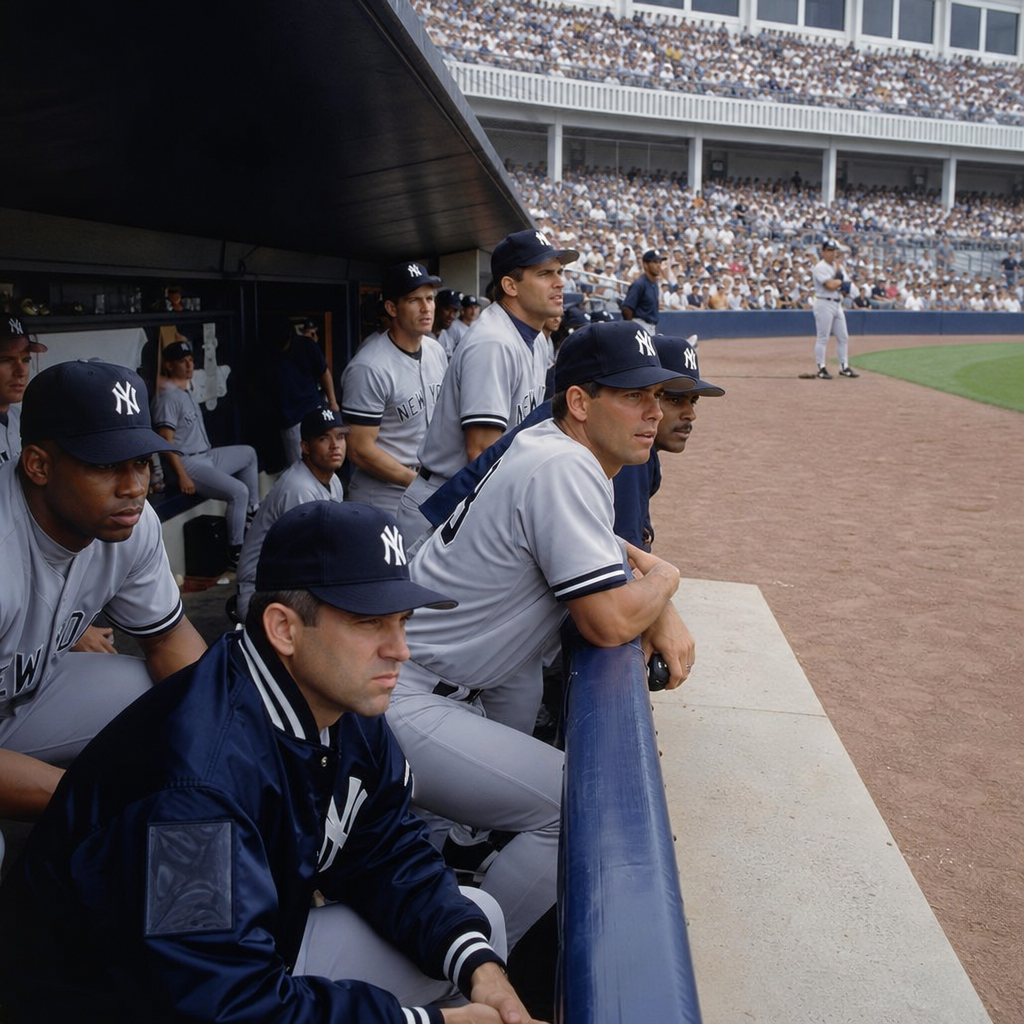
The 1998 New York Yankees are usually remembered for 114 regular-season wins, a 125-50 finish including the playoffs, and a roster fronted by Derek Jeter, Bernie Williams, Paul O’Neill, Tino Martinez, David Cone, David Wells, Andy Pettitte, and Mariano Rivera. That star power deserves its place in baseball history. Yet the deeper explanation for why the 1998 Yankees became one of the defining entries in any discussion of dynasties and great teams lies in the supporting cast. The Yankees bench and bullpen turned talent into daily advantage, protected the club from injury or slump, and gave manager Joe Torre matchup flexibility that few rivals could equal.
In baseball terms, bench depth means the quality of reserve position players who can start, pinch-hit, pinch-run, or improve late-inning defense without sharply weakening the lineup. Bullpen depth means a relief corps with multiple dependable arms capable of covering different leverage situations, from middle innings to the ninth. On truly elite clubs, those units are not afterthoughts. They are force multipliers. I have always found that when great teams are revisited years later, the household names dominate memory, but the shape of a season is usually built by the players who absorb hidden innings, emergency starts, platoon at-bats, and one-run leads in the sixth and seventh.
That is exactly why the 1998 Yankees belong at the center of any Famous Baseball Teams hub covering dynasties and great teams. They were not simply top-heavy. They were layered. New York finished first in the American League in runs scored and also first in fewest runs allowed, a combination that reflects roster completeness rather than a few isolated career years. The bench helped maintain offensive quality and defensive stability across 162 games. The bullpen shortened games before “bullpenning” became a trend, with Rivera anchoring a group that also included Ramiro Mendoza, Mike Stanton, Jeff Nelson, and reliable depth behind them. Understanding that infrastructure explains how the Yankees sustained excellence from April through October and why the 1998 club remains a model for roster construction.
Why depth mattered on a 114-win dynasty-level team
The simplest answer is that no team wins 114 games with only its stars. Even healthy championship clubs encounter sore hamstrings, doubleheaders, travel fatigue, platoon disadvantages, and starts that unravel in the fourth inning. The 1998 Yankees survived all of it because Torre rarely had to choose between resting a regular and conceding a game. His roster let him rotate without panic. That matters over six months, especially in an era when offense was rising across the sport and every weakness could be exposed.
Depth also mattered because New York’s roster design matched the realities of the late 1990s American League. Teams still used more traditional benches than modern clubs, and relievers were increasingly specialized. The Yankees had enough quality to exploit both trends. They could counter tough left-handed pitching, improve outfield defense late, carry competent infield cover, and move from starter to setup relievers to Rivera with unusual smoothness. In practical terms, that meant more wins in close games, fewer damaging losing streaks, and less pressure to overextend the rotation.
When people compare great teams across eras, I always come back to this point: dominant clubs separate themselves not only by peak talent but by the absence of weak links. The 1998 Yankees rarely offered opponents an easy pocket in the lineup or a comfortable inning once the starter exited. That is what made them feel relentless on a nightly basis.
The bench gave Joe Torre answers every week
New York’s bench was not famous in the way the lineup was, but it was functional, experienced, and versatile. Tim Raines, one of the smartest veteran players on the roster, could still get on base, run, and handle outfield work while bringing championship-caliber baseball intelligence. Chili Davis offered switch-hitting thump and gave Torre a professional designated hitter or pinch-hitting option. Darryl Strawberry, limited to 101 games but still dangerous, added left-handed power and fear factor in reserve duty. Shane Spencer became a late-season sensation, but even before his September home run surge, he represented the kind of controllable depth contenders need. Luis Sojo covered the infield dependably and delivered one of the most important insurance hits of the World Series in Game 4.
What made this group valuable was not that each reserve produced star numbers; it was that each could fill a specific need without forcing the team out of its identity. Raines could start or enter for on-base skill and baserunning judgment. Davis could lengthen the order against the right matchup. Strawberry could change a game with one swing. Sojo could protect the infield when a regular sat. Spencer could supply corner-outfield coverage and instant offense. Torre knew what each man could do, and because the roles were clear, the bench stayed game-ready instead of drifting into low-impact inactivity.
Veteran depth also reduced clubhouse volatility. Reserve players often shape a season by accepting irregular playing time without creating friction. The 1998 Yankees had many strong personalities, but the supporting cast fit the club’s standard of professionalism. That is a real competitive advantage, especially for teams expected to win every night.
Key contributors and the jobs they solved
Several reserves deserve attention because they solved concrete roster problems. Raines, at age 38, was no longer the elite leadoff threat of his Montreal prime, yet he remained highly useful. He posted a strong on-base profile in limited duty and brought polished instincts as a pinch-runner and spot starter. Late in games, he could turn a walk or single into scoring position without needing a steal sign on every count. That subtle pressure widened Torre’s options.
Strawberry is another important case. His season was interrupted, and his role was not everyday, but his left-handed power fit perfectly on a righty-leaning team. Opposing managers could not relax when he was available off the bench. Chili Davis served a similar function from both sides of the plate. His presence gave the Yankees another hitter with postseason experience and enough power to punish a mistake. On clubs with lesser depth, the backup designated hitter slot often becomes dead roster space. New York turned it into a productive at-bat source.
Sojo’s value is easiest to miss if you only scan season totals. Utility infielders rarely accumulate glamorous numbers. But championship teams need someone who can play second, short, or third, execute routine plays, and keep the offense moving. Sojo did that. Spencer, meanwhile, showed how a deep roster can incubate breakout contributors. His regular-season line came in limited playing time, but his famous September burst underscored a broader truth: New York had enough support talent that even emerging players entered favorable situations rather than being forced into overexposure.
The bullpen made six innings feel like enough
If the bench kept the roster stable, the bullpen made leads feel permanent. Rivera was the headliner, but the 1998 Yankees relief unit worked because innings before the ninth were often controlled just as effectively. Jeff Nelson’s sidearm angle gave hitters a different visual challenge, especially right-handers. Mike Stanton provided a trusted left-handed option against dangerous lefty bats and tough pockets of the lineup. Ramiro Mendoza was perhaps the most valuable glue arm of all, capable of multiple innings, emergency starting, and high-quality bridge work. Graeme Lloyd and Darren Holmes added situational reliability and length.
The result was a bullpen architecture that modern analysts would immediately recognize as leverage-aware. Torre did not have to force every problem into a rigid save framework because he had several relievers he trusted in meaningful spots. Rivera’s brilliance still defined the late game, but opponents had to survive Nelson’s deception, Stanton’s angle, or Mendoza’s versatility first. By the time the ninth arrived, many games were functionally over.
This mattered strategically because the Yankees rotation, excellent as it was, did not need to chase complete games. Cone, Wells, Pettitte, Orlando Hernandez, and others could hand over a lead after six or seven innings knowing the relief chain was strong. That lowers cumulative fatigue and improves the quality of starts over a full season. It is one reason great bullpens amplify great rotations instead of merely supporting them.
How New York’s depth compared with other great teams
The 1998 Yankees are the hub standard for discussing dynasties and great teams because their reserve quality compares well with other champions from different eras. Some historic clubs leaned on a terrifying top four in the lineup or a front-loaded rotation but carried visible bench holes. New York did not. Their stars were excellent, yet the reserves and relievers looked more like a continuation of the system than a fallback plan.
| Roster area | 1998 Yankees strength | Why it mattered |
|---|---|---|
| Bench outfield | Raines, Strawberry, Spencer | Allowed rest, platoon flexibility, and late power |
| Utility infield | Luis Sojo | Protected regulars without major defensive drop-off |
| Primary setup options | Nelson, Stanton, Mendoza | Created favorable matchups before Rivera |
| Closer | Mariano Rivera | Converted late leads at an elite rate |
| Emergency coverage | Mendoza and deep reserves | Reduced the cost of short starts and minor injuries |
This balance is why the 1998 Yankees belong in the same conversation as the 1927 Yankees, 1975-76 Reds, 1986 Mets, and other elite champions often covered under dynasties and great teams. Their case is not nostalgia-driven. It is structural. They paired star excellence with role-player competence at nearly every pressure point on the roster.
Postseason proof that the supporting cast was real
October often exposes weak depth because opposing teams can target bench limitations and force managers into stressful bullpen decisions. The 1998 Yankees passed that test decisively. They went 11-2 in the postseason, beating Texas, Cleveland, and San Diego, and the supporting cast repeatedly reinforced the stars. Sojo’s two-run single in World Series Game 4 stretched a tight game. Strawberry and other reserves provided dangerous bench looks. The bullpen posted exactly the kind of calm efficiency that elite regular-season teams need in order to become champions rather than trivia answers.
Rivera threw 13 1/3 postseason innings with overwhelming authority, but he was not acting alone. Nelson, Stanton, and Mendoza made Torre comfortable attacking games aggressively. That confidence changes managerial behavior. A manager with a shaky middle relief corps tends to leave starters in too long, chase matchups he does not like, and expose tired arms. Torre could act earlier and cleaner because the relief depth had earned trust over six months.
For anyone building out a broader reading path on Famous Baseball Teams, this is the lesson that links the 1998 Yankees to other dynasties: championship dominance is rarely only about MVP-level players. It is about turning roster spots 16 through 25 into assets rather than liabilities. New York did that better than almost anyone.
Lessons for evaluating dynasties and great teams
When you study great baseball teams, begin with stars but do not stop there. Ask who handled the 300 plate appearances that regulars did not take. Ask who got the seventh inning against the opponent’s best hitters. Ask whether the utility infielder could start three games in a week without chaos. Ask whether the bench created tactical options or merely occupied space. The 1998 Yankees score exceptionally well on every one of those questions.
They also show that depth is not accidental. General manager Bob Watson and the front office, working within a strong organizational pipeline, assembled a roster with overlapping skills, veteran steadiness, and enough flexibility to absorb disruption. Torre then assigned roles clearly and preserved trust. That combination of front-office design and field management is a hallmark of dynasties. Talent alone starts a window; usable depth keeps it open.
The 1998 New York Yankees remain the ideal hub example for dynasties and great teams because their bench and bullpen explain the gap between a very good club and a historic one. If you want to understand how 114 wins became possible, look beyond the marquee names and study the reserves, the matchup relievers, and the utility players who made excellence sustainable. Use that lens when comparing every legendary roster, and the patterns become clear: the greatest teams are deep, adaptable, and relentlessly prepared. Explore the rest of this Famous Baseball Teams series with that standard in mind.
Frequently Asked Questions
Why was the 1998 Yankees bench and bullpen so important to a 114-win season?
The 1998 New York Yankees were not just a star-driven team that happened to catch lightning in a bottle. Their greatness was reinforced every night by a bench and bullpen that kept the roster functional, flexible, and relentless over the long grind of a 162-game season and then through October. That depth mattered because even elite everyday players need rest, sluggers go through slumps, and starting pitchers rarely carry a team by themselves from April through the World Series. The Yankees were able to absorb all of that without losing their identity or their pace.
On the bench, New York had players who could step into different roles without causing a major drop-off in performance or execution. Whether the need was a spot start, a late-game defensive substitution, a pinch-hit at-bat, or a tactical matchup move, the Yankees had answers. That gave manager Joe Torre unusual freedom. He was not managing from a place of desperation. He was managing from a position of strength, because he knew the roster extended well beyond the starting nine.
The bullpen was equally central to the formula. Once the game moved beyond the starter, opponents still had to deal with wave after wave of quality arms. The Yankees could shorten games, protect leads, and survive nights when the rotation did not go especially deep. In practical terms, that meant fewer losing streaks, fewer wasted leads, and fewer games slipping away because one weak link could not get key outs. Over six months, that consistency is exactly what separates a very good team from a historic one.
What made the 1998 Yankees stand out is that their depth did not simply patch holes. It actively enhanced the club’s style. The bench contributed situational hitting, defense, and versatility. The bullpen contributed structure, matchup advantages, and late-inning dominance. Together, they turned a talented team into a machine. That is a major reason the Yankees did not just win often, but seemed to apply pressure every single night in a way few teams in history have matched.
Who were the key bench players on the 1998 Yankees, and what did they bring to the roster?
The 1998 Yankees had a bench filled with players who understood roles and executed them with professionalism. Tim Raines brought veteran intelligence, patience, and on-base skill. Even though he was no longer in his athletic prime, he remained a smart offensive player who could still influence games with his approach and experience. He gave the Yankees a calm, accomplished reserve who could contribute in the outfield and at the plate without needing everyday at-bats to stay useful.
Ricky Ledée added athleticism and outfield depth, giving New York another capable option when a regular needed rest or when the club wanted a different late-game look. Chad Curtis also played an important role in the outfield mix, supplying energy, defensive reliability, and occasional offense. A team playing as many meaningful games as the Yankees did needed more than three outfielders it could trust, and that depth allowed Torre to manage workloads without fear.
At catcher, Joe Girardi provided far more than a backup label suggests. He was trusted by the pitching staff, strong in game management, and capable of stepping in behind the plate without disrupting rhythm. For a team built around preventing runs and controlling games, that reliability at the backup catcher spot was a real asset, not a luxury. Good teams often survive backup catching situations; great teams stabilize them. The 1998 Yankees did exactly that.
On the infield side, players such as Luis Sojo gave the Yankees versatility and contact-oriented at-bats. Sojo fit the team perfectly because he could move around the diamond and contribute in understated but meaningful ways. He was the kind of player championship teams almost always seem to have: not a headline generator, but someone who makes innings cleaner, bench management easier, and situational baseball more effective.
The larger point is that the Yankees bench was not built around one superstar reserve. It was built around fit. They had veterans, defenders, adaptable role players, and players who accepted irregular playing time while still staying ready. That matters tremendously on a championship team. The stars gave New York star power, but the bench gave the team its durability and tactical range.
How did Joe Torre use the Yankees’ depth to keep the team consistent all season?
Joe Torre’s handling of the 1998 Yankees is one of the clearest examples of how depth and leadership work together. A deep roster only becomes meaningful if the manager trusts it and uses it correctly. Torre did that exceptionally well. He understood that over the course of a historic season, consistency would come not just from posting the same lineup every day, but from making sure the entire roster stayed engaged and capable of contributing when called upon.
Torre rotated complementary players in ways that kept regulars fresh without undermining continuity. That balancing act is harder than it sounds. Resting a key player can weaken a lineup if the bench cannot respond, but the Yankees had enough quality reserves that occasional days off did not turn into surrendered games. Torre could use his bench strategically rather than reluctantly, and that helped maintain the team’s energy level over a long season.
He also benefited from having role players who accepted their assignments. On many teams, part-time playing time can create tension. On the 1998 Yankees, the roster largely embraced a collective mission. Veterans and reserves understood that readiness was part of the job. That clubhouse buy-in made Torre’s task easier and allowed him to deploy players in ways that fit game situations rather than worrying about managing dissatisfaction.
In the bullpen, Torre leaned on a clear hierarchy while still taking advantage of matchup options and trusted middle relief. That structure gave the team stability. Players knew their jobs. Starters understood they did not always need to throw complete games, relievers understood where they fit, and Mariano Rivera’s presence at the end gave the entire staff confidence. Torre’s bullpen management was effective because he had legitimate options before the ninth inning, not just one dominant closer masking other weaknesses.
Ultimately, Torre’s greatest strength in 1998 may have been that he never had to overmanage. The Yankees were talented, experienced, and deep enough that his decisions often reinforced existing strengths rather than trying to manufacture them. That is one reason the team looked so composed. The roster had answers, and Torre consistently put those answers in positions to matter.
How good was the 1998 Yankees bullpen beyond Mariano Rivera?
Mariano Rivera rightly receives enormous attention, because he was the ultimate finisher and one of the defining closers in baseball history. But focusing only on Rivera misses a crucial part of the 1998 Yankees story. The bullpen was effective because it was layered. Rivera was the final blow, but the Yankees had enough support around him to control games before the ninth inning arrived.
Mike Stanton was an important piece, particularly from the left side. Having a dependable left-handed reliever gave New York flexibility against dangerous pockets of opposing lineups and helped neutralize matchup threats in key innings. Jeff Nelson provided another power arm and gave the bullpen a different look, particularly in setup situations. Ramiro Mendoza was especially valuable because he could bridge multiple innings, relieve starters early, or serve in a hybrid role that modern fans would immediately recognize as extremely useful. His versatility gave the Yankees insurance in games that did not unfold according to script.
That is what made the group so strong. It was not just about individual names; it was about coverage. The Yankees had relievers for leverage, relievers for matchups, and relievers who could soak up important innings when the starter exited earlier than expected. That prevented overuse, reduced vulnerability, and let New York handle a wide variety of game states without panic. A bullpen becomes elite not only when it has a famous closer, but when it creates a dependable path from the middle innings to the handshake line. The 1998 Yankees had exactly that.
Just as important, the bullpen fit the personality of the team. It was efficient, unflashy in the middle tiers, and brutally effective late. Opponents often knew that if they had not done damage early, the game was becoming progressively harder to win. That psychological pressure is real. Once the Yankees took a lead, they did not merely have a chance to hold it. They often made it feel inevitable.
So while Rivera was the centerpiece, the 1998 bullpen should be remembered as a complete unit. Its strength came from role clarity, arm quality, and adaptability. Without that, 114 wins would have been much harder to reach, and the club’s postseason dominance would have been less sustainable.
Does the depth of the 1998 Yankees help explain why they are considered one of the greatest teams ever?
Yes, absolutely. When historians, fans, and analysts rank the greatest teams in baseball history, they are not just counting wins. They are asking how sustainable that success was, how complete the roster looked, and whether the team’s excellence held up under pressure. The 1998 Yankees check every one of those boxes, and depth is a major reason why.
Many great teams rely heavily on a handful of stars having exceptional years. The 1998 Yankees certainly had stars, and those stars delivered. But what elevated the team into historic