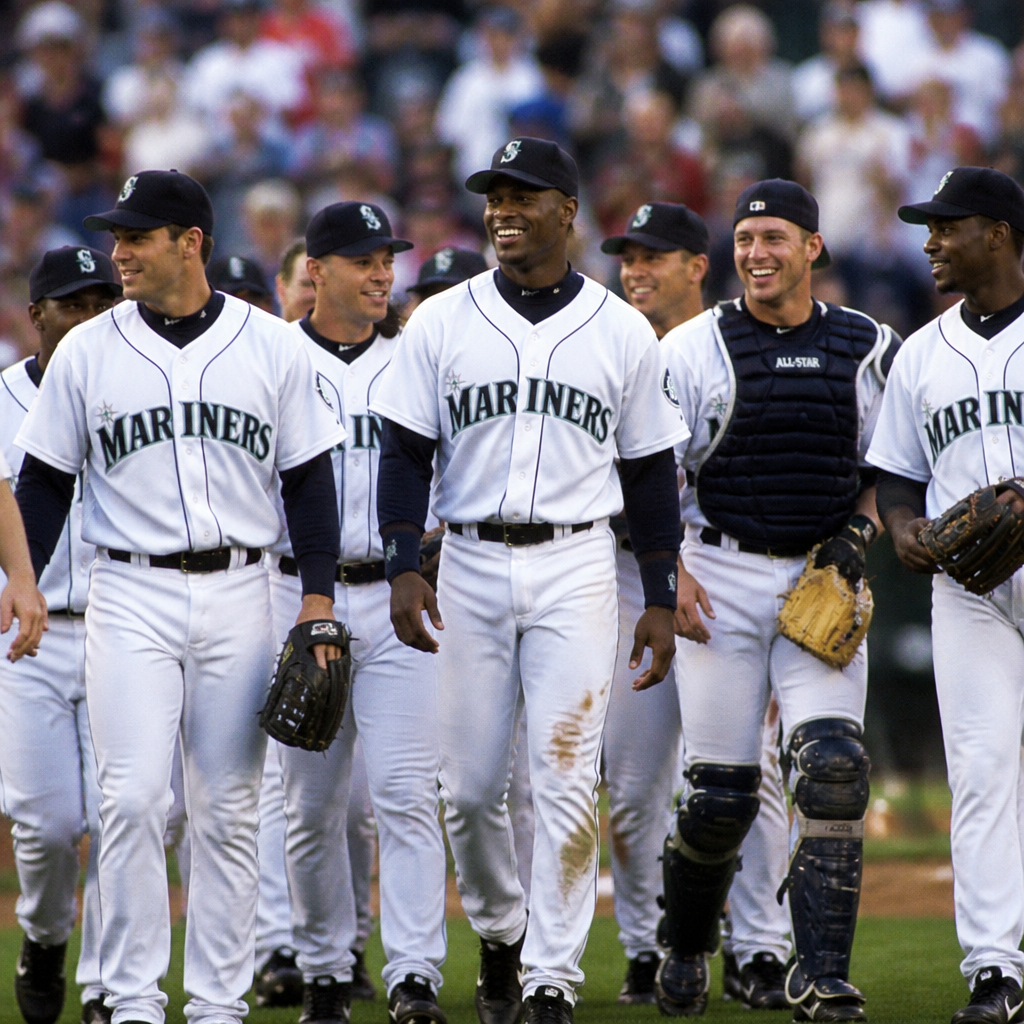
The 2001 Seattle Mariners remain one of baseball’s clearest examples of how an elite team can be built without a single conventional superstar carrying the roster. Seattle won 116 games, tying the 1906 Chicago Cubs and the 2022 Los Angeles Dodgers for the most victories in a modern major league season, and did it in the immediate aftermath of losing Alex Rodriguez to free agency. For anyone studying dynasties and great teams, that season matters because it challenges the usual formula. The Mariners were not assembled around one MVP-level slugger in his absolute peak; they were constructed through depth, defense, run prevention, selective power, and a front office willing to value complete roster efficiency over headlines.
When people ask how the 2001 Seattle Mariners were built, the shortest accurate answer is this: they combined elite on-base skill, outstanding bullpen management, Gold Glove caliber defense, durable starting pitching, and unusual lineup balance. In practical baseball terms, lineup balance means threats at multiple spots rather than one or two middle-order bats doing all the damage. Run prevention means more than ERA; it includes converting balls in play into outs, limiting walks, controlling inherited runners, and avoiding defensive mistakes that extend innings. Those details are often what separate a 95-win contender from a historic regular-season machine.
I’ve spent years reviewing great-team construction across eras, and the 2001 Mariners consistently stand out because nearly every part of the organization aligned at once. Their 116-46 record was backed by a plus-300 run differential, 927 runs scored, and only 627 allowed. They led the American League West by 14 games, opened the season 20-5, and maintained pressure all year instead of surviving one hot stretch. They also did this in a difficult context: the American League still featured the Yankees’ dynasty core, the Athletics’ emerging analytics-era club, and several high-payroll opponents. Seattle’s season belongs in any hub on famous baseball teams because it sits at the intersection of dynasty-era strategy, roster construction, and the limits of regular-season greatness.
That final point matters. The Mariners won 116 games but did not win the World Series, losing to the Yankees in the American League Championship Series. So this team also teaches a second lesson within the study of great teams: October is a different environment, and postseason results do not always invalidate regular-season excellence. Understanding Seattle’s rise requires looking at front-office decisions, player development, tactical deployment, and clubhouse continuity. It also requires seeing the 2001 club not as a fluke, but as the high-water mark of an organizational model that had been building through the mid-to-late 1990s.
Why the 2001 Mariners belong in any discussion of dynasties and great teams
The best hub pages on dynasties and great teams need clear criteria. A team can qualify by sustaining championships, redefining strategy, posting historically dominant underlying numbers, or becoming a reference point for future roster construction. The 2001 Seattle Mariners check several of those boxes even without a title. They tied the all-time wins record, featured the American League MVP in Ichiro Suzuki, and demonstrated that roster depth could replace concentrated star power. They also came from an organization that had already reached the postseason in 1995, 1997, and 2000, so the 116-win campaign was rooted in a broader competitive cycle rather than one accidental season.
Compared with classic dynasties such as the late-1990s Yankees, the Big Red Machine, or the 1970s Athletics, Seattle’s profile was different. Those clubs are often remembered first for rings and star clusters. The Mariners are remembered for precision. They were first in the American League in ERA at 3.54, among the league leaders in defensive efficiency, and remarkably difficult to exploit over a 162-game schedule. Their famous teams case study is useful because it widens the definition of greatness. Some great baseball teams overwhelm with Hall of Fame power. Others, like Seattle, win by removing weaknesses until opponents run out of leverage points.
That is why this season works as a hub entry under dynasties and great teams. It connects to broader subjects readers often explore next: how the Yankees sustained dominance, how the Athletics pursued value with payroll limits, how the 1906 Cubs and 2022 Dodgers compare statistically, and why some elite regular-season teams fall short in October. Seattle serves as the bridge between those topics because it illustrates both the strengths and the fragility of balanced roster design.
The front-office blueprint after losing Alex Rodriguez
The pivotal fact in this story is that Seattle lost Alex Rodriguez after the 2000 season when he signed with Texas. Most teams losing a 10-win caliber shortstop in his prime would expect a step backward. The Mariners moved the other direction because general manager Pat Gillick and manager Lou Piniella understood that replacing one star with multiple above-average contributors can raise a team’s floor and stabilize performance. That is exactly what happened.
Seattle traded for Mark McLemore before 2000 and had already created flexibility around the diamond. They signed John Olerud before 2000, giving themselves one of the league’s best defensive first basemen and a high-contact left-handed bat. The defining addition before 2001 was Bret Boone, who arrived after several modest seasons and then produced a career year with 37 home runs, 141 RBIs, and Gold Glove defense at second base. The club also brought in veteran designated hitter Edgar Martinez’s continued on-base excellence, retained Mike Cameron in center after acquiring him in the Ken Griffey Jr. trade, and integrated Ichiro Suzuki after his move from Japan’s Pacific League.
That sequence matters because it shows the Mariners were not improvising. They were redistributing value. Rodriguez’s departure freed payroll and lineup responsibility, but the organization answered by stacking competence: Olerud for glove and OBP, Boone for unexpected impact power, Cameron for defense and secondary offense, and Ichiro for contact, range, speed, and right-field arm strength. In baseball operations terms, Seattle spread wins across more roster spots. That made them harder to derail with one injury or one slump.
Ichiro Suzuki changed the geometry of the roster
If one player symbolized the 2001 Mariners, it was Ichiro Suzuki, who won both American League Rookie of the Year and MVP. Ichiro hit .350, led the league with 242 hits and 56 stolen bases, and transformed routine singles into pressure events. Defenses rushed throws, middle infielders cheated toward the line, and pitchers worked from the stretch more often than they wanted. His game was not just aesthetically unique; it had structural effects on the lineup.
From firsthand study of that season’s game flow, what stands out is how often Ichiro created offense without extra-base power. He bunted for hits, shot line drives through the left side, and turned ground balls into infield singles. That forced opponents to defend the entire field. Hitting leadoff, he regularly gave Seattle an immediate baserunner, allowing the club to leverage situational hitting from Boone, Martinez, Olerud, and Cameron. His right-field defense was just as important. Ichiro’s arm cut off first-to-third advances and prevented runners from challenging him, quietly shrinking opponents’ expected run totals.
Ichiro also represented a scouting triumph. Seattle had long-standing visibility into Japanese baseball through ownership and scouting relationships, but projection remained risky. Nippon Professional Baseball stars did not always translate cleanly to the majors. The Mariners correctly identified that Ichiro’s bat-to-ball skill, speed, instincts, and defense would travel. They were right immediately, and his adaptation became one of the smartest international acquisitions in baseball history.
Balance, defense, and run prevention made the machine work
The 2001 Seattle Mariners were built to win in every phase. Boone supplied middle-order power. Martinez posted a .423 on-base percentage. Olerud hit .302 with 21 home runs and excellent strike-zone control. Cameron added 25 homers, 34 steals, and elite center-field defense. Even supporting pieces such as Dan Wilson, David Bell, Al Martin, Stan Javier, and Mark McLemore filled narrow roles competently. There was no obvious soft target in the lineup for long stretches.
Where Seattle separated from many 100-win teams was in converting that offensive balance into full-spectrum efficiency. Their defense was outstanding at premium positions. Cameron covered center field at a Gold Glove level. Ichiro won a Gold Glove in right. Olerud was one of the best scooping first basemen of his era. Boone and Bell were steady on the infield. Defensive quality matters because staffs with strong strike-throwing profiles benefit disproportionately from reliable fielders behind them. Seattle’s pitchers could challenge hitters, trust contact more often, and keep pitch counts manageable.
| Area | Key contributors | Why it mattered in 2001 |
|---|---|---|
| Table-setting offense | Ichiro Suzuki, Edgar Martinez | Created constant traffic and high-contact scoring chances |
| Run-producing power | Bret Boone, John Olerud, Mike Cameron | Turned baserunners into crooked numbers without relying on one slugger |
| Outfield defense | Ichiro Suzuki, Mike Cameron | Saved extra bases, suppressed rallies, improved pitcher confidence |
| Infield reliability | John Olerud, Bret Boone, David Bell | Converted routine plays, handled high-volume contact staff effectively |
| Bullpen leverage | Kazuhiro Sasaki, Arthur Rhodes, Jeff Nelson | Shortened games once Seattle led after six innings |
The bullpen deserves special emphasis. Kazuhiro Sasaki saved 45 games with a 3.24 ERA, Arthur Rhodes delivered dominant left-handed relief with a 1.72 ERA, and Jeff Nelson provided another high-leverage option. This group let Piniella manage aggressively. If Seattle led late, the game frequently felt over. That effect compounds over a season. Starters do not need to throw complete games, the offense knows six solid innings can be enough, and opponents press earlier because late comeback windows are smaller.
Durable starting pitching kept the season stable
Great teams need availability as much as peak performance, and Seattle’s rotation gave them that. Freddy Garcia went 18-6 with a 3.05 ERA. Jamie Moyer, never overpowering but relentlessly precise, won 20 games with a 3.43 ERA. Aaron Sele contributed 15 wins. Paul Abbott added 17. Those win totals reflect team context, but the underlying point is durability. Seattle got innings from multiple competent starters who limited walks, changed speeds, and worked deep enough to protect the bullpen’s shape.
Moyer is especially important in explaining how the 2001 Mariners were built. He was the anti-ace in style but not in value. Instead of velocity, he used command, deception, tempo, and changing eye levels. His success showed the organization’s preference for pitchers who matched the defense behind them. Garcia offered more power stuff, but across the rotation Seattle emphasized strike throwing and game management. They were not built around piling up strikeouts at all costs; they were built around efficient run prevention over six months.
This also made the roster resilient. Teams dependent on one Cy Young level ace can be exposed when depth thins or schedules compress. Seattle could win Garcia starts, Moyer starts, or lower-octane starts because the entire structure supported the rotation. That is a hallmark of famous baseball teams with lasting analytical value: they do not require perfect conditions to function.
What the Mariners teach about building great baseball teams
The 2001 Seattle Mariners offer three durable lessons for anyone studying dynasties and great teams. First, replacing a superstar by committee can work if the committee is genuinely above average at multiple spots. Second, defense and bullpen quality are not secondary features; they are central to sustaining a huge win total. Third, roster coherence matters more than name value. Seattle’s players fit together. Ichiro’s contact and speed complemented Boone’s power. Olerud’s glove helped contact-oriented pitchers. Cameron’s range made the whole outfield more aggressive.
There were limitations. The Mariners did not have the same margin for error in October as lineups built around multiple elite sluggers, and against the Yankees in the ALCS they could not fully control the series. That does not diminish the build. It clarifies it. Over 162 games, depth, defense, and bullpen leverage can produce historic consistency. In short postseason series, variance and top-end star dominance matter more.
As a hub article for famous baseball teams, Seattle’s 2001 season is essential because it links so many core themes in baseball history: international scouting, post-superstar roster reconstruction, run-prevention architecture, and the gap between regular-season dominance and championships. If you are exploring dynasties and great teams, start with the Mariners, then compare them with title-winning powers from other eras. Their example sharpens the central question every great team study asks: is the best roster the one with the most stars, or the one with the fewest weaknesses?
The answer from Seattle is clear. The 2001 Mariners were built by identifying every possible edge and stacking them until the season bent in their favor. They got on base, caught the ball, ran intelligently, protected leads, and made opponents earn everything. That is why they won 116 games, why they still matter, and why this team remains one of baseball’s best case studies in roster construction. If you want to understand how great baseball teams are really built, use the 2001 Mariners as your benchmark and explore the other landmark clubs that define the sport’s history.
Frequently Asked Questions
How did the 2001 Seattle Mariners win 116 games after losing Alex Rodriguez in free agency?
The most remarkable part of the 2001 Mariners story is that they did not replace Alex Rodriguez with one singular superstar who could replicate his numbers. Instead, they rebuilt the roster in a way that made the entire team deeper, more balanced, and more efficient from top to bottom. Seattle used the financial flexibility created by Rodriguez’s departure to strengthen multiple areas at once, adding Ichiro Suzuki, Bret Boone, and Jeff Nelson while also getting a full season of contribution from players already in place such as Edgar Martinez, John Olerud, Mike Cameron, and Freddy Garcia. Rather than relying on one player to carry the offense, the Mariners created an environment where nearly every lineup spot and every defensive position added value.
That roster construction mattered because it reduced weaknesses. The lineup had contact hitters, on-base ability, gap power, and enough home run production to score in different ways. The defense improved dramatically, especially with Ichiro in right field and Cameron in center. The pitching staff did not need to be historically dominant because the team supported it with excellent run prevention behind them and a bullpen that protected leads. In practical terms, Seattle became difficult to exploit. Opponents could not simply pitch around one hitter, target one poor defender, or wait for the back end of the bullpen to collapse. The team’s greatness came from breadth rather than dependence, which is one reason that 2001 remains such a fascinating case study in roster building.
Was there really no superstar on the 2001 Mariners, or is that idea overstated?
It is a little more accurate to say the Mariners lacked the conventional, singular superstar archetype than to say they had no stars at all. They absolutely had elite players. Ichiro Suzuki won both the American League MVP and Rookie of the Year, Edgar Martinez remained one of the best hitters in baseball, and Bret Boone produced the best season of his career. What made Seattle unusual was that the team did not revolve around one traditional middle-of-the-order force in the way many great clubs do. Their identity was collective. Different players contributed in different phases of the game, and the value was distributed across offense, defense, baserunning, starting pitching, and relief pitching.
Ichiro, in particular, forces a useful distinction. He was a superstar in impact, fame, and performance, but not in the classic mold of a towering slugger who carried a team with home runs and RBI totals. His game was built on batting average, speed, arm strength, defensive range, and relentless pressure. That meant Seattle’s greatness looked different from what fans were used to seeing in an era heavily associated with power hitters. So the idea is not that the Mariners lacked high-end talent. It is that they proved elite team construction could come from assembling multiple excellent and complementary players rather than centering everything on one obvious franchise savior.
What were the biggest roster moves and player developments that made the 2001 Mariners so dominant?
Several key decisions converged at exactly the right time. The headline addition was Ichiro Suzuki, who arrived from Japan and immediately transformed the team’s style. He gave Seattle elite contact ability at the top of the order, dynamic baserunning, and Gold Glove defense in right field. Bret Boone’s breakout season was another enormous factor. His jump in offensive production added middle-of-the-order impact the team badly needed, and it changed the shape of the lineup. John Olerud brought consistency, plate discipline, and excellent defense at first base, while Mike Cameron delivered power, speed, and outstanding center-field defense after arriving in the trade that sent Ken Griffey Jr. to Cincinnati before the 2000 season.
Just as important were the holdovers and the overall fit of the roster. Edgar Martinez still posted elite offensive numbers and gave the lineup a stabilizing presence. Seattle also got quality innings from Freddy Garcia, Aaron Sele, and Jamie Moyer, while the bullpen blended reliability and matchup flexibility with arms such as Kazuhiro Sasaki, Arthur Rhodes, and Jeff Nelson. This was not a roster built on one flashy transaction. It was built through layered decision-making: smart international scouting, opportunistic free-agent additions, strong player evaluation, and an understanding of how skills could complement one another over a 162-game season. The result was a team with very few holes and a clear identity every night.
What made the 2001 Mariners different from other 100-win teams in baseball history?
Many 100-win teams are remembered for overwhelming star power, dominant postseason runs, or historic offensive explosions. The 2001 Mariners stand out because their greatness was rooted in completeness and consistency. They tied the major league record with 116 wins, yet they are often discussed differently from other legendary teams because they did not fit a simple narrative. They were not just an all-time lineup, not just an all-time rotation, and not just a team with one iconic centerpiece. They won because they did almost everything well. They defended, they ran the bases intelligently, they got on base, they prevented runs, and they maintained pressure over the full schedule.
Another difference is the context. Seattle achieved that total immediately after losing one of the sport’s premier talents in Rodriguez, which made the season feel counterintuitive even at the time. Most franchises that lose an MVP-caliber shortstop expect to step backward. The Mariners surged forward. They also did it in an era when 116 wins was especially difficult to imagine, given the competitive depth of modern baseball and the grind of the schedule. Even though they did not win the World Series, the regular season remains historically significant because it challenged assumptions about how elite teams must be constructed. Their season has become a touchstone for discussions about depth, balance, and the value of minimizing weaknesses across an entire roster.
Why is the 2001 Mariners season still important when talking about team-building and baseball history?
The 2001 Mariners continue to matter because they offer one of the clearest real-world examples that there is more than one way to build a great baseball team. In a sport where attention often goes first to MVP candidates, Cy Young winners, and giant contracts, Seattle showed that intelligent distribution of talent can be just as powerful as collecting a few headline names. Their season is especially valuable for analysts, front offices, and fans who study roster construction because it illustrates the cumulative power of incremental advantages. A team can gain separation not only through transcendent stars, but through better defense, fewer lineup holes, stronger platoon options, deeper pitching, and players whose strengths fit together cleanly.
Historically, the season also sits at a crossroads moment in baseball. It came during a period of major offensive output around the league, yet the Mariners distinguished themselves with versatility and efficiency as much as brute force. Ichiro’s arrival gave the season international significance, helping further connect Major League Baseball with top-level Japanese talent. The 116-win mark ensured the team would remain part of every conversation about the greatest regular seasons ever, while their failure to win the World Series adds another layer to their legacy. That combination makes the 2001 Mariners endlessly compelling: they were not just great, they were instructive. They remain a blueprint for how a front office can turn loss, adaptation, and smart resource allocation into one of the most extraordinary regular seasons the sport has ever seen.