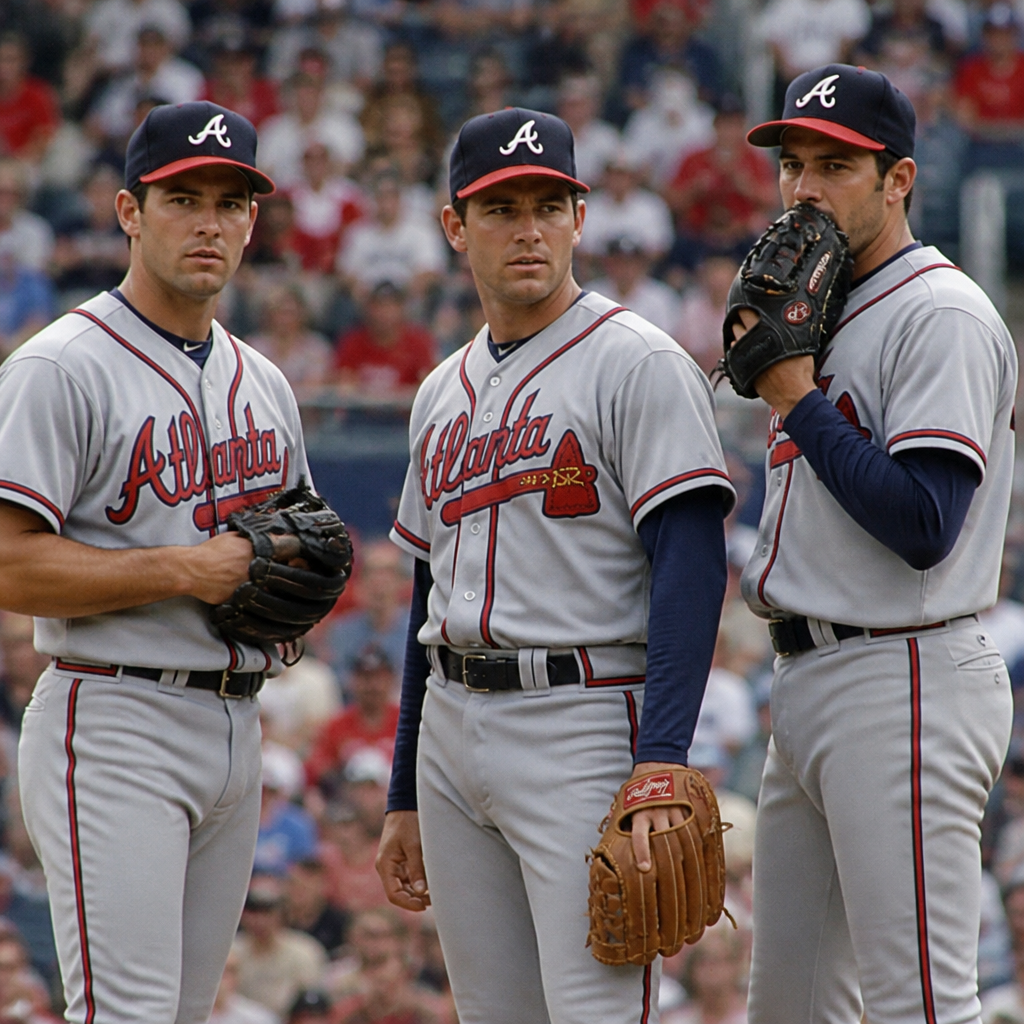
The 1996 Atlanta Braves rotation represented the clearest expression of what a modern baseball dynasty could look like: not a single superstar carrying a club, but a layered, repeatable system built around elite starting pitching, organizational continuity, and October-level expectations that began in April. For readers exploring famous baseball teams, dynasties, and great teams, the Braves of the 1990s deserve hub status because they combined sustained division dominance with one of the most recognizable rotations the sport has produced. Greg Maddux, Tom Glavine, and John Smoltz were not merely excellent in isolation. Together, they formed the identity of a franchise that defined National League excellence for more than a decade.
When people refer to the 1996 Atlanta Braves rotation, they usually mean the front three: Maddux, Glavine, and Smoltz. In practical baseball terms, a rotation is the sequence of starting pitchers a team uses every five games, and in the Braves’ case, it was the engine of both regular-season consistency and postseason pressure. Atlanta had already won the 1995 World Series and entered 1996 with the burden every defending champion knows well: anything short of another pennant would feel incomplete. That expectation matters because great teams are measured differently from good ones. A solid club aims for contention; a dynasty-caliber club is judged by how convincingly it turns talent into repeated October appearances.
I keep coming back to the 1996 Braves when evaluating great teams because they sit at the intersection of dominance and frustration. They won 96 games, captured the National League East, and sent three Hall of Fame-caliber starters to the mound in a period when innings still mattered and aces were expected to work deep into games. Yet the season is remembered as much for what did not happen as for what did. Atlanta reached the World Series, built a two-games-to-none lead over the New York Yankees, and then lost four straight. That arc is exactly why this team belongs in any serious discussion of baseball dynasties: the 1996 Braves show how even historically strong teams can be vulnerable in short postseason series.
As a hub for dynasties and great teams, this article uses the 1996 Braves rotation as a case study in how baseball powerhouses are built, why elite pitching travels across eras, and what separates sustained greatness from a single championship burst. The central question is simple: how good was this rotation, and why did it create such enormous October expectations? The answer begins with run prevention, command, durability, and a team culture that expected six strong innings as a baseline, not a ceiling.
Why the 1996 Braves belong in any dynasty conversation
The Braves were already deep into one of baseball’s longest runs of relevance by 1996. From 1991 through 2005, Atlanta won an extraordinary string of division titles, and the 1996 club sat near the center of that stretch. In discussions of famous baseball teams, dynasties are not defined only by championships. They are defined by recurring superiority, the ability to regenerate pressure on opponents, and a style so clear that decades later fans can still describe it in one sentence. With the Braves, that sentence is easy: they rolled out aces relentlessly, controlled the strike zone, and made every series feel shorter for the other side.
That identity was not marketing language. It was visible in the numbers and in the game flow. Atlanta led the National League in earned run average in 1996, and the rotation gave manager Bobby Cox something every contender wants but few sustain: predictable starts. Predictability in baseball is not glamorous, yet it is one of the foundations of a great team. A lineup can slump for a week. A bullpen can wobble. A defense can have a rough series. But if a club knows its starter is likely to work into the seventh inning while limiting walks, the entire roster settles into cleaner roles.
The 1996 Braves also matter because they illustrate a crucial truth about dynasties: timing changes public memory. Had Atlanta finished the Yankees after taking the first two games of the World Series, this club would likely be cited more often among the definitive teams of the era. Instead, the loss compressed perception. The roster still looked imposing, but the conversation shifted from whether the Braves would become a mini-empire to why they won only one championship during a period of sustained excellence. That tension makes them one of the most instructive great teams in baseball history.
Maddux, Glavine, and Smoltz: three aces, three different blueprints
What made the 1996 Atlanta Braves rotation so special was not simply that it had famous names. It had stylistic contrast at the highest level. Greg Maddux operated with precision that remains the gold standard for command pitching. He did not overpower hitters in the conventional sense. He expanded the plate with movement, sequencing, and location, turning weak contact into an art form. In 1996, he went 15-11 with a 2.72 ERA, and those figures only partially capture how exhausting he was for opponents. Hitters often walked back to the dugout feeling they had been out-thought before they had been overmatched.
Tom Glavine offered a different kind of pressure. As a left-hander with impeccable control and a devastating changeup, he created uncomfortable at-bats through angle, timing disruption, and edge command. He finished 1996 at 15-10 with a 2.98 ERA, numbers that fit neatly within the broader pattern of his peak seasons. Glavine’s value in a dynasty setting was enormous because he changed the visual and tactical profile of a series. After seeing Maddux’s darting two-seamers and surgical precision, opponents had to reset for a lefty who attacked tempo and location from another plane.
John Smoltz completed the trio by adding power and aggression. In 1996 he went 24-8 with a 2.94 ERA and won the National League Cy Young Award. That 24-win season became one of the defining campaigns of the decade. Smoltz was the rotation’s force starter, capable of missing bats and dictating counts with a harder arsenal than Maddux or Glavine. He gave Atlanta a different route to dominance. Where Maddux could make an offense disappear through efficiency, and Glavine could gradually suffocate a lineup, Smoltz could seize a game with intensity and strikeout stuff.
In my experience studying great staffs, this is the profile that separates memorable rotations from truly historic ones: overlap in quality, contrast in method. Opponents could not prepare for one Braves ace and carry that plan unchanged into the next night. Each starter forced a different adjustment. Over a seven-game series, that diversity is psychologically draining and strategically expensive.
The numbers behind the reputation
The reputation of the 1996 Braves rotation was earned, not romanticized after the fact. Atlanta finished 96-66 and again built its success around run prevention. Smoltz’s 24 wins drew headlines, but the larger story was volume at elite quality. Maddux, Glavine, and Smoltz all worked more than 250 innings in an era when front-line starters were still expected to carry heavy workloads. That matters because innings are not just a counting stat. They reflect trust, health, game management, and the ability to keep stress off the bullpen over six months.
The front three combined for 768.2 innings in 1996, an extraordinary total by any standard and almost unimaginable in the current game. Their ERAs all sat under 3.00. Smoltz struck out 276 hitters. Maddux walked only 28 batters all season, a number so low it still reads like a printing error in a modern context. Glavine provided 235 strikeouts and the stabilizing consistency that made losing streaks hard to start. When a team gets that much quality from its top three, it controls series before first pitch because matchup probability begins leaning its way almost every night.
| Pitcher | 1996 Record | ERA | Innings Pitched | Strikeouts | Defining Trait |
|---|---|---|---|---|---|
| Greg Maddux | 15-11 | 2.72 | 245.0 | 172 | Elite command and weak contact |
| Tom Glavine | 15-10 | 2.98 | 241.2 | 181 | Left-handed changeup and edge control |
| John Smoltz | 24-8 | 2.94 | 253.2 | 276 | Power arsenal and strikeout dominance |
The fourth and fifth starters are part of the story too, even if history remembers the front-line stars first. A dynasty-level team is never only its headliners. The Braves also received important innings from Denny Neagle and Steve Avery, giving Cox enough depth to avoid overextending the bullpen or forcing playoff-style urgency in midsummer. That structure let Atlanta preserve the rotation’s rhythm while maintaining pressure in the standings.
Advanced analysis reinforces the traditional view. Maddux’s walk rate was microscopic, Smoltz paired volume with swing-and-miss stuff, and Glavine’s run prevention remained elite despite facing lineups built increasingly around patience and power. If you are comparing great teams across eras, the lesson is straightforward: raw win totals matter less than repeatable skills. The 1996 Braves excelled in strike throwing, contact management, workload, and game-to-game adaptability.
How the rotation shaped Atlanta’s October expectations
No defending champion enters a season quietly, but the Braves carried a particularly heavy kind of expectation because their path to October looked so sustainable. Teams driven by hot offense can cool off. Teams built around one ace are vulnerable if that pitcher has an ordinary outing. Atlanta was different. The Braves expected to enter every postseason series with an advantage in at least three games, and often in four if the rest of the staff aligned correctly. That is why the 1996 club inspired not just optimism, but assumption.
Those expectations followed a clear baseball logic. In a short series, elite starting pitching compresses randomness. A great offense can be slowed by weather, park dimensions, or sequencing luck. A dominant starter can strip those variables down by limiting balls in play and preventing crooked innings. I saw this principle repeatedly in 1990s postseason baseball: when Atlanta’s starters got ahead in counts, opponents began chasing not just pitches but opportunities. One scoreless trip through the order often became three.
The Braves reinforced that belief in the National League Championship Series against the St. Louis Cardinals. Atlanta lost the opener, then recovered behind its pitching and depth to win the pennant. By the time the World Series began against the Yankees, the common assumption was that Atlanta’s rotation would be decisive. Through two games, that looked accurate. The Braves won both in New York and returned home seemingly in control of the series.
Then the limitations of dynasty logic appeared. October does not always reward the better overall team; it rewards the team that best concentrates execution in a narrow window. The Yankees adjusted, their bullpen management sharpened, and Atlanta’s offense failed to create enough separation after the strong start. The Braves still pitched well enough to win more than they did, but not so overwhelmingly that the lineup could disappear without consequence. For all the justifiable focus on the rotation, the 1996 World Series is a reminder that no great team is invulnerable when run support fades at the wrong time.
What this team teaches about dynasties and great baseball teams
The 1996 Atlanta Braves are central to the study of dynasties because they reveal both the strength and fragility of sustained excellence. First, they show that a great team needs a stable identity. Atlanta’s identity was unmistakable: develop or acquire top-flight pitching, let veteran starters work deep, support them with disciplined defense, and trust Bobby Cox to maintain role clarity across the roster. Dynasties are rarely accidental. They are usually the product of a repeated operating model that players understand and front offices protect.
Second, the Braves demonstrate that greatness should be measured across seasons, not only by rings. This can sound like excuse-making, but it is actually a necessary correction. Baseball’s postseason is a small sample by design. The 1927 Yankees, 1975-76 Reds, late-1990s Yankees, and other landmark teams are remembered fondly because titles aligned with talent. Atlanta’s 1990s run is remembered more ambiguously because the championships did not pile up at the same rate. Yet the underlying quality was undeniable, and the 1996 rotation remains one of the cleanest examples of a dynasty-caliber foundation.
Third, the club offers a useful comparison point for anyone exploring other famous baseball teams. If you are building out a broader view of dynasties and great teams, the natural related topics include the Big Red Machine, the 1986 Mets, the 1998 Yankees, the early-2010s Giants, and the modern Astros. The Braves fit that conversation because they sustained elite standards year after year, but they stand apart for doing it with a rotation that could beat opponents in three distinct ways. That is rare even among champions.
The final lesson is practical. Great teams create expectations because they reduce uncertainty better than everyone else. The 1996 Braves reduced uncertainty every fifth day, then every fourth day, then again the next night. Even now, when clubs prioritize velocity, bullpen leverage, and matchup flexibility, Atlanta’s model remains persuasive. If you can run three aces with different repertoires and proven command into a postseason bracket, you have built the strongest advantage baseball still recognizes.
The 1996 Atlanta Braves rotation deserves its place at the center of any discussion about famous baseball teams, dynasties, and great teams because it captured both the power and the pressure of sustained excellence. Maddux, Glavine, and Smoltz gave Atlanta a pitching core that was durable, stylistically varied, and relentlessly effective. Their combined workload and run prevention set a standard that still feels extraordinary, and their presence shaped every expectation surrounding the season. The Braves were not just good enough to contend. They were structured to make contention feel routine.
That is why this team remains so compelling. It won 96 games, returned to the World Series, and reminded the sport that elite rotations can define an era. At the same time, the club exposed the narrow margins that separate a dynasty everyone celebrates from one people debate. Atlanta’s 1996 season is not diminished by that tension; it is made more important by it. We learn more from great teams that faced real resistance than from simplified legends.
For anyone building a deeper understanding of baseball history, start here: study how the Braves assembled this rotation, how each ace attacked hitters differently, and how regular-season dominance translated into October expectation. Then use this team as a bridge to the wider history of dynasties and great teams across eras. The 1996 Braves are not just a memorable staff. They are a blueprint for how baseball greatness is built, tested, and remembered. Explore the rest of this topic with that standard in mind.
Frequently Asked Questions
Why was the 1996 Atlanta Braves rotation considered one of the defining staffs of the 1990s?
The 1996 Atlanta Braves rotation stood out because it combined top-end star power with remarkable stability, giving the club a competitive advantage almost every night of the season. Greg Maddux, Tom Glavine, and John Smoltz were not simply excellent pitchers on the same roster; they were three very different aces whose contrasting styles made the staff especially difficult for opponents to prepare for in a series. Maddux overwhelmed hitters with precision, movement, and command that bordered on surgical. Glavine mastered pace, location, and deception, often making lineups chase pitches just off the edge of the strike zone. Smoltz added power and intimidation, giving Atlanta a hard-throwing presence who could dominate with pure stuff as well as big-game confidence.
What made the rotation historically important was not only how talented it was, but how sustainable it felt. The Braves were not relying on one magical season or one pitcher having a career year. They had built an environment where elite starting pitching was the foundation of the franchise, and that gave the team a dynasty-like structure. By 1996, this model was fully recognizable: Atlanta expected to lead its division, expected to pitch deep into games, and expected to enter October believing its rotation could control any postseason matchup. That combination of regular-season consistency and postseason relevance is a major reason the 1996 staff remains central to any conversation about great teams of the era.
How did Greg Maddux, Tom Glavine, and John Smoltz complement one another in the 1996 rotation?
One reason the 1996 Braves are remembered so vividly is that their three headline starters did not succeed in the same way. Maddux was the artist of the group, using command, movement, timing, and intelligence to make elite hitters look overmatched. He could turn a game into a clinic on efficiency, getting weak contact early in counts and controlling tempo from the first inning on. Glavine offered a different kind of challenge. As a left-hander with outstanding feel, he changed hitters’ sightlines and made at-bats uncomfortable in a quieter, more methodical way. He lived on precision and disruption, and his ability to work the corners kept offenses from ever settling in.
Smoltz completed the trio by giving Atlanta an element of velocity and edge. He could miss bats in ways the others did not, and he often brought a visible intensity that translated well in high-pressure moments. Together, the three created a rotation that attacked opponents from multiple angles. A lineup that spent one night trying to solve Maddux’s movement and command might see Glavine’s left-handed finesse the next, followed by Smoltz’s power stuff after that. In a short series, that variety was devastating. In a full season, it was exhausting for the rest of the league. Their complementarity is a big part of why the 1996 Braves represented more than a collection of stars; they represented a fully formed pitching identity.
What made October expectations so intense for the 1996 Braves?
By 1996, the Braves were no longer a feel-good contender or an emerging power. They were a franchise operating under championship expectations from Opening Day forward. Their run of division titles had established them as the class of the National League, and their 1995 World Series title raised the standard even further. That context is crucial. For most teams, a great regular season is the goal. For the 1996 Braves, the regular season was almost treated as proof of concept. The real judgment came in October, where the roster’s design was supposed to produce a championship-level edge.
The pressure was heightened because the team’s greatest strength, its rotation, was tailor-made for postseason baseball. When a club can line up Maddux, Glavine, and Smoltz in a playoff series, anything short of a deep run feels disappointing. That is why discussion of the 1996 Braves often centers not just on how good they were, but on what was expected of them. They were built to win in the format that matters most: short series, high leverage, and minimal margin for error. Fans, analysts, and opponents all understood that Atlanta’s standard was not merely to contend, but to convert regular-season dominance into October success. That expectation gives the 1996 Braves an important place in baseball history, because they embodied the burden that comes with sustained greatness.
Did the 1996 Braves represent a baseball dynasty even though they did not win the World Series every year?
In the broader baseball sense, yes, the 1990s Braves absolutely fit the dynasty conversation, and the 1996 club is one of the clearest snapshots of why. Dynasties are often measured too narrowly by championship totals alone, but baseball is a sport where postseason series are short, variance is real, and even elite teams can be knocked out despite being constructed exceptionally well. The Braves’ case rests on something deeper: year-after-year supremacy within their division, a stable core, a clear organizational identity, and a level of sustained excellence that very few franchises achieve. The 1996 team captured all of those qualities in a particularly sharp way.
This was a club that did not need to reinvent itself every season. It had a repeatable formula: dominant starting pitching, disciplined roster building, institutional continuity, and stars who were both individually brilliant and collectively coherent. That is what modern dynasties often look like. They are not random spikes; they are systems. The 1996 Braves are especially useful as a reference point because they show how a team can become a permanent fixture in championship conversations through process as much as through trophies. Even if some fans debate the term “dynasty” because the title count does not match a few other historic runs, the Braves’ long stretch of relevance and excellence makes them one of the most important sustained powers in modern baseball.
Why does the 1996 Braves rotation still matter to readers interested in famous teams and great baseball eras?
The 1996 Braves rotation still matters because it helps explain how greatness can be built in baseball over time. Some famous teams are remembered for overwhelming offense, iconic personalities, or one dramatic postseason. The Braves offer a different and, in many ways, more instructive model. They show what happens when a franchise builds around pitching excellence, continuity, and a championship standard that becomes part of the club’s everyday identity. For readers exploring legendary teams, that makes the Braves a valuable hub topic because they connect to larger themes: the rise of sustained divisional dominance, the premium placed on starting pitching in the 1990s, and the challenge of translating regular-season power into postseason titles.
The 1996 season is especially compelling because it captures the Braves at a mature point in their run. They were no longer surprising anyone, and that is exactly what makes them interesting. Opponents knew what was coming and still had trouble stopping it. The names Maddux, Glavine, and Smoltz remain shorthand for elite rotation construction, but the real legacy is broader than star recognition. The Braves demonstrated how an organization could establish October expectations before summer even began. For anyone studying baseball dynasties, powerhouse rotations, or the anatomy of great teams, the 1996 Braves remain essential because they represent sustained excellence under pressure, not just isolated brilliance.