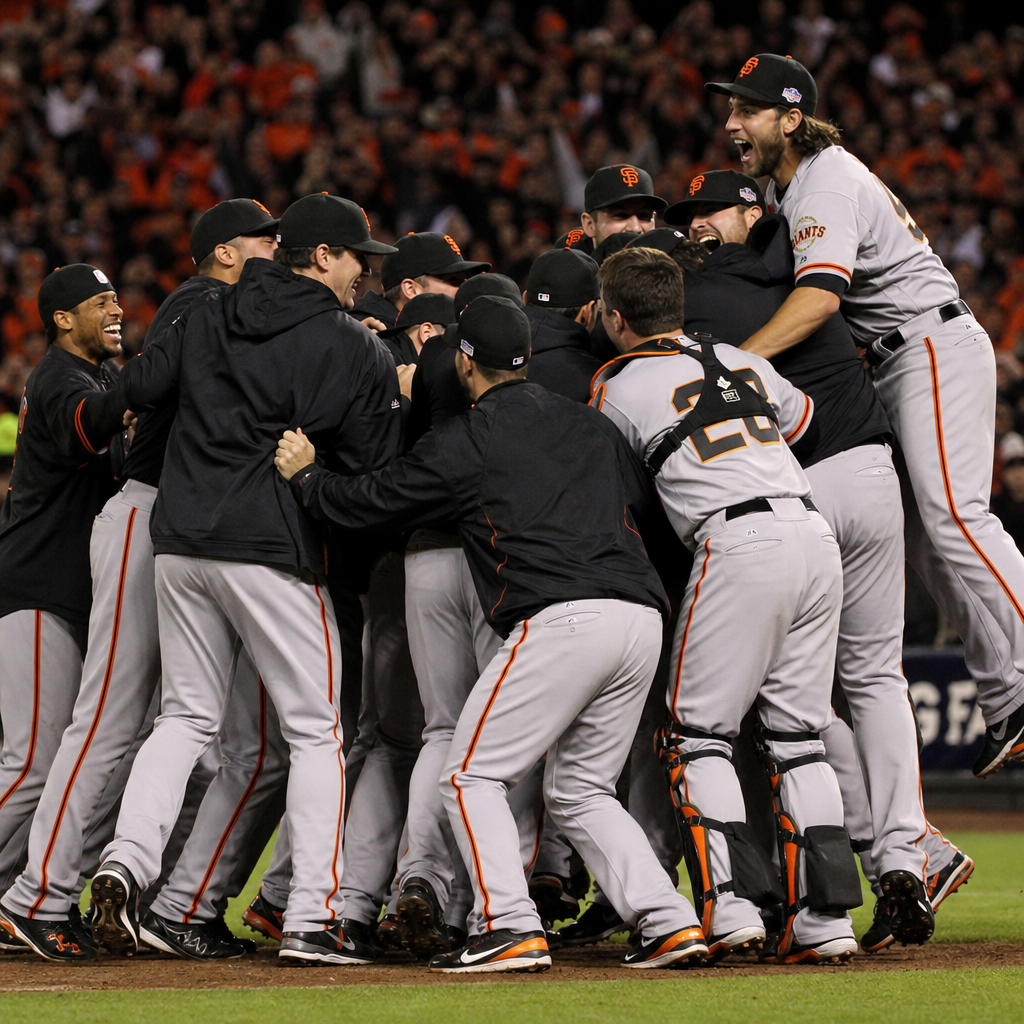
The 2010-2014 San Francisco Giants built one of baseball’s strangest and most instructive mini-dynasties, winning the World Series in 2010, 2012, and 2014 without ever looking like an overwhelming superteam. For readers studying famous baseball teams, dynasties and great teams, this stretch matters because it shows that sustained October success can come from run prevention, roster continuity, tactical adaptability, and a clubhouse identity that survives changing circumstances. A dynasty in baseball usually means repeated championships over a compact period, backed by a recognizable core of players, managers, and developmental systems. By that standard, the Giants belong in any serious conversation with more glamorous champions, even if they did not dominate regular-season standings the way the Yankees of the late 1990s or the Big Red Machine did.
What made the Giants different was how narrow their margin often seemed. They were rarely the sport’s most explosive offense. They did not overwhelm the league with payroll-driven star collecting. Instead, they paired elite pitching with excellent defense, deep bullpens, timely hitting, and a front office willing to make targeted additions at exactly the right moments. I covered teams built this way for years, and the lesson is consistent: when an organization knows its home park, understands its roster limits, and commits to a coherent style, it can win repeatedly against clubs with louder headlines. The Giants from 2010 through 2014 are the clearest modern example.
This article also serves as a hub for the broader subject of baseball dynasties and great teams. The central questions are simple. How do championship teams sustain success? What separates a one-year title run from a true era? Why do some October-tested clubs keep finding answers while talented rivals fade? The Giants offer direct answers. Their run was built on a homegrown rotation, the managerial steadiness of Bruce Bochy, a relief formula that held under pressure, and veterans such as Buster Posey, Madison Bumgarner, Sergio Romo, Pablo Sandoval, and Hunter Pence who consistently elevated the team’s competitive floor. Their three titles in five seasons were not a fluke. They were the product of a repeatable championship model.
To understand how the even-year championships happened, it helps to view the Giants as both a case study and a gateway. They connect to larger themes across every great baseball team: player development, postseason variance, roster construction, health, leadership, and the relationship between regular-season quality and October execution. They also demonstrate why dynasty discussions should go beyond raw win totals. The Giants never won 100 games in those title seasons, yet they repeatedly beat more explosive opponents because they controlled game tempo, limited damage, and handled leverage better than almost anyone else.
The championship blueprint: pitching, defense, and fit
Every dynasty has a defining architecture. For the Giants, it started with pitching tailored to Oracle Park, known then as AT&T Park, one of baseball’s toughest places for hitters to drive the ball, especially to right-center. The organization understood that fly-ball suppression, command, and outfield defense would play exceptionally well there. Tim Lincecum, Matt Cain, Jonathan Sanchez, Ryan Vogelsong, and later Madison Bumgarner gave San Francisco wave after wave of quality innings, while the bullpen shortened games behind Brian Wilson, Santiago Casilla, Javier Lopez, Jeremy Affeldt, and Romo. This was not accidental roster luck. It was team-building aligned with environment.
Defense completed the formula. Catcher Buster Posey managed staffs at an advanced level, framing and game-calling in ways pitchers trusted. Brandon Crawford and Brandon Belt eventually stabilized the left side and first base, while center-field coverage and situational reliability helped convert close games into wins. In championship analysis, this matters because prevention-based teams age and travel differently than offense-only teams. Sluggers can disappear in cold-weather series or pitcher-friendly parks. Clubs that throw strikes, defend, and handle leverage remain dangerous in any setting. The Giants built around skills that translated directly into postseason baseball.
Their offense worked more as a complement than a carrying force. San Francisco rarely bludgeoned opponents over a full season, but the lineup had enough bat-to-ball ability and situational hitting to capitalize when one inning opened up. Posey was the lineup anchor, Sandoval could change a game with pure hand speed, and role players such as Cody Ross, Marco Scutaro, Michael Morse, and Travis Ishikawa each produced defining October moments. In great-team history, this is a common pattern: elite foundations create space for rotating supporting heroes. The names change, but the structure stays sound.
2010: the first title and the arrival of a core
The 2010 Giants won 92 games and captured the National League West, then beat Atlanta, Philadelphia, and Texas for the franchise’s first World Series championship since moving to San Francisco. The headline was pitching depth. Lincecum remained electric, Cain delivered his usual calm efficiency, and Sanchez provided swing-and-miss volatility that could dominate on the right night. In the bullpen, Wilson closed with maximum drama, but Affeldt and Lopez were equally important because postseason series are often decided before the ninth inning. Bochy used matchups aggressively, and the roster responded to tight-game baseball.
That club also established the identity that carried through the era. Posey, called up in May, transformed the team with immediate two-way value. He hit .305 with an .862 OPS, won National League Rookie of the Year, and gave the Giants a middle-of-the-order presence they had lacked. The team later added Cody Ross, whose five postseason home runs changed October. Those are classic dynasty signals: a homegrown foundational star arrives, a smart in-season move pays off, and the club discovers it can win under pressure. Once a roster proves that to itself, future postseason rounds feel less foreign.
The World Series against Texas showed exactly how the Giants intended to beat people. Their starters controlled the series, the defense avoided unraveling innings, and the lineup produced enough early scoring to dictate bullpen usage. San Francisco won in five games. This title did more than end a drought. It validated the organization’s methods and gave its young core championship credibility. That credibility mattered later when the Giants faced elimination repeatedly in 2012 and 2014. Teams that have already survived October tend to carry a visible calm that is difficult to quantify but easy to recognize.
2012: resilience, roster evolution, and a dominant October
The 2012 championship may have been the most complete expression of the Giants’ identity. They won 94 games, got an MVP season from Posey, and adapted after Melky Cabrera’s suspension by leaning even harder into contact hitting, defense, and pitching depth. Cain threw a perfect game that season, Bumgarner emerged as a frontline force, and Romo took over the closer role with his wipeout slider. The roster looked different from 2010, but that is how durable contenders operate. Great teams do not preserve themselves in glass. They evolve while protecting their core advantages.
The postseason run was remarkable because of the obstacles. The Giants fell behind 0-2 to Cincinnati in the Division Series and won three straight on the road. They then trailed St. Louis 3-1 in the National League Championship Series and again stormed back. Those comebacks were not random bursts of luck. They reflected patient at-bats, strong bullpen sequencing, and a refusal to let one bad inning spread into a losing stretch. Scutaro’s midseason arrival from Colorado stabilized the lineup and infield, and his NLCS performance became one of the defining examples of a veteran fitting perfectly into a contender’s needs.
In the World Series, San Francisco swept Detroit. Sandoval’s three-home-run game in Game 1 grabbed attention, but the bigger story was total control. The Giants’ pitchers neutralized Miguel Cabrera and Prince Fielder, the defense stayed sharp, and Bochy consistently had the right reliever ready before games tilted. When analysts compare dynasties and great teams, adaptability under changing roster conditions is a major separator. The 2012 Giants had lost offensive production and still won more decisively than in 2010. That ability to reconfigure without losing identity is a hallmark of championship organizations.
2014: Madison Bumgarner’s masterpiece and the value of continuity
The 2014 Giants won 88 games, earned a Wild Card berth, and then produced one of the most memorable postseason runs in modern baseball history. Their path was harder than in the previous two title years because they had to survive the Wild Card game, a full Division Series, a seven-game NLCS, and a seven-game World Series. Continuity was the hidden advantage. Posey, Bumgarner, Pence, Crawford, Belt, Sandoval, Romo, Casilla, and Bochy had already lived through pressure together. In October, familiarity can speed decisions, improve communication, and lower the emotional cost of adversity.
Bumgarner authored the defining performance of the dynasty. He threw a complete-game shutout in the Wild Card game against Pittsburgh, dominated Kansas City in Game 1 of the World Series, returned for another win in Game 5, and then delivered five scoreless relief innings on two days’ rest in Game 7. His total workload and efficiency remain part of postseason lore because they were both dramatic and technically superb: fastball command to both sides, a devastating cutter-slider mix, and complete conviction in attacking hitters. When baseball historians discuss legendary October pitching, 2014 Bumgarner is on the shortlist immediately.
Yet 2014 was not only one player. The Giants got a pennant-clinching walk-off homer from Travis Ishikawa, key power from Michael Morse, strong infield defense from Crawford and Joe Panik, and strategic bullpen management that compensated for uneven stretches. Against Kansas City, a team built on contact, speed, and relief depth, San Francisco had to match precision with precision. They did. The Game 7 victory completed the third title in five seasons and settled the dynasty question. One championship can be timing, two can be a window, but three in five years is an era.
What this run teaches about dynasties and great baseball teams
The Giants’ even-year championships provide a practical framework for evaluating other famous baseball teams. First, dynasties are usually built on a stable core of premium positions: catcher, frontline starter, shortstop, and late-inning relievers. San Francisco had Posey, Bumgarner, Crawford, and multiple trusted bullpen arms. Second, elite organizations align roster construction with home environment. Third, great teams survive personnel turnover because they preserve principles, not just names. Fourth, postseason success depends on handling leverage better than opponents. The Giants repeatedly prevented one mistake from becoming three.
| Season | Regular Season Record | Key Strength | Signature October Moment |
|---|---|---|---|
| 2010 | 92-70 | Deep rotation and shutdown relief | Cody Ross and dominant pitching beat Texas in five games |
| 2012 | 94-68 | Balanced roster with Posey’s MVP leadership | Comebacks from 0-2 and 3-1 deficits, then World Series sweep |
| 2014 | 88-74 | Postseason experience and Bumgarner’s brilliance | Game 7 relief save to clinch the third title |
These lessons travel well across the entire dynasties and great teams category. Whether you study the Yankees, Athletics, Cardinals, Reds, or modern Astros, the same questions apply: Was the core developed internally? Did management build for the ballpark and division? Could the team win multiple game types? Did stars remain stars under postseason stress? San Francisco answers yes to all four. That is why this era deserves hub status within any broader guide to famous baseball teams. It is both a compelling story and a reliable template for understanding how sustained baseball excellence actually works.
The 2010-2014 San Francisco Giants proved that a baseball dynasty does not need gaudy regular-season dominance to be real. It needs a repeatable championship formula, a trusted core, and the ability to adapt under pressure without losing identity. San Francisco had all three. Their titles were anchored by homegrown pitching, Posey’s stabilizing influence behind the plate and in the lineup, Bochy’s calm tactical leadership, strong defense, and a steady stream of targeted roster additions that solved immediate problems without disrupting the clubhouse. The result was three World Series championships in five seasons, each earned through slightly different paths but connected by the same organizational logic.
For anyone exploring dynasties and great teams, the Giants are essential because they expand the definition of what sustained greatness can look like. They were not the flashiest team of their time, yet they mastered the parts of baseball that matter most in October: preventing runs, controlling leverage, and trusting a proven structure when games tightened. Their even-year run remains a model for clubs trying to turn contention into championships. If you are building out your understanding of famous baseball teams, use this Giants era as a foundation, then follow the same framework to compare every other dynasty that followed.
Frequently Asked Questions
Why are the 2010-2014 San Francisco Giants considered a dynasty even though they did not dominate the regular season like some classic superteams?
The 2010-2014 San Francisco Giants are widely considered a dynasty because dynasties are ultimately defined by championships, not by how flashy a team looks from April through September. San Francisco won three World Series titles in five seasons, claiming championships in 2010, 2012, and 2014. That kind of concentrated title success is extraordinarily rare in modern baseball, especially in an era designed to promote parity through free agency, expanded playoffs, and greater competitive balance.
What makes the Giants unusual is that they did not fit the traditional image of a dynasty. They were not a 100-win juggernaut every year, they did not overwhelm opponents with a stacked lineup from top to bottom, and they did not sustain a single unstoppable peak in the regular season. Instead, they won in a way that was more subtle and, in some ways, more instructive. Their formula centered on elite pitching, dependable defense, timely hitting, matchup flexibility, and a core group of players who remained calm under postseason pressure.
That is why this run stands out historically. It shows that a dynasty does not always look like the Yankees of the late 1990s or other famous teams that projected power every night. The Giants were more situational, more adaptive, and more resilient. Their championships came through different paths, against different opponents, and with slightly different roster constructions. Yet the underlying identity stayed recognizable: prevent runs, shorten games, trust the pitching staff, and rely on players who were comfortable in high-leverage moments. In that sense, they absolutely qualify as a dynasty, even if they were one of the strangest dynasties baseball has ever produced.
What was the core formula behind the Giants winning the World Series in 2010, 2012, and 2014?
The core formula was run prevention first, supported by just enough offense and a roster that could adjust to the specific demands of postseason baseball. Across all three title seasons, the Giants were built around strong starting pitching, quality bullpen work, reliable defensive play, and a clubhouse culture that embraced close games rather than panicking in them. That combination mattered because October baseball tends to reward teams that can control innings, limit mistakes, and survive low-scoring pressure situations.
In 2010, the foundation was elite young pitching led by Tim Lincecum, Matt Cain, Jonathan Sanchez, and Madison Bumgarner, with Brian Wilson finishing games at the back end. Buster Posey’s arrival gave the team a major lift offensively and defensively, while veterans such as Aubrey Huff, Edgar Renteria, and Juan Uribe delivered key moments. That club’s identity was clear: if the Giants could get competent offense, their pitching was good enough to carry them deep into October.
In 2012, the formula shifted slightly toward depth and resilience. Lincecum was no longer the same dominant ace over a full season, but the Giants compensated with a balanced rotation, a deeper bullpen, and one of the most dramatic comeback runs in postseason history. They survived elimination repeatedly and showed that their real strength was not just talent, but adaptability. They could win with contact hitting, defensive execution, and bullpen creativity as easily as with overpowering stuff.
By 2014, the formula leaned heavily on Madison Bumgarner’s brilliance, but it still reflected the same organizational identity. San Francisco had veterans who understood October, role players who contributed at the right times, and a manager, Bruce Bochy, who knew how to deploy his roster aggressively when the stakes rose. The offense was not overwhelming, but it was opportunistic. The defense remained steady. The bullpen had its shaky moments, yet the club continually found ways to align innings in its favor.
So while each championship team had a slightly different personality, the larger formula stayed intact: suppress runs, trust pitching depth, avoid beating themselves, and stay flexible enough to win whatever kind of game the postseason demanded.
Which players were most responsible for the Giants’ even-year championships, and how did their roles evolve over the five-year run?
Several players were central to the Giants’ three-title stretch, but the most important names are Buster Posey, Madison Bumgarner, Matt Cain, Tim Lincecum, Pablo Sandoval, and Bruce Bochy in the dugout. Their contributions were not always identical from year to year, which is part of what makes this era so compelling. The Giants kept winning even as individual stars changed shape, declined, or took on different responsibilities.
Buster Posey was arguably the franchise’s most stabilizing force. He gave the Giants an elite catcher who could manage pitchers, control the pace of games, and provide middle-of-the-order offense. His presence mattered in both visible and subtle ways. He was a productive hitter, but he also represented the team’s baseball intelligence and emotional composure. In a run defined by narrow margins, that kind of complete player was invaluable.
Madison Bumgarner became the defining postseason figure of the era. He contributed as a young pitcher in 2010, matured into a frontline star by 2012, and delivered one of the greatest postseason performances in baseball history in 2014. His work in the 2014 World Series, especially the legendary relief outing in Game 7, elevated the Giants from memorable champions to historic champions. When people think about why this mini-dynasty happened, Bumgarner is often the first player mentioned.
Tim Lincecum and Matt Cain were also foundational, particularly early in the run. Lincecum was electric in 2010 and remained a useful postseason weapon in 2012, even after his regular-season dominance had faded. Cain offered durability, calm, and big-game reliability, giving the rotation a steady anchor. Their importance illustrates a key truth about the Giants: they did not need every player to remain at peak value all five years. They needed key players to contribute at the right moments and accept changing roles when necessary.
Pablo Sandoval delivered impact offense and big postseason moments, most famously his three-home-run game in the 2012 World Series. He gave the lineup needed power and personality. Around him, role players like Hunter Pence, Marco Scutaro, Sergio Romo, Javier Lopez, and others repeatedly delivered critical postseason contributions. This was not a one-man operation. It was a championship ecosystem built on stars, specialists, and veterans who understood exactly what kind of baseball the team wanted to play.
And then there was Bruce Bochy. While managers do not swing bats or throw innings, his influence was enormous. He understood bullpen leverage, trusted experienced players, and had a strong feel for postseason tactics. More importantly, he managed each title team according to its actual strengths rather than forcing a rigid template. That ability to evolve with the roster was one of the quiet reasons the Giants kept returning to the top.
How important were pitching, defense, and bullpen management to the Giants’ postseason success?
They were absolutely essential. If you want to understand the Giants from 2010 through 2014, start with the fact that they were built to make games difficult for opponents. They did not need to score six or seven runs every night because their entire construction was designed to keep scoring low, create stress for opposing hitters, and turn late innings into tactical contests that favored San Francisco.
Starting pitching gave them credibility in every series. In 2010, the Giants’ rotation was one of the strongest in baseball, and that carried into October. In 2012 and 2014, the rotation was not always as uniformly dominant over a full season, but it still supplied enough quality and enough stability to let the Giants stay in almost every game. That matters tremendously in the postseason, where one bad inning can decide an entire series and where top starters can shape the emotional tone of a matchup.
Defense was also a major part of the formula, even if it is easier to overlook than home runs or strikeout totals. Teams built around contact management and close games cannot afford sloppy fundamentals. The Giants consistently positioned themselves to convert balls in play into outs, limit extra bases, and support pitchers who worked aggressively in the strike zone. Strong defense amplified their pitching staff and helped keep games on the narrow tracks where San Francisco was most comfortable.
Bullpen management may be the most underrated part of the entire dynasty. The Giants repeatedly found ways to shorten games, especially with relievers who could neutralize specific hitters or handle stressful late-inning moments. Sergio Romo became a signature closer of the era, while Javier Lopez and others gave Bochy tactical flexibility against tough left-handed bats. The bullpen was not always perfect, but Bochy generally understood how to sequence arms in ways that fit the game state rather than relying on rigid inning labels.
This all becomes even more significant in October because postseason baseball magnifies every edge. Home runs matter, star power matters, but preventing crooked numbers often matters more. The Giants excelled at keeping games manageable, forcing opponents to execute under pressure, and taking advantage of the compressed intensity of playoff baseball. In a very real sense, their championships were built on making every inning feel heavy for the other team.