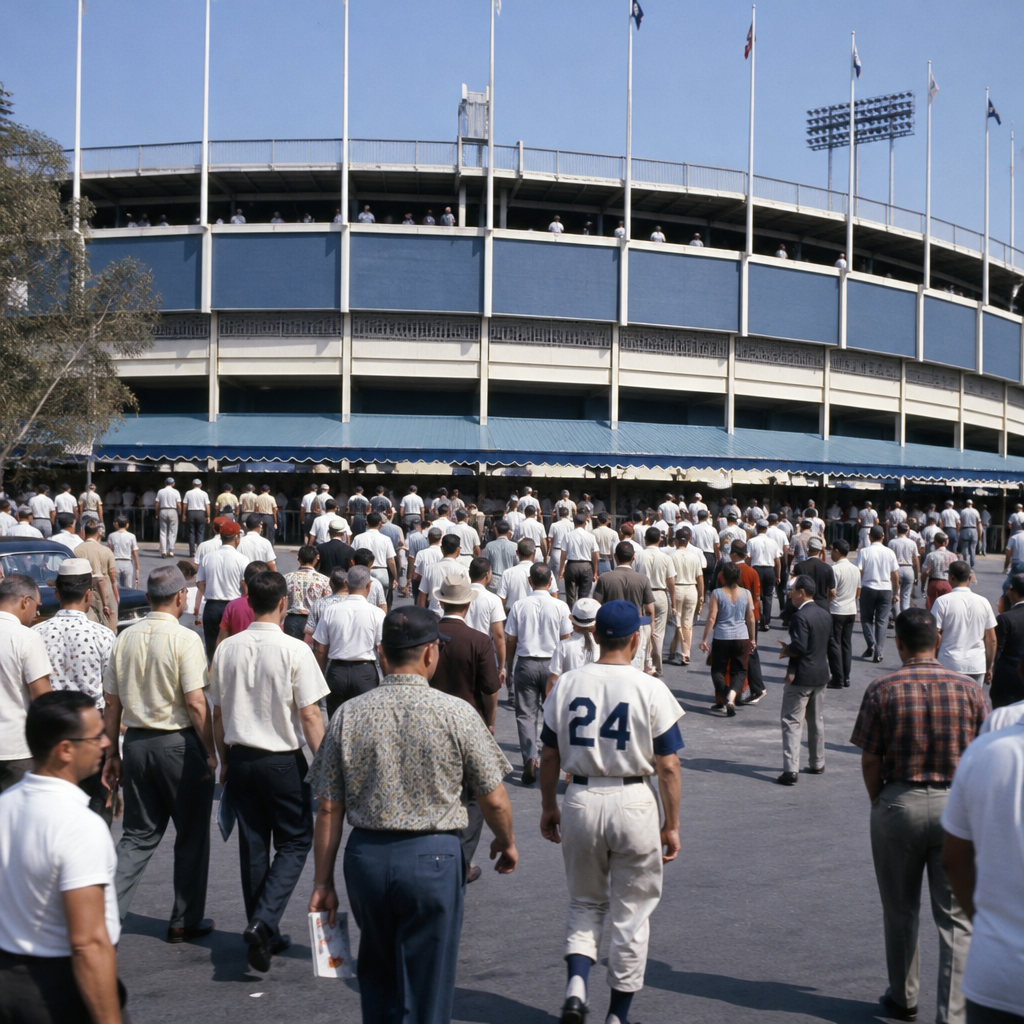
In 1958, Major League Baseball stopped being a northeastern and midwestern circuit and became a truly national game. The relocations of the Brooklyn Dodgers to Los Angeles and the New York Giants to San Francisco did more than shift two famous franchises across the continent; they redrew the sport’s economic map, accelerated postwar patterns of migration and suburban growth, and forced baseball to reconcile tradition with the realities of television, air travel, integration, and municipal power. To understand why the Dodgers and Giants changed the major league map, you have to place 1958 inside a larger story of war, integration, and relocation. World War II altered population centers and industry, Black migration and military service sharpened demands for equal access, Jackie Robinson’s debut in 1947 transformed who could play and who was welcome, and booming western cities offered the land, public financing, and political ambition that cramped eastern ballparks could not match. In practical terms, the move west was about attendance, territory, infrastructure, and ownership strategy. In historical terms, it marked the end of baseball’s old geography. This article serves as a hub for that transformation: how wartime change destabilized established markets, how integration expanded the game’s talent base and audience, why New York could lose two National League clubs, how California leaders secured teams, and what 1958 set in motion for every relocation that followed.
War, Demography, and the End of Baseball’s Old Regional Map
Before the 1950s, major league baseball was clustered tightly in the Northeast and upper Midwest. Boston, New York, Philadelphia, Chicago, St. Louis, Cincinnati, Cleveland, Detroit, Pittsburgh, and Washington formed the practical boundaries of the game. That arrangement made sense in the rail era, when teams needed compact travel routes and owners depended heavily on gate receipts from dense urban neighborhoods. But the United States that emerged from World War II no longer fit that map. Defense spending during the war expanded aircraft production, shipbuilding, oil refining, and electronics on the Pacific Coast. California’s population surged, especially in Los Angeles County and the Bay Area, as workers followed jobs and then stayed to raise families.
I always think the cleanest way to explain the pressure on baseball’s geography is this: the league map still reflected the 1910s, while the country looked increasingly like the 1950s. Wartime migration, highway construction, suburban homebuilding, and rising car ownership changed where fans lived and how they attended events. By the early postwar years, many eastern clubs still played in aging parks wedged into dense neighborhoods with limited parking and little room for modernization. Meanwhile, western cities could promise large parcels of land, easier automobile access, and public officials eager to use sports as civic advertising. When owners evaluated long-term revenue, the question was not simply which city loved baseball more. The question was which city could support modern baseball economics.
Air travel mattered too. In the 1930s, putting a club in California would have been logistically punishing. By the 1950s, commercial aviation had advanced enough that coast-to-coast competition was feasible, even if still demanding. The war had accelerated aviation technology and normalized long-distance movement. Baseball did not move west solely because planes existed, but without postwar aviation the transition would have been far more difficult. The old argument that the Pacific Coast was too far away weakened year by year.
Integration Changed the Game’s Talent, Audience, and Moral Center
No serious account of baseball’s westward move can be separated from integration. Jackie Robinson broke the modern color line with the Brooklyn Dodgers in 1947, and Larry Doby integrated the American League with Cleveland later that same year. Their arrivals did not just improve individual rosters; they changed the moral legitimacy and competitive structure of the sport. Clubs willing to sign Black talent gained access to a deep player pool that segregated teams had ignored. The Dodgers, in particular, became identified with institutional innovation under general manager Branch Rickey. Robinson was followed by Roy Campanella, Don Newcombe, and later a stream of Black and Afro-Latino talent that strengthened Brooklyn on the field and deepened its connection to broader social change.
Integration also changed fan expectations. Black newspapers, civic organizations, and younger urban audiences increasingly judged franchises by whether they were opening opportunities or protecting exclusion. In many cities, baseball was no longer just a neighborhood pastime; it was a public institution being asked to reflect democratic ideals after a war fought against fascism. That did not mean integration was smooth or complete. Housing segregation, discriminatory scouting networks, unequal treatment in spring training, and racist abuse remained part of the sport. Still, by the 1950s, clubs that embraced integration looked modern, ambitious, and better positioned to win.
For western cities, that mattered. Los Angeles and San Francisco sold themselves as forward-looking, fast-growing, nationally important places. Landing major league clubs was part of a broader campaign to present themselves as modern metropolises rather than distant outposts. A team associated with winning, star power, and a postwar future fit that pitch perfectly. The Dodgers’ identity as Robinson’s team carried symbolic weight well beyond the standings. Moving such a franchise west linked California not only to major league baseball but to baseball’s most consequential social transformation.
Why Brooklyn and Manhattan Became Vulnerable
The Dodgers and Giants were iconic, but iconic teams can still face unstable business conditions. In Brooklyn, owner Walter O’Malley confronted an old ballpark problem. Ebbets Field was beloved, intimate, and increasingly obsolete. It seated fewer fans than newer facilities, offered limited parking, and sat on a constrained urban site. O’Malley wanted a new stadium, preferably in Brooklyn at a location with room for automobile access and commercial development. His preferred site near Atlantic and Flatbush was entangled in New York’s urban redevelopment politics, particularly the authority of master builder Robert Moses, who instead favored a city-owned domed stadium in Queens. O’Malley resisted becoming a tenant in a multiuse municipal facility and wanted greater control over revenue streams.
The Giants faced similar pressures at the Polo Grounds. Once legendary, it had become a poor fit for midcentury baseball economics. The neighborhood had changed, attendance had declined, and the park’s unusual dimensions and aging infrastructure made it less appealing as a long-term home. Owner Horace Stoneham saw the same demographic trends others saw: population growth was moving outward and westward, while New York already had three teams competing for fans, media attention, and sponsorship. The Yankees, with their sustained success, further intensified that competition. Neither the Dodgers nor the Giants operated in a vacuum; they operated in a market where nostalgia could not guarantee financial stability.
People often frame the issue as greedy owners abandoning loyal fans, but that oversimplifies the record. Fan devotion in Brooklyn was real, and civic loss was enormous. Yet from an ownership standpoint, the combination of parking limitations, limited land control, rising maintenance costs, and unresolved stadium politics created risk. Baseball in the 1950s was still heavily gate-driven. A club that could not modernize its facility or expand ancillary revenues was vulnerable, especially when another city offered better terms.
How Los Angeles and San Francisco Won the Franchises
California did not passively receive the Dodgers and Giants; civic leaders organized aggressively. Los Angeles had already demonstrated ambition by building the Los Angeles Memorial Coliseum and by pursuing big-league status in multiple sports. City officials and business elites understood that a major league team could serve as proof that Los Angeles belonged among America’s first-rank cities. They offered market size, rapid population growth, a favorable climate, and the possibility of a new stadium. O’Malley ultimately secured land in Chavez Ravine, though only after a bitter and controversial local battle over housing, condemnation, and public use that still shapes the move’s historical memory. The Dodgers played temporarily at the Coliseum before Dodger Stadium opened in 1962.
San Francisco’s pursuit of the Giants was similarly strategic. Mayor George Christopher and local business interests worked to lure Stoneham, emphasizing the Bay Area’s wealth, corporate base, and civic prestige. Crucially, the Giants’ move complemented the Dodgers’ move. O’Malley wanted another National League club on the West Coast to reduce travel burdens and preserve rivalry value. The ancient Dodgers-Giants feud could be transplanted rather than erased. That pairing made western expansion operationally sensible and narratively powerful.
| Factor | Brooklyn/Manhattan Constraints | Los Angeles/San Francisco Advantages |
|---|---|---|
| Stadium situation | Aging parks, limited parking, constrained sites | Room for new facilities and car access |
| Population trend | Dense older neighborhoods, suburban outmigration | Rapid postwar population growth |
| Political support | Contentious redevelopment negotiations | Aggressive civic recruitment |
| Revenue outlook | Fewer modernization options | Larger future market potential |
| League logistics | Crowded New York market | Paired western footprint for scheduling |
That table captures the basic logic. The western cities did not merely offer sunshine. They offered a business model aligned with postwar America: highways, parking, municipal partnership, land assembly, and room to scale. In relocation history, those ingredients became the standard playbook.
1958 in Practice: Travel, Scheduling, Media, and Fan Response
When the Dodgers and Giants opened in California in 1958, the move tested whether major league baseball could operate on a continental scale. Scheduling had to account for longer road trips, travel fatigue, and clustered western swings. Teams from the East and Midwest spent extended periods in California, and the league gradually adjusted routines to make the distances manageable. What looked radical quickly became normal because the competitive and financial upside was obvious. Fans in Los Angeles and San Francisco responded immediately, validating years of speculation that the West Coast could support major league attendance.
Media economics amplified the effect. Television was beginning to reshape sports consumption, and a presence in California gave baseball access to enormous new households and sponsors. Time-zone differences created challenges, but they also extended the game’s daily footprint. Baseball could now matter late into the evening on the East Coast and dominate local identity on the Pacific Coast. The visual image of packed California stands told executives in every sport that the center of gravity in American entertainment was moving.
The emotional cost back east remained severe. Brooklyn lost more than a team; it lost a civic anchor. The Dodgers had represented borough pride against Manhattan power and Yankee dominance. New York National League fans felt abandoned, and many transferred allegiance reluctantly, if at all, until the Mets arrived in 1962. That grief is essential to the story because relocation is never only an accounting exercise. It reorganizes memory, neighborhood identity, and generational loyalty. But professional sports history shows repeatedly that civic emotion and ownership incentives do not always point in the same direction.
The Lasting Legacy for Baseball Eras, Expansion, and Relocation
The 1958 moves established the blueprint for baseball’s modern era. First, they proved that relocation could be a rational league strategy rather than a desperate exception. Second, they confirmed that stadium politics would shape franchise geography as much as tradition or on-field success. Third, they accelerated later expansion and movement, helping open the path to clubs in Minneapolis-St. Paul, Houston, Atlanta, Oakland, Seattle, San Diego, Toronto, Denver, Phoenix, and beyond. Once baseball crossed the continent, no region with sufficient population, money, and political will could be dismissed automatically.
They also closed one era and began another within the broader story of war, integration, and relocation. The war had redistributed people and industry. Integration had remade the sport’s competitive order and public meaning. Relocation translated those forces into geography. The clubs best able to adapt to new demographics, transportation systems, and revenue structures helped define the next half-century of baseball. That is why 1958 belongs at the center of any study of baseball eras: it sits at the hinge between urban neighborhood baseball and national entertainment baseball.
For readers exploring this subtopic as a hub, the key questions to carry forward are clear. How did military mobilization and defense spending reshape the map of American sports markets? How did integration alter scouting, attendance, and franchise identity? How did public financing, land use, and stadium design turn cities into competitors for teams? And how did the pain of losing a club influence later debates over expansion and public subsidies? Answering those questions reveals that the Dodgers’ and Giants’ moves were not isolated events. They were the visible breakthrough of deeper national changes already underway.
The simplest takeaway is this: the Dodgers and Giants changed the major league map because America had already changed, and baseball finally followed. If you want to understand later expansion battles, stadium deals, Sun Belt growth, or the continuing tension between local loyalty and franchise mobility, start with 1958. Use this hub as the foundation, then trace the connected stories of wartime migration, Jackie Robinson and integration, Robert Moses and urban redevelopment, Chavez Ravine, the Polo Grounds, and the rise of coast-to-coast sports. Baseball’s modern geography began when two New York teams looked west and saw the future.
Frequently Asked Questions
Why did the Dodgers and Giants leave New York for California in 1958?
The Dodgers and Giants moved west because the economics of Major League Baseball had changed dramatically by the 1950s. Both clubs still had famous histories and loyal fan bases in New York, but ownership increasingly saw older urban ballparks, limited parking, aging infrastructure, and neighborhood constraints as serious liabilities. Walter O’Malley of the Dodgers wanted a modern stadium that he could control financially, with room for automobiles, improved concessions, and larger crowds drawn from a growing suburban population. When his efforts to secure a new stadium site in Brooklyn stalled, Los Angeles offered land, political support, and the promise of a booming market. The Giants, owned by Horace Stoneham, faced many of the same pressures. Attendance had slipped, the Polo Grounds was aging, and the club was under financial strain. San Francisco, eager to join the top tier of American cities, presented a ready-made opportunity.
The move was also shaped by larger national trends beyond baseball itself. After World War II, population and wealth were shifting toward the Sun Belt and the Pacific Coast. Television was changing how fans consumed games, airlines were making transcontinental travel more practical, and city governments were becoming aggressive in using sports franchises as symbols of civic prestige and economic growth. In that environment, the Dodgers and Giants were not simply abandoning one city for another; they were following the country’s changing demographic and commercial center of gravity. Their relocation reflected a new vision of baseball as a coast-to-coast business rather than a regional institution rooted mainly in the Northeast and Midwest.
How did the 1958 moves change Major League Baseball’s geography and identity?
The arrival of the Dodgers in Los Angeles and the Giants in San Francisco transformed Major League Baseball from a league heavily concentrated in the Northeast and Midwest into a truly national sport. Before 1958, the major leagues were still clustered in older industrial cities, and the absence of teams west of St. Louis made baseball feel regionally bounded despite its national reputation. By placing franchises in California’s two most influential metropolitan areas, the sport broke that geographic barrier in a highly visible way. Suddenly, major league baseball was no longer something centered only around train lines, eastern newspapers, and old urban neighborhoods; it became a continental enterprise with Pacific Coast markets helping define the game’s future.
The symbolic impact was just as important as the logistical one. These moves told fans, owners, broadcasters, and politicians that baseball was willing to adapt to postwar America. It would go where population growth, television audiences, and municipal ambition were strongest. That change in identity paved the way for later expansion and relocation, including the spread of teams into other Sun Belt and western cities. It also altered how the sport thought about scheduling, media rights, and fan reach. A child in California could now grow up with a local National League club, and broadcasters could present baseball as a truly nationwide spectacle. In that sense, 1958 was not just a relocation story; it was the moment the major leagues redefined the map of American sports.
What role did television, air travel, and suburban growth play in the teams’ relocation?
Television, air travel, and suburbanization were central to the logic behind the Dodgers’ and Giants’ moves. Television was reshaping baseball’s business model by reducing a team’s dependence on fans physically attending games from nearby neighborhoods. Clubs could now build broader regional audiences, and owners increasingly recognized that media markets mattered as much as traditional local attachments. California offered enormous population centers and the possibility of attracting viewers across wide geographic areas. At the same time, televised baseball strengthened the appeal of cities with modern ambitions and growing consumer economies, making Los Angeles and San Francisco especially attractive homes for relocated franchises.
Air travel made the move feasible in a way that would have been far more difficult in an earlier era. Baseball had long depended on rail travel, and a west coast franchise would once have posed major scheduling and logistical headaches. By the late 1950s, commercial aviation made regular cross-country movement practical enough for a major league schedule. That did not eliminate every challenge, but it reduced distance from an overwhelming obstacle to a manageable business issue. Suburban growth completed the picture. Postwar families were moving out of dense urban neighborhoods into automobile-oriented communities, and many older ballparks were poorly suited to that new reality. Teams increasingly wanted stadiums with parking, highway access, and room for large-scale development. Los Angeles and San Francisco represented the future that baseball owners believed they needed to embrace: expansive metropolitan regions shaped by cars, television, and modern infrastructure.
How did the relocations affect New York, Los Angeles, and San Francisco?
In New York, the departures marked the end of an era. The city had been the unquestioned center of baseball culture, with the Yankees, Dodgers, and Giants creating one of the richest local rivalries in sports history. Losing both National League teams at once was not just a sporting blow; it was a cultural shock. Fans in Brooklyn and upper Manhattan lost clubs that had been woven into neighborhood identity, family tradition, and civic pride for generations. The emotional reaction was intense because the move seemed to confirm that loyalty and history could be outweighed by business calculations and political leverage. It also left a void in the National League presence in New York until the Mets arrived in 1962.
For Los Angeles and San Francisco, however, the relocations were major civic victories. Both cities gained more than baseball teams; they gained symbols of metropolitan importance. In Los Angeles, the Dodgers quickly became central to the city’s identity as a modern, fast-growing capital of postwar America. In San Francisco, the Giants reinforced the city’s standing as the cultural and commercial gateway to Northern California and the Pacific. These franchises connected local pride to national visibility, drew investment in sports infrastructure, and linked city governments more closely to big-league economics. The moves also helped establish California as a permanent center of gravity in professional sports, proving that western markets could support iconic teams and shape the future of major league competition.
Why is 1958 considered such a turning point in baseball history?
The year 1958 is considered a turning point because it marked the moment when baseball fully entered a new national and economic era. The Dodgers and Giants did not merely relocate; they demonstrated that even two of the sport’s most tradition-rich franchises could be uprooted and reimagined in the service of larger market forces. Their moves made clear that population trends, public subsidies, stadium politics, media reach, and modern transportation would increasingly determine where teams played and how the game grew. This was a decisive break from an older baseball order in which geography had seemed relatively fixed and club identity was assumed to be inseparable from place.
It was also a turning point because the relocations captured several postwar transformations at once. Baseball was adjusting to integration, to the rise of television as a dominant medium, to the political power of municipalities seeking major league status, and to the migration of people and capital toward the suburbs and the West. The moves anticipated the future of professional sports, where franchises would be viewed not only as community institutions but also as mobile assets shaped by media markets and public negotiations. That is why 1958 stands out so strongly in baseball history. It was the year the major leagues stopped looking like a regional inheritance from the early twentieth century and started looking like a modern national business operating on a new American map.