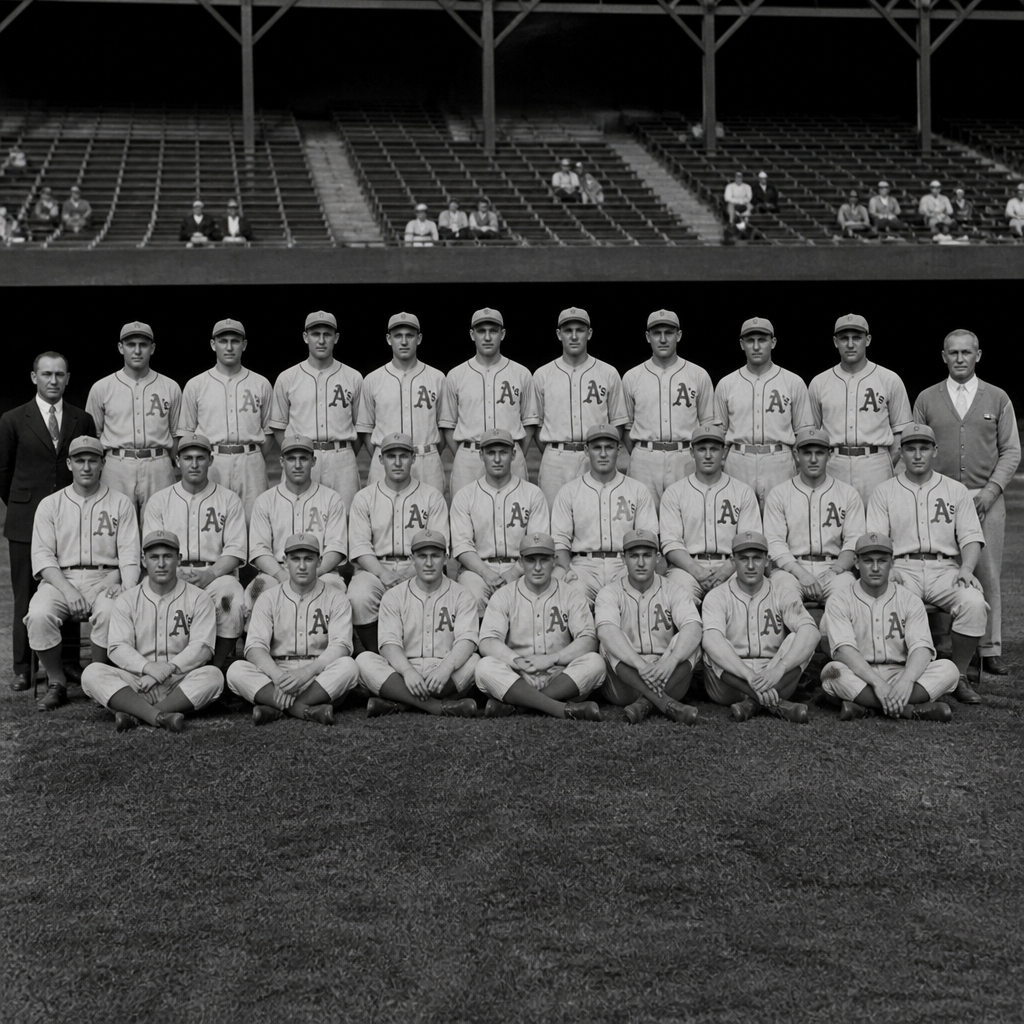
The 1929-1931 Philadelphia Athletics stand among baseball’s greatest dynasties, yet they are often overshadowed by the louder legend of the Ruth-Gehrig Yankees. Managed by Connie Mack and built around a deep, disciplined roster, the Athletics won three straight American League pennants and captured back-to-back World Series titles in 1929 and 1930 before falling just short in 1931. For anyone studying famous baseball teams, dynasties, and great teams, these Athletics are essential because they prove that power alone does not define supremacy. They won with balance, tactical flexibility, elite pitching, and a lineup that punished mistakes from top to bottom.
In baseball history, a dynasty usually means sustained contention over multiple seasons, star-level talent at several positions, postseason success, and a clear organizational identity. The Athletics met every part of that definition. From 1929 through 1931, they posted dominant regular-season records, beat historically strong opponents, and forced direct comparison with the Yankees at the height of New York’s fame. That comparison matters because the question is not whether the Yankees were iconic. They were. The real question is whether another team in the same era could match or exceed them on the field. For three years, Philadelphia did exactly that.
I keep returning to these Athletics when discussing great teams because they offer a sharper case study than many better-publicized champions. Their roster was not carried by one mythic slugger. Instead, it featured Hall of Fame-level contributors such as Jimmie Foxx, Al Simmons, Mickey Cochrane, Lefty Grove, and Max Bishop, plus crucial supporting players like Mule Haas, George Earnshaw, and Bing Miller. The club paired on-base skill, right-handed thump, left-handed pitching excellence, and smart defensive alignment. In practical terms, they were difficult to outscore, difficult to exploit, and remarkably resilient under pressure.
As a hub for dynasties and great teams, this article also frames the broader standard by which baseball powers should be judged. Great teams do more than win one title. They answer every kind of challenge: rival superteams, postseason adversity, roster transitions, and the daily grind of pennant races. The 1929-1931 Athletics passed those tests. Their story belongs alongside the Murderers’ Row Yankees, the Big Red Machine, the postwar Yankees, the 1970s Athletics, and the late-1990s Yankees because their peak was sustained, their opposition was elite, and their style was complete.
Why the 1929-1931 Athletics qualify as a true dynasty
The clearest argument starts with results. Philadelphia won the American League pennant in 1929, 1930, and 1931. They finished 18 games ahead in 1929, 16 games ahead in 1930, and 13.5 games ahead in 1931. In a league that still included the Yankees, that level of separation was extraordinary. They then won the World Series in 1929 against the Cubs and repeated in 1930 against the Cardinals. The 1931 club reached a third consecutive World Series before losing to the Cardinals in seven games. That is not a brief spike. It is sustained dominance.
The numbers behind those pennants are just as persuasive. The 1929 Athletics won 104 games. The 1930 team improved to 102-52 despite every opponent treating them like the standard to beat. In 1931 they won 107 games, the best mark of the three-year run. Modern readers sometimes assume dynasties are built mainly on offense, but Philadelphia excelled on both sides of the run-prevention equation. They scored in volume, reached base consistently, and featured the league’s most overpowering ace in Lefty Grove. They were not merely talented. They were structurally superior.
What I find especially important is context. The late 1920s and early 1930s were not a weak period waiting for a champion to claim empty space. The American League contained the Yankees at near-peak fame, with Babe Ruth and Lou Gehrig still terrorizing pitchers. The Athletics did not inherit the throne after New York collapsed. They ripped it away in direct competition. That head-to-head significance is why this club deserves a central place in any discussion of famous baseball teams. Dynasties become more convincing when they beat another dynasty-caliber rival in real time.
Connie Mack’s leadership further strengthens the case. By the time this run began, Mack was already one of the sport’s defining managers and executives. He had built a previous Athletics dynasty before dismantling it for financial reasons, then patiently reconstructed a new contender. His second great club was less flashy than the Yankees but more adaptable. Mack understood platoon advantages, valued strike-zone judgment, and trusted depth. Those choices matter when assessing great teams because a dynasty is never just a collection of stars. It is a system that repeatedly puts players in positions to succeed.
The roster core that made Philadelphia dangerous every day
The lineup was relentless. Jimmie Foxx was emerging into one of baseball’s all-time great right-handed sluggers, combining home-run power with a high batting average and run production that punished any pitching mistake. Al Simmons supplied another devastating bat, driving balls to all fields and thriving in run-producing spots. Mickey Cochrane added elite catching, leadership, and offensive value from a premium defensive position. Max Bishop gave the club patience at the top of the lineup, while Bing Miller and Mule Haas lengthened the order. Opponents could not pitch around one star and relax. There was no soft landing.
On the mound, Lefty Grove was the club’s defining force. At his best, Grove was overpowering, efficient, and psychologically intimidating. His fastball and command allowed Philadelphia to stop losing streaks quickly and control big series. George Earnshaw provided major support, especially during the 1929 and 1930 seasons, while Rube Walberg contributed another left-handed look. The staff fit the era perfectly: frontline dominance, enough innings from starters to stabilize the schedule, and support from a roster that could score in bunches. In October, that combination became even more dangerous.
Defense often gets lost when older teams are discussed, but this Athletics club was not careless behind the ball. Cochrane’s game management mattered. Infield reliability mattered. So did outfield range in spacious parks. When I evaluate great teams, I look for hidden edges that do not always lead newspaper headlines. Philadelphia had them. They converted batted balls into outs at a strong rate for the period and avoided giving away extra chances. Against lineups like the Yankees, even one extra out per game could swing a pennant race.
| Season | Regular-Season Record | AL Finish | World Series Result | Key Strength |
|---|---|---|---|---|
| 1929 | 104-46 | 1st | Beat Cubs | Deep offense and Grove-Earnshaw pitching |
| 1930 | 102-52 | 1st | Beat Cardinals | Balanced lineup with championship experience |
| 1931 | 107-45 | 1st | Lost to Cardinals in 7 | Peak regular-season dominance |
This balance is why the Athletics remain such a useful reference point for dynasty analysis across baseball history. Compare them with one-dimensional champions and the difference is obvious. Some clubs win with overwhelming pitching but a thin lineup. Others slug their way through regular seasons, then stall in October against top arms. Philadelphia had answers in every phase. If Foxx was quiet, Simmons or Cochrane could carry the attack. If the offense had a slower day, Grove could shorten the game. Great teams create multiple paths to victory, and this club consistently did.
How the Athletics measured up against the Ruth-Gehrig Yankees
The Yankees remain the standard comparison because they represented baseball celebrity, power, and intimidation in its most famous form. Ruth changed the geometry of the sport, and Gehrig was an unmatched run producer. Yet the Athletics challenged them not through mythology but through superior aggregate performance across these three seasons. Philadelphia outfinished New York each year from 1929 through 1931. That simple fact should reshape how the era is remembered. The Yankees were still formidable, but the better team over those pennant races was Connie Mack’s club.
Stylistically, the contrast is revealing. The Yankees were built around transformational middle-of-the-order thunder and immense star gravity. The Athletics had star power too, but they spread pressure throughout the batting order and paired it with more complete pitching depth. In a long season, that matters. Teams survive slumps, injuries, and schedule compression by having six or seven dangerous hitters instead of two or three overwhelming ones. Philadelphia also exploited the tactical side of the game more consistently, taking extra bases, working counts, and using matchup advantages without needing dramatic reinvention.
Another important point is that the Athletics proved they could handle the emotional burden of chasing a giant. Clubs often play tightly when trying to unseat a reigning icon. Philadelphia did the opposite. They were calm, experienced, and visibly confident. I think that confidence flowed from Mack and Cochrane. The team knew it did not need to imitate the Yankees’ style to beat them. It needed to execute its own game. That is a hallmark of many great teams across eras, from the Dodgers of the 1950s to the Reds of the 1970s and beyond.
When building a hub around dynasties and great teams, this comparison helps clarify an important principle: all-time status should not be awarded solely by market size or memory volume. It should be grounded in who actually controlled the competitive landscape. Between 1929 and 1931, the Athletics controlled it. They won more, finished higher, and took two championships. The Yankees had greater long-term brand power, but Philadelphia had the stronger short-run claim to supremacy. That distinction is exactly why these Athletics deserve renewed attention from anyone studying baseball’s elite clubs.
World Series performance and the shape of their legacy
The 1929 World Series win over the Cubs announced the Athletics as champions, but the manner of victory is what made it memorable. Philadelphia staged one of the most famous rallies in Series history in Game 4, scoring 10 runs in the seventh inning after trailing by eight. That comeback captured the character of the club: patient, explosive, and never rushed. In 1930, they repeated against the Cardinals, confirming that the first title was not a lucky peak. Repeating is one of the clearest tests of greatness because every opponent studies the champion more closely.
The 1931 defeat to St. Louis complicates the legacy in a useful way. Great teams are not diminished by a single seven-game loss, especially when they reached a third straight World Series and won 107 regular-season games. If anything, that defeat reminds us how thin the margins can be in October. Baseball’s postseason is not always a perfect meritocracy. Short series can turn on one pitching matchup, one error, or one stranded baserunner cluster. The Athletics did enough over three seasons to establish dynasty credentials regardless of that final outcome.
Why, then, are they less celebrated than some rivals? Market visibility is one reason. New York generated a bigger spotlight, and Ruth dominated national attention. Another factor is what happened next. Financial pressure during the Great Depression pushed Mack to break up the roster, and the dynasty ended before it could stretch deeper into the decade. Even so, the briefness of the peak should not obscure its quality. If your goal is to identify great baseball teams at their apex, the 1929-1931 Athletics belong near the front of the conversation.
For readers exploring famous baseball teams, dynasties, and great teams, the lesson is straightforward. Start with sustained pennants, examine roster balance, weigh the quality of opposition, and study how a club won, not just how often. By those measures, the Philadelphia Athletics were elite. They beat the era’s marquee rival, won consecutive championships, and reached a third straight World Series with one of the most complete rosters baseball had seen. If you are building your own list of baseball dynasties, put the 1929-1931 Athletics in it, then follow the rest of this hub to compare them with every other great team worthy of the name.
Frequently Asked Questions
Why are the 1929-1931 Philadelphia Athletics considered one of baseball’s greatest dynasties?
The 1929-1931 Philadelphia Athletics are considered one of baseball’s greatest dynasties because they combined sustained winning, elite talent, postseason success, and unusual roster balance during one of the sport’s most competitive eras. Under Connie Mack, the Athletics won three straight American League pennants from 1929 through 1931, captured the World Series in 1929 and 1930, and came within one series of winning three consecutive championships. That kind of run places them in rare company.
What made these Athletics especially impressive was that they were not a one-dimensional club built around a single superstar or one overwhelming strength. They had middle-of-the-order power in Jimmie Foxx and Al Simmons, a complete all-around star in Mickey Cochrane, excellent infield play, strong pitching led by Lefty Grove and George Earnshaw, and the strategic discipline that defined Connie Mack’s best teams. They could beat opponents with home runs, timely hitting, pitching depth, defensive reliability, and smart game management.
They also deserve special recognition because they thrived in the shadow of the more heavily mythologized New York Yankees of Babe Ruth and Lou Gehrig. The Athletics were not merely a good team in the same era; they were a genuine rival power that interrupted Yankee supremacy and proved that the American League was not owned by New York alone. For historians of famous baseball teams and great dynasties, that matters enormously. Their success was not a fluke season but a sustained peak, and that is exactly what defines a true dynasty.
Who were the key players on the 1929-1931 Philadelphia Athletics?
The core of the 1929-1931 Philadelphia Athletics was outstanding, and it is one of the main reasons the team remains essential to any discussion of baseball’s greatest clubs. Jimmie Foxx was one of the biggest stars. A fearsome right-handed slugger, Foxx brought enormous power to the lineup and would go on to become one of the defining hitters of his era. Al Simmons was another foundational offensive force, consistently producing high batting averages and run production while giving the Athletics a devastating middle of the order.
Mickey Cochrane was just as important, even if modern fans sometimes overlook catchers when listing dynasty-building stars. Cochrane was an exceptional hitter for his position, a leader on the field, and a steadying presence behind the plate. His all-around value helped hold the club together. On the pitching side, Lefty Grove was the ace and one of the most dominant pitchers in baseball history. He combined power, command, and a fierce competitive edge, making him a nightmare for opposing hitters. George Earnshaw provided high-level support in the rotation and was a major part of why Philadelphia could sustain excellence over multiple seasons.
The roster also featured valuable contributors beyond the headline names. Max Bishop gave the team on-base ability and infield stability, while players such as Jimmy Dykes added versatility, toughness, and experience. That depth is critical to understanding the Athletics. They were not just a collection of stars; they were a complete, well-constructed team. Connie Mack had assembled a roster with few weaknesses, and the blend of stars and role players allowed the Athletics to operate like a machine during their championship years.
How did Connie Mack build and manage a team capable of challenging the Ruth-Gehrig Yankees?
Connie Mack built and managed the 1929-1931 Athletics through patience, talent evaluation, discipline, and a deep understanding of how to shape a roster over time. Mack was already one of the most respected figures in baseball, and he did not create this dynasty overnight. He developed young talent, identified players who fit together, and built a team that could match New York’s star power while often surpassing the Yankees in balance and efficiency.
One of Mack’s great strengths was resisting the temptation to rely solely on glamour or headline-making offense. While the Athletics certainly had power, they were more complete than many rivals. Mack valued hitters who could do more than swing for the fences, pitchers who could work effectively in big situations, and defenders who could convert opportunities consistently. That broader team-building philosophy helped Philadelphia endure across multiple pennant races rather than burn brightly for just one season.
As a manager, Mack brought calm authority. His style was famously composed, but that should not be mistaken for passivity. He knew how to handle personalities, when to trust his stars, and how to maintain focus across a long season. In an era when baseball dynasties were often remembered through larger-than-life individual legends, Mack’s Athletics stood out as a team in the truest sense. He gave them structure, purpose, and confidence, and that allowed them to go toe-to-toe with the Ruth-Gehrig Yankees at the height of New York’s fame. In many ways, Mack’s genius was creating a club that was not intimidated by the Yankees’ aura and was talented enough to beat them anyway.
How did the Philadelphia Athletics compare to the Ruth-Gehrig Yankees of the same era?
The comparison is fascinating because it pits two different kinds of baseball greatness against each other. The Ruth-Gehrig Yankees are remembered as a thunderous, iconic powerhouse driven by two of the most famous names in sports history. Their legend is immense, and for good reason. But the 1929-1931 Philadelphia Athletics were every bit a worthy rival, and in that three-year window they often looked like the more complete club.
Where the Yankees were defined in popular memory by their spectacular top-end star power, the Athletics offered remarkable depth and balance. Philadelphia had elite hitters, but also dominant pitching and strong overall team construction. Lefty Grove gave the Athletics an ace capable of controlling games at the highest level, while Foxx, Simmons, and Cochrane formed an offensive core that could match up with almost anyone. The Yankees had unmatched celebrity and historic firepower, but the Athletics had fewer soft spots and could win in more ways.
This is exactly why the Athletics matter so much in baseball history. They challenged the assumption that the Yankees simply ruled the era uncontested. From 1929 through 1931, Philadelphia seized the American League pennant three straight times, proving that even the mighty Yankees could be displaced by a better-rounded and better-executing opponent. The Yankees may have won the long-term battle for historical attention, but the Athletics won the more important battle on the field during that stretch. That is why any serious discussion of classic baseball teams has to include them alongside New York’s more celebrated dynasty.
Why are the 1929-1931 Philadelphia Athletics often overlooked today?
The biggest reason the 1929-1931 Philadelphia Athletics are often overlooked is that they existed next to one of the loudest legends in all of sports: the Yankees of Babe Ruth and Lou Gehrig. Baseball history, especially in the popular imagination, tends to gravitate toward oversized icons, and no team has ever had a bigger mythic presence than those Yankees. As a result, other great clubs from the same period are often pushed into the background, even when their achievements were extraordinary.
Another factor is that the Athletics’ dynasty was comparatively brief at the top. Although three straight pennants and two World Series titles is a monumental accomplishment, later fans often remember longer-running empires more easily. Philadelphia’s dominance burned intensely from 1929 to 1931, but it did not extend for a full decade. That shorter peak, combined with the eventual dismantling of the roster, made it easier for the team’s legacy to fade in mainstream retellings of baseball history.
Yet being overlooked should not be confused with being lesser. In fact, the relative neglect of these Athletics is one reason they are so rewarding to study. They represent a dynasty that was real, formidable, and historically important, even if it lacks the same marketing power and mythmaking machinery that surrounded the Yankees. For readers interested in famous baseball teams, championship clubs, and the greatest dynasties in sports, the 1929-1931 Athletics are essential precisely because they challenge simplified history. They remind us that baseball’s golden age was not just a one-team story, and that some of the sport’s finest champions are also among its most underrated.