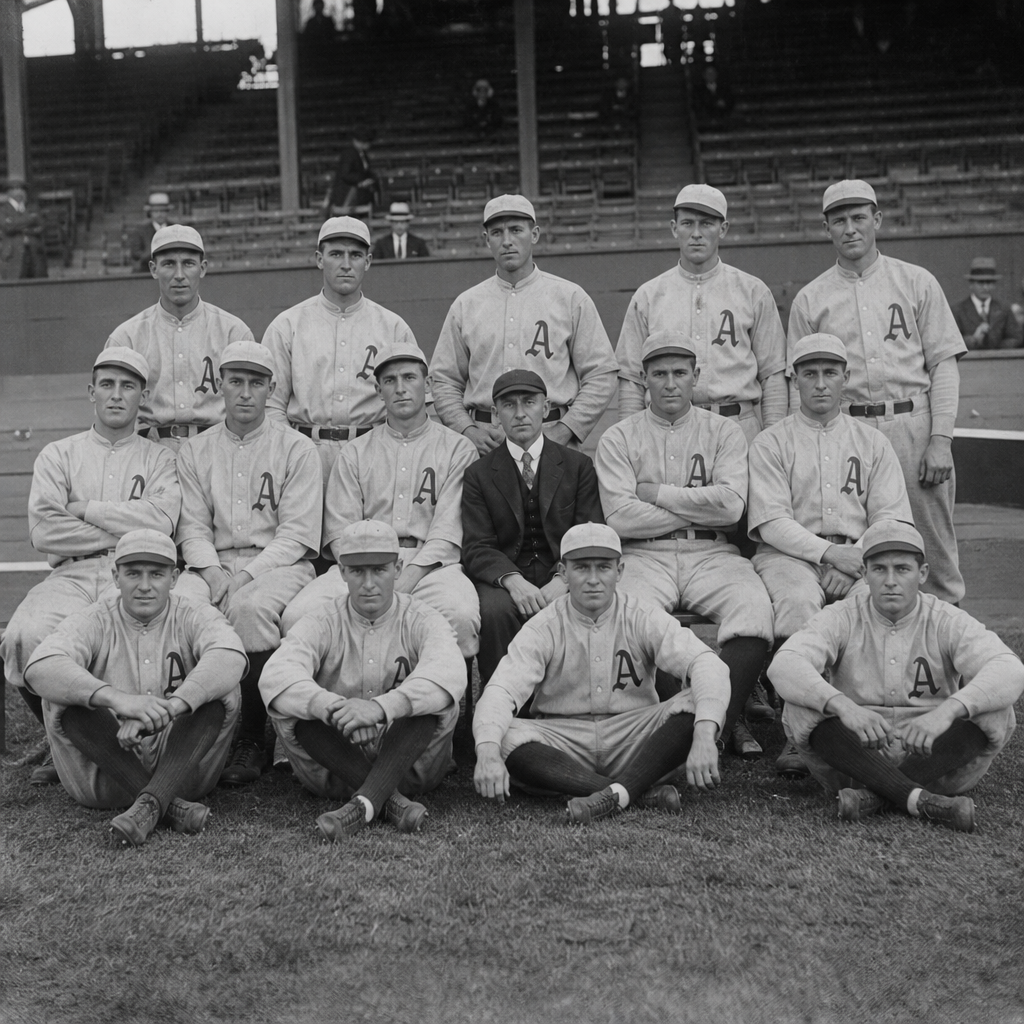
The 1910-1914 Philadelphia Athletics stand as one of baseball’s defining dynasties, a club that fused tactical intelligence, deep pitching, disciplined hitting, and Connie Mack’s unmatched authority into a sustained run of dominance. In baseball terms, a dynasty is not simply a champion that peaks for one October; it is a team that controls its league across multiple seasons, adapts to change, and leaves a model others try to copy. Mack’s Athletics did exactly that. From 1910 through 1914, they won four American League pennants and three World Series titles, finishing first in 1910, 1911, 1913, and 1914 while establishing a style rooted in defense, strike throwing, and situational offense. This period matters far beyond Philadelphia because it offers a template for understanding all great baseball teams: dynasties are built on elite cores, stable leadership, player development, and the capacity to win in more than one way. Any serious discussion of famous baseball teams, especially within the broader subject of dynasties and great teams, has to begin here. I have always found that when you study the Athletics closely, you do not just learn why they won; you learn how baseball power is actually constructed over time.
The club’s importance also comes from timing. The dead-ball era rewarded precision over brute force, and the Athletics mastered that environment without becoming one-dimensional. They stole bases, bunted when needed, converted balls in play into outs, and relied on pitchers who understood economy, movement, and fielding support. Yet they were not merely small-ball specialists. Their lineup had real impact hitters, most famously home run star Frank “Home Run” Baker, and they punished mistakes in high-leverage moments. Mack, tall, formal, and famously composed in the dugout, created a professional culture before “clubhouse culture” became standard baseball language. He managed personalities, balanced veterans with rising talent, and built a roster whose stars fit together rather than competing for space. As a hub for the study of dynasties and great teams, this Athletics era is essential because it connects nearly every theme that recurs in baseball history: transcendent managers, championship windows, financial constraints, postseason proof, and the thin line between a powerhouse and a breakup.
Why the 1910-1914 Athletics qualify as a true dynasty
The case is straightforward. Across five seasons, Philadelphia captured four pennants and three World Series championships. In 1910 they went 102-48 and defeated the Chicago Cubs. In 1911 they followed with a 101-50 season and beat the New York Giants. After a surprising fall to third in 1912, they rebounded in 1913 at 96-57 and again defeated the Giants. In 1914 they won 99 games and another pennant before being upset by the Miracle Braves. That level of repeat contention is the baseline standard for any baseball dynasty. A great team can dominate for one season; a dynasty survives scouting adjustments, aging curves, injuries, and the psychological grind of defending a title.
Context makes the accomplishment even stronger. The American League of this period featured serious competition, including Detroit with Ty Cobb, Cleveland with Nap Lajoie, and strong Washington and Boston clubs. Travel was difficult, rosters were less protected, and medical treatment was primitive by modern standards. Sustaining excellence under those conditions required unusual organizational clarity. The Athletics were not a lucky club that caught one hot month. They consistently finished with the league’s best or near-best run prevention, had enough offense to separate from rivals, and translated regular-season superiority into championships. When I compare dynastic resumes across eras, the first question is always whether a team clearly towered over its own competition. The Athletics did.
Connie Mack’s managerial blueprint and roster construction
Connie Mack was more than a field manager. He was effectively the architect, talent coordinator, cultural standard-setter, and strategic final voice for the franchise. Unlike more theatrical managers, Mack relied on restraint. He signaled confidence through calm, and players understood that discipline was nonnegotiable. His method reminds modern observers that authority in baseball can be quiet and still absolute. He preferred intelligent players who would execute game plans without waste, and he valued pitchers who worked quickly and trusted their defense.
Mack also excelled at balancing star power with role clarity. Eddie Collins gave the infield athleticism, speed, and elite on-base skill. Baker provided left-handed force and timely extra-base hitting. Stuffy McInnis was a polished contact hitter and defender at first base. Jack Barry stabilized shortstop and turned the famous “$100,000 Infield” into the most celebrated unit of its day. Behind and around them, Mack developed a supporting cast that did not need constant headlines to create wins. His best clubs were built less like collections of celebrities and more like integrated systems. That is one reason they fit naturally into any broad study of famous baseball teams: the Athletics show that dynasties are organizational achievements, not just accumulations of stars.
The stars who made the machine work
No dynasty survives without elite players performing at star level in repeated pennant races. Collins was arguably the club’s most complete player, combining batting average, plate discipline, baserunning intelligence, and defensive range. Baker became one of the era’s signature figures by leading the American League in home runs from 1911 through 1914, remarkable in a period when league leaders often finished with totals that seem tiny by modern standards. His power mattered because it was rare and game-changing in context. McInnis brought consistency at first base, while Barry gave the infield balance and reliability.
The pitching staff was equally important. Chief Bender, Eddie Plank, and Jack Coombs formed a championship-caliber core with distinct strengths. Plank, the left-hander, won with command and deception. Bender delivered power and nerve, especially in major games. Coombs was brilliant in 1910, winning 31 games in the regular season and three more in that World Series. The Athletics’ greatness came from overlap: their position stars prevented runs and created pressure, and their pitchers converted those advantages into series control. When a team can beat opponents 2-1 or 8-3, it stops being matchup dependent and starts becoming historically significant.
| Season | Regular-Season Record | American League Finish | World Series Result |
|---|---|---|---|
| 1910 | 102-48 | 1st | Defeated Cubs |
| 1911 | 101-50 | 1st | Defeated Giants |
| 1912 | 90-62 | 3rd | Did not qualify |
| 1913 | 96-57 | 1st | Defeated Giants |
| 1914 | 99-53 | 1st | Lost to Braves |
How the Athletics won games in the dead-ball era
The simplest answer is that they were complete. In the dead-ball era, run scoring was lower, fields were rougher, and one mistake could swing an entire game. Philadelphia thrived by reducing mistakes. Their pitchers limited free passes, their infield converted chances efficiently, and their offense understood inning construction. They advanced runners deliberately, put the ball in playable areas, and forced defenses to execute multiple clean actions. That style can sound ordinary until you compare it with less disciplined clubs that gave away outs or failed to capitalize on scoring position.
Defensively, the Athletics were exceptional at the positions that mattered most in that era: the mound, middle infield, and third base. Collins and Barry covered ground, Baker handled pressure plays, and the pitchers fielded their position well enough to support bunting defenses and quick reactions. Offensively, the team was patient without passivity. They did not chase spectacle; they sought leverage. A single, a steal, a productive out, and a well-placed hit could decide a contest. Yet when Baker or another hitter drove the ball for extra bases, the game could break open quickly. This tactical flexibility is a hallmark of every lasting dynasty, from early twentieth-century powers to modern postseason winners.
World Series performance and championship proof
For a team to be remembered as a dynasty, the regular season cannot be the whole argument. Philadelphia repeatedly proved itself on the sport’s biggest stage. In 1910 the Athletics beat the Cubs four games to one, announcing that their league dominance translated nationally. Coombs was the central figure, but the broader point was roster depth: the club did not rely on one player carrying every game. In 1911 they beat John McGraw’s Giants, an opponent known for intensity and tactical sophistication. Taking consecutive titles against clubs of that caliber elevated the Athletics from excellent to historic.
The 1913 World Series win over the Giants reinforced the pattern. By then, Philadelphia had already shown that 1912 was a stumble, not a collapse. They returned to first place and handled New York again, demonstrating resilience, adaptability, and sustained superiority. The 1914 loss to Boston is part of the story too. Great teams are not immune to upsets, and dynasties are often remembered more clearly when they reveal their vulnerability. The Braves swept the Series, but the defeat does not erase what came before. If anything, it highlights a recurring truth in baseball history: even dominant teams can be overturned in a short series when timing, health, and variance align against them.
The $100,000 Infield and baseball’s first great team identity
One reason the Athletics still matter in baseball memory is that they developed a recognizable identity around the infield. Collins, Baker, Barry, and McInnis became known as the “$100,000 Infield,” a label that signaled both excellence and market value long before modern free agency. The nickname helped define how fans and writers understood elite teams. This was not merely a winner; it was a unit with branded distinction, a central core people could name, compare, and mythologize.
That matters in the study of famous baseball teams because dynasties endure partly through identity. The Murderers’ Row Yankees, the Big Red Machine, and later champions all had shorthand that communicated structure and greatness. The Athletics were early masters of that phenomenon. Their infield was not marketing fluff. It represented real baseball value: defensive security, offensive production, and continuity across seasons. In practical terms, that continuity reduced strategic uncertainty. Mack knew what he would get from the middle of his diamond, and pitchers trusted the gloves behind them. Championship teams often describe confidence as contagious; this club institutionalized it.
Why the dynasty ended and what it teaches about great teams
The breakup came fast, and that abrupt ending is as instructive as the rise. After 1914, the rival Federal League challenged established baseball economics, salaries rose, and Mack responded by dismantling much of the roster. Eddie Collins had already been sold after 1914, and more stars followed. Financial pressure, ownership calculation, and changing league conditions can close a championship window even when the talent base remains strong. Dynasties are never purely about on-field quality; they depend on whether an organization can afford to keep excellence together.
This is why the 1910-1914 Athletics belong at the center of any hub on dynasties and great teams. They show the full lifecycle. First comes identification of undervalued talent. Then comes the building of a coherent core. Next comes repeated contention, championship validation, and the development of a lasting identity. Finally comes disruption, often driven by economics as much as competition. I have seen this pattern echoed in later eras again and again. The details change, but the structure does not. If you want to evaluate whether another famous baseball team deserves the dynasty label, this Athletics run gives you the checklist: sustained first-place finishes, elite core players, tactical clarity, postseason success, and historical influence beyond the standings.
The 1910-1914 Philadelphia Athletics were Connie Mack’s first great dynasty and one of baseball’s foundational superteams. They won four pennants in five years, captured three World Series, fielded the era’s most famous infield, and demonstrated that disciplined roster construction can outperform flash. Their greatness was not accidental. It rested on Hall of Fame talent, dead-ball era tactical mastery, consistent run prevention, and a manager who understood both baseball detail and human management. Just as important, their story explains how dynasties actually work: they are built patiently, proven under pressure, and often broken by forces beyond the field.
For readers exploring famous baseball teams, this Athletics club should be a starting point, not a footnote. It links early baseball strategy to later championship models and provides a clear benchmark for comparing every great team that followed. Study the records, the players, the World Series results, and the financial collapse that ended it, and the lesson becomes clear: sustained greatness is rare because it requires excellence in every layer of an organization at once. If you are building out your understanding of dynasties and great teams, start with Connie Mack’s Athletics, then use them as the standard against which all other baseball powers are measured.
Frequently Asked Questions
Why are the 1910-1914 Philadelphia Athletics considered Connie Mack’s first great dynasty?
The 1910-1914 Philadelphia Athletics are considered Connie Mack’s first great dynasty because they combined longevity, dominance, and identity in a way very few early baseball clubs ever did. This was not a team that simply caught fire for one season and disappeared. Philadelphia won pennants in 1910, 1911, 1913, and 1914, and captured the World Series in 1910, 1911, and 1913. Even in 1912, when they did not finish first, they still won more than 90 games, which underscored how consistently strong the club remained across the entire five-year window. That level of sustained success is what separates a dynasty from a single champion.
Just as important, the Athletics had a clear baseball philosophy that reflected Connie Mack’s influence. They were disciplined at the plate, strong on the mound, fundamentally sharp in the field, and usually calmer than their opponents in pressure situations. Mack was famous for leading with quiet authority rather than theatrical outbursts, and his teams often mirrored that temperament. He built a roster that was not only talented but also balanced, with stars in every phase of the game and role players who understood exactly what was expected of them.
The club also left a larger historical mark. In the years before the modern Yankees became baseball’s defining empire, the Athletics showed what a fully formed baseball powerhouse looked like. They set a model for how to build around elite pitching, patient offense, defensive reliability, and a stable managerial vision. That is why historians and fans alike view the 1910-1914 Athletics not merely as a winner, but as the first truly great Connie Mack machine.
Who were the key players that made the 1910-1914 Athletics so dominant?
The greatness of the 1910-1914 Athletics started with an exceptional core of players, many of whom are now remembered as among the finest of the Deadball Era. On the mound, Chief Bender, Eddie Plank, and Jack Coombs gave Philadelphia one of the strongest pitching foundations in baseball. Bender brought power, poise, and big-game credibility. Plank, a crafty left-hander, was one of the smartest and most durable pitchers of his generation. Coombs, especially at his peak, was capable of overwhelming hitters and carrying huge workloads. Having that kind of rotation meant the Athletics could control series, survive slumps, and stay formidable over the long season.
Offensively, the lineup featured stars who blended patience, contact ability, and timely hitting. Eddie Collins was perhaps the club’s most complete position player, a brilliant second baseman whose speed, baseball intelligence, and all-around skill made him one of the era’s great catalysts. Frank “Home Run” Baker gave the Athletics middle-of-the-order power at a time when true power hitters were rare, and his postseason heroics only enhanced his reputation. Stuffy McInnis added dependable production and polished defense at first base, while Danny Murphy and Amos Strunk contributed range, professionalism, and steady offense from the outfield.
At third base and in the infield overall, Baker and Collins gave the Athletics star quality, but the club’s edge came from how well the pieces fit together. This was not a random collection of famous names. Mack assembled complementary talent. He had pitchers who worked efficiently, fielders who converted chances cleanly, hitters who avoided wasteful at-bats, and leaders who understood situational baseball. The result was a roster with multiple Hall of Fame-level players and enough depth to make the entire operation feel relentless. That balance is a major reason the Athletics were so difficult to beat year after year.
What made Connie Mack such an effective manager during this era?
Connie Mack’s effectiveness during the 1910-1914 run came from a rare combination of authority, patience, talent evaluation, and long-range thinking. He did not manage with noise. Instead, he projected control through composure, discipline, and judgment. In an era when baseball could be rough-edged and emotional, Mack’s calm presence gave his club stability. Players understood that he expected professionalism, smart play, and accountability, and he built a culture where mental mistakes and selfish behavior had little place.
Mack was also an outstanding architect of a roster. He recognized not only raw ability but also temperament and fit. He knew how to identify pitchers who could handle pressure, infielders who could think through a game, and hitters who would not give away outs. That broader understanding of team construction is one reason the Athletics were more than just talented; they were coherent. The roster reflected a plan, and that plan was anchored in run prevention, offensive discipline, and strategic flexibility.
Another key part of Mack’s brilliance was his ability to adapt without losing the core identity of the club. The Deadball Era rewarded clubs that could manufacture runs, control the baseball, and exploit opponents’ mistakes, but Mack’s Athletics were not one-dimensional. They could play small ball, but they also had hitters who could drive the ball with authority when opportunities emerged. He understood when to trust his stars, when to demand fundamentals, and how to keep a talented roster aligned across multiple seasons. In practical terms, that is what dynastic leadership looks like. Mack did not merely win games; he created an organization with standards, continuity, and a competitive method that held up year after year.
How did the Athletics compare to other great teams of the Deadball Era?
The 1910-1914 Athletics compare very favorably to the other great clubs of the Deadball Era because they combined sustained regular-season excellence with repeated championship success. That matters in historical comparisons. Many teams from that period had a remarkable single year, but the Athletics repeatedly returned to the top of the American League and proved that their formula was durable. They were not built around one fluky performance, one miraculous pennant race, or one superstar carrying everyone else. Their success was systematic.
Compared with rival powers of the period, Philadelphia stood out for balance. Some clubs leaned heavily on pitching, while others depended more on speed, bunting, or defensive pressure. The Athletics could do all of those things well, but what made them especially formidable was that they had very few weaknesses. Their rotation could match up with elite opponents, their defense converted chances consistently, and their lineup featured disciplined hitters who could sustain innings. In an era when one mistake could decide a low-scoring game, that kind of all-around sharpness was a major competitive advantage.
The Athletics also deserve credit for their influence. Great Deadball teams were often identified by execution and toughness, but Mack’s club added an extra layer of organizational intelligence. They looked like a modern powerhouse in early form: carefully assembled, strategically flexible, and deeply aware of how to win over six months rather than just one week. That is why they are often placed alongside the very best teams of their generation. When historians discuss the pre-Babe Ruth giants of the sport, the Philadelphia Athletics of this period are always central to the conversation.
Why did the Athletics’ dynasty end after 1914?
The dynasty effectively ended after 1914 because the forces holding the team together began to give way all at once. Although the Athletics were still champions in 1914, the baseball and financial landscape was changing rapidly. The emergence of the Federal League created salary pressure by giving players a new competing destination. Owners who had previously exercised greater control over payroll now faced the possibility of losing stars or paying significantly more to keep them. Connie Mack, who was both manager and part of the club’s larger business structure, became more cautious about long-term costs.
That financial strain collided with the natural fragility of keeping a dynasty intact. Star players age, injuries accumulate, contract demands rise, and dynastic rosters become harder to maintain. Mack became famous, and controversial, for breaking up successful clubs when he believed their economic future no longer made sense. After 1914, key players from the Athletics’ championship core began to leave, and the team’s remarkable continuity vanished. Once that core was disrupted, it became nearly impossible to replicate the same blend of experience, chemistry, and high-end talent.
There was also a baseball reason beyond money alone: dynasties are difficult to sustain because the margin at the top is always thinner than it appears. The Athletics had spent years operating at an elite level, but maintaining that standard required a near-perfect alignment of stars, support players, health, and managerial control. Once the roster fractured, the club lost the interconnected strengths that had made it so imposing. In that sense, the end of the dynasty was not one dramatic collapse but the unraveling of a carefully constructed machine. Even so, the legacy of the 1910-1914 Athletics endured. Their run remained one of the earliest and clearest examples of what a true baseball dynasty looks like.