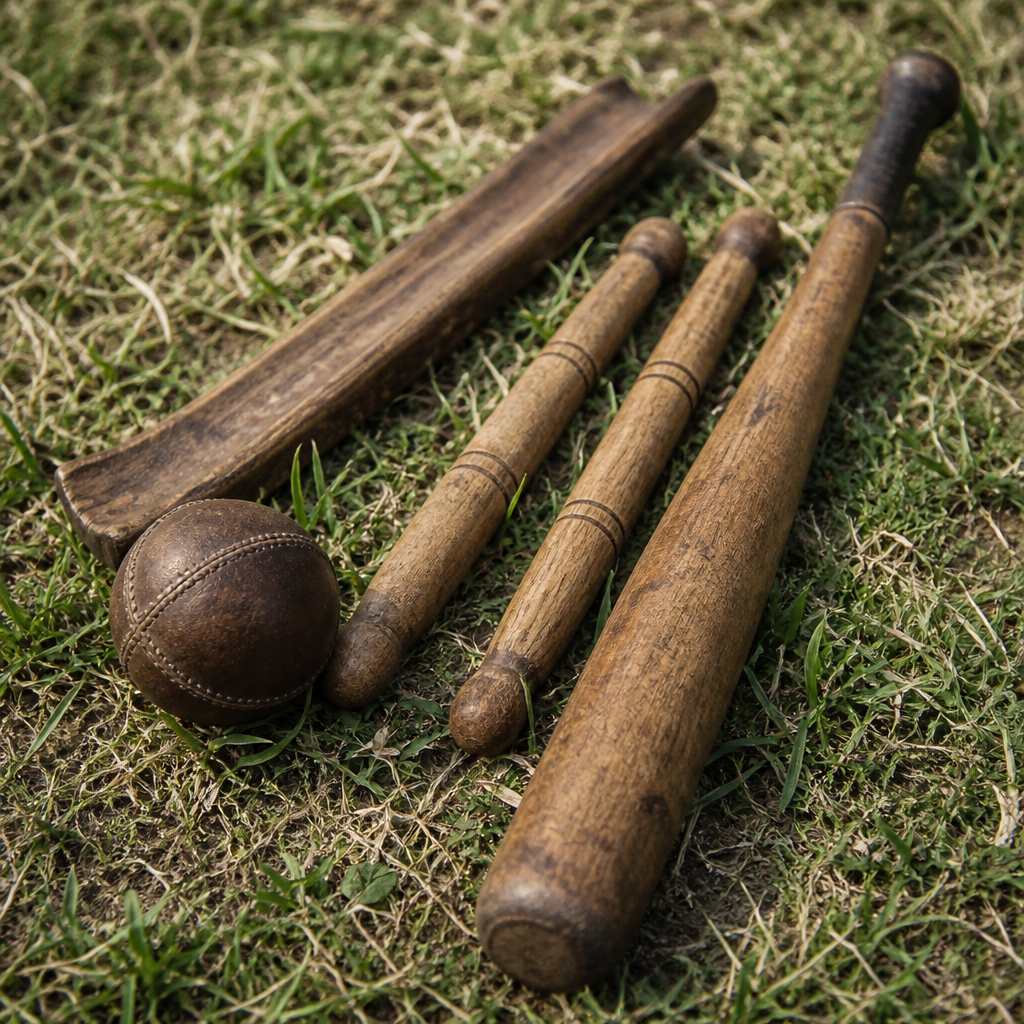
Wicket and baseball share a family resemblance that becomes clearer the deeper you study early American sport. Both are bat-and-ball games built around striking, running, fielding, and retiring opponents, yet wicket developed along a distinct path that reveals how varied North American play was before modern baseball rules hardened. In the early history of baseball, wicket matters because it shows that organized bat-and-ball competition in the United States did not emerge from a single invention or one tidy origin story. Instead, Americans played several related games, adapted local customs, and gradually favored the rule set that became baseball.
In practical terms, wicket was most strongly associated with the Northeast, especially Connecticut, western Massachusetts, and parts of New York. Players used a broad, often spoon-shaped bat, a low wicket instead of the upright striker’s target familiar from cricket, and a style of underhand bowling suited to skimming the ball toward the ground. Matches could involve many participants, wide fields, and local rules that varied from town to town. Baseball, by contrast, eventually standardized nine players per side, a diamond with ninety-foot basepaths, overhand or sidearm pitching within defined limits, and codified methods of recording outs, innings, and statistics. That standardization helped baseball spread nationally, while wicket remained regionally rooted.
As someone who has worked through nineteenth-century rulebooks, newspaper match reports, and club histories, I have found wicket especially useful for explaining what baseball inherited and what it rejected. It preserved older habits: handmade equipment, flexible team sizes, and community-centered contests that blurred the line between recreation and formal competition. At the same time, comparisons with baseball illuminate the rise of clubs, written rules, and spectator culture. Understanding wicket therefore is not a side note. It is central to any serious look at bat-and-ball origins, because it captures the messy, local, transitional world from which baseball emerged.
This hub article examines where wicket came from, how it was played, how it compared with baseball, and why it faded. Along the way, it answers common questions directly: Was wicket older than baseball in America? Did baseball come from wicket? Why did baseball win? The short answer is that wicket was one of several older American bat-and-ball traditions, baseball was not simply copied from it, and baseball triumphed because its rules, clubs, media coverage, and urban portability made it easier to organize, teach, and commercialize on a national scale.
What Wicket Was and Where It Fit in Bat-and-Ball Origins
Wicket was an American bat-and-ball game with deep roots in New England and the Mid-Atlantic during the late eighteenth and nineteenth centuries. It likely drew from English antecedents, but in the United States it evolved into its own recognizable form. The key distinction is that wicket was not merely a rustic version of baseball, nor a direct copy of cricket. It stood between broader folk traditions and emerging codified sport. If you map early American bat-and-ball origins, you find several branches: town ball, one old cat, rounders-like children’s games, cricket, and wicket. Baseball rose from that crowded ecosystem rather than from a single parent.
Documentary evidence places wicket in communities where baseball later gained strength. Connecticut is especially important. Clubs and local newspapers there reported wicket matches well into the nineteenth century, long after baseball clubs were forming in New York. That persistence tells historians two things. First, Americans already understood competitive bat-and-ball play before baseball’s famous club era of the 1840s and 1850s. Second, regional loyalty mattered. People did not simply drop familiar games the moment a new code appeared. They weighed convenience, identity, and habit.
Bat-and-ball origins are often oversimplified into a search for the first game or the one true ancestor. That approach misses how games actually develop. Rules migrate. Equipment changes because of materials and craft knowledge. Communities alter play to fit available ground, player age, weather, and local taste. Wicket illustrates this perfectly. It used a bat and ball, required timing and fielding skill, and rewarded coordinated team play, all features central to baseball. Yet its target, bowling style, and field geometry differed enough that anyone claiming baseball simply “came from wicket” is compressing a much more complex history.
How Wicket Was Played
The basic structure of wicket can be described plainly. A bowler delivered the ball underhand toward a low wooden wicket. The striker used a broad bat to defend the wicket and score by running. Fielders attempted to catch struck balls, strike the wicket, or put runners out under local rules. That sounds familiar to baseball fans, but the details changed the feel of the game dramatically. The low wicket encouraged skimming deliveries and defensive strokes unlike the upright swing paths common in baseball. The bat’s shape, wider and flatter than a baseball bat, was better suited to stopping or guiding low balls.
Field size and team size could be expansive. In many accounts, wicket used more players than baseball and occupied broader ground, which made contests social as much as tactical. A village or town could gather large sides without needing exact roster symmetry. That flexibility was a strength in rural communities where organized recreation depended on whoever turned up. It was also a weakness when sports culture shifted toward scheduled interclub competition. Baseball’s fixed nine-man team became easier to arrange, practice, and compare.
Scoring and dismissals also differed by locality. Some wicket matches used innings and run totals that resemble cricket more than baseball. Others reflected vernacular customs that would look odd in a modern scorebook. This variability is not a sign that wicket was unserious. Early sport often mixed agreed principles with local modifications. What matters historically is that wicket had enough structure to sustain clubs and repeat competition, but not enough nationwide uniformity to support rapid expansion across cities and states.
| Feature | Wicket | Baseball |
|---|---|---|
| Primary region | Connecticut, western Massachusetts, parts of New York | National by the late nineteenth century |
| Target defended | Low wicket near the ground | Home plate area and strike zone concept |
| Bat shape | Broad, often spoon-shaped | Round, narrow cylindrical bat |
| Delivery style | Underhand, often skimming low | Evolved from underhand to varied pitching motions |
| Team size | Often larger and flexible | Standardized at nine players |
| Rules | Local variation common | Increasingly codified through clubs and leagues |
| Playing field | Could be broad and irregular | Diamond-based and standardized |
| Historical trajectory | Regional persistence, then decline | National dominance and professionalization |
Key Similarities Between Wicket and Baseball
The strongest similarity is structural: one side puts a ball in play with a bat, then tries to score by running while the other side fields and records outs. That shared grammar matters because it explains why Americans who knew wicket could readily understand baseball. They already valued hand-eye coordination, strategic placement of hits, base running judgment, and collaborative defense. In both games, success depends not just on power but on anticipation. Fielders read angles, runners assess risk, and batters adapt to delivery patterns.
A second similarity is social organization. By the mid-nineteenth century, both games could support clubs, challenge matches, and local prestige. Newspaper coverage of wicket matches used language familiar to baseball historians: lineups, notable plays, margins of victory, and civic pride. That means wicket was part of the same broader culture that nourished baseball’s growth. It was not an isolated folk survival untouched by modern sport. In several towns, wicket and baseball overlapped, with communities gradually shifting attention rather than making an abrupt leap.
Third, both games sat within a larger American preference for adaptable outdoor recreation. Before enclosed stadiums and national leagues, a successful bat-and-ball game needed to work on commons, pastures, and improvised grounds. Wicket did that well. Baseball eventually did it even better because its field could be reproduced more consistently. Still, the continuity is significant: baseball’s rise makes more sense when you see that many Americans already enjoyed a recognizable template of batting, running, and retiring sides.
The Crucial Differences That Set Baseball Apart
The most decisive difference was standardization. Baseball, especially through the Knickerbocker rules and later the National Association of Base Ball Players, moved toward a shared code. Distances, player counts, foul territory, methods of putting runners out, and game length became clearer. Wicket never achieved comparable national agreement. Historians sometimes underrate how important that is. Standard rules do more than settle disputes. They allow clubs in different towns to compete fairly, newspapers to report games consistently, and new players to learn expectations quickly.
Equipment created another divide. The wicket bat’s broad face encouraged a style of play that looked and felt different from baseball hitting. Baseball’s narrower bat, combined with evolving pitching and fielding practices, rewarded a more varied offensive approach. As ball manufacture improved and clubs practiced more regularly, baseball could showcase line drives, bound catches in its early phase, strategic bunting later on, and eventually extra-base hitting in a way wicket did not emphasize to the same degree.
Baseball also fit urban life more neatly. In my review of period club records, this pattern appears repeatedly: sports that require less interpretive local knowledge spread faster in cities with growing populations and busy schedules. A baseball club could recruit nine men, mark out a diamond, and rely on printed rules used elsewhere. Wicket’s regional habits and broader personnel demands made replication harder. When rail travel, newspapers, and intercity competition expanded, baseball’s portability became a major competitive advantage.
Wicket, Town Ball, Rounders, and Cricket in Context
Any hub on bat-and-ball origins should place wicket among its neighboring games. Town ball was a loose category covering several American running games with bat-and-ball elements, often using soaking or plugging runners with the ball. Rounders, more prominent in British and Irish contexts, shared the base-running circuit familiar to baseball historians, though direct lines of influence are debated. Cricket contributed vocabulary, club culture, and methods of formalizing competition. Wicket touched all these worlds without fully matching any of them.
This is why responsible baseball history avoids single-cause explanations. The old Abner Doubleday myth failed because it ignored abundant evidence of earlier bat-and-ball play. But replacing that myth with another simplistic claim, such as “baseball came from wicket,” does not solve the problem. Baseball drew from a transatlantic pool of practices and from American local experimentation. Wicket is one of the clearest examples of that experimentation because it was organized enough to document and distinct enough to compare.
For readers exploring the early history of baseball, this broader frame matters. If you move from wicket to town ball, then to early New York game rules, you can see the process of selection at work. Americans tested different balances between offense and defense, formality and flexibility, local character and intercity uniformity. Baseball prevailed not because other games lacked merit, but because its rule set proved unusually scalable.
Why Wicket Declined While Baseball Expanded
Wicket declined for several connected reasons. First, baseball’s institutions became stronger. Clubs multiplied in the 1850s, newspapers published rules and match reports, and governing bodies encouraged conformity. Second, baseball served schools, cities, and employers well. It could be taught quickly, scheduled efficiently, and watched easily by spectators. Third, military camps during the Civil War accelerated baseball’s spread by exposing men from different regions to a common game. Wicket never received an equivalent national transmission system.
There was also a cultural shift in what Americans expected from sport. As recreation moved toward standard fixtures, standings, and commercial spectatorship, games with heavy local variation faced pressure. Wicket remained meaningful in places where tradition carried weight, especially in Connecticut, but its comparative advantage narrowed. A regionally cherished game can survive for decades; it struggles when competitors offer easier travel competition, clearer printed instruction, and stronger media storytelling.
That does not mean wicket disappeared instantly. Local persistence is one of the most important lessons here. Older games often coexist with rising ones for a generation or more. In some communities, baseball arrived first as an occasional novelty, then as a youth preference, then as the main club sport. Wicket’s decline was therefore gradual, not abrupt, and that gradualism is exactly what historians should expect when customs, identities, and institutions overlap.
What Wicket Reveals About the Early History of Baseball
Wicket reveals that baseball emerged from adaptation, not sudden invention. Americans were already comfortable with bat-and-ball competition, club challenges, and rule negotiation. Baseball’s achievement was to consolidate those impulses into a format that balanced familiarity with precision. Looking at wicket makes baseball’s eventual dominance more impressive, not less, because it had to win against established alternatives that people genuinely enjoyed.
Wicket also reminds us that regional sport histories matter. National narratives can flatten the map, making it seem as though one code simply radiated outward from New York. The real story is more textured. Different communities backed different games, and baseball’s rise involved persuasion, imitation, convenience, and infrastructure. When historians compare wicket and baseball carefully, they can explain not only where baseball came from, but why some plausible rivals remained local.
For anyone building a deeper understanding of bat-and-ball origins, wicket is indispensable. Study its rules, equipment, and geography, and the early history of baseball becomes less mythical and more human: a story of experimentation, local pride, and practical choices. The key takeaway is simple. Wicket was an important early American bat-and-ball game that resembled baseball in broad structure but differed in equipment, field design, and standardization. Baseball became the national game because it codified better, traveled better, and scaled better. Use this hub as your starting point, then continue into related topics such as town ball, rounders, cricket, and the New York game to see the full lineage clearly.
Frequently Asked Questions
What was wicket, and how was it different from early baseball?
Wicket was an early American bat-and-ball game that flourished especially in parts of the Northeast during the eighteenth and nineteenth centuries. At a basic level, it looked familiar to anyone who knows baseball: one side batted, the other fielded, players tried to strike a pitched or delivered ball and run to safe points, and the defense worked to put runners or batters out. That family resemblance is exactly why wicket is so important to the history of American sport. It demonstrates that long before baseball became the dominant national pastime, Americans were already playing organized competitive games built on many of the same ideas.
The key difference is that wicket was not simply “baseball before baseball.” It had its own equipment, field layout, customs, and local traditions. The wicket itself was often much wider and lower than the upright strike zone people associate with baseball, and that alone shaped the style of play. Batting, delivering the ball, defending the field, and retiring runners all worked under a distinct logic. In many versions of wicket, the action emphasized placement, ground-level play, and strategic running in ways that could feel noticeably different from the later baseball game standardized by clubs and rulemakers.
Another major distinction is historical trajectory. Baseball eventually became codified through clubs, published rules, governing bodies, and expanding press coverage. Wicket remained more regional and less uniformly standardized, which helped preserve local character but limited its long-term reach. So while both games shared the broad grammar of bat, ball, runner, and field, wicket followed its own developmental path. That makes it valuable not just as a curiosity, but as evidence that early American sporting culture was diverse, experimental, and far less linear than a simple origin story for baseball would suggest.
Why does wicket matter in the history of baseball?
Wicket matters because it complicates the idea that baseball sprang from a single moment, inventor, or tidy chain of development. When historians look closely at early American bat-and-ball games, they find a crowded landscape that included wicket, town ball, round ball, and other local variations. Wicket is one of the clearest examples of that broader sporting environment. Its existence shows that Americans were already participating in organized games with batting, running, and fielding structures before baseball rules became dominant.
That matters for two reasons. First, it helps explain why baseball could spread so successfully. The public was not being introduced to an entirely alien pastime. Instead, many communities already understood the pleasures and competitive rhythms of striking a ball, advancing runners, making catches, and recording outs. Baseball’s rise happened in a culture that was already fluent in related forms of play. Wicket therefore belongs in the prehistory of baseball not because it directly turned into baseball everywhere, but because it reveals the sporting habits and expectations that made baseball legible and appealing.
Second, wicket shows that early American sport did not evolve in a straight line toward one inevitable final form. Baseball became standard, but that outcome was historical, not preordained. Other games had strong regional followings, their own traditions, and their own communities of players. By studying wicket, we see a richer and more contested story: American bat-and-ball culture was once plural, and baseball won out through organization, standardization, publicity, and social networks rather than through some automatic superiority. In that sense, wicket is essential evidence for understanding baseball as part of a larger ecosystem rather than as a lone invention.
How was wicket actually played?
Because wicket varied by region and over time, there was no single universal version, but the core structure was consistent enough to outline. Two sides competed, with one team batting and running while the other fielded. A ball was delivered to a batter, who attempted to strike it and then run between designated points or toward goals that functioned somewhat like bases. The fielding side tried to retire the batter or runners by catching batted balls, breaking the wicket, or putting players out according to the local rules in use. Like many early games, wicket blended familiar patterns with practices that could differ sharply from later baseball.
One of the most distinctive features was the wicket itself. Rather than the tall, narrow arrangement that later cricket uses or the abstract strike zone of baseball, wicket often employed a broad, low target. That changed how the ball was delivered and how it was struck. Play could involve lower trajectories and tactical hitting adapted to the physical design of the wicket and the expectations of the local code. The bat, too, could differ in shape and use from the standardized baseball bat that became common later, and the style of batting reflected those differences.
Running and retiring opponents also reflected an earlier sporting world in which rules were not fully nationalized. In some forms of early American bat-and-ball play, outs could be made by methods now foreign to modern baseball audiences, and wicket occupied that same flexible environment. What makes the game especially interesting is that it could still be highly organized and competitive even without the rigid nationwide standardization later associated with baseball. In other words, wicket was not informal chaos. It was a legitimate sporting tradition with established expectations, but those expectations were rooted in local practice rather than a single modern rulebook.
Did wicket influence baseball directly, or were they just related games?
The safest historical answer is that wicket and baseball were related games within the same broader bat-and-ball tradition, and in some places wicket likely influenced how people understood and played other local games, including forms that fed into baseball culture. But it would be too simplistic to claim that wicket directly became baseball in any universal or one-to-one sense. The historical record points instead to overlap, coexistence, and mutual context rather than a single clean line of descent.
That distinction is important. People often want early sport history to produce a straightforward family tree with one parent game and one clear successor. In reality, early American recreation was messy, regional, and interconnected. Communities borrowed ideas, adapted customs, preserved local favorites, and sometimes played multiple bat-and-ball games side by side. Wicket belongs to that world. It likely shaped sporting habits in the places where it was strong, familiarizing players and spectators with organized competition based on batting, running, and fielding. Those habits formed part of the cultural soil from which baseball grew.
So rather than seeing wicket as a discarded draft of baseball, it is better to understand it as a parallel tradition that helps explain the environment in which baseball emerged. Some features may have echoed across games, and some participants may have moved between them, but baseball’s eventual standardized form was assembled through broader processes of codification and club organization. Wicket’s importance lies less in serving as a direct ancestor and more in proving that early America already sustained multiple viable bat-and-ball traditions before baseball consolidated national authority.
Why did baseball survive as the dominant game while wicket faded?
Baseball’s dominance was not just a matter of gameplay; it was also a matter of timing, institutions, publicity, and standardization. During the nineteenth century, baseball benefited from the growth of urban clubs, newspapers, published rules, intercity competition, and governing organizations that could define a common version of the game. That standardization made it easier for teams from different places to compete under shared expectations. Once a game reaches that level of organizational clarity, it becomes easier to teach, promote, schedule, commercialize, and celebrate.
Wicket, by contrast, remained more regionally rooted. That local strength gave it staying power in the communities that loved it, but it also limited broader expansion. A game can be highly meaningful and still lose ground if it lacks the same networks of promotion, institutional backing, and rule uniformity as a rival. As baseball clubs multiplied and baseball coverage spread, the sport gained cultural momentum. It became not just something people played, but something they read about, traveled to watch, and identified with across cities and states.
There is also a broader cultural point here. Sports history often rewards the game that can present itself as modern, portable, and nationally coherent. Baseball accomplished that in a way wicket did not. As a result, wicket came to be remembered more as a regional survivor or historical precursor than as a national contender. Yet its fading should not be mistaken for insignificance. On the contrary, wicket’s decline helps reveal how American sport changed: local variation gave way to standardized national forms. In that transition, baseball became the winner, but wicket remains indispensable for understanding what was lost, what persisted, and how diverse early American play really was.