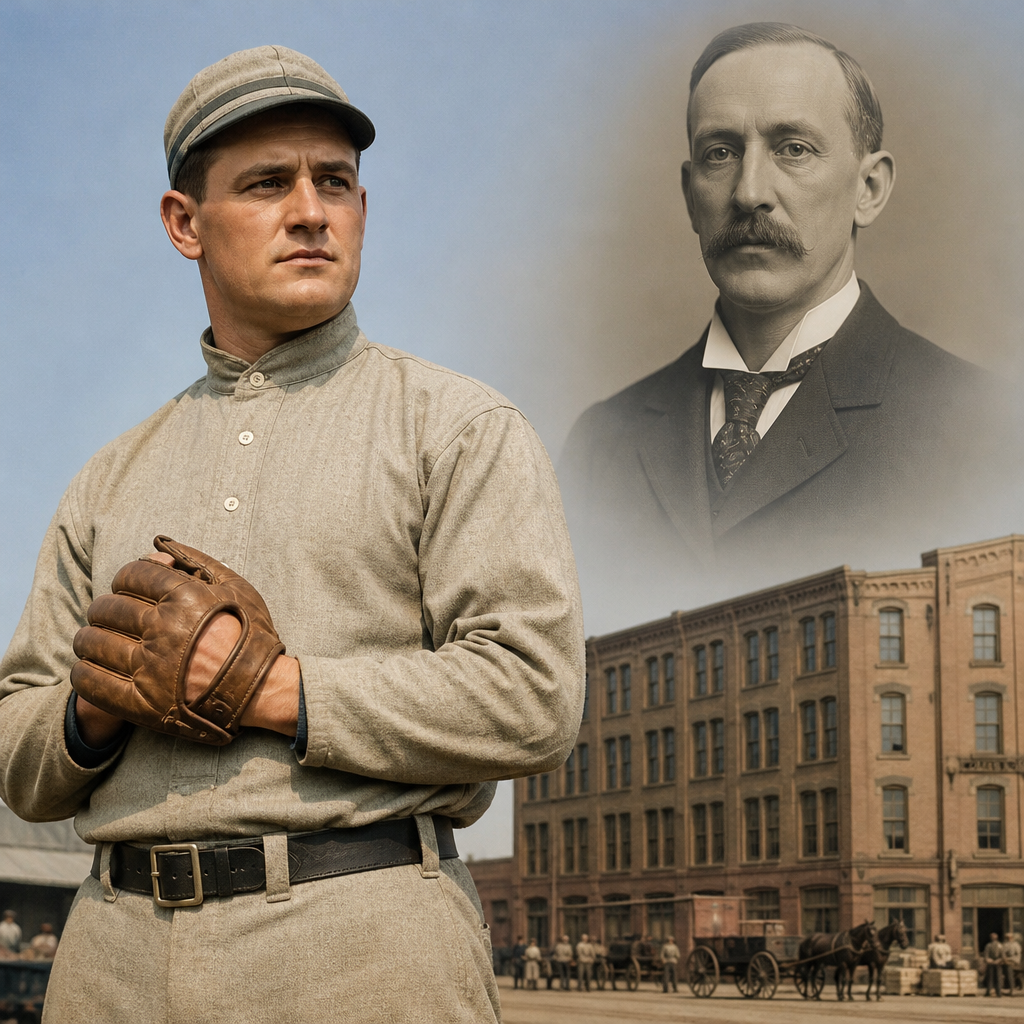
Albert Spalding helped shape baseball twice: first as the dominant pitcher of the 1870s, and then as the executive, marketer, publisher, and organizer who turned a growing game into a national business. Any serious look at the early history of baseball must place him at the center of the story, because his career connects what happened on the field with what happened in boardrooms, sporting-goods factories, rule meetings, and newspaper columns. For readers exploring early players and innovators, Spalding is the ideal hub figure. His life touches professionalization, league stability, equipment manufacturing, global promotion, statistics, mythmaking, and the emerging idea that baseball represented American identity.
To understand Albert Spalding, it helps to define a few terms that shaped his era. A star pitcher in the 1870s was not a modern strikeout specialist throwing overhand from a raised mound. Pitchers then worked under very different rules, often delivering the ball with a motion closer to an underhand or low-arm style, and their role was to initiate action rather than overpower hitters. Professional baseball itself was still unstable. Teams folded, leagues reorganized, schedules changed, and players frequently jumped clubs. A business pioneer in that environment was someone who could create order, establish reliable revenue, sell equipment, and persuade the public that the sport deserved lasting loyalty.
That is exactly what Spalding did. I keep returning to him when mapping the subtopic of early players and innovators because he sits at the intersection of nearly every major development before 1900. As a player, he won at an extraordinary rate with the Boston Red Stockings and later the Chicago White Stockings. As an executive, he worked with National League owners to stabilize professional baseball after the chaos of earlier ventures. As a manufacturer, he built A.G. Spalding & Bros. into the leading sporting-goods company in the United States. As a publisher, he put rule books, guides, and annuals into players’ and fans’ hands. As a promoter, he took baseball on a world tour. And as a public figure, he helped create enduring narratives about where baseball came from and what it meant.
This article serves as a hub for the broader study of early players and innovators. Through Spalding, readers can branch into companion topics such as Cap Anson and early leadership, Henry Chadwick and baseball journalism, George Wright and shortstop play, Harry Wright and team management, the rise of the National League, the history of baseball equipment, and the contested origins of the game. If you want one figure who ties those strands together, Albert Spalding is the clearest choice.
How Albert Spalding Became Baseball’s First Great Professional Pitcher
Born in 1850 in Byron, Illinois, Albert Goodwill Spalding emerged as a baseball talent during the sport’s formative professional years. He first gained national attention with the Rockford Forest City club, where his pitching and all-around play marked him as one of the best young athletes in the country. In 1871, the first season of the National Association of Professional Base Ball Players, he joined the Boston Red Stockings. That move placed him on the most important early powerhouse in professional baseball.
Spalding’s pitching record remains remarkable even when adjusted for a very different era. He won 47 games in 1871, 38 in 1872, 41 in 1873, 52 in 1874, and 54 in 1875. Those totals reflect the workload of nineteenth-century aces, who routinely started nearly every game, but they also reflect his exceptional durability and command. Contemporary accounts praised his control, intelligence, and composure. He was not simply collecting wins because he played for strong clubs. He was the key reason those clubs dominated. Historians still rank him among the best pitchers of the pre-modern game because he paired heavy usage with sustained excellence.
One important point for modern readers is that Spalding retired from top-level pitching at just twenty-five. That sounds shocking until you remember how quickly baseball careers could shift in the nineteenth century. Travel was difficult, contracts were unstable, and business opportunities for a prominent player could exceed the value of staying on the field. Spalding recognized earlier than most stars that his name had commercial power. He moved from athletic celebrity to enterprise while he was still young enough to capitalize on both reputations.
From Clubhouse to Front Office: Building Stable Professional Baseball
After his Boston years, Spalding became a central figure in Chicago baseball. He joined the Chicago White Stockings, first as a player and later as an executive partner to club founder William Hulbert. This partnership matters because the National League, founded in 1876, was designed as a corrective to the disorder of the National Association. Earlier professional baseball had struggled with weak central authority, uneven scheduling, financial instability, and gambling concerns. Hulbert and Spalding supported a more disciplined structure based on dependable franchises, enforceable rules, and stronger owner control.
In practical terms, that meant regularized schedules, territorial protection for clubs, and clearer expectations around player contracts. It also meant a business model that treated baseball less like a loose association of local teams and more like a managed entertainment industry. Spalding was not the only architect of this shift, but he was one of the most influential operators making it work on the ground. He understood players, fans, newspapers, and merchants, and he recognized that league credibility would increase attendance and consumer trust.
Chicago became the ideal place for this next stage of baseball growth. The city was expanding rapidly after the Great Fire of 1871, rail connections were improving, and the Midwest offered a broad market beyond the older Eastern centers. Spalding helped turn the White Stockings into a flagship franchise. That success reinforced a lesson he would apply repeatedly: winning teams build brands, and strong brands sell more than tickets. They sell gloves, balls, scorebooks, and the idea of belonging to a national pastime.
How A.G. Spalding & Bros. Changed the Sporting Goods Industry
Spalding’s lasting influence rests as much on manufacturing and retail as on baseball itself. A.G. Spalding & Bros., founded in the late 1870s, grew into the dominant sporting-goods company of its time. The business sold baseballs, bats, gloves, uniforms, tennis rackets, golf clubs, and eventually products for dozens of sports. Spalding understood a principle that now seems obvious but was revolutionary then: standardized equipment builds confidence in the sport. If clubs, schools, colleges, and amateur teams used reliable gear from a recognized brand, the game became easier to organize and easier to expand.
Baseballs provide the clearest example. In a fragmented market, inconsistent balls could affect play, durability, and fairness. By tying his company name to quality and official status, Spalding helped create the expectation that serious competition required standardized equipment. That commercial move had cultural effects. It linked baseball to measurable standards and made consumers feel they were buying into the authentic game. The company’s catalogs and guides reinforced this message by blending instruction, advertising, and authority in one package.
| Area | What Spalding Did | Why It Mattered |
|---|---|---|
| Equipment | Produced branded baseballs, bats, gloves, and uniforms at scale | Made organized play more consistent and accessible |
| Publishing | Issued guides, rule books, and annual records | Spread standard rules and shaped public understanding |
| League operations | Supported stronger owner coordination in the National League | Improved stability, scheduling, and club credibility |
| Promotion | Used celebrity, tours, and endorsements to market baseball | Turned the sport into a national consumer product |
In my experience studying nineteenth-century sports businesses, very few figures combined celebrity endorsement and vertical integration as effectively as Spalding. He had been the star athlete, he sold the equipment, he distributed the literature, and he sat close to the centers of league power. That concentration of influence helped his company grow, but it also raises fair questions about control. When one person shapes products, records, and public narratives, his version of the sport can overshadow competing voices.
Publishing, Promotion, and the Making of Baseball’s National Image
Spalding did not rely on goods alone. He was a publisher and image-maker. The Spalding Base Ball Guide became one of the most important annual publications in the sport. It included rules, statistics, commentary, schedules, and essays that framed baseball as orderly, respectable, and distinctly American. In an age before radio and television, printed guides did more than inform. They standardized knowledge. If a player, club secretary, or fan wanted to know how the game was supposed to be played, these guides were often the reference point.
He also understood spectacle. The 1888-1889 around-the-world baseball tour remains one of the most ambitious promotional efforts in early sports history. Spalding organized a traveling group of players who played exhibition games across the United States, Hawaii, New Zealand, Australia, Ceylon, Egypt, Italy, France, and Britain. The baseball quality of these exhibitions varied, and local audiences often treated them as novelties, but the tour mattered because it announced baseball as exportable American culture. Spalding presented the game as disciplined, modern, and worthy of international attention.
That promotional vision had domestic consequences too. Americans reading about the tour in newspapers could see baseball as larger than regional rivalries. It became part of a national story about expansion, commerce, and identity. Spalding was especially skilled at aligning his business goals with these broader themes. When he sold sporting goods, he was also selling participation in a civic ritual. When he promoted baseball abroad, he was also enhancing the prestige of the game at home.
Albert Spalding and the Origins Debate: Influence, Myth, and Memory
No account of Spalding is complete without addressing his role in the baseball origins debate. In the early twentieth century, he strongly supported the claim that baseball was invented in Cooperstown, New York, by Abner Doubleday in 1839. This argument, advanced through the Mills Commission, has since been discredited by historians. Documentary evidence shows that baseball evolved from earlier bat-and-ball games rather than springing fully formed from one inventor. The work of researchers such as Henry Chadwick and later scholars demonstrated a more complex lineage tied to British and American game traditions.
Why did Spalding back the Doubleday story so forcefully? Part of the answer lies in nationalism. He wanted baseball to be understood as wholly American, not as an adaptation of English antecedents like rounders. A clean origin story served marketing, civic pride, and the cultural positioning of baseball as the national game. It was simpler to celebrate a founding myth than to explain gradual evolution across multiple communities and decades.
This episode reveals both Spalding’s power and his limitations. He was brilliant at building institutions and narratives, but he was not a neutral historian. For readers exploring early players and innovators, that distinction matters. Innovators shape the game, yet they also shape how the game remembers itself. Spalding’s legacy is strongest when we see both sides clearly: he professionalized baseball and promoted it masterfully, but he also helped popularize a false story that endured for generations.
Why Spalding Matters in a Hub on Early Players and Innovators
As a hub article, this page points outward to the wider cast who built early baseball. Spalding belongs beside Harry Wright, who pioneered professional team management; George Wright, whose shortstop play set early standards; Cap Anson, whose hitting and leadership made him the era’s biggest star; Henry Chadwick, whose journalism and box score innovations helped fans understand the game; and executives such as William Hulbert, who helped create firmer league governance. Spalding intersects with each of them. He played against or alongside the sport’s leading figures, worked inside its emerging power structures, and marketed the products and publications that amplified their influence.
He also helps explain how innovation in baseball was rarely limited to tactics on the field. Some innovators changed strategy. Others changed infrastructure. Spalding changed infrastructure at scale. He made baseball easier to schedule, easier to equip, easier to explain, and easier to sell. That does not make him the sole architect of early professional baseball, but it does make him indispensable to understanding how the sport moved from loosely organized clubs to a durable national institution.
Albert Spalding’s story shows that early baseball history is not just a record of games won and lost. It is also the story of systems, products, media, and myths. As a pitcher, he dominated an emerging professional sport. As an executive, he backed the structures that gave that sport stability. As a businessman, he supplied the equipment that standardized play. As a publisher and promoter, he expanded baseball’s reach and fixed its image in the public mind. Even his mistaken support for the Doubleday myth teaches an important lesson: the people who build a sport often shape its memory as powerfully as its rules.
For anyone studying early players and innovators, Spalding is the essential starting point because his career connects nearly every major theme in nineteenth-century baseball. Follow his path and you move naturally into the rise of the National League, the development of pitching, the growth of sporting-goods manufacturing, the spread of baseball journalism, and the debate over origins. Explore those related subjects next, and the early history of baseball becomes not a collection of isolated biographies, but a coherent story about how talent, organization, commerce, and culture created America’s national pastime.
Frequently Asked Questions
Who was Albert Spalding, and why is he so important to early baseball history?
Albert G. Spalding was one of the most influential figures in the history of baseball because he excelled in two roles that rarely belong to the same person: elite player and transformational executive. In the 1870s, he built his reputation as one of the game’s dominant pitchers, winning at an extraordinary rate and helping establish standards of excellence during baseball’s formative professional years. At a time when the sport was still organizing itself, Spalding was one of the players who gave it legitimacy on the field through consistent performance, star power, and competitive success.
His importance, however, goes far beyond his pitching record. After his playing career, Spalding became a driving force behind baseball’s business and cultural expansion. He worked as an executive, sporting-goods manufacturer, publisher, promoter, and league organizer, helping transform baseball from a promising pastime into a structured national industry. He understood something many of his contemporaries did not: the future of baseball depended not only on winning games, but also on controlling equipment, shaping public opinion, standardizing rules, building brands, and presenting the sport as an essential part of American life.
That is why historians place him at the center of early baseball history. Spalding connected the action on the diamond with the decisions made in offices, factories, rule meetings, and newspapers. He helped define how baseball was played, how it was sold, and how it was remembered. If you want to understand how baseball grew from a rough early professional game into a national business and cultural institution, Albert Spalding is one of the key people to study.
How successful was Albert Spalding as a pitcher before he entered the business side of baseball?
Spalding was not simply a former player who later found success in business; he was one of the standout baseball stars of his era. Pitching in the 1870s, he became known for remarkable durability, consistency, and winning results at a time when pitchers carried massive workloads and the game itself was still evolving. He played in the years before modern pitching developed into its current form, so success depended heavily on control, stamina, fielding support, and a deep understanding of hitters. Spalding thrived under those conditions.
He built a reputation as a pitcher who could anchor top clubs and deliver victories in a young professional game that had not yet settled into modern patterns. In early baseball, stars were essential to a team’s identity, and Spalding was exactly that kind of player. His achievements made him one of the best-known athletes of the period, which later gave him credibility in the baseball world beyond his playing days. People listened to Spalding in part because he had already proven himself where it mattered most to fans and club owners: on the field.
That playing success mattered in another way too. Because he had firsthand experience with the realities of the sport, Spalding understood the needs of players, teams, schedules, travel, equipment, and promotion better than many pure businessmen could. His pitching career gave him practical knowledge and public stature, both of which helped him become a major force in shaping baseball’s next stage of growth. In that sense, his success as a pitcher was not separate from his later business career; it was the foundation for it.
How did Albert Spalding help turn baseball into a national business?
Spalding helped transform baseball into a national business by recognizing that the sport needed more than competition to grow—it needed systems, branding, and infrastructure. He became deeply involved in the sporting-goods industry, most famously through the company that bore his name, and used that platform to connect baseball’s popularity with commercial opportunity. Selling baseballs, gloves, bats, uniforms, and other athletic equipment allowed him to profit from the game’s expansion while also helping standardize what players and teams used. That kind of standardization was crucial in making baseball look more professional and more organized.
He was also an important publisher and promoter. By producing guides, rule books, and baseball literature, Spalding helped define how the public understood the game. In the nineteenth century, controlling information mattered enormously. If fans, clubs, and journalists relied on your publications for statistics, rules, and interpretation, you had significant influence over the sport’s image and authority. Spalding recognized that baseball’s commercial future depended on more than attendance receipts; it depended on national visibility and a consistent story about what baseball was and why it mattered.
Another major part of his contribution was organizational leadership. Spalding played a role in baseball’s league structures and governance, helping shape the relationships among owners, teams, players, and officials. He understood that if baseball was going to survive as a business, it needed discipline, coordination, and a degree of centralized control. In short, Spalding helped build baseball’s economy from multiple directions at once: equipment, publishing, promotion, and administration. That broad vision is what made him a pioneer rather than just a successful former athlete.
What was Albert Spalding’s influence on baseball’s rules, organization, and public image?
Spalding’s influence on baseball reached into the three areas that most determine a sport’s long-term stability: how it is governed, how it is played, and how it is presented to the public. As an organizer and executive, he participated in the efforts to bring order to a game that was still maturing. Early professional baseball faced constant issues involving league stability, player movement, business competition, and standards of conduct. Spalding was among the figures who pushed the sport toward stronger institutional control, believing that stability was essential for credibility and financial growth.
He also had a hand in shaping baseball’s public image. Through publishing and promotion, Spalding helped frame the sport as uniquely American, respectable, and nationally significant. This was not accidental. He understood that public perception could strengthen baseball’s place in the culture and attract broader support from fans, communities, schools, and businesses. By presenting baseball as more than entertainment—as a symbol of discipline, national identity, and healthy competition—he elevated its status and widened its appeal.
His authority was amplified by the fact that he moved comfortably between multiple worlds. He knew players because he had been one. He knew owners and executives because he became one. He knew the equipment trade because he built a business in it. He knew the press because he used print so effectively. That combination gave him unusual power to influence debates about rules, standards, and baseball’s larger meaning. Even when his views were controversial or self-serving, they mattered because he had become one of the central architects of the sport’s early structure and story.
Why does Albert Spalding still matter when discussing the evolution of modern baseball?
Albert Spalding still matters because many of the basic relationships that define modern sports were visible in his career long before they became standard: the link between star athletes and business opportunity, the value of branding, the importance of league organization, the commercial power of equipment sales, and the role of media in shaping public understanding. He was one of the earliest baseball figures to see the game as a complete ecosystem rather than just a contest between teams. That insight makes him a foundational figure in sports business history as well as baseball history.
Modern baseball depends on tightly connected systems—professional leagues, official equipment, media coverage, marketing, statistics, publishing, and national identity. Spalding worked on early versions of nearly all of those fronts. He understood that the sport’s future would be shaped as much by executives, manufacturers, and promoters as by players and managers. In many ways, he anticipated the modern reality that sports are both athletic competitions and major commercial enterprises.
For readers exploring early players and innovators, Spalding stands out because his story shows how deeply the game’s development depended on people who could bridge performance and power. He was not merely present during baseball’s growth; he actively directed it. His legacy survives in the way baseball became organized, marketed, equipped, and narrated to the public. To study Albert Spalding is to study how baseball became not just a popular game, but a durable national institution.