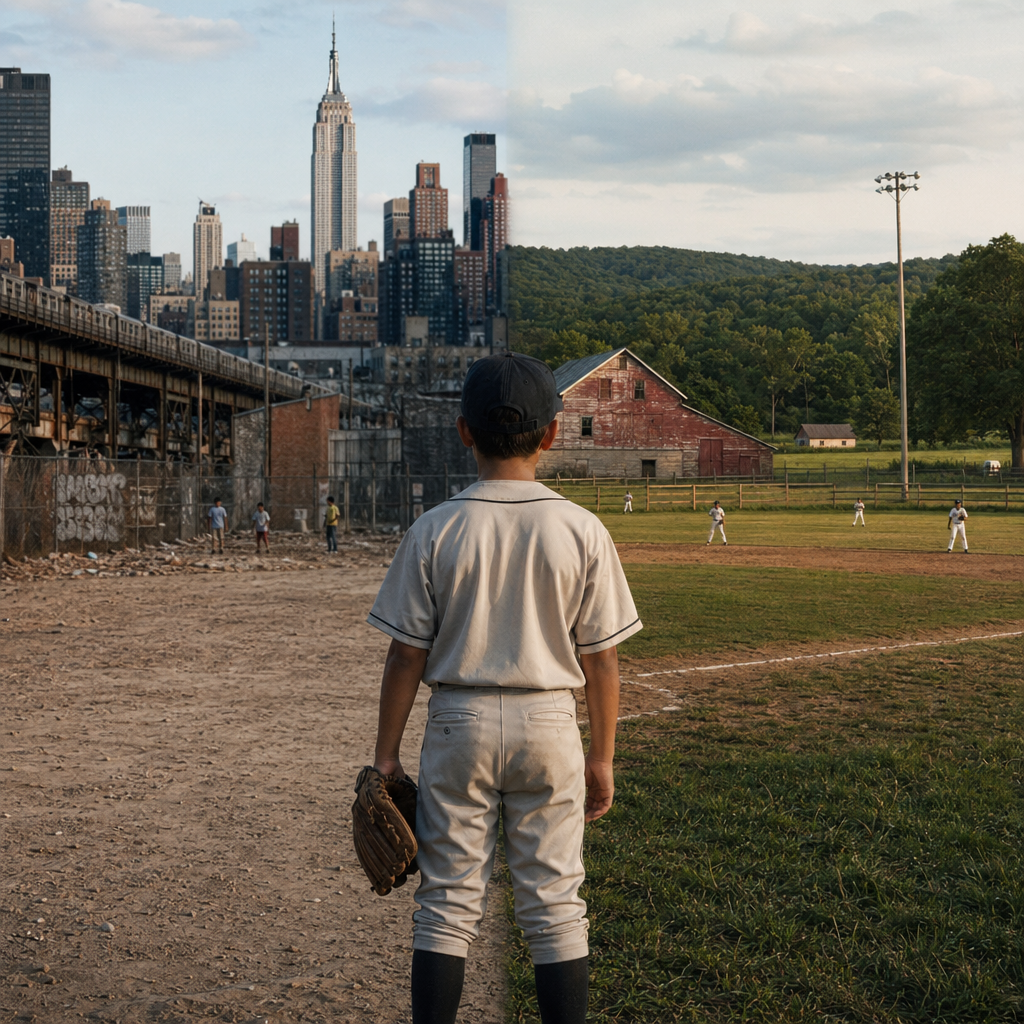
Baseball films use setting as more than scenery; city blocks, industrial lots, cornfields, schoolyards, and isolated diamonds shape the sport’s meaning on screen. In the subtopic of Baseball in Literature and Film, “Urban vs. Rural: Baseball’s Different Settings in Films” works as a hub because it connects many miscellaneous themes that do not fit neatly into one team, era, or genre. Urban settings in baseball movies usually emphasize pressure, diversity, money, media attention, and crowded ambition. Rural settings more often emphasize memory, family lineage, open space, local ritual, and the idea that the game belongs to ordinary people before it belongs to institutions. Those patterns are not absolute, but they are durable.
When I map baseball films by setting, I look at three practical questions. First, where is the field located in relation to daily life: tucked between apartment buildings, attached to a school, carved out of farmland, or sitting as a civic monument downtown? Second, what social forces press on the characters: scouts, owners, neighbors, parents, segregation, migration, class mobility, or nostalgia? Third, how does the camera use space: tight frames and noise in the city, or horizon lines and quiet in the country? Those choices influence plot, character, and even sound design. A backlot game in a dense neighborhood feels different from a twilight catch beside wheat fields, even before a word is spoken.
This matters because baseball cinema often uses place to answer larger questions about American identity, belonging, and change. A city baseball film can dramatize aspiration in a competitive environment, while a rural film can stage the conflict between preservation and progress. For readers exploring miscellaneous baseball stories across film and literature, setting provides a useful organizing principle. It links children’s baseball movies, historical dramas, immigrant stories, fantasy tales, women’s baseball narratives, and minor league road stories. Once you notice how often filmmakers use urban and rural environments to define stakes, the whole subtopic becomes easier to navigate and compare.
What urban settings contribute to baseball films
Urban baseball films frame the game as public performance. The city brings density, surveillance, and competition. Sandlots squeezed between brick buildings, municipal parks under elevated trains, and major league stadiums surrounded by traffic all signal that baseball exists amid work, commerce, and social friction. In practical filmmaking terms, urban settings create visual clutter and layered sound: sirens, vendors, crowds, subway rumble, radio chatter. That sensory pressure supports stories about proving oneself, escaping limited options, or surviving systems larger than any single player.
One clear example is The Sandlot, which sits in a suburban environment rather than a skyscraper downtown, yet still plays like a community-built urban fringe space. The neighborhood field is bounded, negotiated, and collectively owned by kids. The lot matters because it is not pastoral wilderness; it is leftover land transformed into civic space. Films set in Brooklyn, the Bronx, Chicago, or industrial mill towns similarly present baseball as an improvisation inside inhabited, contested territory. In those stories, the field becomes a temporary democracy where class, ethnicity, and age can mix, even if unequal power returns the moment the game ends.
Urban settings also support baseball films about institutional power. Consider movies centered on major league clubs, sportswriters, front offices, or scandal. These plots need hotels, press rooms, police presence, courthouses, night games, and packed stands. The city allows baseball to be shown as industry, not just pastime. Eight Men Out uses Chicago as a system of money, labor exploitation, and organized vice; the urban environment makes the Black Sox scandal legible as a labor story as much as a sports story. Sugar, while moving between places, uses urban baseball infrastructure to reveal how global talent pipelines feed professional ambition.
What rural settings contribute to baseball films
Rural baseball films usually slow the tempo and widen the moral frame. Open landscapes let filmmakers connect baseball to seasonality, inheritance, and the passage of time. A farm field or a small-town diamond can suggest that the game predates commercialization and may outlast modern anxieties. That is why rural settings often appear in films dealing with memory, grief, reconciliation, or myth. The visual logic is straightforward: long shots, natural light, and quieter soundscapes invite contemplation. When characters hear wind, insects, or distant traffic instead of a packed crowd, the audience is pushed inward.
Field of Dreams remains the defining example. Its Iowa farm setting is not incidental background; it is the mechanism of the film’s emotional argument. Baseball emerges from cornfields as if memory itself had taken physical form. The rural field separates the game from urban commerce and returns it to family, regret, and wonder. Small-town baseball films such as The Natural also depend on the contrast between humble origins and larger arenas. Even when a story later moves into cities or stadium spectacle, the rural beginning supplies moral authenticity. Filmmakers rely on that contrast because viewers instinctively read the country as a repository of origin stories.
Rural settings are equally useful in films about community ritual. Local games in small towns can gather nearly every social layer in one place: farmers, shopkeepers, children, elders, churchgoers, and school officials. In narrative terms, that means one game can stand in for an entire civic order. It can reveal who belongs, who is excluded, and who carries local memory. Baseball becomes a seasonal ceremony tied to county fairs, summer evenings, and inherited nicknames. Even when these films are idealized, the best ones acknowledge limits such as insularity, economic decline, and resistance to change.
How filmmakers use contrast between city and country
The strongest baseball films often gain power by moving between urban and rural settings rather than choosing only one. That movement creates a built-in dramatic contrast between intimacy and spectacle, freedom and discipline, innocence and professionalism. In screenwriting terms, the transition changes the pressure on the protagonist. A player who thrives on a hometown field may shrink under urban media scrutiny. A scout hardened by city routines may rediscover purpose on a weathered rural diamond. This contrast is common because baseball itself has always linked local play with national systems of recruitment, fandom, and mythology.
I often group these contrasts into practical functions for analysis and teaching:
| Setting pattern | What it usually signifies | Film example |
|---|---|---|
| Rural to urban | Rise, ambition, loss of innocence, commercialization | The Natural |
| Urban to rural | Return, healing, perspective, family repair | Field of Dreams |
| Alternating both | Conflict between memory and profession | A League of Their Own |
| Neighborhood field versus stadium | Play as freedom versus baseball as institution | The Sandlot |
A League of Their Own is especially useful here because it crosses spaces and social identities. The film includes farm backgrounds, bus travel, urban ballparks, and wartime industrial contexts. That mobility shows baseball as a connector between private life and national culture. The women’s league is not just a sports novelty; it is a spatial story about who gets access to public arenas. When the game shifts from intimate practice spaces to formal stadiums, the audience sees legitimacy being negotiated in real time. Setting, therefore, becomes evidence of status.
This contrast also shapes audience emotion. Rural scenes often ask viewers to feel continuity, while urban scenes ask them to feel urgency. Directors exploit this difference through editing rhythm, color palette, and crowd scale. Quick cuts and compressed frames in city ballparks heighten stakes. Extended shots in open landscapes create reflection or awe. The same sport can appear as labor, entertainment, sacrament, or childhood freedom depending on where the game is placed.
Class, race, and migration across baseball settings
Any serious discussion of urban and rural baseball films must address class, race, and migration. Settings are not neutral containers. Urban baseball spaces in film often depict immigrant neighborhoods, Black communities, working-class districts, or industrial labor zones where baseball offers visibility and mobility. Rural settings can represent rooted tradition, but they can also conceal exclusion, land ownership inequality, and limited opportunity. The most valuable films understand both sides.
42 demonstrates how baseball settings expose power. Ballparks, hotels, trains, dugouts, and Southern road environments all show that Jackie Robinson’s experience changed with geography. The city could offer larger crowds and greater exposure, but it also intensified scrutiny. Rural or small-town spaces could feel intimate, yet they could also amplify local prejudice. The Bingo Long Traveling All-Stars & Motor Kings uses travel and makeshift venues to show Black baseball entrepreneurship outside white-controlled institutions. The settings are essential because they reveal who controls the gate, the gate receipts, and the terms of dignity.
Migration narratives deepen this theme. Films about Latin American prospects, barnstorming teams, or players moving from small towns into professional circuits depend on setting shifts to dramatize dislocation. Housing conditions, language barriers, transportation networks, and training sites become part of the story. Baseball is never only what happens between the foul lines. In film after film, who can move, who must stay, and who profits from that movement are questions written into the locations themselves.
Memory, myth, and the built environment
Baseball films repeatedly turn settings into memory machines. Old stadiums, vacant lots, porches, barns, and roadside diamonds all carry narrative residue. Viewers do not just see a field; they infer generations of use, weather, repair, and storytelling. That is why production design matters so much in this subtopic. The dirt texture, fence material, scoreboard style, and seating arrangement all communicate whether baseball is being presented as polished spectacle, local ritual, or fading dream.
Bull Durham offers a different angle by locating baseball in the minor league built environment of Durham, North Carolina. This is not pure rural nostalgia and not big-city glamour. It is a transitional landscape of buses, modest stadiums, and regional identity. That middle setting matters for a miscellaneous hub because many baseball films live between poles. Minor league parks, college fields, military bases, and exurban developments complicate a simple urban-rural binary. They show that baseball cinema often works best in in-between places where desire exceeds resources and status remains unsettled.
Myth enters when settings appear slightly outside time. Twilight lighting, empty bleachers, and isolated diamonds encourage audiences to treat baseball as a language of remembrance. Used carefully, this can be profound. Used lazily, it becomes cliché. The best films earn their mythic tone by grounding place in social reality: weathered boards, long drives, unpaid bills, racial boundaries, or family strain. Without those details, the setting is decorative. With them, it becomes a credible vessel for emotion.
How this miscellaneous hub connects the wider subtopic
As a hub page for miscellaneous baseball stories in film and literature, this topic helps readers organize related articles by place-based themes. Urban settings connect naturally to pieces on stadium culture, immigrant neighborhoods, labor history, sports journalism, and the economics of professional baseball. Rural settings connect to articles on nostalgia, pastoral imagery, family inheritance, mythic Americana, and small-town community formation. In practice, readers often move between these categories, so internal exploration works best when place anchors the comparison.
It also broadens the canon. Not every important baseball story is about the World Series, a famous slugger, or a major league clubhouse. Children’s neighborhood games, women’s wartime leagues, Negro Leagues road trips, farm-team towns, and fantasy narratives all belong here. Setting is the thread that ties them together. If you are building out the Baseball in Literature and Film cluster, use this hub to compare how authors and directors frame baseball as public industry, private ritual, or a bridge between the two. That approach reveals why the sport remains such a flexible storytelling instrument across genres and eras.
The core takeaway is simple: urban baseball films usually stress proximity, pressure, and institutions, while rural baseball films usually stress memory, space, and origin. The most enduring works do more than repeat those associations; they test them, reverse them, and place characters in motion between them. Once you read baseball settings this way, details that seemed decorative become central evidence. A chain-link fence, a downtown facade, a cornfield, a bus route, or a weathered grandstand can tell you what kind of baseball story you are in before the first pitch is thrown.
Use this hub as your starting point for the miscellaneous side of Baseball in Literature and Film. Follow the setting, and you will find the themes: class, migration, nostalgia, gender, labor, myth, and community. Rewatch a favorite baseball movie with place in mind, and the film will almost always reveal a deeper argument about who gets to play, who gets remembered, and what the game means beyond the scoreboard.
Frequently Asked Questions
How do urban and rural settings change the meaning of baseball in films?
In baseball films, setting often functions like a second script. An urban setting usually frames the game as something shaped by pressure, ambition, money, noise, and constant public attention. City-based baseball stories tend to place the sport inside a larger system of media coverage, class difference, business interests, and social diversity. The ballpark may sit near apartment blocks, industrial spaces, traffic, or crowded neighborhoods, which makes baseball feel tied to modern life and public scrutiny. In these films, players are often not just competing against an opponent; they are also confronting expectations from fans, owners, headlines, and the city itself.
Rural settings, by contrast, often turn baseball into something more intimate, reflective, and symbolic. A field surrounded by open land, cornfields, schoolyards, or a quiet small town can make the game feel connected to memory, community, family, and personal identity. These landscapes reduce the sense of urban overload and allow baseball to stand for continuity, innocence, healing, or tradition. That does not mean rural baseball films are simple or naive. In many cases, they use open space to ask big questions about belonging, loss, generational change, and the meaning people attach to the game. The result is that urban settings often emphasize baseball as a public performance, while rural settings more often present it as a personal ritual or communal bond.
Why are urban baseball settings often associated with pressure and spectacle?
Urban baseball settings naturally lend themselves to stories about visibility and intensity. Cities are crowded, fast-moving environments where success and failure are highly public. When a baseball film takes place in a city, the sport is often presented as part of a broader social machine that includes newspaper coverage, radio or television commentary, financial stakes, celebrity culture, and fan demand. Even the visual language of the city contributes to this effect. Tight streets, packed stands, looming buildings, and industrial backdrops create the feeling that there is always an audience and always something at stake.
This environment can make the game feel less like a pastime and more like a test of nerve, image, and survival. Urban baseball movies frequently explore themes such as performance under scrutiny, commercialization, racial and ethnic diversity, labor and class dynamics, and the tension between love of the game and the business built around it. A city setting also helps filmmakers show baseball as deeply woven into public life. The game becomes a shared civic event, but one that carries conflict as well as excitement. In that sense, urban settings amplify baseball’s dramatic potential by placing every at-bat and every decision inside a dense social world where ambition, reputation, and economics are always in play.
What do rural baseball settings symbolize in film?
Rural baseball settings often symbolize emotional clarity, memory, and the enduring cultural mythology of the game. A diamond carved out of open land or placed beside a small schoolyard can make baseball feel elemental, almost timeless. Without the distractions of the city, the film can direct attention toward relationships, inner conflict, family history, and the spiritual or nostalgic meanings attached to the sport. This is why rural settings so often appear in baseball films that deal with fathers and sons, lost chances, community identity, or the idea of returning to something essential.
At the same time, the rural setting can symbolize an ideal that is both comforting and complicated. It may suggest innocence, but films often use that apparent simplicity to examine change, decline, or the gap between myth and reality. A quiet field can become a place where characters confront regret, recover purpose, or reconnect with a shared past. The openness of rural space gives filmmakers room to use baseball as metaphor: for renewal, for escape, for tradition, or for the persistence of hope. Because of that, rural settings are rarely just pretty backdrops. They are narrative spaces where baseball becomes linked to identity, belonging, and the emotional imagination of American life.
How do filmmakers use visual contrast between city and countryside in baseball movies?
Filmmakers often rely on strong visual contrast to communicate what kind of baseball story they are telling. In urban baseball films, the camera may emphasize density and motion: chain-link fences, brick walls, train tracks, crowded sidewalks, stadium lights, traffic, and industrial textures. These images make the sport feel embedded in a world of competition and constant activity. The frame can seem compressed, with baseball squeezed into available spaces such as neighborhood lots or tightly packed ballparks. That visual strategy reinforces themes of pressure, improvisation, and social complexity.
In rural baseball films, the imagery usually opens up. Wide shots of fields, empty horizons, natural light, weather, and surrounding farmland create a different emotional rhythm. The game appears less confined and more contemplative, as if baseball exists in conversation with landscape and time. This visual spaciousness can make moments on the field feel mythic, intimate, or reflective. It also allows silence, pause, and memory to matter in ways they might not in a city-centered story. The contrast between cramped urban spaces and expansive rural ones helps audiences understand, often instantly, whether the film is approaching baseball as public spectacle, social struggle, personal healing, or cultural legend.
Why is the urban-versus-rural divide such a useful theme in baseball film analysis?
The urban-versus-rural divide is useful because it connects a wide range of baseball-film themes that might otherwise seem unrelated. It gives critics and viewers a way to discuss how setting shapes genre, tone, character development, symbolism, and even the moral world of a film. A movie set in a city can foreground issues such as commercialism, diversity, public pressure, and institutional power. A movie set in the countryside or a small town can highlight memory, tradition, intimacy, and mythmaking. Looking at the setting helps explain not only what happens in the story, but why baseball means what it means within that story.
This framework is especially valuable in the broader study of baseball in literature and film because it acts as a hub for many overlapping concerns. It can connect sports narratives to class, regional identity, nostalgia, migration, family structure, race, media culture, and ideas of national belonging. Rather than treating baseball as a single symbol, the urban-rural contrast shows that the sport can represent very different things depending on where it is played and who is watching. That makes the topic especially rich for analysis. It reveals how baseball films use place to turn a familiar game into a flexible storytelling language capable of expressing both collective tension and personal longing.