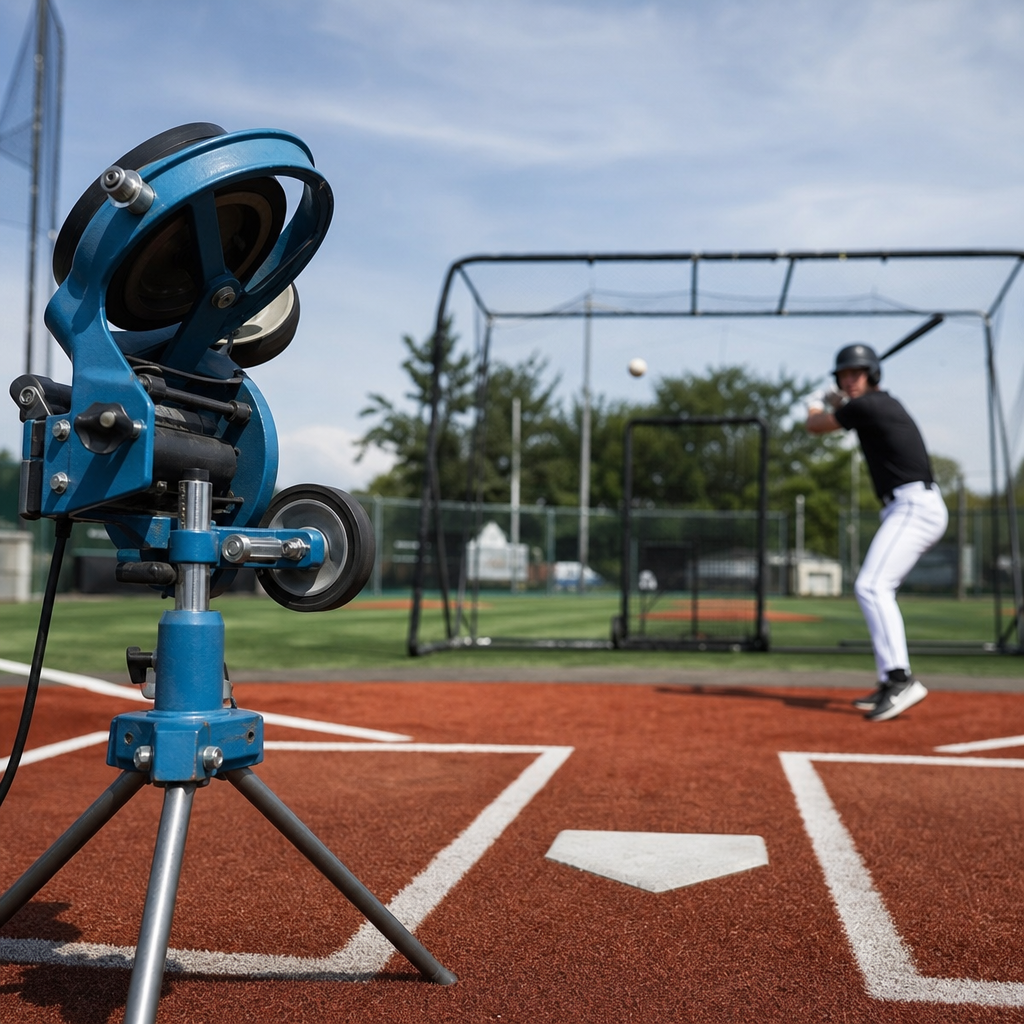
Pitching machines have transformed baseball training from a weather-dependent, coach-limited routine into a repeatable, measurable practice environment that can develop hitters, fielders, and catchers with unusual precision. In baseball, a pitching machine is any mechanical or programmable device that delivers balls at controlled speeds, angles, spins, and intervals, allowing athletes to rehearse game situations without requiring a live pitcher on every repetition. As a hub topic within historic baseball innovations, pitching machines matter because they sit at the intersection of engineering, player development, and the sport’s broader shift toward data-driven instruction. I have seen teams reshape entire practice plans around machine work, using it not as a gimmick but as a tool that expands reps, reduces fatigue on human arms, and creates training conditions that would be difficult to reproduce consistently by hand. Understanding how pitching machines evolved, what they teach well, and where they fall short helps explain why they remain one of the most influential training technologies in the history of baseball.
The significance of pitching machines becomes clearer when placed inside the longer story of baseball innovation. Historic changes in the sport often start with a simple problem: players need more efficient ways to practice a skill, coaches need more control over variables, and organizations want methods that scale from youth levels to the major leagues. Before machines became common, batting practice depended heavily on coaches throwing overhand, sidearm, or from behind protective screens, a setup that consumed time and often produced inconsistent velocity and movement. Early machines answered the need for volume, but modern systems now support advanced swing training, vision work, defensive drills, and pitch recognition. That arc mirrors other baseball developments, from aluminum bats to radar tracking, where the core benefit is standardization. A machine can throw the same pitch location dozens of times, then deliberately vary it, letting athletes isolate mechanics or decision-making. For readers exploring historic innovations in baseball, pitching machines are a central case study because they show how technology changed not only the tools of practice, but the philosophy of coaching itself.
The Origins of Pitching Machines in Baseball Practice
The history of pitching machines begins with a practical coaching problem: no team had enough live arms to provide endless quality batting practice. In the early twentieth century, clubs experimented with mechanical feeders and projection devices, but the real breakthrough came when inventors built machines capable of delivering baseballs with enough force and regularity to mimic usable batting practice. Jugs, ATEC, and later Hack Attack became recognizable names because they solved different parts of the equation: durability, portability, speed range, and spin control. By the mid-twentieth century, wheel-based machines had become increasingly visible at high schools, colleges, and professional spring training complexes. These systems used one, two, or three rotating wheels to grip and propel the baseball, allowing operators to adjust velocity and approximate pitch type through wheel speed and alignment.
What made this innovation historic was not merely automation. It was the ability to make practice reproducible. When I have worked around machine-based hitting sessions, the greatest advantage has always been consistency. A coach can set 78 miles per hour at the top of the zone and know the hitter will see that general look repeatedly, which is nearly impossible with front toss or fatigued live batting practice. That consistency changed training culture. Instead of accepting random practice quality, coaches could structure specific objectives: staying through the middle of the field, learning to handle high velocity, or training reaction time on short-distance velocity drills. In baseball’s wider innovation timeline, pitching machines deserve attention alongside video analysis and modern tracking systems because they were among the first tools to convert practice from largely artisanal instruction into controlled skill development.
How Pitching Machines Work and What Types Exist
Most pitching machines fall into three categories: arm-style machines, wheel-style machines, and programmable smart machines. Arm-style machines use a mechanical arm to throw the ball in a motion somewhat similar to a human delivery. They can create a more natural release feel, but they usually require more maintenance and can be less versatile in changing pitch shape quickly. Wheel-style machines are the most common. A single-wheel machine is often used for basic batting practice and ground-ball work, while two-wheel and three-wheel machines can better simulate fastballs, breaking balls, and variable pitch planes. By changing wheel speeds, tilt, and feed angle, operators influence backspin, topspin, side spin, and perceived release point. Smart machines add software controls, remote programming, and pitch sequencing, making them especially useful for college and professional environments.
Different machine types serve different training goals, and choosing one depends on the level of play, budget, and skill being trained. Youth programs often benefit from simpler, lower-speed units because the priority is confidence, timing, and contact. A high school varsity team may need a machine that throws high-velocity fastballs and modest breaking balls for game preparation. College and professional clubs increasingly use advanced programmable machines such as Trajekt or similar systems that pair video and pitch replication, sometimes mirroring the release characteristics of specific opposing pitchers. Those setups are expensive, but they address an important reality: once hitters reach advanced levels, generic batting practice is less useful than context-specific preparation.
| Machine Type | Main Strength | Typical Use Case | Key Limitation |
|---|---|---|---|
| Single-wheel | Affordable, simple setup | Youth batting practice, basic fielding drills | Limited pitch realism |
| Two-wheel | Better velocity and movement control | High school and travel-ball hitting sessions | Less precise than advanced systems |
| Three-wheel | Improved pitch type simulation | College training and advanced hitter prep | Higher cost and setup complexity |
| Programmable smart machine | Custom sequencing and pitcher replication | Professional scouting-based preparation | Expensive and requires technical support |
How Pitching Machines Improved Hitting Development
The biggest impact of pitching machines has been on hitters, because they increase quality repetitions without exhausting coaches or pitchers. In practical terms, hitters need thousands of swings to build timing, bat path efficiency, zone awareness, and contact quality. A machine allows those reps to happen faster and under more stable conditions. Coaches can run overload-underload bat routines, high-velocity training, opposite-field rounds, or two-strike approach work with minimal interruption. I have seen players make clear progress when sessions are designed around one variable at a time. For example, a machine set to attack the inner third at consistent speed helps a hitter learn how early the body must move to keep the barrel connected and avoid getting jammed. A different setting, elevated with backspin, forces a flatter entry and a direct path to the ball.
Pitching machines also support pitch recognition and decision-making, though only when used correctly. One common mistake is turning every machine round into mindless swing volume. Effective coaches build decisions into the drill. A hitter may be told to take everything off the black, attack only middle-up, or track ten pitches before swinging. More advanced work uses mixed sequences to train read-and-react behavior rather than rote timing. Research and applied player development both support the idea that variable practice improves transfer to competition, especially once a player has basic mechanics in place. That is why strong hitting programs mix machine work with front toss, live at-bats, and video review rather than relying on any one method. The machine provides repeatability; the coach provides context.
Beyond Batting Practice: Fielding, Catching, and Position-Specific Training
Although most people associate pitching machines with hitters, their impact extends well beyond the batter’s box. Infield coaches use machines to generate hard one-hoppers, short hops, and line drives at consistent pace, helping fielders improve glove presentation, footwork, and exchange speed. Outfielders use fungo machines and wheel machines for fly-ball routes, gap reactions, and wall-read practice. Catchers benefit from receiving drills on velocity and movement patterns that challenge glove quietness, body control, and transfer mechanics. Because the machine can maintain speed and repetition, a coach can isolate one defensive pattern for extended periods in ways that hand-hit balls rarely match.
Position-specific machine training matters because baseball defense relies on reading ball flight under time pressure. Repetition alone is not enough; the ball has to arrive with realistic pace. A middle infielder training on a machine that produces sharply spinning ground balls learns to judge hop timing more accurately than during casual fungo rounds. Catchers facing machine-thrown breaking balls can sharpen presentation and blocking angles without overburdening a bullpen arm. Even baserunning can be integrated, with runners reading balls off machine contact for secondary leads or tag-up decisions. Historically, this broadened use of machines changed the daily structure of practice. Teams were no longer limited to one coach’s bat and one line of waiting players. Multiple stations became possible, increasing touches and making practice more efficient across an entire roster.
The Limits of Pitching Machines and Why Live Reps Still Matter
For all their value, pitching machines do not perfectly replicate a human pitcher. The release window is often different, visual cues from arm action are absent, and some machines create pitch movement that looks close to game action without matching it exactly. Hitters preparing only on machines can become accustomed to the machine’s timing signature and struggle when facing a pitcher with deception, varying tempos, or unusual extension. This is especially true against skilled breaking-ball pitchers, left-handers with angle, or relievers with elite carry and late movement. In my experience, the best programs treat machine work as one component of a training ecosystem rather than a total replacement for live pitching.
There are also practical limitations involving safety, maintenance, and drill quality. Wheels wear down. Ball seams can affect consistency. Feed systems jam. Poorly aligned machines can reinforce bad swings by throwing unrealistic locations or flat trajectories. At younger ages, coaches sometimes set velocity too high, which teaches survival instead of skill. There is also the temptation to chase quantity over learning, turning valuable training time into empty hacks. The corrective is straightforward: match the machine setting to the athlete’s level, define the purpose of each round, and blend machine sessions with live reads, coach feedback, and objective measurement from tools such as bat sensors, high-speed video, or ball-flight data. Used this way, machines sharpen training instead of narrowing it.
Pitching Machines in the Broader History of Baseball Innovation
Pitching machines belong in any serious discussion of exploring historic innovations because they illustrate how baseball adopts technology in stages. First comes a narrow solution to a practical problem, in this case generating batting practice without depending on a live thrower. Then the tool evolves into a platform for broader development. Finally, the sport reorganizes itself around the new capability. That pattern can be seen with radar guns, video replay, bat sensors, and ball-tracking systems such as TrackMan, Rapsodo, and Hawk-Eye. Pitching machines followed the same path. What began as a convenience became a developmental standard. Today, many organizations build entire hitting plans around machine progression, combining attack-angle feedback, exit velocity targets, and situational sequencing.
The larger lesson is that innovation in baseball succeeds when it improves repeatability without erasing the human element. Pitching machines did not replace coaches; they gave good coaches more precise tools. They did not eliminate live pitching; they made live reps more purposeful by allowing earlier skill work to happen in controlled settings. They also democratized access to higher-level practice. A small program with one reliable machine can provide more consistent batting reps than a larger program relying only on tired coaches throwing batting practice. That practical advantage explains their staying power. If you are exploring historic baseball innovations, start with pitching machines as a hub topic, then connect outward to training analytics, biomechanics, and modern player development systems. The machine is not the whole story, but it is one of the clearest examples of technology permanently changing how baseball teaches skill.
Pitching machines changed baseball training because they made practice more controllable, repeatable, and scalable across every level of the sport. Their history shows how a simple mechanical solution grew into a foundational development tool used for hitting, defense, catching, and game preparation. The most important takeaway is balance. Machines are excellent for building volume, isolating specific skills, and preparing players for velocity or location patterns, but they work best when paired with live reads, thoughtful coaching, and clear drill design. That combination is what turns reps into improvement.
As a hub within the broader story of innovations and changes in baseball, this topic also points readers toward the sport’s wider evolution. Pitching machines connect naturally to articles on batting practice history, biomechanics, ball-tracking technology, training data, and the rise of individualized player development. Together, those subjects explain how baseball moved from instinct-heavy coaching to structured, evidence-based instruction without losing the game’s competitive creativity. Few inventions capture that transition as clearly as the pitching machine.
If you are building deeper knowledge of historic baseball innovations, use pitching machines as your next starting point. Study how they developed, how teams use them, and where they fit alongside newer tools. The better you understand this one invention, the easier it becomes to understand modern baseball training as a whole.
Frequently Asked Questions
What is a pitching machine, and why has it become so important in baseball training?
A pitching machine is a mechanical or programmable training device designed to deliver baseballs at controlled speeds, trajectories, release points, and, in many cases, spin profiles. Its importance in baseball training comes from one major advantage: repeatability. Unlike live throwing sessions, which can vary from pitch to pitch and depend on the stamina, availability, and skill of a coach or practice pitcher, a pitching machine can produce the same drill conditions over and over again with remarkable consistency. That makes it one of the most efficient tools for building timing, tracking, swing decisions, glove work, receiving skills, and overall baseball instincts.
For hitters, the machine creates a predictable environment where players can isolate specific skills. A coach can set the machine to deliver fastballs at a certain speed, challenge reaction time with shorter distance setups, or simulate breaking balls and off-speed pitches to improve recognition. For fielders, machine-fed ground balls, line drives, and fly balls help sharpen first-step reactions, footwork, and glove positioning. Catchers benefit from repeated receiving reps, transfer work, blocking drills, and practice against higher velocities than may be practical in a normal team session.
Pitching machines have also changed the structure of practice itself. Teams are no longer limited by weather, bullpen availability, or the physical wear that comes with asking pitchers or coaches to throw hundreds of batting practice pitches. Because the machine allows measurable and repeatable training, players can track progress more clearly and coaches can build practice plans around specific developmental goals rather than general repetition alone. In that sense, the pitching machine is not just a convenience tool; it is a major reason modern baseball training is more precise, data-driven, and efficient than in earlier eras.
How do pitching machines help hitters improve more effectively than traditional batting practice alone?
Pitching machines help hitters improve by creating a controlled training environment where variables can be adjusted one at a time. In traditional batting practice, the quality of the session often depends on the coach’s arm strength, command, consistency, and endurance. That setup can still be valuable, especially for rhythm and confidence, but it is difficult to maintain exact speed, location, and movement over a long period. A pitching machine removes much of that variability, allowing hitters to train with a level of precision that is hard to duplicate manually.
One of the biggest benefits is the ability to match drills to developmental needs. A young hitter learning basic timing may work against a steady stream of strikes at moderate speed. A high school or college player might train against elevated velocity to improve reaction time. More advanced machines can simulate different pitch types, helping hitters recognize spin, stay balanced, and make better swing decisions. Coaches can also vary intervals between pitches, forcing players to reset mentally and physically the way they would during real at-bats.
Another major advantage is repetition volume. Hitters can see far more quality pitches in a shorter amount of time, which accelerates learning. If a player needs to work specifically on handling inside pitches, outside pitches, high fastballs, or breaking balls down in the zone, the machine can feed those looks repeatedly until the adjustment becomes more natural. That focused repetition is especially useful for building muscle memory, improving barrel accuracy, and refining contact quality.
Just as important, pitching machines support objective feedback. Because the delivery is consistent, changes in swing performance are easier to connect to the hitter’s mechanics, timing, or approach. When the same pitch produces different outcomes across multiple swings, coaches and players can more accurately identify what is working and what is not. In practical terms, that means the machine turns hitting practice from a general activity into a more deliberate skill-development process. Traditional batting practice still has a place, but pitching machines often make improvement faster, more measurable, and more targeted.
Can pitching machines be used for more than batting practice?
Absolutely. Although many people associate pitching machines primarily with hitting drills, their impact reaches well beyond batting practice. In modern baseball training, pitching machines are commonly used to develop fielders, catchers, and even overall team defensive coordination. Because the machine can reproduce batted-ball patterns with consistency, it becomes a versatile tool for creating realistic, repeatable defensive reps that would otherwise be difficult to generate at scale.
For infielders, a pitching machine can deliver hard ground balls, short hops, one-hoppers, and line drives that train reaction time, glove angle, body control, and throwing preparation. Coaches can direct repetitions to specific zones, helping players work on backhands, forehands, double-play feeds, and charging slow rollers. Outfielders benefit from machine-generated fly balls, sinking liners, and balls hit with different trajectories, all of which help improve reads off the bat, route efficiency, and catch mechanics. Since the machine can reproduce similar contact repeatedly, fielders can focus on refining technique without waiting for a coach or hitter to produce the right kind of ball.
Catchers also gain a great deal from machine work. They can practice receiving high-velocity pitches, handling movement, blocking balls in the dirt, and improving transfer speed on throw-downs. Some programs use machines to challenge catchers with game-like sequences, combining pitch receiving and recovery mechanics in rapid succession. This is especially valuable because catchers need enormous repetition to become technically efficient, and machines provide those reps without placing constant physical demands on live pitchers.
Pitching machines can even support situational training. Coaches may use them to replicate hit-and-run contact, bunt defense reactions, first-and-third defensive communication, or cutoff-and-relay drills that begin with a machine-hit ball. In that sense, the machine becomes not just a skills device but a practice organizer that allows a team to rehearse complex scenarios with greater consistency. Its true value lies in how broadly it can be applied across player development, from individual mechanics to team defense.
Are pitching machines realistic enough to prepare players for live game pitching?
Pitching machines are highly effective training tools, but their realism depends on the type of machine, how it is set up, and how it is integrated into a complete development plan. The best machines can replicate game-relevant velocity, movement, angle, and tempo closely enough to make them extremely useful for preparing players. However, even advanced machines do not perfectly replace live pitching, because game at-bats involve more than just seeing a ball travel through the strike zone. They also involve reading a pitcher’s body language, release cues, sequencing tendencies, and competitive adjustments.
That said, pitching machines excel at preparing players for specific parts of game performance. Hitters can train reaction time against velocity, rehearse swing decisions against simulated pitch shapes, and improve contact consistency through high-volume repetition. Some programmable machines can mirror the release slot and pitch mix of certain pitcher types, which helps players prepare for upcoming opponents or develop comfort against left-handed and right-handed looks. Machines can also be placed at shortened distances to create an “overload” effect, making standard game speed feel more manageable.
The key is understanding that realism exists on a spectrum. A simple wheel machine throwing straight fastballs may be excellent for timing and basic barrel control but limited in pitch recognition value. A more advanced machine with spin control and variable sequencing offers a much closer approximation of live competition. Even then, players still need live at-bats to learn how to compete under uncertainty, adjust to changing pitch patterns, and respond emotionally in real game situations.
The most effective baseball programs use pitching machines as one part of a balanced training system. Machines handle volume, precision, and repeatability better than almost any other tool. Live pitching adds unpredictability, deception, and competitive decision-making. Together, they produce more complete preparation than either method alone. So yes, pitching machines are realistic enough to be extremely valuable, but they are at their best when they complement, rather than fully replace, live baseball experience.
What should coaches, players, and parents consider when choosing a pitching machine for training?
Choosing the right pitching machine starts with understanding the age, skill level, and training goals of the player or team. Not every machine is built for the same purpose. Some are designed for youth fundamentals and simple strike delivery, while others are engineered for high-level training with adjustable speed, spin, pitch type, and defensive-function use. The best choice depends less on brand name alone and more on whether the machine matches the demands of the environment in which it will be used.
One major factor is performance capability. Coaches should look at speed range, pitch consistency, ball compatibility, and whether the machine can throw only straight pitches or also simulate curves, sliders, and changeups. For defensive work, it matters whether the machine can produce ground balls, line drives, and fly balls with enough reliability to support fielding drills. A machine that works well for a backyard hitter may not meet the needs of a travel team, high school program, or college facility.
Portability and setup are also important. Some machines are compact and easy to move, making them ideal for individual or small-group practice. Others are heavier, more powerful, and intended to stay in cages or dedicated training spaces. Parents may care about ease of use and storage, while coaches often need durability, quick adjustments, and the ability to run efficient team sessions. Power source matters as well, since some machines require standard electricity and others can run on batteries for field use.