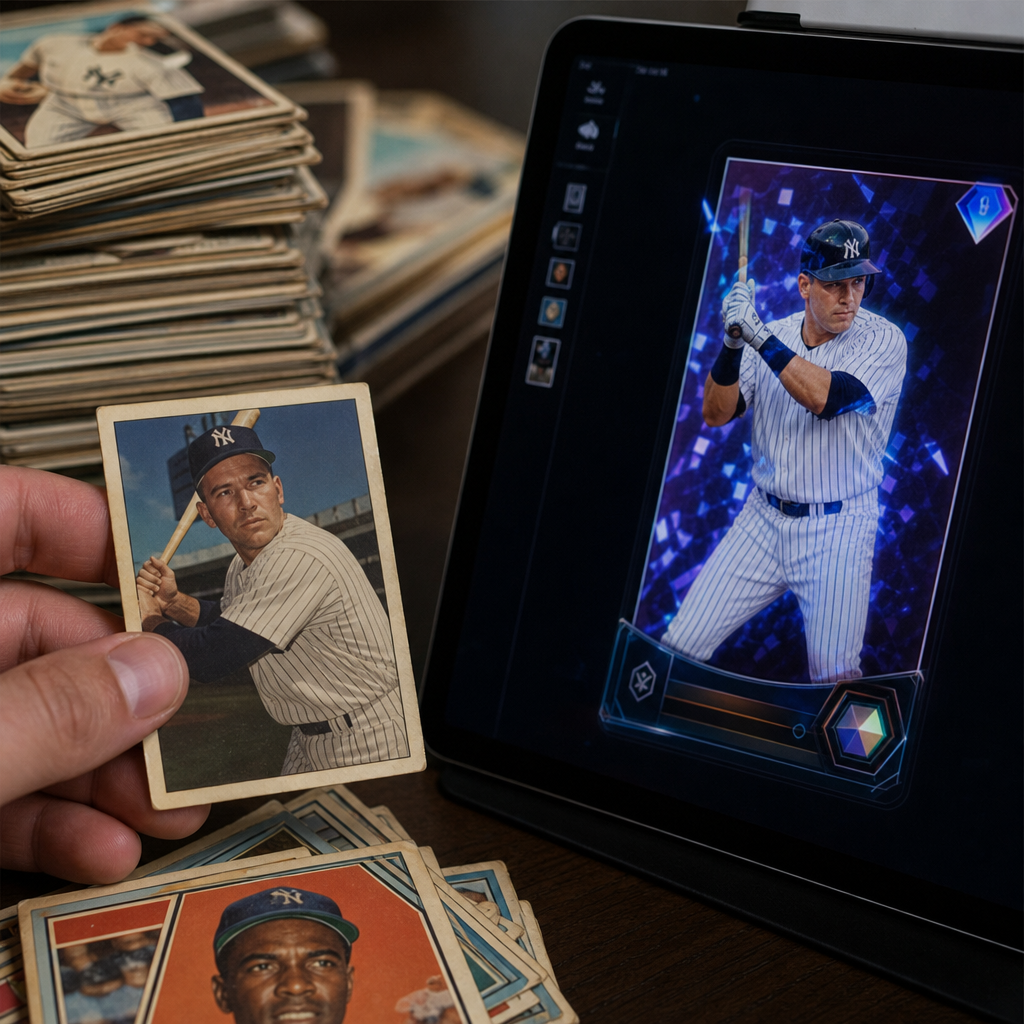
Baseball cards began as small printed inserts tucked into cigarette packs and gum boxes, but they have evolved into a complex market where history, design, technology, and finance intersect. The transformation of baseball cards from simple collectibles to digital assets reflects broader changes in baseball culture and in the way fans assign value to objects. What started as a promotional extra became a hobby, then an investment category, and now, in some cases, a blockchain-based token tied to verified ownership.
In working with collectors, auction data, grading reports, and card marketplaces, I have seen this shift happen in stages rather than all at once. A baseball card is no longer just cardboard with a player photo. It can be a historical artifact, a price-tracked alternative asset, a digitally authenticated collectible, or a hybrid of all three. Understanding that evolution matters for fans, investors, and historians because baseball cards mirror the sport’s own pattern of innovation: print gave way to mass media, mass media gave way to data, and data is now giving way to digital scarcity and global online markets.
Key terms help clarify the discussion. A vintage baseball card usually refers to older issues, often pre-1980, though definitions vary by market segment. Grading is the third-party assessment of a card’s condition by firms such as PSA, SGC, and Beckett. A parallel is a version of a base card with a different color, serial number, or finish. A digital asset in this context can mean a natively digital baseball collectible, a tokenized representation of ownership, or a blockchain-recorded collectible with fixed supply and verifiable provenance. These categories overlap, but they are not identical, and serious collectors distinguish them carefully.
This topic sits at the center of historic innovation in baseball because cards have repeatedly absorbed new production methods, new business models, and new definitions of ownership. They document players, preserve eras, shape fan memory, and reveal how technology changes collecting behavior. As a hub article, this guide explains the major turning points, the forces that changed value, the rise of grading and data, and the move toward digital collecting so readers can navigate the full history and connect to deeper articles on individual eras, technologies, and market trends.
How Baseball Cards Began as Marketing Tools and Cultural Records
The earliest baseball cards were not designed for modern hobbyists. In the late nineteenth century, companies used them primarily as advertising premiums. Tobacco brands such as Allen & Ginter and Goodwin & Company inserted illustrated cards into packs to stiffen packaging and encourage repeat purchases. The famous T206 set, issued between 1909 and 1911 by the American Tobacco Company, became a landmark because it combined mass distribution, vivid lithography, and a roster of stars that later generations would treat as foundational baseball history. Its Honus Wagner card became iconic not only because of rarity but because scarcity, story, and player significance converged in a single object.
These early cards performed an archival function before that was fully recognized. They captured uniforms, team identities, league affiliations, and player likenesses from periods when photography and sports broadcasting were limited. Collectors often describe cards as snapshots of baseball’s past, and that is accurate. A prewar card can preserve details about typography, sponsorship, regional distribution, and visual culture that do not survive as clearly anywhere else. For historians exploring the sport’s commercial growth, baseball cards are source material as much as memorabilia.
The next major phase arrived with gum and candy issues. Goudey’s 1933 set helped define the modern card format by pairing colorful player portraits with broad national distribution. Bowman and Topps later standardized the postwar market. By the 1950s, Topps had effectively built the template that still influences card design: front image, team branding, statistics, biographical notes, and season recap. This shift mattered because the card became a self-contained information product. A child did not just collect a face; he collected performance data, narrative, and a piece of league identity.
The Modern Hobby: Scarcity, Condition, and the Rise of Secondary Markets
Baseball cards became a true hobby when collectors moved from simple accumulation to organized valuation. Card shows, hobby shops, magazines, and price guides transformed collecting into a structured market. By the 1970s and 1980s, publications such as Beckett Baseball Card Monthly influenced expectations about worth, rookie card significance, and set completion. I have found that many longtime collectors still describe this period as the moment when the hobby learned to speak the language of pricing, population, and investment, even if those terms were less formal than they are today.
Condition emerged as the decisive factor because two copies of the same card could sell for radically different amounts. Centering, corners, edges, print quality, and surface wear all affected value. This was not trivial. A 1952 Topps Mickey Mantle in poor shape remained desirable, but a high-grade example became exponentially more valuable because survival in elite condition was rare. That logic underpins the modern market: scarcity is not just about how many cards were printed, but how many remain in top condition decades later.
The boom-and-bust cycle of the late 1980s and early 1990s offers a crucial lesson in baseball card history. Manufacturers printed massive quantities, believing endless demand would continue. Many collectors entered the market expecting routine cards to appreciate, but oversupply depressed long-term values for much of the era now called the junk wax period. This was one of the hobby’s most important innovations through failure. It taught manufacturers and collectors that artificial abundance undermines collectible value. The lesson directly influenced later strategies such as serial numbering, short prints, autographs, memorabilia inserts, and controlled release calendars.
As online selling matured through eBay, major auction houses, and dedicated marketplaces, secondary trading expanded from local shops to a global market. Price discovery improved because more transactions were visible. A collector in Ohio could compare sales with buyers in Tokyo or Toronto. This wider market rewarded knowledge, punished assumptions, and gave overlooked cards new demand. It also made data literacy central to successful collecting, especially when evaluating true scarcity versus manufactured rarity.
Why Grading Changed the Baseball Card Industry
Third-party grading fundamentally changed trust in the baseball card market. Before grading companies became dominant, disputes over condition were common because sellers and buyers often used different standards. PSA, founded in 1991, helped standardize a numerical scale from 1 to 10. Beckett and SGC added competing frameworks and credibility. Encapsulation in tamper-evident holders reduced uncertainty, while population reports allowed buyers to see how many examples had received a specific grade. That combination of standardization and transparency increased confidence, especially for high-value cards sold remotely.
I have watched graded cards alter collector behavior in practical ways. Buyers often search a grade first and a card second. For some segments, the slab became part of the product because it carries brand reputation, registry compatibility, and resale liquidity. PSA’s Set Registry encouraged collectors to compete for the highest-graded complete sets, creating demand pressure for already scarce top-condition examples. In effect, grading transformed condition from a subjective opinion into a tradable data point.
Grading also introduced tradeoffs. It improved trust, but it also encouraged overfinancialization. Some collectors began cracking and resubmitting cards in pursuit of marginally higher grades, while modern manufacturers saw demand shift toward cards with gem-mint potential. Delays and inconsistent outcomes during grading surges also reminded the market that no system is perfect. Still, grading remains essential because the baseball card industry depends on credible authentication, especially as counterfeit technology improves and values increase.
| Innovation | What It Changed | Practical Effect on Collectors |
|---|---|---|
| Third-party grading | Standardized condition assessment | Made long-distance buying safer and pricing more consistent |
| Population reports | Quantified scarcity by grade | Helped buyers judge whether a premium was justified |
| Serial numbering | Limited print runs on specific cards | Reduced uncertainty about supply in modern products |
| Online marketplaces | Expanded global access to listings and sales data | Improved price discovery and liquidity |
| Blockchain verification | Recorded ownership and provenance digitally | Enabled natively digital collectibles and token-based trading |
Manufacturing Innovation: Autographs, Relics, Parallels, and Data-Driven Design
After the junk wax era, card makers had to rebuild perceived scarcity and excitement. Companies such as Topps, Upper Deck, Panini, and Fleer introduced innovations that changed both product design and collecting strategy. Certified autograph cards gave collectors a pack-issued signature guaranteed by the manufacturer, solving a major authenticity problem associated with in-person signed cards. Game-used relic cards added swatches of jerseys, bats, or other equipment, creating a direct material link between player and card. Numbered parallels, refractors, and short prints introduced visible tiers of rarity that could be tracked more reliably than vague claims of limited availability.
These changes made opening packs feel more like probability-based treasure hunting. They also segmented the market. Set builders still chased complete base runs, but hit chasers focused on low-numbered autographs and premium inserts. In my experience, this segmentation is one of the most significant historic innovations because it turned one hobby into several parallel hobbies operating at once. A vintage historian, a prospect speculator, a rainbow parallel collector, and a player supercollector may all say they collect baseball cards, yet they use different tools, data, and buying logic.
Advanced analytics influenced card content too. Statistics once limited to batting average, home runs, and RBI expanded into metrics-aware storytelling. While the back of a card still cannot present the full language of Statcast, WAR, or pitch movement profiles, modern collectors increasingly interpret a player’s card market through performance models, age curves, prospect rankings, and injury risk. A prospect card today often trades on expected future value more than current achievements. That is a sharp departure from earlier collecting patterns centered mainly on established stars and nostalgic set completion.
The Shift to Digital Assets and Tokenized Ownership
The digital phase did not eliminate physical baseball cards; it added a new layer of collecting built around verification, portability, and online identity. Digital collectibles can exist entirely on licensed platforms, where users buy packs, complete sets, and trade cards in marketplace ecosystems. They can also be represented through blockchain tokens that record ownership and transaction history. The underlying promise is clear: a digital baseball collectible can have controlled supply, instant transferability, and transparent provenance without requiring physical storage, shipping, or insurance.
This transition follows logic established by physical cards. Collectors always cared about scarcity, authenticity, and provenance. Digital systems simply express those concerns with databases, smart contracts, and wallet-based ownership. In practice, the strongest digital products succeed when they replicate familiar collector behaviors: pack opening, rarity tiers, special inserts, achievement rewards, and player-driven demand. Platforms that ignore hobby psychology usually struggle, because fans do not value technology for its own sake. They value trust, status, community, and a believable reason an item should remain desirable over time.
There are limitations. A blockchain record can verify token history, but it cannot by itself create enduring demand. Licensing, platform stability, user experience, and legal clarity all matter. Environmental concerns around some blockchain systems, though reduced on more efficient networks, have also shaped adoption. Most importantly, digital ownership depends on platform governance and rights structure. Collectors should ask whether they own the token, the underlying media, the commercial rights, or simply licensed access. Those distinctions are not minor; they determine long-term utility and risk.
What This Evolution Means for the Future of Baseball Collecting
The transformation of baseball cards from printed promotions to digital assets shows how innovation in baseball often happens at the edges first, then becomes mainstream. Cards changed when printing improved, when distribution scaled, when grading standardized trust, and when online data connected buyers worldwide. They are changing again as collectors become comfortable owning value in both physical and digital form. The likely future is hybrid rather than purely digital: physical cards with embedded authentication, digital twins tied to graded slabs, stronger provenance records, and marketplaces that integrate collecting, content, and community.
For readers exploring historic innovations in baseball, baseball cards offer an ideal hub topic because they connect commerce, fandom, technology, and memory in one object. They show how a child’s keepsake became a recognized asset class and how authenticity moved from visual inspection to third-party grading to cryptographic verification. The main lesson is not that every card is an investment or that digital collectibles will replace cardboard. It is that baseball cards endure because they keep adapting to how fans discover players, measure rarity, and express identity. If you want to understand baseball’s broader pattern of change, follow the history of the card and then explore each era, format, and technology in greater detail.
Frequently Asked Questions
How did baseball cards evolve from simple promotional items into valuable collectibles?
Baseball cards began as practical marketing tools rather than prestige collectibles. In the late 19th and early 20th centuries, card makers and consumer brands included them in cigarette packs, candy products, and gum boxes as a way to attract buyers and build brand loyalty. At first, their value was tied mostly to novelty. They featured player portraits, team names, and basic biographical details, giving fans a small, tangible connection to the sport at a time when mass media was still developing. As baseball grew into a defining part of American culture, these cards became keepsakes that preserved moments, stars, and teams in a portable format.
Over time, scarcity, condition, and nostalgia transformed those simple inserts into serious collectibles. Cards from earlier eras survived in limited quantities, especially in high grades, which made them more desirable. At the same time, collectors began organizing around sets, manufacturers, and player themes, turning casual accumulation into a structured hobby. Price guides, card shops, conventions, and dedicated publications helped standardize how people evaluated worth. What had once been an inexpensive extra item became an object that could carry historical significance, sentimental appeal, and financial value all at once.
The rise of superstar athletes, media coverage, and auction culture further accelerated this shift. Certain cards became icons because they represented legendary players, key rookie seasons, or visually memorable designs. In other words, baseball cards evolved because the surrounding culture changed: fans began to see them not just as printed cardboard, but as artifacts of baseball history. That change in perception laid the foundation for the modern market, where a card can be appreciated as a collectible, a piece of sports heritage, and an investment-grade asset.
What factors determine the value of a baseball card in today’s market?
A baseball card’s value is shaped by a combination of physical characteristics, historical context, market demand, and increasingly, technological features. One of the biggest factors is the player depicted on the card. Cards featuring Hall of Famers, record breakers, cultural icons, and especially rookie-year appearances tend to command the strongest interest. A card associated with a major career milestone or a player with enduring legacy often has more staying power than one tied only to short-term hype.
Condition is another central factor, and in the modern hobby it is often measured through professional grading. Grading companies evaluate centering, corners, edges, and surface quality, then assign a numerical score. Even small differences in grade can create major price gaps, particularly for sought-after vintage cards or limited modern releases. Scarcity also matters. Some cards are rare because of age and low survival rates, while others are intentionally manufactured as limited editions with serial numbering, autographs, special patches, or parallel designs. In both cases, rarity can significantly influence value, but only if collectors actually want the card.
That demand piece is critical. A rare card with little interest behind it will not necessarily perform well, while a more available card tied to a beloved player may remain highly liquid. Design and storytelling matter too. Cards that reflect a classic era, a famous set, or a turning point in the hobby often carry broader appeal. In today’s market, authentication, provenance, and sales data also play larger roles than ever before. Collectors and investors now compare recent auction results, population reports, and marketplace trends before buying. For digital or tokenized cards, additional factors such as platform credibility, blockchain ownership records, and utility within a digital ecosystem can also affect pricing. In short, value is not determined by one thing alone; it is created at the intersection of rarity, condition, player importance, collector psychology, and market infrastructure.
How has technology changed the baseball card hobby and collecting experience?
Technology has reshaped nearly every part of the baseball card world, from discovery and authentication to buying, selling, and community building. In earlier decades, collectors relied on local card shops, trade shows, hobby magazines, and word of mouth. Today, online marketplaces, auction platforms, grading databases, and social media have created a far more connected and transparent environment. A collector can now research a card’s sales history, compare condition examples, watch live breaks, and purchase from sellers around the world in a matter of minutes. That level of access has expanded the hobby dramatically and lowered many of the barriers that once limited participation.
Professional grading and digital recordkeeping have also added a layer of trust and standardization. Slabbed cards with serial numbers and online verification tools make it easier to confirm authenticity and assess condition. Population reports help buyers understand how many copies of a particular card exist in each grade, which can influence both pricing and strategy. Meanwhile, scanning technology, high-resolution photography, and detailed listing tools have improved the ability to evaluate cards remotely, even if in-person inspection still matters for serious purchases.
Perhaps the biggest technological shift, however, is the move beyond physical cardboard into digital ownership models. Some platforms now offer officially licensed digital cards, tokenized collectibles, or blockchain-based assets that represent ownership of unique or limited-edition items. These products appeal to a generation comfortable with digital scarcity, online trading, and virtual display. At the same time, they have sparked debate about what it really means to “own” a collectible when the object is not physical. Still, whether one prefers vintage paper stock or blockchain-backed collectibles, technology has undeniably expanded the definition of the baseball card hobby. It has turned a once local pastime into a global, data-driven, and increasingly hybrid collecting experience.
What are digital baseball cards and blockchain-based baseball assets?
Digital baseball cards are collectible items that exist in electronic form rather than as printed cardboard. They may feature player images, statistics, animations, limited-edition artwork, or interactive elements that are impossible in physical formats. Some digital cards are simply licensed collectibles housed within a platform account, while others are issued as blockchain-based tokens that can be individually tracked, bought, sold, and in some cases transferred between users. The blockchain component is important because it introduces a transparent ownership ledger, making it possible to verify scarcity and transaction history in a way that resembles authentication and provenance in the traditional card market.
When people refer to blockchain-based baseball assets, they are usually talking about tokenized collectibles that use decentralized technology to record ownership. In practical terms, that means a digital card or highlight can be associated with a unique token on a blockchain network. Supporters argue that this creates provable scarcity in the digital realm, something that was historically difficult because digital files can be copied endlessly. Even if the image or media is viewable by many people, the token represents the officially recognized collectible ownership record. This distinction is a major reason digital assets have gained attention among both collectors and speculators.
That said, digital baseball assets are not identical to traditional cards, and they come with their own risks and considerations. Their value can depend heavily on platform stability, licensing agreements, user demand, market sentiment, and the long-term relevance of the technology behind them. Unlike a physical card stored in a collection, a digital asset may rely on a company’s ecosystem, wallet accessibility, or broader blockchain infrastructure. For some collectors, that adds exciting new possibilities such as instant trading, integrated marketplaces, and gamified ownership. For others, it raises questions about permanence, utility, and whether digital ownership delivers the same emotional connection as holding a historic card in hand. The category is still evolving, but it clearly represents the next stage in how fans define collectible value.
Are baseball cards now considered investments, and what should collectors keep in mind?
Yes, baseball cards are now widely viewed by many people as alternative investments, but that perspective should be approached carefully. Over the past few decades, headline-grabbing auction sales, rising interest in sports memorabilia, and increased market visibility have pushed cards into the broader conversation about assets. High-end vintage cards, rare rookie issues, and low-population graded examples have attracted serious capital from collectors, dealers, and investors alike. In some cases, cards have performed impressively over time, especially those tied to legendary players and historically significant sets. The emergence of digital collectibles and tokenized card-related assets has only strengthened the idea that baseball cards are no longer just hobby items; they can also function as speculative holdings.
However, treating cards strictly as investments can be risky. Markets can be volatile, trends can cool quickly, and prices often reflect emotion as much as fundamentals. A player’s on-field performance, injury history, Hall of Fame prospects, media visibility, and cultural status can all affect value. In modern cards, overproduction concerns, frequent product releases, and changing collector tastes can complicate long-term outlooks. For digital assets, additional uncertainty comes from technology shifts, regulatory changes, and platform adoption. Liquidity also matters. A card may have a theoretical value based on comparable sales, but actually realizing that price depends on timing, demand, and transaction costs.
The smartest approach is usually a balanced one. Collect what genuinely interests you, learn the history of the market, pay attention to grading and authenticity, and avoid assuming that every card will appreciate. Serious collectors tend to do well when they combine passion with discipline. They understand why an item matters, not just what it sold for last week. Whether the asset is a century-old tobacco card or a blockchain-tracked digital collectible, long-term value tends to favor pieces with strong stories, recognized scarcity, cultural relevance, and lasting collector demand. In that sense, baseball cards