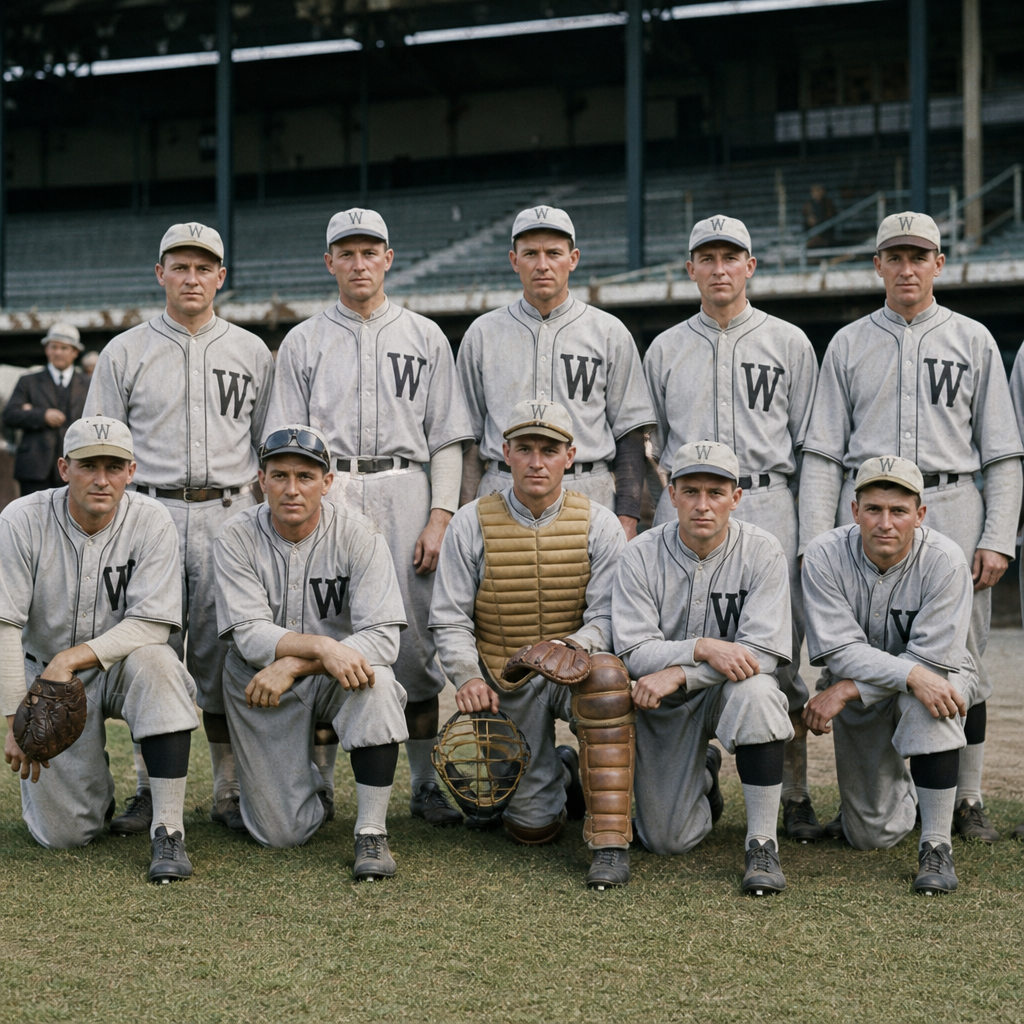
The original Washington Senators occupy a singular place in baseball history because they connect several of the sport’s biggest themes at once: losing and loyalty, transcendent greatness and front-office failure, capital-city politics and franchise relocation. For readers exploring relocated and defunct franchises, the Senators are the essential hub case. They began as one of the American League’s charter clubs in 1901, played six decades in Washington, produced one of baseball’s most dominant pitchers in Walter Johnson, won a World Series in 1924, declined badly after their brief peak, and ultimately moved to Minnesota in 1961 to become the Twins. Their story explains how a team can be historically important even when its all-time record looks bleak.
When discussing the original Washington Senators, it helps to define the name clearly. “Washington Senators” was used by multiple major league teams, and “Nationals” also appeared in official naming. The franchise covered here is the American League club founded in 1901 that relocated after the 1960 season. It should not be confused with the expansion Washington Senators that started in 1961 and later became the Texas Rangers in 1972. In practical baseball history, the “original Senators” are the 1901–1960 franchise that became the Minnesota Twins. That distinction matters because records, retired identities, and player legacies follow the franchise line, not the city name alone.
This franchise matters far beyond Washington or Minnesota. It serves as a blueprint for understanding how old teams were built, how stars could carry weak rosters, how attendance and ownership shaped survival, and how relocation reshaped Major League Baseball in the twentieth century. I have always found that once readers grasp the Senators’ timeline, other relocated and defunct franchises make more sense: the St. Louis Browns becoming the Baltimore Orioles, the Boston Braves moving to Milwaukee and then Atlanta, the Philadelphia Athletics leaving for Kansas City and Oakland, and the Brooklyn Dodgers and New York Giants departing for California. The Senators sit in the middle of that larger pattern. Their rise and exit show exactly how unstable “permanent” franchises could be before modern revenue systems, public financing norms, and national media money changed the business.
They also matter because the franchise embodies one of baseball’s sharpest contrasts. On one hand, the club was notorious for losing, memorialized in the line often attributed to Charles Dryden: “First in war, first in peace, and last in the American League.” On the other hand, it featured Walter Johnson, whose career remains one of the clearest measures of sustained pitching excellence in baseball history. Any serious article about famous baseball teams, especially under relocated and defunct franchises, needs to treat the original Senators as both a cautionary tale and a foundational one.
Origins of the franchise and why Washington struggled
The original Washington American League franchise began in 1901, when Ban Johnson’s new league declared itself a major league and challenged the established National League. Washington was a logical market: it was the nation’s capital, politically visible, and symbolically important for a league trying to look national rather than regional. Yet from the start, the club struggled competitively. Early rosters lacked depth, talent evaluation was inconsistent, and ownership was rarely stable enough to create long-term baseball operations advantages. In an era before the amateur draft, international academies, and advanced player development systems, strong organizations separated themselves through scouting networks, financial discipline, and competent leadership. Washington too often lacked all three at once.
The Senators played in a baseball culture very different from the modern game. Teams relied heavily on gate receipts, travel was harder, and roster construction could swing dramatically based on one owner’s willingness to spend or one manager’s ability to identify players. Washington’s fan base was loyal but limited compared with larger industrial cities. The city also had structural challenges as a baseball market. Much of the local population worked in government, seasonality affected attendance, and the area did not always generate the same sustained commercial support seen in New York, Chicago, Detroit, or Cleveland. In weak years, poor play depressed crowds, and smaller crowds made it harder to invest in improvement. That cycle trapped the club repeatedly.
Despite those weaknesses, Washington did produce one of the era’s most consequential baseball figures in owner Clark Griffith, who arrived as manager and later became principal owner. Griffith was respected as a baseball man and helped stabilize the organization institutionally, but stability did not always translate to consistent winning. He kept the franchise viable in the capital for decades, yet budget-conscious decision-making and uneven roster support also limited championship opportunities. This dual legacy is important: Griffith deserves credit for preserving major league baseball in Washington for as long as he did, but he also presided over too many seasons in which the club asked extraordinary players to compensate for ordinary teams.
Walter Johnson and the making of a baseball identity
No figure defines the original Washington Senators more than Walter Johnson. Debuting in 1907, Johnson became the franchise’s identity, standard of excellence, and main argument for national relevance. He was not simply a great pitcher on a weak team; he was one of the most dominant pitchers the sport has ever produced. Johnson won 417 games, struck out 3,509 batters, threw 110 shutouts, and posted a career 2.17 earned run average across 21 seasons, all with Washington. Those numbers remain extraordinary even after accounting for era and workload. His fastball was legendary, his control improved over time, and his durability was almost unmatched.
What made Johnson’s career especially remarkable was the context around it. He spent most of his prime on clubs that did not give him the run support or lineup protection common to stars on dynastic teams. Modern fans sometimes ask how a pitcher could be that great and still appear in relatively few pennant races. The answer is simple: baseball is too interdependent for one player, even an all-time pitcher, to overcome weak hitting and thin depth every year. Johnson could dominate a game every fourth day, later every fifth by modern logic, but he could not bat in the middle of the order, field shortstop, and build the bench.
Still, Johnson gave the Senators legitimacy. He won MVP awards in 1913 and 1924, led the league repeatedly in strikeouts, wins, and shutouts, and became known not just for power but for sportsmanship. That mattered in an era when the league marketed stars heavily through newspaper coverage. Washington may have lacked the deep-winning tradition of the Yankees or Athletics, but with Johnson on the mound it had a figure every baseball fan recognized. In practical franchise terms, he did what landmark stars often do for vulnerable clubs: he extended civic patience, attracted attention beyond the standings, and made a team impossible to dismiss.
The 1924 championship and the Senators’ brief golden age
The high point of original Senators history came in the 1920s, when better roster balance finally supported Johnson and Washington turned into a genuine contender. The club won the American League pennant in 1924, then defeated John McGraw’s New York Giants in a dramatic World Series. This was not a fluke carried by one pitcher alone. Manager Bucky Harris, only 27 years old, brought energy and tactical sharpness. Goose Goslin supplied impact offense. Sam Rice, Joe Judge, Ossie Bluege, and Muddy Ruel gave the lineup and defense credibility. Washington won 92 games, then captured Game 7 of the World Series in extra innings after a famous bad-hop grounder contributed to the deciding rally.
The 1924 title remains one of the most meaningful championships in baseball history because it delivered on years of frustration. Johnson, after so many seasons of personal brilliance without a title, finally reached the summit. He relieved in Game 7 and earned the victory, a fitting if exhausting symbol of how much the franchise still depended on him. Washington returned to the World Series in 1925, again against the Giants, but lost in seven games. In 1933 the Senators won another pennant under manager Joe Cronin, only to lose the World Series to the Giants. Those seasons proved Washington could contend when management assembled enough complementary talent around its core.
| Season | Result | Key Figures | Why It Mattered |
|---|---|---|---|
| 1924 | Won World Series | Walter Johnson, Bucky Harris, Goose Goslin | Only championship in Washington for the original franchise |
| 1925 | Won pennant, lost World Series | Johnson, Harris, Rice | Confirmed 1924 was not a one-year fluke |
| 1933 | Won pennant, lost World Series | Joe Cronin, Heinie Manush, Goose Goslin | Last major peak before long decline |
For a hub article on relocated and defunct franchises, these peaks are essential. Teams do not disappear only because they lack history; sometimes they disappear despite meaningful success. Washington had real baseball substance, iconic players, and championship memories. Relocation was not caused by a complete absence of tradition. It came because tradition alone could not solve long-term business and competitive problems.
Decline, attendance problems, and the road to relocation
After 1933, the original Senators sank into the pattern most fans remember: occasional respectable clubs, but many losing seasons and limited hope. From the mid-1930s through 1960, Washington rarely looked built for sustained success. Farm systems became more important across baseball, and richer or more efficient franchises gained an edge by developing waves of players. Washington did produce talent, including Cecil Travis, Buddy Myer, Mickey Vernon, Early Wynn for a period, and later Harmon Killebrew, but the club did not consistently convert talent into durable contention. Injuries, military service disruptions during World War II, shallow depth, and ownership conservatism all played roles.
Attendance became the central issue. Griffith Stadium was historic and atmospheric, but by the 1950s it was aging, difficult in some respects for fans to access comfortably, and tied to a team that too often lost. Television also changed baseball economics. Clubs in larger or more dynamic markets could leverage broader media reach, while weaker teams risked seeing at-home viewing erode the gate without equal broadcast revenue. The Senators were not alone in this problem. The Browns, Athletics, and Braves all faced versions of it, and the postwar period saw owners think more aggressively about market shifts. Franchise relocation was no longer unthinkable; it was becoming a rational business strategy.
Calvin Griffith, Clark Griffith’s nephew and successor, concluded that Washington could not support the franchise at the level he wanted. Minnesota, by contrast, offered a growing Upper Midwest market, strong civic interest, and less direct competition for fan attention. The region had long supported high-level minor league baseball, especially the Minneapolis Millers and St. Paul Saints, and local leaders pushed hard for a major league club. In 1960, the American League approved the relocation. To soften the political blow of losing baseball in the capital, the league simultaneously awarded Washington an expansion team for 1961, also called the Senators. That move preserved the city’s place in the league but did not preserve the original franchise. Its history, records, and player lineage moved to Minnesota.
From Washington Senators to Minnesota Twins
When the franchise became the Minnesota Twins in 1961, the change was more than cosmetic. It was a reset in branding, geography, and long-term fortunes. “Twins” referenced the Twin Cities of Minneapolis and St. Paul, signaling regional inclusion rather than single-city loyalty. Yet the baseball continuity is direct. The club’s franchise records trace back through Washington, and stars who debuted as Senators, most notably Harmon Killebrew, became central to the early Twins identity. This is a common source of confusion for newer fans, but baseball treats the original Senators and the Twins as one continuous franchise line.
Minnesota immediately demonstrated why relocation had appealed to ownership. Attendance improved sharply, the team became more commercially viable, and the organization soon fielded stronger clubs. By 1965, the Twins won the American League pennant behind Killebrew, Tony Oliva, Zoilo Versalles, Jim Kaat, and Mudcat Grant. That fast improvement did not erase the Washington years; it highlighted the argument Griffith had made, fairly or unfairly, that a different market could better support major league success. For historians, this is where the Senators’ story becomes especially useful. It shows that franchise moves are rarely about one factor alone. Performance, facility quality, local economics, ownership strategy, and league politics all intersect.
The original Washington Senators therefore stand at a crossroads within the broader topic of relocated and defunct franchises. They connect dead-ball baseball to expansion-era baseball, a legendary ace to modern franchise mobility, and a proud city identity to the uncomfortable reality that teams follow revenue and opportunity. If you are mapping this subtopic, the Senators belong alongside the Browns/Orioles, Athletics, Braves, Dodgers, Giants, and the second Senators/Rangers. Study them closely, and the entire landscape of baseball relocation becomes easier to understand.
The original Washington Senators were far more than a losing old ballclub that left town. They were a foundational American League franchise, the long-time home of Walter Johnson, the 1924 world champions, and the direct ancestor of today’s Minnesota Twins. Their history explains how baseball teams can be culturally significant even when they spend many seasons in the second division. It also shows how fragile franchise stability once was. A club could have a Hall of Fame icon, a championship banner, and deep civic recognition, yet still relocate when ownership, attendance, facilities, and league economics aligned against its city.
For anyone exploring famous baseball teams through the lens of relocated and defunct franchises, the Senators are the ideal starting point because nearly every major issue appears in their timeline: naming confusion, star power, brief contention, chronic underperformance, stadium challenges, ownership decisions, market comparisons, and continuity after a move. The Washington years and the Minnesota years are one story, not two separate ones. Understanding that continuity is the key takeaway. If you want to go deeper into this subtopic, use the Senators as your reference point, then compare their path with the Browns, Athletics, Braves, Dodgers, Giants, and second Senators.
Start there, and the history of baseball’s vanished and relocated teams becomes much clearer.
Frequently Asked Questions
Who were the original Washington Senators, and why are they so important in baseball history?
The original Washington Senators were one of the American League’s charter franchises, beginning play in 1901 and representing Washington, D.C., for 60 seasons before relocating after the 1960 campaign. They matter because their story brings together many of baseball’s defining themes in one franchise: chronic losing, intense fan loyalty, legendary individual talent, ownership instability, and eventual relocation. For anyone trying to understand how early baseball evolved into the modern major leagues, the Senators are one of the most revealing case studies.
For much of their existence, the Senators struggled on the field, which helped inspire one of the most famous lines in baseball lore: “First in war, first in peace, and last in the American League.” Yet despite that reputation, the team was far from irrelevant. Washington remained a major-league city for decades, and the club served as a fixture of baseball in the nation’s capital. The Senators also produced one of the game’s greatest all-time players in Walter Johnson, whose career alone would make the franchise historically significant.
The team’s importance extends beyond wins and losses. The Senators illustrate the tension between civic identity and business reality in professional sports. They played in the capital, often in the shadow of politics and national symbolism, but were subject to the same economic pressures that affected every other franchise. By the mid-20th century, attendance issues, outdated facilities, and ownership ambitions helped push the club toward relocation. That move eventually linked the franchise’s history to the Minnesota Twins, making the Senators essential to understanding not just Washington baseball, but the broader pattern of franchise movement in Major League Baseball.
How did Walter Johnson shape the identity and legacy of the Washington Senators?
Walter Johnson is the central figure in the history of the original Washington Senators and one of the greatest pitchers in baseball history. Debuting with Washington in 1907, Johnson became the franchise’s defining star through a combination of overpowering talent, longevity, and remarkable personal reputation. His blazing fastball, durability, and consistency made him one of the dead-ball era’s most feared pitchers, and his accomplishments gave the Senators credibility and stature during a period when the club often lacked depth around him.
Johnson’s statistical record is extraordinary. He won 417 games, one of the highest totals in baseball history, and accumulated 110 shutouts, a mark that still stands as a major-league record. He led the league in multiple categories over many seasons, dominated hitters in an era when pitchers were expected to carry enormous workloads, and remained elite for years. His individual greatness was so overwhelming that it elevated the image of the entire franchise. In many ways, the Senators were Walter Johnson’s team more than they were anyone else’s.
His influence was not limited to numbers. Johnson gave the franchise legitimacy in a city and on a club that often struggled to compete consistently. He helped transform Washington from a perennial afterthought into a champion when the Senators finally reached their peak in the 1920s. The crowning moment came in 1924, when Washington won the American League pennant and then captured its only World Series title. Johnson, after years of near-singlehandedly carrying the franchise, played a decisive role in that championship run, cementing his place not just in Senators history, but in baseball mythology.
Even after his playing career ended, Johnson remained deeply associated with the team and the city. His legacy became shorthand for everything noble and memorable about the original Senators: excellence amid adversity, loyalty to a struggling franchise, and the possibility of greatness even in a historically uneven organization. When people remember the original Senators, they almost always begin with Walter Johnson, and that is exactly as it should be.
Did the original Washington Senators ever succeed, or were they really as bad as their reputation suggests?
The original Senators were not successful on a consistent basis, but their reputation as nothing more than a hopeless losing franchise oversimplifies the story. It is true that they spent many seasons near the bottom of the American League standings and became emblematic of long-term underperformance. However, the franchise did have meaningful high points, particularly in the 1920s and early 1930s, when it became one of the league’s stronger clubs.
The greatest moment in team history came in 1924. Managed by Bucky Harris and led by Walter Johnson, the Senators won the American League pennant and defeated the New York Giants in a dramatic seven-game World Series. That remains the only World Series championship in the history of the original Washington franchise. They returned to the World Series in 1925, again winning the pennant, although they lost to Pittsburgh. The Senators also captured another American League pennant in 1933, showing that the 1924 title was not just a one-year fluke.
Still, those peaks were exceptions rather than the rule. Over the full 1901–1960 span, Washington more often finished in the second division than in contention. The club’s chronic difficulties in building sustained depth, investing in talent, and modernizing operations contributed to long-term mediocrity. So yes, the losing reputation was rooted in reality—but it should be balanced with the fact that this franchise did win a championship, claim multiple pennants, and produce stretches of genuine competitiveness.
That contrast is part of what makes the Senators so compelling. They were not simply bad; they were intermittently great, often frustrating, and always tied to bigger questions about how a baseball franchise can squander opportunity while still creating enduring memories. Their history is more layered than the cliché suggests, which is one reason they continue to fascinate baseball historians.
Why did the original Washington Senators move, and how did they become the Minnesota Twins?
The original Washington Senators relocated after the 1960 season because ownership believed the franchise had stronger long-term prospects outside the nation’s capital. The move was driven by a blend of business concerns and structural problems: inconsistent attendance, limited revenue growth, dissatisfaction with the team’s market position, and broader uncertainty about whether Washington could support a successful major-league club under the existing conditions. At the center of the decision was owner Calvin Griffith, who concluded that the franchise could do better in Minneapolis–St. Paul.
The relocation reflected a pattern that became increasingly common in professional sports during the mid-20th century. Teams were no longer rooted exclusively by tradition; they were also mobile businesses evaluating market size, stadium arrangements, fan support, and financial upside. Griffith saw the Twin Cities as a more promising environment, and Major League Baseball approved the move. Beginning in 1961, the franchise became the Minnesota Twins.
Importantly, this means the Minnesota Twins are the direct continuation of the original Senators franchise. The club’s lineage runs from Washington in 1901 to Minnesota in 1961 without interruption. That includes the statistical and historical continuity of players, managers, and franchise records. Walter Johnson, the 1924 World Series title, and the early Senators years are all part of Twins franchise history, even though they took place in Washington, D.C.
To soften the blow politically and symbolically, Major League Baseball immediately created a new Washington Senators expansion team in 1961. That new club was not the same franchise; it was a separate entity that later moved to Texas and became the Rangers. This often causes confusion. In simple terms: the original Senators became the Minnesota Twins, while the second Washington Senators team, founded in 1961, eventually became the Texas Rangers. Understanding that distinction is essential when tracing baseball franchise history.
What is the lasting legacy of the original Washington Senators today?
The legacy of the original Washington Senators is much larger than their record in the standings. They remain one of baseball’s most instructive franchises because they sit at the crossroads of loyalty, failure, greatness, and change. Their history helps explain how a team can matter deeply to the sport even without sustained success. In that sense, the Senators are not just a Washington story or a Twins origin story—they are a baseball story.
One major part of that legacy is emotional and cultural. The Senators became symbols of faithful fandom in difficult circumstances. Generations of Washington supporters stayed attached to a club that rarely rewarded them with championships, which gave the franchise a kind of tragic dignity. The team’s presence in the capital also tied baseball to national identity in a unique way. Presidents attended games, political figures followed the club, and the Senators occupied a space no other franchise could fully replicate.
Another part of their legacy is historical continuity. Because the franchise became the Minnesota Twins, the Senators are not merely a vanished artifact; they remain alive through an active major-league organization. Twins history begins in Washington, and that connection gives the original Senators an unusually visible afterlife compared with many defunct or relocated teams. Their stars, records, and defining moments still belong to a franchise that exists today.
Finally, the Senators endure as a cautionary example. Their story highlights what can happen when a franchise leans too heavily on a few great figures, fails to build sustainably, and cannot fully align ownership ambition with on-field competitiveness. Yet they also show how a team can produce unforgettable greatness despite those flaws. From Walter Johnson’s dominance to the 1924 championship to the eventual move that created the Minnesota Twins, the original Senators continue to serve as one of baseball’s clearest windows into the