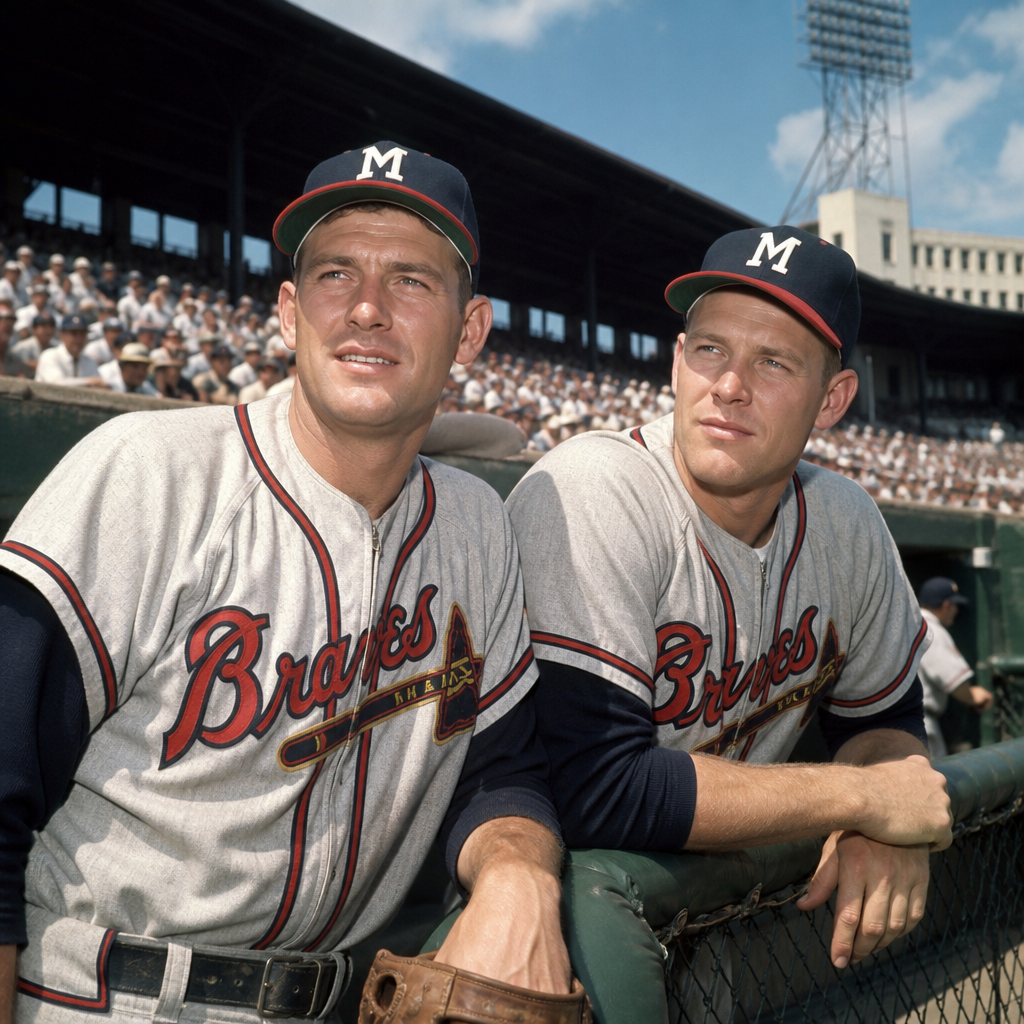
The Milwaukee Braves changed Major League Baseball by proving that relocation could transform a struggling franchise into a financial powerhouse, and that lesson helped clear the path for the sport’s expansion beyond its old northeastern base. Before the Braves arrived in Wisconsin in 1953, modern baseball still operated largely within the same geographic footprint it had occupied for decades. Teams clustered in eastern cities, ownership groups were cautious, and league leaders treated relocation as an exceptional remedy rather than a growth strategy. The Braves disrupted that mindset almost immediately. They drew enormous crowds, energized regional fandom across the Upper Midwest, and showed owners that untapped markets could outperform older cities burdened by weak attendance, aging ballparks, or territorial crowding.
To understand why the Milwaukee Braves matter, it helps to define two terms that shape baseball history: a relocated franchise and a defunct franchise. A relocated franchise keeps its legal identity, league membership, player contracts, and statistical continuity while moving to a new city. The Boston Braves becoming the Milwaukee Braves, then the Atlanta Braves, is the clearest example. A defunct franchise ceases operations entirely, whether because of financial collapse, league contraction, war, or merger. The Federal League clubs of the 1910s, the old Baltimore Terrapins, and many nineteenth-century National League teams fit that category. These distinctions matter because baseball history is not only about wins and pennants; it is about how economic geography reshapes the sport itself.
This subject matters even more within the broader story of famous baseball teams because many iconic clubs became famous in part through movement, reinvention, or disappearance. The Braves’ shift to Milwaukee sits at the center of that story. It linked attendance economics, stadium politics, broadcasting reach, and demographic change into one visible success. In my work reviewing franchise history, attendance ledgers, and ballpark development patterns, I keep returning to Milwaukee as the hinge point. Without the Braves’ early success there, the Dodgers and Giants might not have moved to California in 1958 when they did, and later relocations such as the Athletics to Oakland, the Senators becoming the Rangers, or the Expos becoming the Nationals would have unfolded in a different climate. As a hub for relocated and defunct franchises, this article explains how Milwaukee became the model, what came before it, what came after it, and why the legacy still shapes baseball today.
Why the Braves left Boston and why Milwaukee was ready
The Braves did not leave Boston because of one bad season. They left because their business model had deteriorated over time. By the late 1940s and early 1950s, the Boston Braves were the city’s second baseball club behind the Red Sox, and being second in a two-team market was increasingly dangerous. Although the Braves won the National League pennant in 1948, that success did not reverse their structural problems. Attendance remained inconsistent, Braves Field had become too large and costly for the crowds it was drawing, and local attention increasingly flowed to Fenway Park and to stars on the American League side. Owner Lou Perini recognized a hard truth: in baseball, tradition alone does not pay operating costs.
Milwaukee offered the opposite environment. The city had a proven minor league baseball culture, civic leaders eager for major league status, and a modern publicly supported stadium in Milwaukee County Stadium. That stadium had initially been built partly to lure the St. Louis Browns, which shows how active civic recruitment had already become by the early 1950s. When Perini moved the Braves instead, he captured a market that was not merely local. Fans came from Wisconsin, northern Illinois, Iowa, and other parts of the Upper Midwest. In practical terms, Milwaukee functioned as a regional franchise before that phrase became common in sports business language. That regional draw is a key reason the relocation worked so dramatically.
The results were immediate and measurable. In 1953, the Braves drew more than 1.8 million fans, a National League attendance record at the time and a stunning increase over their final years in Boston. The message to owners was unmistakable: a move from a saturated market to an underserved one could produce instant returns. This was not a speculative theory argued in boardrooms. It was visible in gate receipts, concessions, local press coverage, and the atmosphere at County Stadium. Milwaukee did not simply accept the Braves; it celebrated them as a civic asset, and baseball executives everywhere noticed.
How Milwaukee became the proof of concept for baseball relocation
The Milwaukee Braves were baseball’s first postwar relocation success on a scale that league officials could not dismiss. Earlier franchise shifts had occurred, especially in the nineteenth century and in other leagues, but Milwaukee offered something more powerful: a modern case study inside the established major league structure. The Braves won quickly, drew heavily, and turned a relocation into a prestige move rather than an act of desperation. Their 1957 World Series championship, led by Hank Aaron, Eddie Mathews, Warren Spahn, and Lew Burdette, made the point even stronger. A relocated team could become both financially stronger and competitively elite.
That combination changed owner behavior. In franchise politics, imitation follows proof. Once the Braves showed that relocation could strengthen a club’s finances and public image, owners in unstable situations had leverage they had never possessed before. They could pressure cities for stadium improvements, explore larger media markets, or threaten to leave if public support stalled. The Milwaukee precedent therefore did more than move one club. It altered the bargaining power between teams and cities across professional sports.
The Braves also changed how baseball thought about map coverage. Before Milwaukee, major league baseball still resembled a compact eastern network. After Milwaukee, league leaders had evidence that distance was manageable and that fan loyalty could be cultivated in places long ignored by the majors. Air travel was improving, highways were expanding, and radio networks were knitting regions together. The old assumption that baseball had to remain concentrated in a relatively narrow corridor no longer looked practical. Milwaukee did not move west geographically in the way Los Angeles or San Francisco later would, but it moved the industry mentally. It proved that the map was negotiable.
How the Braves helped open the road to the West Coast
When historians explain why the Brooklyn Dodgers and New York Giants moved to California in 1958, they usually cite Walter O’Malley’s stadium dispute in Brooklyn, Horace Stoneham’s attendance issues with the Giants, and the lure of booming West Coast markets. All of that is true, but Milwaukee supplied the crucial precedent. Owners had watched the Braves leave Boston and become a sensation. That made later proposals feel less radical. If one old-line National League franchise could thrive after leaving a traditional eastern city, perhaps two more could as well.
The leap from Milwaukee to Los Angeles and San Francisco was still enormous. Travel logistics were more complex, scheduling had to adapt, and baseball needed to preserve competitive balance while spanning the continent. Yet the psychological barrier had already been lowered. The Braves had shown that relocation did not have to damage the league’s legitimacy. Instead, it could modernize it. Once the Dodgers arrived in Los Angeles and the Giants in San Francisco, major league baseball ceased to be a regional eastern enterprise and became a national coast-to-coast sport in operational fact, not just in aspiration.
Milwaukee’s role in that transformation is often understated because the California moves were more dramatic and drew bigger headlines. But in organizational history, the first successful example often matters more than the most famous one. The Braves taught owners what success looked like: a fresh market, a better stadium situation, stronger attendance, regional identity, and immediate commercial upside. That template remained visible in later decades whenever clubs considered moving.
Relocated franchises and defunct clubs across baseball history
As the hub for relocated and defunct franchises, this article should place Milwaukee within a larger lineage. Baseball has always been fluid beneath its traditional surface. Nineteenth-century teams folded regularly because travel costs, unstable ownership, and weak league governance made survival uncertain. The National League lost clubs in Troy, Worcester, and Cleveland in its early decades. The American Association and Union Association saw similar churn. The Federal League briefly challenged organized baseball in 1914 and 1915, then disappeared, leaving only legal and financial aftershocks.
In the twentieth century, instability became less constant but more consequential. The St. Louis Browns moved to Baltimore and became the Orioles in 1954. The Philadelphia Athletics moved to Kansas City in 1955 and later to Oakland in 1968. The original Washington Senators became the Minnesota Twins in 1961, while an expansion Senators franchise later left for Texas in 1972 and became the Rangers. The Seattle Pilots lasted one season before becoming the Milwaukee Brewers in 1970. The Montreal Expos relocated to Washington in 2005 and became the Nationals. Each move reflected a mix of attendance, television prospects, stadium conditions, ownership capital, and political support.
| Original franchise | Relocated or defunct outcome | Why it matters |
|---|---|---|
| Boston Braves | Moved to Milwaukee in 1953, later Atlanta in 1966 | Established relocation as a modern growth strategy |
| St. Louis Browns | Moved to Baltimore in 1954 | Showed weak second-team markets were vulnerable |
| Brooklyn Dodgers | Moved to Los Angeles in 1958 | Helped make MLB a coast-to-coast league |
| New York Giants | Moved to San Francisco in 1958 | Confirmed western expansion could work in tandem |
| Seattle Pilots | Moved to Milwaukee in 1970 | Returned major league baseball to a proven market |
| Montreal Expos | Moved to Washington in 2005 | Illustrated modern relocation shaped by revenue and stadium politics |
Defunct franchises tell a different story. They remind us that before relocation became the preferred solution, failure often meant extinction. Teams folded when leagues could not guarantee schedules, investors lacked reserves, or cities could not support professional baseball consistently. That history makes the Braves even more significant. Their move represented a maturing industry learning how to preserve franchise value instead of letting clubs disappear.
Why Milwaukee eventually lost the Braves anyway
Milwaukee’s success was real, but it was not permanent. By the early 1960s, attendance had declined from the euphoric heights of the 1950s, and ownership began looking toward larger long-term markets. That is a reminder baseball historians should always stress: relocation solves some problems while creating others. A market that feels ideal in one decade may look limited in another, especially when television revenue grows faster than gate revenue. Atlanta offered a bigger metropolitan future, southern growth potential, and a chance to become the first major league team in a rapidly developing region. In 1966, the Braves moved again.
The departure angered Milwaukee fans and triggered legal and political backlash. Wisconsin officials challenged the move, and the city’s sense of betrayal was deep because the Braves had become part of Milwaukee’s civic identity. Yet the fact that Milwaukee later received the Brewers through the relocation of the Seattle Pilots confirmed another enduring truth: a city that demonstrates strong baseball support remains attractive, even after losing a team. In that sense, Milwaukee’s baseball credibility survived the Braves’ exit.
The Braves’ departure also underscores the central tension in franchise history. Teams speak the language of community, and often sincerely, but they operate within a business system that rewards mobility when local conditions shift. Fans experience permanence emotionally; owners evaluate it financially. Any serious discussion of relocated franchises has to hold both realities at once.
The lasting legacy for famous baseball teams and franchise history
The Milwaukee Braves belong near the center of any conversation about famous baseball teams because their importance extends far beyond wins, stars, or championships. They changed the business logic of the sport. They showed that relocation could revive revenue, widen a club’s regional footprint, and encourage leagues to reimagine national reach. Without Milwaukee, the westward movement of baseball almost certainly slows. Without that shift, the sport’s media growth, scheduling patterns, and franchise map look very different today.
They also anchor the broader study of relocated and defunct franchises. If you are exploring this subtopic, Milwaukee is the essential starting point because it links earlier instability to the modern era of strategic movement. From the Browns and Athletics to the Dodgers, Giants, Senators, Pilots, and Expos, later cases all reflect questions the Braves forced baseball to confront first: Where is the strongest market? How much does stadium quality matter? When does regional support outweigh tradition? What happens when civic loyalty and ownership incentives diverge?
The clearest takeaway is simple. The Milwaukee Braves did not merely change addresses; they changed baseball’s horizon. Their move proved that the future of a franchise could lie beyond its past, and that lesson helped launch the sport toward new cities, new regions, and new generations of fans. If you are building a deeper understanding of famous baseball teams, continue through the relocated and defunct franchise stories connected to this hub, because together they explain how baseball became truly national.
Frequently Asked Questions
Why were the Milwaukee Braves so important to baseball history?
The Milwaukee Braves were important because their move from Boston to Milwaukee in 1953 showed Major League Baseball that relocation could do far more than rescue a struggling team. It could completely reinvent a franchise. Before that move, baseball’s leadership still thought largely in old geographic terms. The game’s power centers were concentrated in the Northeast and Midwest, and many owners were hesitant to believe that a club could thrive outside the traditional map of established major league cities. The Braves changed that almost immediately.
Milwaukee embraced the team with extraordinary enthusiasm, producing attendance figures that stunned the sport. Instead of merely surviving in a new city, the Braves became one of baseball’s biggest attractions, drawing huge crowds and generating strong revenues. That success gave owners and league officials a real-world example that a franchise did not have to remain tied to an aging market simply because of tradition. In practical terms, the Braves proved that where a team played could be just as important as how it performed on the field. In historical terms, they helped shift baseball from a static, regionally concentrated business into a more mobile national enterprise.
Why did the Braves leave Boston for Milwaukee in the first place?
The Braves left Boston because the franchise had become economically weak and struggled to compete for attention in a crowded market. By the early 1950s, Boston was no longer an ideal situation for the club. The Braves had long lived in the shadow of the Red Sox, and attendance had fallen badly. Financially, the team needed a way to escape a market where fan support and business momentum were limited. Ownership increasingly saw relocation not as a radical idea, but as a necessary solution.
Milwaukee, by contrast, offered a much more promising environment. The city had a strong baseball culture, a modern stadium situation, and a fan base eager to support a major league team. Local leaders were aggressive in courting a franchise, understanding the economic and civic prestige that came with major league baseball. For the Braves, the move represented a chance to reach a less saturated market where they would be the main attraction rather than the secondary club in a two-team city. The decision was controversial, but from a business perspective it made clear sense. The Braves were not simply chasing novelty; they were responding to the realities of attendance, revenue, and market opportunity.
How did the Milwaukee Braves prove that relocation could be a financial success?
The Braves proved relocation could work by delivering immediate and dramatic results at the box office. Once the team arrived in Milwaukee, fans responded in enormous numbers. Attendance surged to levels the franchise had not come close to reaching in Boston, and the Braves quickly became one of the best-supported teams in the majors. That kind of turnout mattered because baseball owners paid close attention to gate receipts. In the pre-television-revenue era, ticket sales were a central measure of a franchise’s health.
What made the Milwaukee example so powerful was not just that attendance improved, but that it improved at a scale impossible to ignore. The city demonstrated that a franchise could unlock tremendous value by entering a market with pent-up demand, civic enthusiasm, and limited direct competition. The Braves also benefited from becoming a regional attraction, drawing not only Milwaukee residents but fans from across Wisconsin and neighboring areas. This broadened the team’s commercial reach and reinforced the idea that a ballclub did not need to rely solely on one urban core. For other owners, the lesson was unmistakable: relocation could turn a weak operation into a profitable one if the new market was better aligned with modern fan demand.
How did the Braves’ move help pave the way for baseball’s expansion westward?
The Braves’ success in Milwaukee helped pave the way for westward movement by breaking an old assumption inside baseball: that the major leagues were essentially fixed in place. Before the 1950s, owners often treated the existing map of teams as natural and permanent, even though the country itself was changing. Population growth, transportation improvements, and new media were all making the United States more interconnected, but baseball remained heavily rooted in its traditional eastern footprint. The Braves showed that this old model was no longer the only viable one.
Once Milwaukee demonstrated that a relocated team could flourish in a new market, other owners and league executives had a precedent they could point to. That precedent mattered enormously when conversations later turned to cities far beyond baseball’s historic base, including those on the West Coast. If a team could leave Boston and thrive in Wisconsin, then the idea of moving clubs to Los Angeles or San Francisco no longer seemed unthinkable. The Braves did not themselves move west in 1953, but they helped legitimize the broader strategy of using relocation to match franchises with stronger markets. In that sense, they were a critical bridge between baseball’s old regional era and its emerging national era.
Did the Milwaukee Braves change how owners and league officials thought about franchise relocation?
Yes, very significantly. Before the Braves moved, relocation was still viewed by many within baseball as disruptive, risky, and potentially damaging to the sport’s traditional structure. League officials worried about territorial rights, rivalries, travel demands, and the political fallout of abandoning older cities. But the Braves provided a case study that was hard to argue with. They did not merely move and remain stable; they moved and became a major success story. That forced owners to reconsider long-held assumptions about loyalty, geography, and franchise value.
After Milwaukee, relocation looked less like an act of desperation and more like a legitimate business tool. Owners began to think more strategically about population trends, stadium quality, market competition, and regional growth. League leadership also learned that the major leagues could no longer ignore the changing national landscape. As America’s population spread and new cities rose in economic influence, baseball had to decide whether it would follow that growth or remain anchored in outdated patterns. The Braves helped answer that question. Their move gave credibility to the argument that the sport’s future depended on flexibility, expansion, and a willingness to place teams where fan demand was strongest. That shift in thinking became one of the defining forces behind baseball’s mid-century transformation.