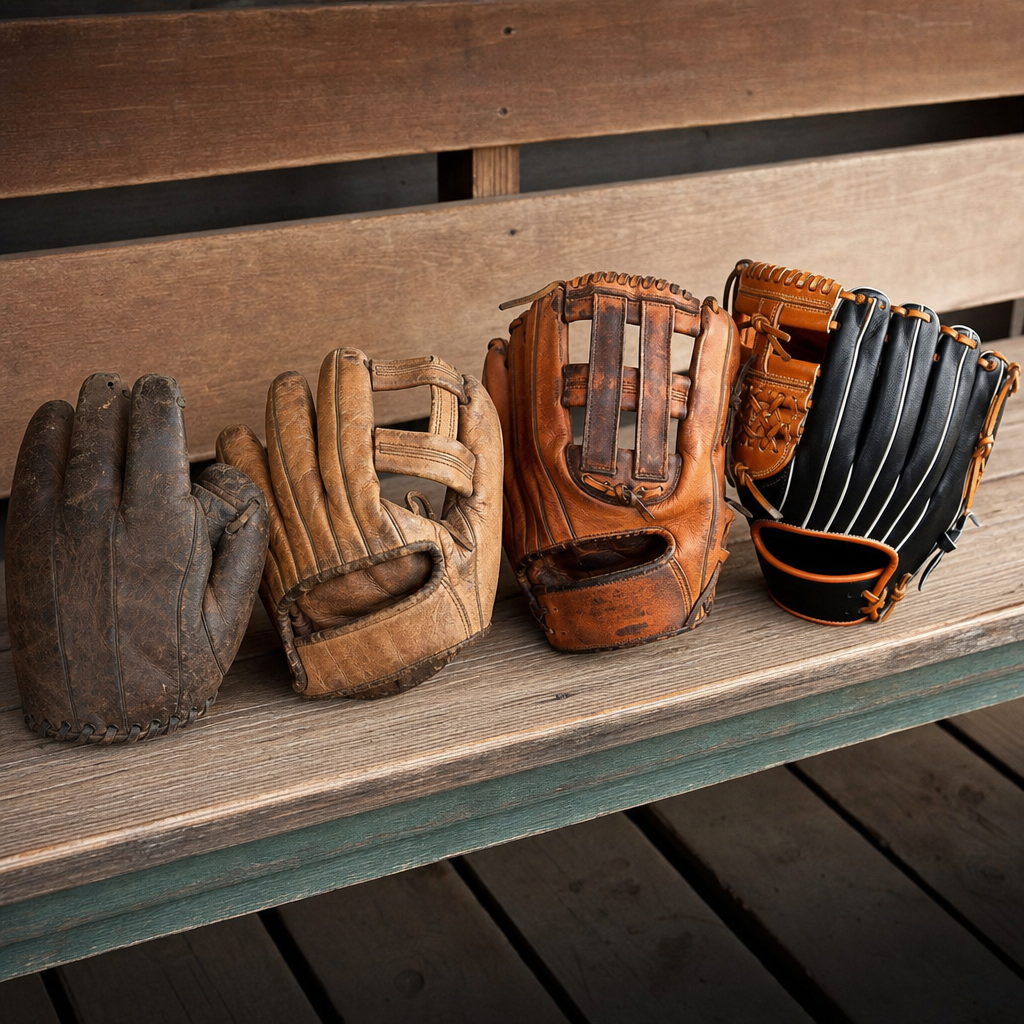
Baseball gloves began as ridiculed accessories and became one of the sport’s most important technologies, shaping defense, strategy, safety, and player identity across every era of the game. The evolution of baseball gloves is not just a story about leather and laces; it is a history of how baseball itself modernized. In the 1870s and 1880s, many players still caught barehanded because toughness was admired and equipment was viewed with suspicion. Early adopters used simple padded work gloves or flesh-colored hand coverings designed to hide the fact that they wanted protection. From those improvised beginnings came the specialized mitts, webs, pockets, and position-specific patterns that now define modern fielding.
When discussing baseball glove history, a few terms matter. A glove generally refers to a five-finger fielding glove used by infielders, outfielders, and pitchers, while a mitt describes fingerless designs used mainly by catchers and first basemen. The web is the leather connection between thumb and index finger; the pocket is the curved catching area formed through break-in and design. Full-grain leather, welting, lacing, heel padding, and hinge points all influence how a glove closes and controls the ball. These details may sound technical, but they explain why fielding standards rose dramatically over time.
This topic matters because glove design changed what was possible on the field. Better gloves increased catch rates, reduced hand injuries, encouraged harder throws, and allowed defenders to attempt plays that earlier generations simply could not make reliably. As someone who has handled vintage gloves and compared them with modern professional models, I can say the difference is immediate: nineteenth-century gloves feel like protective accessories, while modern gloves feel like precision tools. For a hub page on historic innovations in baseball, gloves are central because they connect craftsmanship, rules, player development, manufacturing, and the game’s visual identity. Understanding their evolution helps explain broader changes in baseball, from dead-ball defense to televised athletic spectacle.
From Bare Hands to Early Protection
In baseball’s earliest decades, fielders were expected to catch with bare hands. The sport inherited attitudes from cricket and other bat-and-ball games where visible protection could be mocked as softness. Players paid a price. Broken fingers, bruised palms, split nails, and chronic hand damage were common. By the 1870s, a few professionals began experimenting with gloves, especially older players and catchers whose hands had already suffered. Albert Spalding, later famous as a sporting goods magnate, reportedly wore a glove after hand injuries. Catcher Doug Allison is frequently cited among the first to use hand protection in games during the 1870s.
These first gloves were primitive. Some were modified work gloves with extra padding sewn into the palm. Others were flesh-toned to make them less noticeable to critics and opponents. They had little webbing, almost no structured pocket, and minimal wrist support. Their main purpose was to reduce pain, not to secure the baseball. Even so, they represented a major conceptual innovation: players were beginning to treat equipment as performance technology rather than a sign of weakness. That change in mindset paved the way for every later development.
As use spread in the 1880s, gloves slowly gained acceptance. Players realized that protecting the hand preserved careers and improved confidence on difficult chances. Catchers and first basemen were especially influential because they handled hard throws repeatedly. Once those positions adopted specialized hand protection, fielders elsewhere had a practical model to follow. The game was still far from modern glove standards, but the stigma was weakening, and manufacturers recognized a growing market.
The Rise of Sporting Goods Makers and Standard Designs
By the late nineteenth century, companies such as Spalding, Reach, Rawlings, and later Wilson began transforming gloves from improvised gear into catalog products. This manufacturing shift mattered as much as any single design tweak. Once sporting goods firms standardized patterns, sizes, materials, and pricing, players at amateur and professional levels could access equipment built specifically for baseball rather than adapted from labor or winter wear. Manufacturers also used player endorsements, mail-order catalogs, and team-supply contracts to normalize glove usage.
Early commercial gloves were still modest by modern standards. Finger stalls were thin, padding was limited, and many models left fingertips exposed. Yet each production cycle added useful changes: reinforced palms, stitched heel sections, better leather quality, and more secure wrist closures. By the 1890s, glove makers were no longer merely selling protection; they were selling fielding improvement. Advertising language emphasized clean catches, reduced sting, and stronger defensive play. That message aligned with baseball’s growing professionalism.
The business side also accelerated innovation. Manufacturers learned that players wanted gear tailored to their roles. Catchers needed thickly padded mitts to handle fast pitches. First basemen needed broader receiving surfaces. Infielders valued quicker transfer and control. Outfielders benefited from reach and ball security. This demand led to one of the most important trends in baseball equipment history: specialization. Once gloves were designed around position-specific tasks, defensive expectations rose across the sport.
Key Design Breakthroughs That Changed Fielding
The most decisive breakthroughs were padding, finger definition, webbing, deeper pockets, and better lacing systems. Padding made repeated catches tolerable, but webbing changed fielding mechanics. Early gloves had little or no web between thumb and forefinger, so players trapped the ball more than they caught it. As sewn webs evolved into stronger one-piece, tunnel, basket, trapeze, and H-web structures, gloves could secure line drives and backhand plays far more reliably. A deeper pocket let fielders receive the ball with less rebound and more control.
Another major advancement was glove closure. Modern gloves are engineered with hinge points that allow thumb and fingers to close around the ball. Vintage gloves often felt flat and resistant. Better patterns, welting, and lacing created a shape that worked with the hand’s natural motion. That meant faster transfers for middle infielders, safer receptions for first basemen stretching toward throws, and more dependable over-the-shoulder catches for outfielders.
Leather quality improved as tanning methods advanced. Durable steerhide became common for many professional-grade gloves, while kip leather offered a lighter, smoother feel preferred by some elite players. Internal construction improved too. Palm lining, finger stalls, and heel padding were adjusted for comfort and structure. These changes sound incremental, but in equipment history, incremental improvements often produce revolutionary results because they compound over decades.
| Era | Typical Glove Features | Effect on Play |
|---|---|---|
| 1870s–1880s | Padded work-glove style, little structure, exposed fingers | Basic protection, limited catching assistance |
| 1890s–1910s | Dedicated baseball gloves, more padding, enclosed fingers | Higher confidence, broader acceptance |
| 1920s–1940s | Improved webs, deeper pockets, position-specific models | Cleaner catches, sharper defensive specialization |
| 1950s–1980s | Advanced lacing, stronger leather, pro-endorsed patterns | Greater control, consistency, and player branding |
| 1990s–present | Refined pocket geometry, customized fit, premium materials | Maximum performance tuned to position and preference |
How Catcher’s Mitts and First Base Mitts Became Specialized
Catcher’s equipment evolved fastest because no position absorbed more repeated impact. Nineteenth-century catchers stood farther back from the plate, but as pitching velocity increased and rules changed, receiving became more demanding. Early catcher’s gloves gained heavy padding and eventually lost separate fingers, becoming mitts with broad surfaces designed to deaden the ball. By the early twentieth century, the catcher’s mitt had become a highly specialized tool with thick padding, a closed or nearly closed front, and later a hinged design to help frame and secure pitches.
First base mitts followed a related but distinct path. A first baseman must receive throws from varied arm angles while maintaining footwork on the bag. That requires length, scoop, and a forgiving pocket. Fingerless mitt designs helped first basemen trap throws cleanly and extend toward errant balls. Over time, longer mitts with curved edges and stronger pocket structure made picks and stretches more reliable. Defensive metrics from different eras are imperfect, but game film and written accounts make the trend clear: specialized first base mitts expanded the range of playable throws.
These innovations also influenced coaching. Players could be taught receiving techniques built around equipment strengths, such as presenting a target, funneling the ball, and securing low throws. Equipment and technique advanced together, which is a recurring theme across baseball history.
The Web Era, Player Endorsements, and Midcentury Refinement
From the 1920s through the 1950s, glove design matured rapidly. One famous milestone often cited is Bill Doak’s web design, patented in the early 1920s. Doak, a major league pitcher, proposed a laced web between thumb and index finger that created a more functional pocket. His concept influenced generations of gloves and demonstrated that players themselves could drive meaningful equipment innovation. Once webbing improved, fielders could catch and retain the ball rather than simply knock it down.
Midcentury manufacturers built heavily around endorsements. Rawlings, Wilson, MacGregor, Nokona, and Spalding released signature models associated with star players. These gloves did more than market the product; they spread preferred patterns, pocket depths, and finger lengths throughout youth and amateur baseball. A model linked to a respected shortstop or outfielder gave buyers a practical template for their own development. In my experience examining vintage catalogs, this was the period when gloves became part of baseball aspiration, not just utility.
Television also mattered. Fans could now see defensive plays repeatedly and identify equipment details. The glove became a visible symbol of position and style. Manufacturers responded with better aesthetics, cleaner logos, contrasting welting, and recognizable web types. Yet performance remained the core selling point. A glove had to close well, hold shape, and survive seasons of use. The best models earned loyalty because players trusted them in game speed conditions.
Modern Gloves, Customization, and the Limits of Innovation
Today’s gloves reflect more than a century of trial, craftsmanship, and player feedback. Brands such as Rawlings, Wilson, Mizuno, 44 Pro, Easton, and Nokona offer highly specific options in pattern, leather, web, stiffness, and break-in feel. Infield gloves are usually smaller for quick transfer. Outfield gloves are longer for reach. Pitchers often choose closed webs to conceal grips. Catcher’s mitts and first base mitts remain entirely separate categories. Professional players frequently select exact pattern families, such as a deep-pocket outfield model or a shallow middle-infield design, because tiny differences influence performance.
Customization is now central. Players choose wrist openings, embroidery, lace color, welting style, and leather grade, but function still matters more than appearance. The wrong glove can slow transfer times, create excess rebound, or fatigue the hand. A quality glove should match position, age, hand strength, and level of play. Youth players especially benefit from manageable stiffness and appropriate size rather than oversized models they cannot close properly.
Innovation does have limits. Baseball rules and traditions constrain radical redesigns, and leather remains dominant because it balances structure, feel, durability, and repairability better than most synthetic alternatives. Modern gloves are excellent, but they still require break-in, maintenance, relacing, and sensible use. In other words, evolution has refined the glove into a mature technology rather than replacing its core identity.
The history of baseball gloves shows how a small equipment change can transform an entire sport. What began as mocked hand protection became a defining instrument of defensive excellence. Over decades, improvements in padding, webbing, pocket depth, leather quality, and position-specific design raised catch reliability, reduced injuries, and expanded the kinds of plays defenders could attempt. Catcher’s mitts, first base mitts, infield gloves, and outfield patterns all emerged because baseball demanded tools matched to distinct tasks.
This evolution also mirrors larger changes in baseball. As the sport professionalized, manufacturers standardized production, players influenced design, and coaching adapted to equipment capabilities. Signature models, patented webs, and premium leathers turned gloves into both performance tools and cultural objects. Yet the central lesson remains practical: better glove design changed on-field behavior. It improved confidence, technique, and outcomes in ways visible from the nineteenth century to today’s major leagues.
For anyone exploring historic innovations in baseball, glove history is essential because it links craftsmanship, rules, commerce, and athletic development in one clear timeline. If you want to understand how baseball modernized, start with the glove, then follow that story into bats, balls, protective gear, training methods, and stadium technology across the rest of this hub.
Frequently Asked Questions
Why were baseball gloves controversial when they were first introduced?
In baseball’s early decades, especially in the 1870s and 1880s, many players and fans saw gloves as a sign of weakness rather than innovation. The sport was closely tied to ideas of toughness, masculinity, and endurance, so catching a hard-thrown ball with bare hands was often treated as proof of courage and skill. Because of that mindset, early players who experimented with hand protection could be ridiculed for needing assistance. At first, the earliest “gloves” were not specialized baseball equipment at all. Players sometimes used padded work gloves, flesh-colored gloves designed to hide their use, or lightly modified leather hand coverings that offered only minimal protection.
The controversy also reflected the culture of a young sport that had not yet fully embraced equipment as part of performance. Many people believed true talent should be displayed without technological help. Over time, however, repeated injuries, the increasing speed of play, and the practical advantages of hand protection changed opinions. As pitchers threw harder and fielders were asked to handle sharper grounders and faster line drives, gloves became less about avoiding pain and more about improving consistency and extending careers. What began as a mocked accessory gradually earned acceptance because it solved real problems on the field. In that sense, the early controversy around baseball gloves reveals a larger shift in how the game understood professionalism, safety, and competitive advantage.
How did early baseball gloves differ from modern gloves?
Early baseball gloves were dramatically simpler, smaller, and less specialized than the gloves used today. In the beginning, they looked more like ordinary work gloves than modern sporting equipment. They had thin leather, little padding, and almost no webbing between the fingers, which meant they did very little to help a player secure the ball. Their main purpose was basic hand protection rather than ball control. Some early models exposed the fingertips so players could still feel the ball, which shows how uncertain athletes still were about fully committing to glove use. Even when gloves became more common, they remained relatively flat and modest in shape compared with the deep-pocketed designs familiar now.
Modern baseball gloves, by contrast, are position-specific tools engineered for performance. Catcher’s mitts are heavily padded to absorb repeated impact from high-velocity pitches. First baseman’s mitts are elongated to help scoop throws and stretch for outs. Infield gloves are generally smaller for quick transfers, while outfield gloves are longer and deeper to help track and secure fly balls. Webbing styles, pocket depth, leather quality, finger stalls, heel padding, and wrist adjustments are all carefully designed with the demands of each position in mind. The difference between early and modern gloves illustrates how baseball moved from a game of improvised equipment to one of technical refinement, where glove design directly influences defense, strategy, and player development.
What role did glove evolution play in changing the way baseball was played?
The evolution of baseball gloves had a major effect on how the game was played because better equipment expanded what defenders could realistically do. As gloves improved in padding, shape, and durability, fielders could play more aggressively and with greater confidence. They were better able to handle hard-hit balls, attempt difficult catches, and make cleaner transfers. This had a direct impact on defensive strategy. Infielders could react faster to sharply hit ground balls, outfielders could pursue catches with more confidence, and first basemen benefited from mitts that made scoops and stretches more reliable. The result was not just fewer injuries, but a broader defensive range and a higher overall standard of fielding.
Glove development also helped baseball modernize strategically. As equipment improved, teams could place more value on defensive specialists because gloves allowed elite fielders to convert difficult plays into outs more consistently. That shifted roster construction, coaching priorities, and even player expectations. A glove was no longer passive protection; it became an active part of a player’s skill set. Better gloves also influenced how pitchers approached hitters, because stronger defense behind them made certain pitching strategies more practical. In this way, glove evolution shaped the rhythm of the sport, contributing to cleaner defense, more sophisticated positioning, and a more complete understanding of baseball as a game influenced by both athletic ability and technological adaptation.
When did baseball gloves become standard equipment rather than optional accessories?
Baseball gloves became standard equipment gradually rather than all at once. In the late 19th century, they were still viewed by some as unnecessary or even embarrassing, and many players continued to field barehanded. But as the sport grew more competitive and professionalized, the advantages of gloves became impossible to ignore. Players who used them discovered they could better protect their hands, recover more quickly from impacts, and perform more consistently over the course of a season. By the end of the 19th century and into the early 20th century, glove use had become far more common, especially as manufacturers began producing purpose-built baseball gloves rather than modified general-use handwear.
The real turning point came when gloves stopped being seen as a crutch and started being recognized as essential equipment. Improvements such as additional padding, stronger leather construction, more dependable fit, and eventually webbing made gloves increasingly effective. Once players saw that gloves could improve fielding rather than merely reduce pain, adoption accelerated. By the early decades of the 20th century, gloves were no longer unusual accessories but expected tools of the game. From there, they continued evolving into highly specialized pieces of equipment that reflected the needs of specific positions. Their move from optional to standard tells the story of baseball becoming more professional, more demanding, and more willing to embrace innovation in pursuit of better performance.
Why are baseball gloves considered an important part of player identity today?
Today, a baseball glove is more than equipment; it is one of the clearest expressions of a player’s role, preferences, and personality. Different positions require different glove shapes and features, so a glove immediately communicates how a player functions on the field. An infielder’s glove suggests speed and quick handling, an outfielder’s glove hints at range and reach, and a catcher’s mitt signals durability and defensive command. Beyond position, players often develop strong attachments to their gloves because they break them in over time, shaping the pocket and feel to match their own style. The result is a piece of equipment that becomes deeply personal, almost an extension of the hand.
This sense of identity also has a historical dimension. As gloves evolved from ridiculed protective accessories into advanced tools of the sport, they became symbols of baseball’s changing values. They represent skill, preparation, craftsmanship, and professionalism. Players choose leather type, web style, fit, lacing patterns, and pocket depth based on how they want to field the ball, and those choices can reflect both practical needs and individual confidence. For many athletes, a glove carries memory as well as function: practices, key plays, long seasons, and years of use are built into it. That is why the history of baseball gloves matters so much. Their evolution is not just about technology; it is about how the sport came to value performance, safety, specialization, and self-expression all at once.