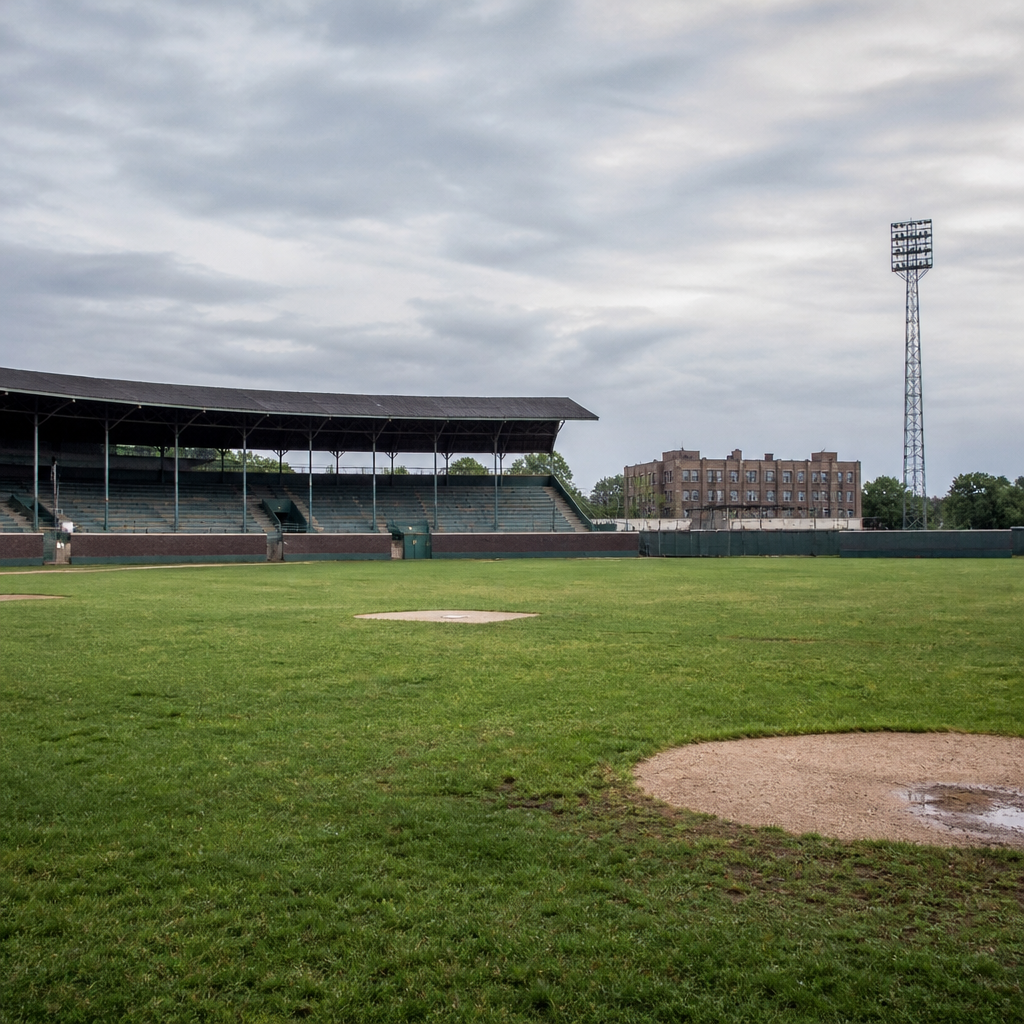
Before ivy, rooftop bleachers, and the marquee on Clark and Addison, the Chicago Cubs built their identity at West Side Grounds, a vanished ballpark that deserves a central place in any serious discussion of lost MLB ballparks. In baseball history, a lost ballpark is more than a demolished structure. It is a former major league venue whose physical footprint has been erased or radically repurposed, while its competitive, architectural, and civic legacy still shapes how the game is remembered. West Side Grounds fits that definition perfectly. It was the Cubs home before Wrigley Field, it hosted one of the sport’s earliest dynasties, and it stood at the heart of a rapidly changing Chicago during baseball’s formative decades.
I have spent years tracing old ballpark sites, comparing Sanborn maps, newspaper diagrams, and city directories against current street grids, and West Side Grounds is one of the clearest examples of how a ballpark can disappear physically yet remain foundational historically. Opened in 1893 and used by the National League club through 1915, the park witnessed the rise of stars such as Cap Anson, Frank Chance, Joe Tinker, Johnny Evers, and Mordecai Brown. It also staged the Cubs teams that won World Series titles in 1907 and 1908. When fans ask where the Cubs were before Wrigley Field, the direct answer is West Side Grounds, but the fuller answer reveals why this site matters within the broader study of lost MLB ballparks: it connects team identity, urban development, ballpark design, and early professional baseball economics in one place.
The significance extends beyond nostalgia. Studying West Side Grounds helps explain how early baseball parks were built, why they moved, and what was gained or lost when clubs left them behind. These venues were often wooden, tightly fit into city blocks, vulnerable to fire, and designed around streetcar access rather than automobile traffic. They reflected the city around them. As Chicago expanded and fan expectations changed, clubs pursued larger crowds, better amenities, and more durable construction. That transition, which eventually carried the Cubs to Weeghman Park, later renamed Wrigley Field, mirrors patterns seen across other vanished major league parks. Understanding West Side Grounds therefore gives readers a framework for understanding the entire lost ballparks subtopic.
This hub article covers the site, the teams, the playing conditions, the reasons for its disappearance, and the wider lessons it offers. If you are exploring iconic ballparks, West Side Grounds is not a side note before Wrigley Field. It is the starting point for the Cubs’ modern baseball identity and a gateway to understanding why so many early major league parks were celebrated, outgrown, demolished, and then nearly forgotten.
What West Side Grounds Was and Where It Stood
West Side Grounds was the Chicago National League club’s home from 1893 through 1915. The ballpark occupied a site bounded by Congress, Loomis, Harrison, and Throop on Chicago’s Near West Side. Contemporary sources often refer to the area by older street naming conventions, which can confuse modern readers, but the essential point is straightforward: this was a dense urban neighborhood west of downtown, not an isolated sports complex. Fans arrived by streetcar and rail, walked from nearby commercial corridors, and experienced baseball as part of everyday city life.
The park replaced the club’s earlier South Side venue after the World’s Columbian Exposition reshaped land use pressures in Chicago. Ownership needed a practical, profitable home, and the West Side location offered access and room within the city grid. Like many nineteenth century parks, West Side Grounds evolved over time rather than springing into existence in one final form. Grandstands were expanded, outfield dimensions shifted, and capacity increased as demand grew. Estimates vary by year, but the park eventually accommodated well over 14,000 spectators and, with standing room in major games, considerably more.
Architecturally, it belonged to the transitional generation of baseball grounds. It was not yet the concrete-and-steel monument style later associated with parks such as Shibe Park or Comiskey Park, but it was more organized and commercially ambitious than the rough earlier enclosures of professional baseball. The grandstand wrapped the infield, outfield fences sat close enough to surrounding streets and buildings to create asymmetry, and the field dimensions reflected adaptation rather than symmetry. That irregularity was normal in the era. It also shaped strategy, especially in dead-ball baseball, where bunting, baserunning, hit placement, and defense mattered more consistently than home run power.
For anyone researching lost MLB ballparks, location is never a minor detail. Ballparks were economic engines, neighborhood landmarks, and transit destinations. West Side Grounds anchored the Cubs in a working city district, and that urban relationship helps explain both its success and its eventual obsolescence. The park worked because it fit turn-of-the-century Chicago. It disappeared because Chicago and baseball changed faster than the site could adapt.
The Cubs Dynasty Built Before Wrigley Field
West Side Grounds matters most because of what happened on the field. The Cubs teams of the early twentieth century were not merely good; they were one of baseball’s defining dynasties. Under Frank Selee and then player-manager Frank Chance, Chicago developed a disciplined, defense-heavy, tactically sharp club that dominated the National League. From 1906 through 1910, the Cubs won four pennants in five seasons. They captured the World Series in 1907 and 1908, and the 1906 club posted a remarkable 116 wins in a 154-game schedule, a total that remains one of the greatest regular-season achievements in major league history.
The famous double-play trio of Tinker to Evers to Chance played a large role in that success, but reducing the team to one poem undersells its depth. Mordecai Brown, known as Three Finger Brown, was an elite pitcher whose movement and command thrived in the dead-ball environment. Ed Reulbach, Orval Overall, and Jack Pfiester gave Chicago exceptional rotational strength. Johnny Kling was one of the best defensive catchers in the game. At West Side Grounds, this roster turned the park into a fortress.
Home-field advantage in that era was real and often substantial. Teams knew every contour, every lighting quirk, and every bounce from hard-packed infields and uneven outfields. West Side Grounds rewarded precision. The Cubs paired strong pitching with clean infield defense and aggressive situational hitting, forcing opponents to play their style. When modern fans ask why West Side Grounds should matter if Wrigley Field became the iconic Cubs address, the answer is simple: the franchise’s earliest championship standard was established here, not at Wrigley.
The park also hosted important cultural moments. It staged crosstown games, high-stakes pennant races, and World Series contests at a time when baseball was becoming the national sport. Newspapers devoted enormous space to these events, and images of packed grandstands helped define the visual language of big-league baseball. Long before television, venues like West Side Grounds created the spectacle that made professional baseball feel major. The Cubs were not waiting for Wrigley Field to become important. They were already one of the sport’s flagship franchises at West Side Grounds.
How the Ballpark Played in the Dead-Ball Era
To understand West Side Grounds, you have to understand the game it hosted. Dead-ball era baseball, generally dated from the 1900s until 1919, emphasized run manufacturing over slugging. Balls were used longer, became softer during games, and were harder to drive. Parks varied widely in shape and size, and strategic baseball exploited those differences. West Side Grounds was part of that ecosystem. Reports from the period describe a park where dimensions and conditions encouraged line drives, bunts, steals, hit-and-run plays, and run prevention.
Because exact dimensions changed across renovations, historians should avoid claiming a single immutable outfield map. What is clear is that the park was asymmetrical and urban constrained, with fences adapted to the block rather than imposed on open land. That produced familiar dead-ball dynamics: quirky caroms, territory that fielders learned intimately, and offensive values influenced by placement more than brute force. In practical terms, this meant a smart club could squeeze major advantages from preparation. The Cubs did exactly that.
| Feature | West Side Grounds Impact | Why It Mattered |
|---|---|---|
| Asymmetrical layout | Rewarded local knowledge of angles and fence distances | Improved defensive positioning and extra-base hit prevention |
| Dead-ball equipment | Limited home run frequency | Made pitching, bunting, and baserunning more decisive |
| Urban site constraints | Created irregular foul ground and sightlines | Favored teams accustomed to daily conditions |
| Natural surface variability | Produced inconsistent bounces | Elevated the value of elite infield defense |
Modern readers sometimes assume older parks were primitive in a simplistic sense. In reality, they were highly specific competitive environments. Managers built rosters to fit them. Groundskeepers influenced pace and bounce through maintenance practices. Catchers and infielders communicated positioning based on batter tendencies and field conditions. I have found that once you stop comparing these parks to modern standardized venues and instead evaluate them on their own terms, their sophistication becomes obvious. West Side Grounds was not merely a place where games happened. It was an active factor in how the Cubs won.
Why West Side Grounds Was Lost
West Side Grounds disappeared for reasons common to many lost MLB ballparks: materials, land value, changing expectations, and ownership opportunity. First, like numerous nineteenth century parks, much of its structure was wood. Wooden ballparks were cheaper and faster to build, but they posed fire risks and had practical limits on expansion and modernization. By the early twentieth century, the new benchmark was the concrete-and-steel park, which promised larger capacities, better sightlines, greater durability, and a stronger civic image.
Second, the neighborhood around the park was changing. Urban land in Chicago had rising commercial value, and baseball clubs increasingly had to weigh the profitability of aging sites against newer options. Third, fan expectations were evolving. As the sport matured, owners sought more comfortable seating, improved circulation, and more reliable facilities. Finally, the Cubs had a compelling alternative. In 1916, they moved to Weeghman Park on the North Side, a newer ballpark built for the Federal League’s Chicago Whales. That park, after ownership and naming changes, became Wrigley Field.
This move was not a simple upgrade from bad to good. It was a strategic response to a changing industry. West Side Grounds had served the Cubs well, but the center of gravity in baseball architecture had shifted. Once the club left, the old site no longer had a viable major league future. The ballpark was demolished, and the neighborhood gradually absorbed the land into ordinary urban use. That pattern is familiar in baseball history. Unlike a cathedral or courthouse, a ballpark often loses protection the moment its tenant departs. Without a team, nostalgia alone rarely preserves the structure.
There is also a cautionary lesson here for preservation debates. People tend to think iconic venues are always recognized in time. They are not. West Side Grounds hosted championship baseball and helped define a major franchise, yet it did not survive long enough to become a shrine. Lost ballparks often vanish before the culture fully understands what was important about them.
West Side Grounds in the Larger Story of Lost MLB Ballparks
As a hub for lost MLB ballparks, West Side Grounds provides a template for reading similar cases across baseball history. Many vanished parks share the same core traits: central urban locations, irregular footprints, wood-heavy construction, limited parking, transit-oriented attendance, and eventual replacement by larger or more modern venues. Examples include the Polo Grounds in New York, South Side Park in Chicago, Huntington Avenue Grounds in Boston, and Bennett Park in Detroit. Each park mattered deeply to its franchise, each reflected a specific phase of city growth, and each was ultimately expendable once professional baseball’s economics changed.
What makes West Side Grounds especially useful as a hub topic is the strength of its before-and-after contrast. It predates one of the most famous surviving ballparks in the world. That creates a clean historical bridge for readers: before Wrigley Field, there was West Side Grounds; before the enduring landmark, there was the more vulnerable urban original. This transition helps explain a broader truth about iconic ballparks. Survival is not the same as importance. Some parks are iconic because they endured. Others are iconic because they shaped the game even though they disappeared.
For researchers, fans, and city historians, the best way to study lost parks is through multiple source types together. Contemporary newspaper coverage reveals crowd size, game atmosphere, and civic meaning. Fire insurance maps show footprint and materials. Team guides and scorecards clarify naming and seating arrangements. Census and transit records explain why locations worked. Present-day site visits, even when little remains, help translate abstract history into physical space. That method is how forgotten grounds regain context. West Side Grounds rewards exactly this kind of layered reading, and any comprehensive exploration of lost MLB ballparks should start there before branching into individual venue histories.
What Fans Should Remember Today
West Side Grounds should be remembered as the Cubs home before Wrigley Field, but that description is only the entry point. It was the site of two World Series champions, the base of one of baseball’s greatest dynasties, and a case study in how early major league parks were woven into city neighborhoods. It shows that lost MLB ballparks are not marginal footnotes. They are essential chapters in franchise history, urban history, and the development of the sport itself. When a stadium vanishes, the games, systems, and communities tied to it do not vanish with it. They simply become harder to see unless someone reconstructs the story carefully.
The key takeaway is practical as well as historical. If you want to understand iconic ballparks, do not only study the survivors. Study the missing parks that made the survivors possible. West Side Grounds explains why the Cubs became a powerhouse, why urban baseball architecture evolved, and why replacement does not erase significance. It also offers a roadmap for exploring this entire subtopic: trace the site, identify the era, study how the park played, and ask why the franchise moved on. That framework works across baseball’s vanished landscape.
For readers building a deeper understanding of lost ballparks, start with West Side Grounds and then follow the chain outward to other disappeared venues across Chicago, New York, Boston, Detroit, and beyond. The reward is a richer view of baseball history, one grounded not just in surviving landmarks but in the places that built the game and then slipped from the map. Keep exploring the lost ballparks story, and the history of every modern stadium will make more sense.
Frequently Asked Questions
What was West Side Grounds, and why is it so important in Chicago Cubs history?
West Side Grounds was the Chicago Cubs’ home ballpark before the team moved to what is now Wrigley Field, and it played a foundational role in shaping the franchise’s early identity. Located on Chicago’s West Side, the park was the setting for some of the most important years in Cubs history, including the club’s rise as a National League power in the early twentieth century. Long before the visual trademarks most fans now associate with the Cubs—ivy-covered walls, the iconic marquee, and the neighborhood atmosphere of Clark and Addison—the team developed its reputation for winning, drawing crowds, and commanding national attention at West Side Grounds.
The ballpark matters because it was more than a temporary stop on the way to a more famous address. It was the home of the Cubs during an era when the franchise established itself as one of baseball’s elite organizations. This includes the period in which the Cubs won National League pennants and captured World Series titles, making West Side Grounds the actual stage for some of the club’s greatest competitive achievements. If Wrigley Field represents the enduring image of the Cubs, West Side Grounds represents the place where much of the team’s early greatness was built.
It is also important in the broader history of lost MLB ballparks. A lost ballpark is not just a demolished stadium; it is a site whose physical structure has disappeared while its historical influence remains very much alive. West Side Grounds fits that definition perfectly. Though the park itself is gone, its legacy continues through the Cubs’ early championship history, the development of baseball in Chicago, and the way historians trace the evolution of urban ballparks. In that sense, West Side Grounds deserves recognition not simply as “the stadium before Wrigley,” but as one of the most significant vanished venues in major league history.
Where was West Side Grounds located, and what happened to the site after the ballpark disappeared?
West Side Grounds stood on Chicago’s West Side, bounded by streets that placed it firmly within the city’s dense urban grid rather than in an isolated entertainment district. Like many early baseball parks, it was woven into the surrounding neighborhood, with nearby homes, businesses, and transit connections helping make the ballpark part of everyday city life. That urban placement was typical of the era and is one reason the park remains so interesting to historians studying how baseball functioned within rapidly growing American cities at the turn of the twentieth century.
After the Cubs left and the park eventually disappeared, the site was repurposed, as happened with many early ballparks whose land became more valuable for other forms of urban development. This is one of the defining features of a lost ballpark: the original footprint is often overwritten by streets, buildings, institutions, or residential uses, leaving little to no visible sign that a major league venue once stood there. In the case of West Side Grounds, the disappearance of the ballpark underscores how completely urban change can erase even highly important sports landmarks from the physical landscape.
That erasure is precisely why the site still matters. When a historic ballpark vanishes, the burden of memory shifts from architecture to research, maps, photographs, newspaper accounts, and civic storytelling. For West Side Grounds, the former location becomes a kind of historical puzzle, reminding us that some of baseball’s most important places survive only in documentation and collective memory. Even without grandstands or field lines still visible, the site remains meaningful because it once hosted championship baseball and helped define the Cubs long before Wrigley Field became the franchise’s symbolic home.
What major baseball moments took place at West Side Grounds?
West Side Grounds was the backdrop for some of the most consequential achievements in early Cubs history. Most notably, it was home during the franchise’s dominant run in the first decade of the twentieth century, when the Cubs became one of the strongest teams in the sport. This includes seasons that produced National League pennants and World Series championships, making the park one of the central locations in the story of baseball’s early modern era. For any fan trying to understand where the Cubs’ tradition of national relevance began, West Side Grounds is essential ground.
The park hosted stars and teams that helped define dead-ball era baseball, a style of play marked by strategic bunting, aggressive baserunning, elite pitching, and lower-scoring games than later generations would expect. Watching baseball at West Side Grounds would have meant seeing the sport during a formative period, when team construction, tactics, and fan culture were still being refined into the patterns that later became standard in the major leagues. That context gives every important game played there a larger historical significance beyond the Cubs alone.
Its greatest importance, however, lies in the cumulative weight of what happened there. West Side Grounds was not famous for a single isolated event; it was important because it consistently served as the home field for a powerhouse franchise at the peak of its early success. That means pennant races, postseason glory, and the day-to-day building of a championship culture all unfolded there. In baseball history, that kind of sustained relevance can matter even more than one legendary afternoon, because it turns a park into a true historical anchor for an era.
How did West Side Grounds compare to Wrigley Field and other classic ballparks?
West Side Grounds and Wrigley Field represent two very different chapters in Cubs history. West Side Grounds belonged to an earlier generation of ballparks, one closer to the rougher, more transitional architecture of nineteenth- and early twentieth-century baseball. It was part of a period when professional teams often moved among multiple venues, ballpark construction standards were still evolving, and urban stadiums were designed around existing street patterns and practical constraints. Wrigley Field, by contrast, became famous not only as a baseball venue but as a lasting civic icon with a highly recognizable visual identity.
Compared with later classic parks, West Side Grounds may seem less familiar to modern fans because fewer physical traces and cultural symbols survived. It does not have the instantly recognizable imagery that keeps Wrigley, Fenway Park, or even demolished parks like Ebbets Field alive in the popular imagination. Yet historically, its significance is immense. It was the site of championship baseball, a major urban gathering place, and a key example of how early major league teams embedded themselves in city neighborhoods. In other words, its lack of modern fame should not be mistaken for lack of importance.
In the wider conversation about classic and lost ballparks, West Side Grounds stands out because it bridges baseball’s earliest urban traditions and the rise of the modern Cubs brand. Wrigley Field eventually became the more beloved and enduring structure, but West Side Grounds supplied the competitive pedigree that gave the franchise substance before Wrigley supplied its mythology. Seen that way, the two ballparks are not rivals in memory; they are sequential pillars of Cubs history, with West Side Grounds laying much of the groundwork for everything that followed.
Why should fans of lost MLB ballparks care about West Side Grounds today?
Fans of lost MLB ballparks should care about West Side Grounds because it captures exactly why vanished sports sites continue to matter. A lost ballpark is not memorable only because it is old or demolished. It matters when a place once held major competitive, architectural, and civic meaning, even if the structure itself is gone. West Side Grounds checks every one of those boxes. It was home to one of baseball’s premier early dynasties, embedded in the life of a growing American city, and eventually erased in a way that makes historical recovery both necessary and compelling.
It also offers a corrective to the tendency to compress Cubs history into the Wrigley Field era alone. Wrigley is central to the franchise’s identity, but it did not create the Cubs from nothing. Before the team became attached to its most famous address, it built prestige, fan loyalty, and championship credibility elsewhere. Remembering West Side Grounds restores that fuller timeline and helps fans see the Cubs not just as a team with a beloved ballpark, but as a franchise with deep roots in multiple corners of Chicago.
Finally, West Side Grounds matters because it illustrates how baseball history often survives through narrative rather than preservation. Not every important venue gets saved, marked, or widely commemorated. Some become invisible beneath later development, and their stories depend on historians, writers, and curious fans to keep them alive. For anyone interested in lost ballparks, that makes West Side Grounds especially powerful. It is a reminder that the game’s heritage lives not only in still-standing stadiums, but also in places the city has moved past even when baseball history has not.