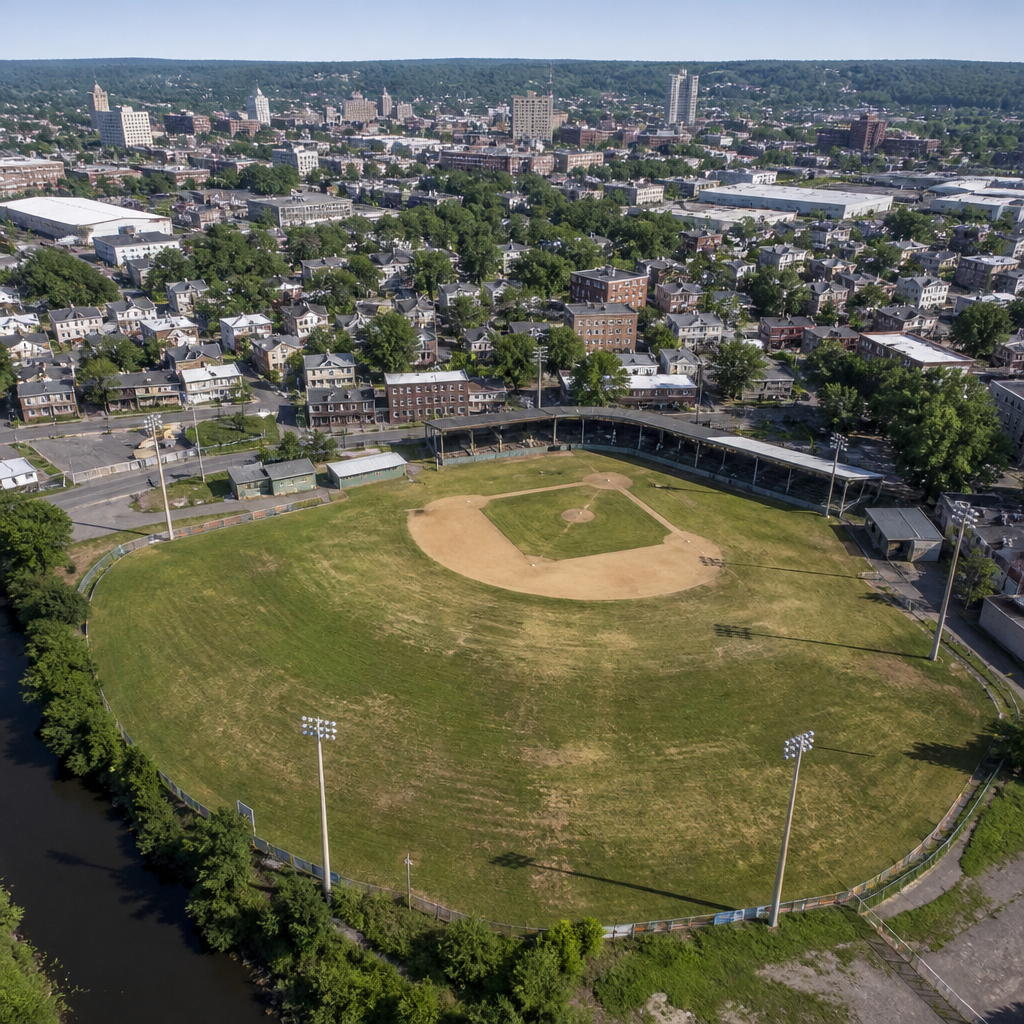
Hinchliffe Stadium stands above Paterson, New Jersey, as one of the most important surviving Negro Leagues ballparks in the United States. More than a historic stadium, it is a rare place where Black baseball history, city identity, architecture, and civil rights memory still meet on original ground. When people search for Negro Leagues ballparks, they are usually asking several questions at once: which sites still exist, why they matter, what games were played there, and how one stadium can help explain a larger national story. Hinchliffe answers all of those questions. Built in 1932 on a dramatic ridge beside the Great Falls of the Passaic River, the venue became a regular stage for Negro League clubs, independent Black baseball teams, integrated exhibitions, football, boxing, school sports, and civic gatherings. Its endurance is remarkable because most Negro Leagues parks were demolished, heavily altered, or absorbed into later development. That scarcity gives Hinchliffe unusual interpretive power.
To understand its significance, it helps to define the terms clearly. The Negro Leagues were not one single league but a network of Black professional baseball leagues and independent teams created because segregation excluded Black players from organized white major leagues. Negro Leagues ballparks included major league parks rented by Black teams, municipal stadiums like Hinchliffe, neighborhood fields, and multipurpose athletic venues. A surviving Negro Leagues ballpark is any place with documented use by Black professional clubs during that era, especially if substantial historic fabric remains. Hinchliffe is central within that conversation because it is one of only a few extant stadiums strongly associated with Negro League play. Along with places such as Rickwood Field in Birmingham and League Park in Cleveland, it helps anchor a scattered physical map of Black baseball history. For readers exploring iconic ballparks, this site works as a hub because it connects architecture, players, teams, preservation, and the broader geography of Negro Leagues venues across the country.
I have found that Hinchliffe makes the subject legible in a way lists of teams and dates alone cannot. You can stand in Paterson and see why municipal ownership mattered, why scheduling flexibility mattered, and why regional location mattered. Northern New Jersey placed the stadium within reach of Black baseball audiences from Paterson, Newark, Jersey City, and New York, while rail access and dense population supported exhibitions and league dates. The stadium’s recent restoration also matters for anyone researching Negro Leagues ballparks today. It shows what preservation can accomplish when historical significance is paired with adaptive reuse, public funding, and local advocacy. As the hub for this subtopic, this article explains Hinchliffe Stadium in depth while also showing how it opens into the larger story of Negro Leagues places nationwide.
Why Hinchliffe Stadium Matters in Negro Leagues History
Hinchliffe Stadium matters because it preserves the context of Black baseball rather than only the memory of famous players. Opened in 1932 as a municipal stadium, it quickly became a home field and showcase site for Black professional baseball in the Northeast. The New York Black Yankees, one of the best-known Negro National League franchises, regularly used Hinchliffe for home games. Other clubs, barnstorming teams, and high-level semipro Black teams also appeared there. That matters historically because the Negro Leagues depended on flexible venue arrangements. Unlike white major league clubs with stable, exclusive ballparks, many Black teams rented fields, shared dates, and followed opportunity. A municipal stadium that welcomed Black baseball provided legitimacy, capacity, and a degree of scheduling stability.
The New York Black Yankees are central to Hinchliffe’s identity. Despite the team name, they were often more nomadic than major league fans expect, using several home venues over time. Hinchliffe became one of their most important bases. Hall of Fame catcher Josh Gibson and star slugger Buck Leonard played there with the Homestead Grays in visiting appearances. Monte Irvin, one of the greatest Black stars of the era and later a pioneering major leaguer, had strong ties to New Jersey baseball culture and to the broader ecosystem that made venues like Hinchliffe essential. Larry Doby, who broke the American League color barrier in 1947, came from nearby Paterson, giving the stadium additional local resonance. The result is a place where national Negro Leagues history and local Black history genuinely overlap.
Just as important, Hinchliffe helps correct a common misconception: that Negro Leagues history happened mostly in the South or only in giant urban parks. In practice, Black baseball thrived in a wide regional circuit that included midsize industrial cities, municipal stadiums, and mixed-use athletic complexes. Paterson was a manufacturing city with immigrant communities, Black residents, labor history, and strong scholastic sports traditions. Hinchliffe fit that urban world. The stadium hosted baseball at a level high enough to draw elite Black teams, yet it remained embedded in everyday public life. That combination is rare, and it is why historians consistently treat the site as a cornerstone when mapping Negro Leagues ballparks that can still be studied in place.
Location, Design, and the Value of a Municipal Stadium
Hinchliffe Stadium sits within the Great Falls Historic District, overlooking one of the country’s most dramatic urban landscapes. Its setting alone distinguishes it from many surviving sports sites. Designed in the early 1930s, the concrete stadium reflected the era’s municipal ambition: cities built athletic facilities as instruments of public health, civic pride, and mass entertainment. The bowl shape, reinforced concrete construction, and oval plan supported football, track, and baseball, making the venue adaptable and financially practical. That multiuse design was not a flaw. For Negro Leagues teams, it was an advantage, because a city-owned multipurpose stadium could be rented for dates that private baseball parks might not offer or might price differently.
Architecturally, Hinchliffe is often described as an outstanding example of Depression-era stadium design. Its horseshoe form, elevated site lines, and durable materials gave it a monumental quality disproportionate to its city size. The Works Progress Administration did not build the stadium, but the project belongs to the same period of civic construction and New Deal-era public works sensibility. In preservation terms, integrity matters: original location, form, circulation patterns, and spectator experience help historians interpret how audiences encountered the games. Even after years of deterioration, enough remained to justify serious restoration. That is one reason the National Park Service and preservation advocates viewed Hinchliffe as nationally significant rather than merely nostalgic.
The municipal model also explains why Hinchliffe belongs in any broad guide to Negro Leagues ballparks. Black baseball teams often needed venues that could accommodate large holiday crowds, doubleheaders, and flexible bookings. City stadiums met those needs. They also offered symbolic value. Playing in a substantial public venue conferred status on clubs too often excluded from the resources routinely available to white teams. At Hinchliffe, spectators were not watching baseball in a marginal space. They were entering one of Paterson’s signature public places. That distinction matters when discussing sports history, because the quality and prominence of a venue shape media attention, attendance patterns, and community memory.
Teams, Players, and Games Associated With the Stadium
Any hub article on Negro Leagues ballparks should connect place to personnel, and Hinchliffe offers a strong roster of names. The New York Black Yankees are the headline club, but the stadium’s significance reaches beyond one team. The Negro National League schedule brought top competition through Paterson, and independent Black clubs used the park as well. Exhibition baseball, the lifeblood of the Black baseball economy, also mattered here. Because Black teams frequently supplemented league schedules with barnstorming dates, fans at Hinchliffe could see championship-caliber talent even when standings alone do not tell the full story.
Josh Gibson and Buck Leonard symbolize the caliber of play associated with the stadium. Gibson’s power and Leonard’s all-around excellence made the Homestead Grays one of Black baseball’s dominant dynasties. Their appearances at Hinchliffe tied Paterson directly to the highest tier of Negro Leagues competition. Monte Irvin represents another dimension: the bridge from Negro Leagues greatness to integrated major league success. Larry Doby adds a local pathway from Paterson athletics to national civil rights significance in baseball. When one venue can be connected to Gibson, Leonard, Irvin, Doby, and the Black Yankees, it is not a peripheral stop. It is part of the core map of Black baseball memory.
| Historic element | Why it matters | Example linked to Hinchliffe |
|---|---|---|
| Home use by Negro League club | Shows recurring, documented professional activity | New York Black Yankees played regular dates there |
| Visiting star appearances | Connects park to elite league competition | Josh Gibson and Buck Leonard appeared with top opponents |
| Municipal ownership | Explains access, scheduling, and civic legitimacy | City stadium available for Black baseball and community events |
| Surviving historic fabric | Makes on-site interpretation possible | Concrete bowl and overall form remained restorable |
| Local civil rights resonance | Links sports story to broader Black history | Larry Doby’s Paterson connection deepens significance |
Researchers should note a larger pattern here. Negro Leagues documentation is sometimes uneven because schedules shifted, newspaper coverage varied, and financial records were not preserved as systematically as those of white major league clubs. That does not weaken Hinchliffe’s case; it reinforces why surviving places are invaluable. Physical sites help historians corroborate local reporting, reconstruct travel patterns, and explain the economics of Black baseball. In practical terms, Hinchliffe is useful because it grounds the record. You can connect newspaper accounts, surviving photographs, oral history, and municipal context to a stadium that still exists.
How Hinchliffe Fits the National Map of Negro Leagues Ballparks
Hinchliffe should be understood as the northeastern anchor in a larger network of Negro Leagues ballparks. Some Black teams rented major league venues such as Yankee Stadium, Comiskey Park, and Griffith Stadium for special events or larger draws. Others relied on purpose-built Black community parks, semipro fields, or municipal stadiums. That variety is exactly why a hub article is necessary. Negro Leagues ballparks were not uniform in scale, ownership, or permanence. Hinchliffe is especially important because it preserves the municipal-stadium model so clearly.
Compare it with Rickwood Field in Birmingham, a historic ballpark strongly associated with the Birmingham Black Barons. Rickwood is older, more conventionally baseball-specific, and deeply tied to one city’s professional baseball identity. League Park in Cleveland offers another model: a major surviving urban park used by Black and white teams, illustrating the overlapping geographies of segregated and integrated baseball. Kansas City’s 18th and Vine district and the Negro Leagues Baseball Museum preserve memory through district context and interpretation even when original playing spaces are altered or gone. Hinchliffe complements these sites by showing how northern municipal infrastructure supported Black professional baseball outside the largest major league settings.
This comparison matters for trip planning and research strategy. If a reader wants to understand Negro Leagues ballparks comprehensively, start with categories. First, look at surviving original venues with substantial integrity, including Hinchliffe, Rickwood, and League Park. Second, examine sites where the ballpark is gone but the location remains historically legible through markers, museums, or surrounding neighborhoods. Third, study rented major league parks that hosted major Negro Leagues events but were not primarily Black baseball homes. Hinchliffe belongs firmly in the first group, which is the rarest and most educational. It offers a direct encounter with architecture, topography, and civic scale that secondary interpretation alone cannot replace.
Preservation, Restoration, and What Visitors Can Learn Today
For decades, Hinchliffe faced the familiar threats that endanger historic sports sites: deferred maintenance, changing school use, neighborhood disinvestment, and the assumption that old concrete stadiums are too expensive to save. Preservation succeeded because advocates argued from evidence, not sentiment alone. The stadium was designated a National Historic Landmark in 2013, reflecting its exceptional significance in American history. That status recognized not only architecture but also Black baseball, education, and community life. Landmark designation did not solve every problem, but it strengthened the case for public investment and careful rehabilitation.
The restored stadium now functions as both venue and teaching tool. That dual role is critical. A preserved Negro Leagues ballpark should not become a sealed relic if active use can be balanced with protection of historic character. Hinchliffe demonstrates adaptive reuse done thoughtfully: contemporary amenities can support events while the core form and historical meaning remain visible. Visitors can learn several things on site that are hard to absorb from books alone. First, the elevated perch clarifies why the stadium felt monumental. Second, the compact urban context shows how closely Black baseball could be tied to neighborhood life. Third, the survival of the structure underscores how exceptional it is that any Negro Leagues venue remains available for interpretation.
For readers using this page as a hub, Hinchliffe also suggests how to evaluate other Negro Leagues ballparks. Ask four questions. Is the team association documented? Does the site retain enough original fabric to interpret the spectator experience? How did ownership shape access for Black teams? What larger community history does the venue reveal beyond baseball? Those questions produce richer results than simply asking whether a famous player once appeared there. Hinchliffe scores strongly on all four, which is why it belongs near the top of any serious list of iconic Negro Leagues ballparks.
Hinchliffe Stadium is more than a restored sports venue; it is one of the clearest gateways into the full story of Negro Leagues ballparks. It matters because it survives, because elite Black baseball was played there regularly, and because its municipal setting explains how the Negro Leagues actually functioned on the ground. Through the New York Black Yankees, visiting stars such as Josh Gibson and Buck Leonard, and the broader Paterson connections of Larry Doby and regional Black baseball culture, the stadium links local memory to national history. Few places do that so completely.
As a hub within the broader Iconic Ballparks topic, Hinchliffe provides the framework readers need to explore the subtopic intelligently. It shows that Negro Leagues venues ranged from rented major league parks to neighborhood diamonds, but that surviving, high-integrity sites are especially valuable. It also shows why preservation matters: when a place remains standing, historians can test records against architecture, geography, and civic context. That makes the story more precise and more human. If you want to understand Negro Leagues ballparks, start with Hinchliffe Stadium, then follow the network outward to other surviving sites, lost parks, museums, and city landscapes that keep Black baseball history visible.
Use this article as your starting point for deeper research into Negro Leagues ballparks, and prioritize visiting the surviving sites whenever possible. Standing where the games were played changes the scale of the history.
Frequently Asked Questions
Why is Hinchliffe Stadium considered so important in Negro Leagues baseball history?
Hinchliffe Stadium is considered one of the most important surviving Negro Leagues ballparks because it is one of the very few places in the United States where the physical setting of Black baseball history still exists in a recognizable, original form. Many Negro Leagues sites have been demolished, radically altered, or absorbed into later development, which makes it difficult for visitors to connect the stories of the players and teams to the actual ground where that history happened. At Hinchliffe, that connection remains unusually direct. The stadium is not just associated with Negro Leagues baseball in a general way; it hosted real games, real stars, and real moments during the era when Black professional baseball was both a major athletic institution and a response to racial exclusion in American life.
Its significance also goes beyond the games themselves. Hinchliffe Stadium represents the larger world in which Negro Leagues baseball existed: segregation, Black entrepreneurship, community pride, and the creation of excellence under unequal conditions. Ballparks like this were places where athletic competition, social gathering, and cultural expression came together. In that sense, Hinchliffe helps people understand Negro Leagues baseball not as a footnote to Major League Baseball, but as a central part of American sports and civil rights history. Because the stadium still stands above Paterson, New Jersey, it continues to serve as a rare and powerful landmark where Black baseball history, urban history, and public memory meet in one place.
What Negro Leagues teams and players are associated with Hinchliffe Stadium?
Hinchliffe Stadium is most closely associated with the New York Black Yankees, one of the best-known Negro Leagues franchises in the Northeast. The stadium served as an important home field for the club during part of its history, linking Paterson directly to the broader story of Black professional baseball in the eastern United States. That association alone would make the site historically meaningful, but Hinchliffe’s importance grows even further because so many notable players and teams connected to Negro Leagues baseball passed through its gates over the years.
Like other major Negro Leagues venues, Hinchliffe was part of a wider circuit of competition and exhibition, which means that its field likely saw appearances by some of the era’s top talent, whether through league games, independent scheduling, or barnstorming events. In the Negro Leagues world, teams often traveled constantly, and ballparks gained prominence by hosting matchups that drew local crowds eager to see stars who were excluded from white major league venues. For that reason, Hinchliffe should be understood not simply as a local stadium, but as a regional stage in the Black baseball network that connected cities, fans, and franchises across the country.
For many visitors today, the most important point is that Hinchliffe preserves the setting where these athletes played at the highest available professional level open to them at the time. The stadium’s association with the New York Black Yankees and with the broader Negro Leagues community makes it a crucial place for interpreting the careers, struggles, and achievements of Black ballplayers whose greatness was too long undervalued in mainstream baseball history.
What makes Hinchliffe Stadium different from other historic baseball sites?
What sets Hinchliffe Stadium apart is the combination of survival, authenticity, and context. Plenty of historic baseball sites are remembered with markers, plaques, or commemorative exhibits, but far fewer retain the original stadium environment itself. Hinchliffe is valuable because it is not just a symbolic location where something once happened somewhere nearby. It is an actual surviving ballpark, with a tangible relationship to the era of Negro Leagues baseball. That gives it a different emotional and educational power. Standing in or near a preserved stadium allows people to imagine sightlines, crowd energy, architectural design, and the lived experience of players and fans in a way that a roadside sign simply cannot match.
The setting above Paterson also matters. Hinchliffe Stadium is part of a larger civic landscape, and that gives the site unusual depth. It speaks not only to baseball history, but also to the identity of the city, the history of public recreation, and the role of monumental civic architecture in American urban life. Built in the 1930s, the stadium reflects the design values of its period while also carrying the layered history of the people who used it. That means Hinchliffe can be read at several levels at once: as a sports venue, as an architectural landmark, and as a site of African American historical memory.
In practical terms, this makes Hinchliffe one of the best places in the country to understand why surviving Negro Leagues ballparks matter. It is not only rare; it helps explain the rarity itself. The stadium shows how much has been lost elsewhere and why preserving original sites is essential for telling a fuller American story.
Why do surviving Negro Leagues ballparks like Hinchliffe Stadium matter today?
Surviving Negro Leagues ballparks matter today because they anchor history in a real place. The Negro Leagues are increasingly recognized as a major chapter in American baseball, but recognition alone is not the same as preservation. When a stadium like Hinchliffe survives, it gives historians, students, baseball fans, and local communities a place where memory becomes visible and concrete. Instead of learning only from statistics, biographies, or museum panels, people can encounter the landscape where Black athletes competed, where communities gathered, and where the realities of segregation and resilience were lived out in public view.
These sites also matter because they correct old habits of historical neglect. For generations, many places important to Black history received less protection, less funding, and less public attention than sites tied to more familiar mainstream narratives. Preserving Hinchliffe Stadium pushes back against that pattern. It affirms that the achievements of Negro Leagues players, owners, and fans deserve the same seriousness given to other baseball landmarks. In that way, preservation becomes part of a broader effort to tell American history more honestly and more completely.
There is also a civic value to keeping these ballparks alive. A preserved stadium can serve as a gathering place, an educational resource, and a point of pride for the surrounding city. At Hinchliffe, that means the story is not frozen in the past. The stadium continues to shape how Paterson understands itself and how visitors understand the city’s place in national history. That ongoing relevance is exactly why surviving Negro Leagues ballparks are more than relics. They are active historical spaces with the power to connect past injustice, athletic achievement, and present-day community identity.
How does Hinchliffe Stadium connect baseball history with civil rights and the story of Paterson, New Jersey?
Hinchliffe Stadium connects baseball history with civil rights because Negro Leagues baseball existed within the realities of racial segregation. Black players were denied equal access to the white major leagues for decades, so the Negro Leagues became both a necessity and a triumph: a world of professional sports built through Black talent, leadership, business organization, and fan support. A stadium like Hinchliffe helps people see that story in physical form. It reminds visitors that the history of baseball cannot be separated from the history of exclusion, resistance, and the demand for recognition. Every Negro Leagues site carries that meaning, but Hinchliffe does so especially powerfully because it remains such a rare surviving venue.
The stadium’s connection to Paterson deepens that civil rights story. Hinchliffe is not isolated from the city around it; it is part of Paterson’s civic and historical landscape. That matters because the meaning of the stadium comes partly from the community that surrounded it, supported events there, and absorbed its legacy over time. As a public place overlooking a historic American city, Hinchliffe reflects the intersection of local identity and national history. It shows how a single venue can tell a story about neighborhood life, public architecture, racial barriers, and cultural achievement all at once.
For modern readers and visitors, this is one of the most compelling reasons Hinchliffe Stadium matters. It helps explain that Negro Leagues baseball was never just about wins and losses. It was also about dignity, opportunity, visibility, and belonging. In Paterson, that larger story still has a home on original ground, which is exactly what makes Hinchliffe such an extraordinary and lasting landmark.