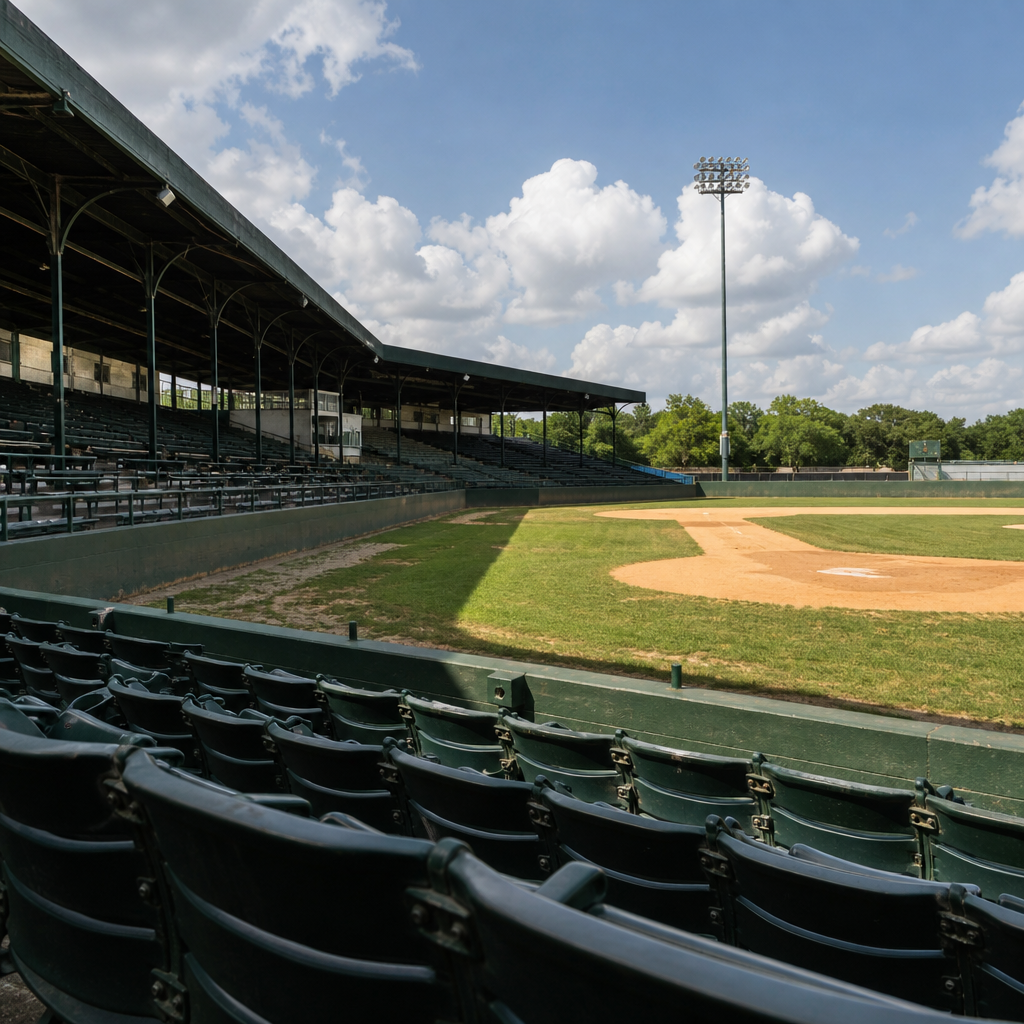
Rickwood Field stands as the most important surviving bridge between early professional baseball and the Negro Leagues, making it essential to any serious guide to Negro Leagues ballparks. Opened in Birmingham, Alabama, on August 18, 1910, Rickwood Field is widely recognized as America’s oldest professional ballpark still in use. It was built for the Birmingham Barons by industrialist Rick Woodward, who modeled parts of the design on Forbes Field and Shibe Park. Yet its deepest historical weight comes from the Black baseball played there, especially by the Birmingham Black Barons, one of the most influential clubs in Negro Leagues history.
For readers exploring iconic ballparks, Rickwood Field works as a hub because it connects architecture, segregation-era sports, player development, community identity, and preservation. A Negro Leagues ballpark was not simply a field used by Black teams. It was often a contested civic space, a revenue engine, a weekend gathering place, and a rare venue where Black excellence was fully visible in public. In many cities, Black clubs rented municipal or minor league parks under restrictive terms, moved frequently, or played in facilities that were underdocumented and later demolished. Rickwood survived where many others did not, which makes it uniquely valuable for understanding the broader landscape of Negro Leagues venues.
The key terms matter. “Professional ballpark” refers to a venue designed for organized, ticketed, high-level baseball rather than an amateur lot or municipal recreation field. “Negro Leagues ballparks” includes both purpose-built homes and shared rental parks used by Black professional teams from the late nineteenth century through integration. “Black Barons” refers to the Birmingham Black Barons, the club most associated with Rickwood Field and best known today as the team where Willie Mays began his professional career as a teenager. Studying Rickwood means studying a place where white minor league baseball and Black professional baseball occupied the same physical space under unequal social conditions.
That tension is exactly why Rickwood matters now. Baseball history was long told through major league timelines, iconic white-owned franchises, and a narrow set of preserved stadiums. In practice, however, many of the sport’s most meaningful stories unfolded in parks like Rickwood Field, where Black clubs drew strong crowds, developed Hall of Fame talent, and built enduring fan cultures despite exclusion from the major leagues. When I have worked through old schedules, lease arrangements, newspaper coverage, and renovation records, Rickwood repeatedly emerges as both a local landmark and a national case study. It is not just old. It explains how America organized baseball, race, commerce, and memory in one grandstand.
Why Rickwood Field Anchors the Story of Negro Leagues Ballparks
Rickwood Field anchors this subtopic because it preserves the physical setting of Negro Leagues baseball better than almost any comparable site. Many Negro Leagues parks are historically significant but fragmented in the present: a marker stands where the stands once rose, a highway crosses the outfield, or the original dimensions can only be reconstructed from Sanborn maps and photographs. At Rickwood, visitors can still encounter the steel-and-concrete grandstand, the intimate scale, the outfield wall, and many sightlines that shaped the baseball experience. Preservation transforms abstraction into evidence.
That evidence matters because Negro Leagues teams often operated under unstable venue arrangements. Clubs such as the Kansas City Monarchs, Homestead Grays, and Newark Eagles played in famous parks, but sometimes as tenants, secondary dates, or traveling attractions. Their use of major and minor league venues shows both popularity and inequality. Rickwood illustrates the pattern clearly. The Birmingham Black Barons played in a first-rate professional park, but they did not control the social order around it. Separate seating customs, segregated city life, and unequal power defined the business environment. A grand ballpark did not erase discrimination; it simply made Black achievement impossible to ignore.
As a hub within the larger Iconic Ballparks topic, Rickwood also points readers outward. It helps frame questions worth asking about every Negro Leagues venue: Who owned the park? Which team held the lease? Was the club a primary tenant or a renter? How did travel schedules affect attendance? What amenities did fans receive? What happened to the site after integration? Those questions connect Rickwood to Hinchliffe Stadium in Paterson, Hamtramck Stadium near Detroit, League Park in Cleveland, Comiskey Park in Chicago, and Municipal Stadium in Kansas City. Each park tells a different version of the same national story: Black baseball was elite baseball, even when its facilities and access were shaped by segregation.
The Ballpark Itself: Design, Setting, and Survival
Rickwood Field opened during an era when baseball architecture was becoming more ambitious. Woodward invested roughly $75,000 in construction, a major sum in 1910, and sought to give Birmingham a modern park that resembled leading venues in the North and East. The result was a steel-and-concrete stadium with covered seating, ornamental detailing, and dimensions that produced a balanced style of play. The original outfield distances changed over time, as they often did in early parks, but the central point remains: Rickwood was not a makeshift field. It was a serious professional facility in an industrial Southern city that expected baseball to matter.
The setting explains part of its longevity. Birmingham was a railroad and steel center, and baseball fit the rhythms of an expanding urban workforce. Rickwood’s neighborhood was closely tied to the city’s industrial life, which meant access for working-class fans but also vulnerability as economic patterns changed. Unlike centrally located downtown parks that were later consumed by redevelopment pressure, Rickwood endured partly because it remained just peripheral enough to avoid immediate demolition and valuable enough to justify periodic upkeep.
Its survival was never automatic. Across the twentieth century, ballparks disappeared when maintenance costs rose, team affiliations shifted, or cities prioritized parking and new construction. Rickwood lasted because local advocates, historians, former players, and preservationists recognized what was at stake. Restoration efforts emphasized historical integrity: period signage, manual scoreboard elements, classic seating character, and the park’s visual relationship to early baseball. That work is why Rickwood serves not just as a monument but as a usable interpretive site. A preserved ballpark teaches with dimensions, shadows, acoustics, and spatial hierarchy in ways no plaque can match.
The Birmingham Black Barons and the Meaning of Home Field
The Birmingham Black Barons gave Rickwood Field its most lasting cultural significance. Founded in 1920 as a Negro National League club and active in several league structures across different periods, the Black Barons were one of the South’s premier Black professional teams. They developed or featured figures such as Willie Mays, Piper Davis, Bill Greason, Mule Suttles, Satchel Paige, and manager Candy Jim Taylor. Their games at Rickwood connected Birmingham to the highest level of Black baseball talent and competition.
Home field in Negro Leagues history meant more than routine scheduling. Because travel was demanding, league finances were precarious, and teams often supplemented official games with exhibitions, a stable home venue could anchor legitimacy. At Rickwood, the Black Barons had access to a recognizable professional stage that elevated both player performance and fan expectations. Crowds came for league matchups, local pride, doubleheaders, and barnstorming attractions. The ballpark became a social destination where Black fans could see stars who were excluded from the major leagues but equal in skill.
The most famous Rickwood-Black Barons connection is Willie Mays. Before he became a New York Giants legend and one of the greatest all-around players in baseball history, Mays played for the Black Barons as a teenager in 1948. Rickwood therefore sits at a crucial developmental crossroads: it is not only a preserved Negro Leagues site, but a place tied directly to the emergence of a player whose career later helped integrate baseball’s historical narrative. That continuity matters. When people stand in Rickwood and think about Mays, they can trace a line from segregated Black baseball to the center of the major league canon.
| Site | City | Primary Negro Leagues Connection | Why It Matters |
|---|---|---|---|
| Rickwood Field | Birmingham | Birmingham Black Barons | Oldest surviving professional ballpark; strongest preserved Black baseball setting |
| Hinchliffe Stadium | Paterson | New York Black Yankees, Negro League events | Rare surviving municipal Negro Leagues venue with recent restoration |
| Hamtramck Stadium | Hamtramck | Detroit Stars successor-era Black baseball | One of the few extant Negro Leagues ballparks built primarily for Black teams |
| League Park | Cleveland | Cleveland Buckeyes | Links major league and Negro Leagues history in one preserved urban site |
| Comiskey Park | Chicago | Chicago American Giants games and events | Illustrates how elite Black clubs used major professional venues as tenants |
Game Day at Rickwood During the Negro Leagues Era
To understand Rickwood fully, it helps to picture a game day during the Black Barons era. Fans arrived dressed for an occasion, not just a pastime. Newspapers promoted matchups with vivid language, often centering star pitchers, rival clubs, or holiday dates expected to draw travel crowds. Vendors, musicians, and neighborhood activity turned the event into something larger than nine innings. In Black communities, attending a high-level baseball game could be both recreation and affirmation, a public demonstration of excellence and business organization in a segregated society.
The baseball itself was fast, tactical, and deeply entertaining. Negro Leagues teams were known for aggressive baserunning, strong defense, flexible use of pitchers, and lineups packed with athletes who could improvise under pressure. That style fit Rickwood well. The park’s dimensions rewarded gap hitting and smart outfield play, while its intimate environment brought fans close enough to read body language and bench chatter. Oral histories consistently show that fans appreciated not just the stars but the pace and inventiveness of the game.
At the same time, the experience was constrained by Jim Crow. Access, seating patterns, concessions, and policing all reflected wider racial hierarchy. Even when Black teams filled the park or delivered the best baseball in town, the surrounding institutions remained unequal. This is a crucial point for any hub article on Negro Leagues ballparks: a historic venue can be beautiful and unjust at once. Preserving Rickwood should not flatten that complexity into nostalgia. The site is powerful precisely because it reveals excellence under pressure, not because it offers a sentimental escape from history.
How Rickwood Compares With Other Negro Leagues Ballparks
Rickwood is often called unique, but comparison makes its significance clearer. Hamtramck Stadium, for example, is indispensable because it is among the very few surviving parks built mainly for Black baseball. Hinchliffe Stadium matters because it was a major municipal setting for Black professional games in the Northeast and has undergone an important rehabilitation. Kansas City’s Municipal Stadium and Chicago’s Comiskey Park were larger and hosted enormous moments, but the original structures do not survive in the same way for direct interpretation. League Park offers an excellent preservation model, yet only part of the original complex remains.
What sets Rickwood apart is the combination of age, continuity, architectural legibility, and marquee association with the Black Barons. It is old enough to speak to the dawn of modern ballpark design, intact enough to educate visitors spatially, and famous enough to connect local memory with national baseball history. For researchers and travelers building an itinerary around Negro Leagues ballparks, it is the most efficient starting point because so many themes converge there.
This hub perspective also helps avoid a common mistake: treating Negro Leagues ballparks as secondary versions of white baseball venues. They were central sites in American sports history. Rickwood proves that point with unusual force. It is not notable merely because major league legends later became linked to it. It is notable because Black baseball made the park historically indispensable.
Visiting Rickwood Field Today and Using It as a Research Hub
For modern visitors, Rickwood Field offers more than a photo stop. It is a practical gateway into Negro Leagues ballparks as a whole. Start with the physical environment: grandstand structure, dugouts, scoreboard, foul territory, and neighborhood context. Then connect the site to people and records. Read about the Birmingham Black Barons, examine local newspaper archives, and compare Rickwood’s survival story with other preserved or vanished venues. The best visits combine place-based observation with documentary research.
If you are building content or travel plans around iconic ballparks, Rickwood should sit near the top of the list because it rewards every level of interest. Casual fans recognize Willie Mays. Architecture enthusiasts notice the early twentieth-century design language. Social historians see evidence of segregation and community resilience. Baseball researchers can trace league affiliations, scheduling patterns, player movement, and the economics of shared facilities. Few stadiums carry so many layers without requiring guesswork about where the game actually happened.
Rickwood Field endures because preservation, scholarship, and public memory finally began to align around the truth that Negro Leagues history belongs at the center of baseball history. That is the main lesson of this ballpark and the wider lesson for every Negro Leagues venue. If you want to understand America’s oldest professional ballpark, study the Black Barons who gave it meaning. If you want to understand Negro Leagues ballparks, start with Rickwood, then follow the network outward to the parks that survived, the parks that changed, and the parks that exist now only in records and memory. Make Rickwood your starting point, and the rest of the story becomes easier to see clearly.
Frequently Asked Questions
Why is Rickwood Field considered so important in baseball history?
Rickwood Field is important because it preserves a rare, nearly unbroken connection to several major eras of American baseball. Opened in Birmingham, Alabama, on August 18, 1910, it is widely recognized as the oldest professional ballpark still in use in the United States. That alone makes it significant, but Rickwood’s real historical power comes from how many baseball stories meet there. It began as the home of the Birmingham Barons, a white minor league club, at a time when professional baseball was expanding rapidly across the country. Its design reflected the ambitions of the era, with owner Rick Woodward borrowing ideas from celebrated parks such as Forbes Field and Shibe Park.
What makes Rickwood Field especially essential, though, is its role as a surviving bridge between early professional baseball and the history of the Negro Leagues. Unlike many historic ballparks that were demolished or heavily rebuilt, Rickwood remained standing long enough to witness and represent both segregated baseball and the extraordinary Black teams and players who competed despite exclusion from Major League Baseball. The park is closely associated with the Birmingham Black Barons, one of the Negro Leagues’ most storied franchises, and with legends such as Willie Mays, who began his professional career there as a teenager. In one place, visitors can trace the architectural history of early ballparks, the culture of Southern baseball, and the resilience and brilliance of Black baseball during segregation. That combination makes Rickwood Field far more than an old stadium; it is one of the most meaningful surviving sites in all of baseball history.
What is the connection between Rickwood Field and the Birmingham Black Barons?
Rickwood Field is deeply tied to the Birmingham Black Barons, one of the most important teams in Black baseball history. Although the ballpark was originally built for the Birmingham Barons of the Southern Association, it also became a crucial home field for the Black Barons during the segregation era. That shared use reflects one of the most revealing aspects of baseball in the early twentieth century: the same physical space could sit at the center of two very different baseball worlds, divided by race but united by the quality of play and the passion of the fans.
The Black Barons were a powerhouse club with a strong regional following and a national reputation in Negro Leagues baseball. Rickwood Field gave the team a prominent stage, and over time the ballpark became inseparable from the memory of Black baseball in Birmingham. It was there that many fans watched elite Black players perform at a level equal to, and often better than, that seen elsewhere in organized baseball. The Black Barons are especially remembered for developing young talent, most famously Willie Mays, who played for the club before becoming one of the greatest players in baseball history. Because of that connection, Rickwood Field is not just a surviving stadium where Negro League games happened; it is one of the clearest physical reminders of how central the Negro Leagues were to American baseball. For anyone studying the Black Barons, Rickwood is not background scenery. It is a core part of the team’s identity and legacy.
Was Rickwood Field really the oldest professional ballpark still in use, and what does “still in use” mean?
Yes, Rickwood Field is widely recognized as America’s oldest professional ballpark still in use, a distinction based on its opening date of August 18, 1910, and its continued survival as an active baseball venue. The phrase “still in use” matters because many older or nearly contemporaneous ballparks no longer exist, while others have lost their original baseball function through demolition, abandonment, or complete transformation. Rickwood, by contrast, continued to host baseball and baseball-related events across the decades, allowing it to retain both physical continuity and cultural relevance.
That does not mean the ballpark has remained frozen in 1910. Like many historic sports venues, Rickwood Field has seen updates, restorations, and maintenance work over time. However, the essential point is that it has never simply become a ruin or a memory. It remains a functioning field where the game can still be played, which gives it a special authenticity. Visitors are not just looking at a historical marker where baseball once happened; they are standing in a place that still performs its original purpose. In preservation terms, that is incredibly valuable. It allows modern audiences to experience scale, sightlines, atmosphere, and setting in a way that photographs and written records cannot fully recreate. So when historians and fans describe Rickwood as the oldest professional ballpark still in use, they are emphasizing both its age and its living status as an active baseball site.
Who built Rickwood Field, and how did its design reflect early twentieth-century baseball?
Rickwood Field was built by Birmingham industrialist Rick Woodward, who wanted a first-class ballpark for the Birmingham Barons. Woodward was part of a generation of baseball owners and civic boosters who saw ballparks as symbols of prestige, growth, and modernity. Rather than settling for a basic local field, he drew inspiration from some of the era’s most admired professional parks, including Forbes Field in Pittsburgh and Shibe Park in Philadelphia. That decision tells us a great deal about the aspirations behind Rickwood from the beginning: it was intended to bring big-league style and seriousness to Birmingham baseball.
The design reflected the transitional character of early twentieth-century ballparks. This was a period when baseball architecture was moving beyond the simplest wooden grounds into more ambitious, durable, and carefully planned spaces. Rickwood embodied that spirit, blending practical baseball function with visual style and a sense of civic importance. Its layout, grandstand, and overall feel connected Birmingham to the broader national culture of professional baseball. At the same time, because the park survived while so many contemporaries disappeared, it now offers a rare glimpse into how fans experienced the game during that formative period. For historians, that is invaluable. For casual visitors, it helps explain why Rickwood feels different from modern stadiums. The park was built in an age when baseball parks were becoming landmarks, not just venues, and Rickwood remains one of the best surviving examples of that idea.
Why does Rickwood Field matter so much in the story of the Negro Leagues?
Rickwood Field matters in the story of the Negro Leagues because it is one of the clearest surviving places where that history can still be seen, felt, and interpreted in context. Many Negro Leagues parks were lost to demolition, urban redevelopment, neglect, or the simple passage of time. As a result, much of Negro Leagues history survives in statistics, newspaper coverage, oral history, and scattered photographs rather than in intact physical sites. Rickwood is different. It remains standing as a powerful witness to the era, especially to the presence of the Birmingham Black Barons and the larger world of Black baseball in the segregated South.
Its importance is also symbolic. Rickwood shows that Negro Leagues history was not separate from baseball history; it was baseball history. The same field that represented organized professional baseball in one context also hosted Black teams, Black stars, and Black fans whose contributions were too often marginalized for decades. That layered history gives the park unusual depth. It helps modern audiences understand segregation not as an abstraction, but as something that shaped where athletes played, how teams traveled, who could be recognized, and how communities gathered around the sport. At the same time, Rickwood tells a story of excellence and endurance. The Black Barons and other Negro Leagues teams brought elite talent, deep community pride, and lasting cultural significance to the park. In that sense, Rickwood Field is not just relevant to Negro Leagues history; it is one of the most important surviving places through which that history can be taught accurately and powerfully.