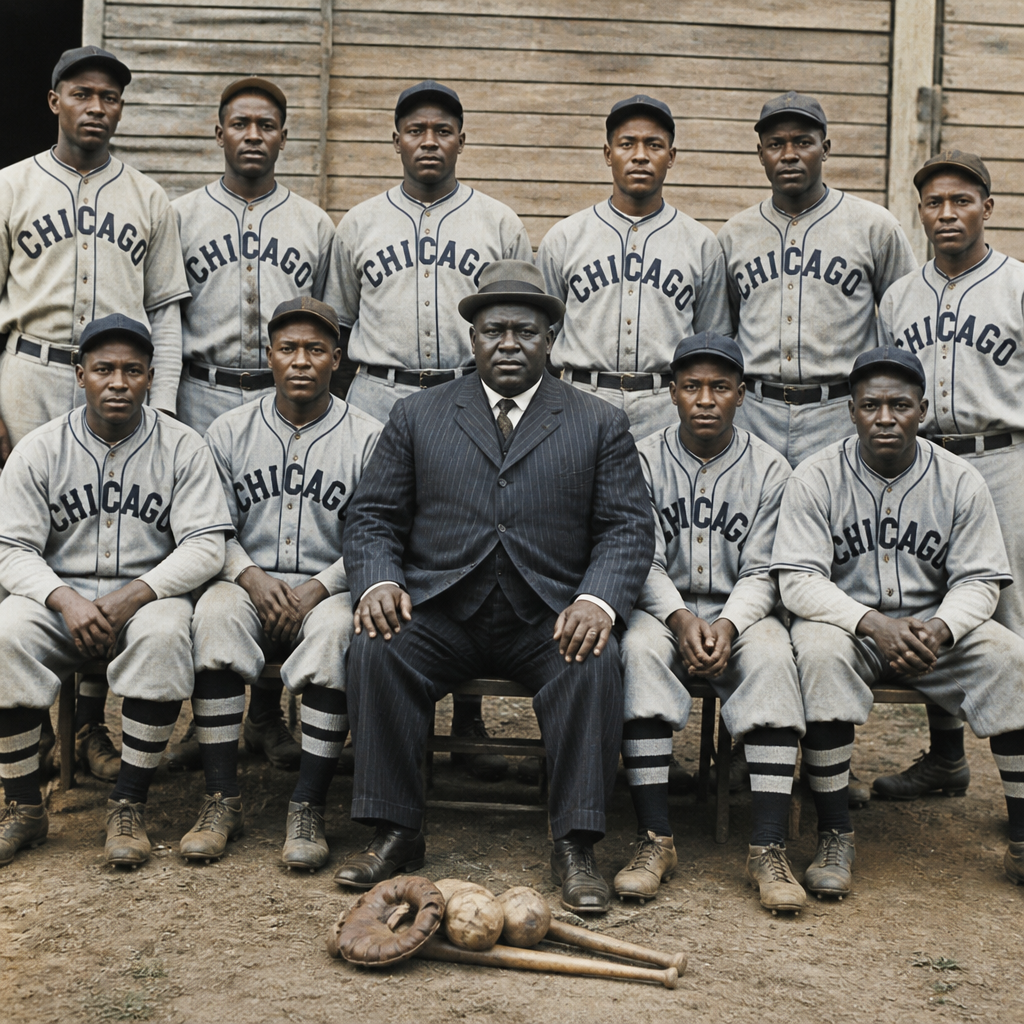
The Chicago American Giants stood at the center of Black baseball’s transformation from talented independent clubs into a structured major league world, and no figure mattered more to that change than Andrew “Rube” Foster. To understand the team is to understand the birth of the Negro National League, the first durable Black major league organized and governed by Black baseball leadership. The American Giants were not merely a successful club from Chicago. They were the model franchise, the financial engine, and the competitive standard that helped turn an idea into an institution. For anyone exploring Negro Leagues teams, this is the essential starting point because the team connects barnstorming culture, urban Black business, player development, league governance, and the long fight for baseball legitimacy.
When historians refer to Negro Leagues baseball, they usually mean the network of Black professional teams and leagues that operated mainly from the late nineteenth century through integration in the mid-twentieth century. The Negro National League, founded in 1920, was the first long-lasting top-tier circuit owned and directed by Black executives on a stable regional model. Rube Foster built it in Chicago after years of managing, promoting, scheduling, and winning with elite clubs. The Chicago American Giants became his proof of concept. I have always found that once readers see how Foster ran this team day to day, the broader history of Negro Leagues teams suddenly becomes concrete rather than abstract.
The club also matters because it shows how baseball and business were inseparable. Foster controlled roster construction, travel, marketing, and gate strategy with unusual discipline. He understood that a Black major league could not survive on talent alone. It needed dependable ballparks, predictable schedules, strong city rivals, and enough prestige to draw both devoted Black audiences and curious white spectators. The American Giants gave him leverage in all those areas. Their success helped establish Chicago as one of the most important centers in Black baseball and made the city a logical home for league meetings, newspaper attention, and championship debates.
As a hub within the broader Famous Baseball Teams topic, this article also frames the wider landscape of Negro Leagues teams. Clubs such as the Kansas City Monarchs, Homestead Grays, Pittsburgh Crawfords, Detroit Stars, St. Louis Stars, Birmingham Black Barons, and Newark Eagles each deserve their own close study. Yet the American Giants sit near the root of the family tree. Their story explains how league baseball emerged from independent touring teams, why ownership structure mattered, how stars were scouted and sold, and why Black baseball became one of the most significant institutions in African American sports and business history.
Rube Foster and the making of the Chicago American Giants
Rube Foster arrived at prominence first as a brilliant pitcher and then as an even more influential manager and organizer. Before founding the Chicago American Giants in 1910, he had already built a reputation with powerhouse Black clubs, especially the Leland Giants. Foster combined tactical sharpness with relentless standards. He emphasized bunt pressure, aggressive baserunning, defensive precision, and pitching discipline years before many white observers credited Black teams with strategic sophistication. People who only know him as a league founder often miss that he was also one of baseball’s great field generals.
The American Giants were formed after a split involving ownership and control of top Chicago Black baseball. Foster wanted authority commensurate with his vision, and he understood that control over a team’s schedule and revenues was as important as control over the lineup card. He secured a strong base at Chicago’s South Side parks, most notably Schorling Park, where the club gained access to dates that gave it rare stability. In practical terms, this meant better attendance planning, more consistent training, and a stronger brand identity than many rivals that still relied heavily on unstable road trips.
On the field, the team quickly became a machine. Foster’s clubs won by exploiting every weakness. They could beat opponents with speed, squeeze bunts, deep pitching staffs, and airtight infield play. They also developed stars who became landmarks in Negro Leagues history, including Pete Hill, John Henry Lloyd, Cristóbal Torriente, and later players tied to the league’s expanding talent web. When I study early box scores and newspaper accounts, what stands out is not only that the American Giants won, but that they imposed a style. Other Negro Leagues teams increasingly had to measure themselves against Foster’s standard of preparation.
Why the Negro National League began in Chicago
The Negro National League was founded in February 1920 at a YMCA in Kansas City, but Chicago was the operating heart of the project because Foster and the American Giants provided its practical foundation. By 1920, Black baseball had enough talent and fan support for a formal league, yet repeated efforts had failed because independent owners protected short-term booking freedom. Foster’s breakthrough was to argue that structure would increase, not reduce, profits if owners accepted contracts, territorial rights, and a championship race that fans could follow from spring through autumn.
Chicago offered ideal conditions. It had a large Black population expanded by the Great Migration, major newspapers that covered Black civic life, robust rail connections, and a sports audience accustomed to paying for high-level baseball. Foster had also proven that a Black team in Chicago could operate with professionalism comparable to white minor league franchises. That mattered when convincing skeptical owners from cities including Detroit, Indianapolis, St. Louis, Dayton, and Kansas City. They were not joining a theory. They were joining a model they had already seen work.
The league’s original membership included the Chicago American Giants, Chicago Giants, Detroit Stars, Indianapolis ABCs, Kansas City Monarchs, St. Louis Giants, Cuban Stars, and Dayton Marcos. The structure was imperfect from the start. Travel was expensive, ballpark access was inconsistent, and disputes over player contracts were common. Even so, the Negro National League changed Black baseball fundamentally. It created schedules, standings, pennant races, and legal mechanisms for enforcing agreements. That gave leading Negro Leagues teams a framework in which sustained excellence could produce not just local prestige but recognized championships.
How the American Giants became the model Negro Leagues team
The American Giants became the model Negro Leagues team because they balanced three demands better than most rivals: competitive excellence, business discipline, and public identity. Foster recruited players who could execute under pressure rather than simply pile up gaudy exhibition numbers. He invested in team cohesion and expected players to respect curfews, signals, and situational responsibilities. In an era when many clubs still lived week to week, that internal order was a competitive advantage.
Business discipline was just as important. Foster understood gate splits, doubleheaders, travel timing, and the promotional value of rivalry games. He booked strategically against strong white semipro clubs and top Black independents, using marquee matchups to build the American Giants brand. He also recognized the importance of press relationships. Black newspapers such as the Chicago Defender were not passive observers; they were essential amplifiers of league legitimacy. Coverage of standings, stars, and disputes made Negro Leagues teams feel permanent to readers and customers.
The team’s public identity extended beyond wins. The American Giants represented modern Black enterprise. Their games were social events, their travel symbolized ambition, and their success countered racist assumptions about Black organizational capacity. This mattered deeply in the 1910s and 1920s, when segregation restricted opportunity but could not suppress demand for excellence. The club showed that Negro Leagues teams were not novelty acts. They were elite professional organizations serving a loyal, knowledgeable audience.
| Team | City | Primary significance | Connection to the American Giants |
|---|---|---|---|
| Chicago American Giants | Chicago | Flagship franchise of early Black major league baseball | Rube Foster’s team and operational model for league structure |
| Kansas City Monarchs | Kansas City | Most durable Negro Leagues dynasty | Major rival and benchmark for league-wide success |
| Detroit Stars | Detroit | Key charter club with strong urban fan base | Helped prove the regional league model could scale |
| Homestead Grays | Pittsburgh/Washington | Later powerhouse with Hall of Fame talent | Illustrated how the Negro Leagues grew beyond the first league core |
| Pittsburgh Crawfords | Pittsburgh | Star-studded 1930s superteam | Showed the talent concentration Foster’s system had helped normalize |
Key players, playing style, and championship culture
No hub on Negro Leagues teams is complete without explaining how talent shaped reputation. The American Giants fielded extraordinary players, but they were not built around individual celebrity alone. Pete Hill brought line-drive hitting and all-around intelligence. John Henry Lloyd, one of the finest shortstops in baseball history, gave the club calm command in the infield. Cristóbal Torriente added power, speed, and arm strength. Later, players such as Bingo DeMoss and Dave Brown reinforced the club’s reputation for depth and polish.
Foster’s style rewarded baseball intelligence. Hit-and-run plays, delayed steals, bunts toward pressure points, and aggressive first-to-third running were central features. This was not reckless speed. It was calculated pressure. Pitchers were expected to throw strikes, field bunts cleanly, and work efficiently enough to support dense schedules. Defenders needed quick hands because many games were played on uneven surfaces where bad hops could punish hesitation. Across the Negro Leagues, clubs copied these habits because they worked in real conditions, not in coaching manuals.
Championship culture came from repetition. The American Giants won championships before and after the league’s creation and were perennial contenders in the 1920s. Their consistency mattered because early Black baseball often lacked stable annual frameworks. By winning across exhibitions, western tours, and formal league play, the club established credibility with fans who had learned to judge teams by both record and reputation. In simple terms, the American Giants became the team other clubs wanted to beat because beating them meant something everywhere.
The wider Negro Leagues ecosystem and the team’s lasting legacy
As a hub article on Negro Leagues teams, it is important to place the American Giants inside the larger ecosystem. Black baseball was never one league, one city, or one business model. It included league clubs, strong independents, Latin American connections, winter ball networks, semipro challengers, and constant player movement. Teams rose and fell with ballpark deals, ownership capital, and local demographics. Foster’s achievement was not eliminating that instability. It was building enough structure that Black baseball could sustain recognized major league competition despite it.
The American Giants influenced how later teams operated even after Foster’s health declined in the mid-1920s. Their administrative example informed contract enforcement, territorial thinking, and the assumption that Black teams could demand first-class presentation. Later giants such as the Monarchs and Grays expanded those lessons, while clubs like the Crawfords showed what concentrated investment in talent could produce. The result was a baseball world that developed stars including Satchel Paige, Josh Gibson, Cool Papa Bell, Buck Leonard, and many others whose fame now anchors the public memory of Negro Leagues history.
The team’s legacy also reaches into baseball recognition today. Major League Baseball’s decision in 2020 to recognize several Negro Leagues as major leagues underscored what scholars and Black baseball historians had argued for decades: these were top professional circuits, not side shows. The American Giants were central to that reality. Their history offers the clearest route into understanding Negro Leagues teams as serious institutions shaped by strategy, entrepreneurship, community support, and extraordinary athletic skill.
The Chicago American Giants matter because they explain how Black baseball moved from brilliance without structure to brilliance with institutions. Rube Foster built a team that could win, earn, organize, and persuade. From that foundation came the Negro National League, a landmark in sports business and African American history. The club’s story also opens the door to the full Negro Leagues teams landscape, from charter members to later dynasties, from local rivalries to national significance.
If you want to understand famous baseball teams beyond the familiar major league canon, start here. Study the American Giants, then follow the connections outward to the Monarchs, Grays, Crawfords, Stars, Eagles, and Black Barons. The deeper you go, the clearer the picture becomes: Black baseball built its own stage, filled it with elite talent, and changed the sport permanently. Explore the related team histories next, and use this article as your map to the Negro Leagues world.
Frequently Asked Questions
Who were the Chicago American Giants, and why are they so important in baseball history?
The Chicago American Giants were one of the most influential Black baseball teams of the early 20th century and a foundational force in the rise of organized Negro League baseball. Based in Chicago and led by the brilliant Andrew “Rube” Foster, the club represented far more than local success. It became the clearest example of what a Black major league team could look like when managed with discipline, business structure, and long-term vision. At a time when segregation shut Black players out of white organized baseball, the American Giants showed that Black baseball could produce elite talent, packed crowds, professional administration, and championship-caliber play on its own terms.
Their historical importance comes from both performance and influence. On the field, the American Giants were regularly one of the strongest teams in Black baseball, known for sharp defense, aggressive baserunning, smart strategy, and a style of play that reflected Foster’s baseball intelligence. Off the field, they helped prove that Black baseball did not have to remain a loose collection of barnstorming clubs. The team became the model franchise for stable scheduling, financial planning, and league membership, making it central to the transformation of Black baseball from independent clubs into a structured league system. In that sense, the Chicago American Giants were not just a great team; they were a blueprint for the future of Black professional baseball.
What role did Rube Foster play in the creation of the Negro National League?
Rube Foster was the driving force behind the creation of the Negro National League in 1920, and his role cannot be overstated. Before founding the league, Foster had already established himself as one of the most respected minds in Black baseball. He was a star pitcher, a gifted manager, a sharp promoter, and a determined organizer who understood both the athletic and business sides of the sport. Through his work with the Chicago American Giants, he saw firsthand the limits of the independent club system. Even the best teams faced unstable schedules, unreliable opponents, uneven finances, and little centralized authority. Foster believed Black baseball needed something more permanent and more professional.
That belief led him to organize leading Midwestern Black clubs into the Negro National League, the first durable Black major league owned and governed by Black baseball leadership. Foster’s importance was not limited to calling meetings or announcing the league’s existence. He helped create the structure, define standards, build legitimacy, and persuade team owners to commit to a shared vision. He wanted the league to be stable enough to survive economic pressure, credible enough to attract fans, and disciplined enough to command respect. As president of the league, he worked to establish rules, schedules, and business practices that would move Black baseball away from instability and toward true major league status. The Negro National League was not an accident of timing; it was the product of Foster’s ambition, credibility, and relentless organizational leadership.
Why was the Chicago American Giants considered the model franchise of early Black baseball?
The Chicago American Giants were considered the model franchise because they embodied the standards Rube Foster wanted for all of Black baseball. They were run with a level of professionalism that set them apart from many independent clubs of the era. Foster emphasized discipline, preparation, and tactical intelligence, and his team reflected those priorities in nearly every aspect of play. The American Giants developed a reputation for being fundamentally sound, strategically advanced, and consistently competitive against top opponents. They did not rely only on raw talent; they were built around organization, execution, and accountability.
Just as importantly, the franchise served as a business model. In an era when Black teams often had to navigate unstable bookings, travel challenges, and exploitative conditions, the American Giants demonstrated that a Black club could operate with structure and purpose. They cultivated fan support in a major city, maintained a recognizable identity, and played a central role in building league credibility. Their success gave Foster a practical example when arguing that Black baseball deserved a formal league system. He was not speaking in theory. He had already built a team that showed what success could look like when talent was matched with management. That combination made the American Giants the standard others were measured against and a cornerstone in the rise of the Negro National League.
How did the Negro National League change Black baseball?
The Negro National League changed Black baseball by giving it stability, legitimacy, and a stronger institutional foundation. Before the league, many Black teams operated independently, which meant they often depended on irregular scheduling, constant travel, and a mix of serious competition and money-driven exhibition games. That independence created flexibility, but it also made long-term planning difficult. Teams could be excellent on the field and still struggle financially or organizationally because there was no durable league framework to support them. The Negro National League helped solve that problem by bringing leading clubs under a common structure.
Its creation meant Black baseball could function more like a true major league. Teams could coordinate schedules more effectively, build rivalries that fans could follow, and establish clearer standards for competition and governance. It also reinforced the idea that Black baseball should be led by Black owners, managers, and executives, which was deeply significant in the segregated sports world of the early 20th century. The league did not eliminate every challenge, and Black baseball continued to face economic inequality, travel hardship, and racism from the broader society. But the Negro National League marked a major turning point. It helped transform Black baseball from a scattered landscape of talented clubs into a more coherent professional world, one with institutions, leadership, and a growing sense of permanence. That shift opened the door for the broader Negro Leagues era and secured a place for Black baseball as a major chapter in American sports history.
What is the lasting legacy of the Chicago American Giants and Rube Foster today?
The lasting legacy of the Chicago American Giants and Rube Foster lies in their role as architects of Black baseball’s modern era. Foster is remembered not only as a great baseball mind but as a builder of institutions. He understood that talent alone would never be enough if Black baseball lacked structure, ownership, and authority. By shaping the American Giants into an elite, professionally run club and then helping launch the Negro National League, he changed the course of the sport. His work gave Black players, teams, and fans something larger than a winning season: it gave them a durable system that affirmed Black excellence and self-determination in one of America’s most important games.
The American Giants remain central to that story because they were the practical proof behind Foster’s vision. They showed that Black baseball could sustain competitive excellence, strong public support, and organizational credibility. Their influence can still be felt in how historians understand the growth of the Negro Leagues and the broader fight for recognition in baseball history. Today, as the Negro Leagues receive increasing scholarly attention and long-overdue official acknowledgment, the American Giants stand out as one of the teams that made that history possible. Their legacy is not just about wins and championships. It is about leadership, innovation, and the creation of a Black baseball institution powerful enough to reshape the sport in the face of segregation.