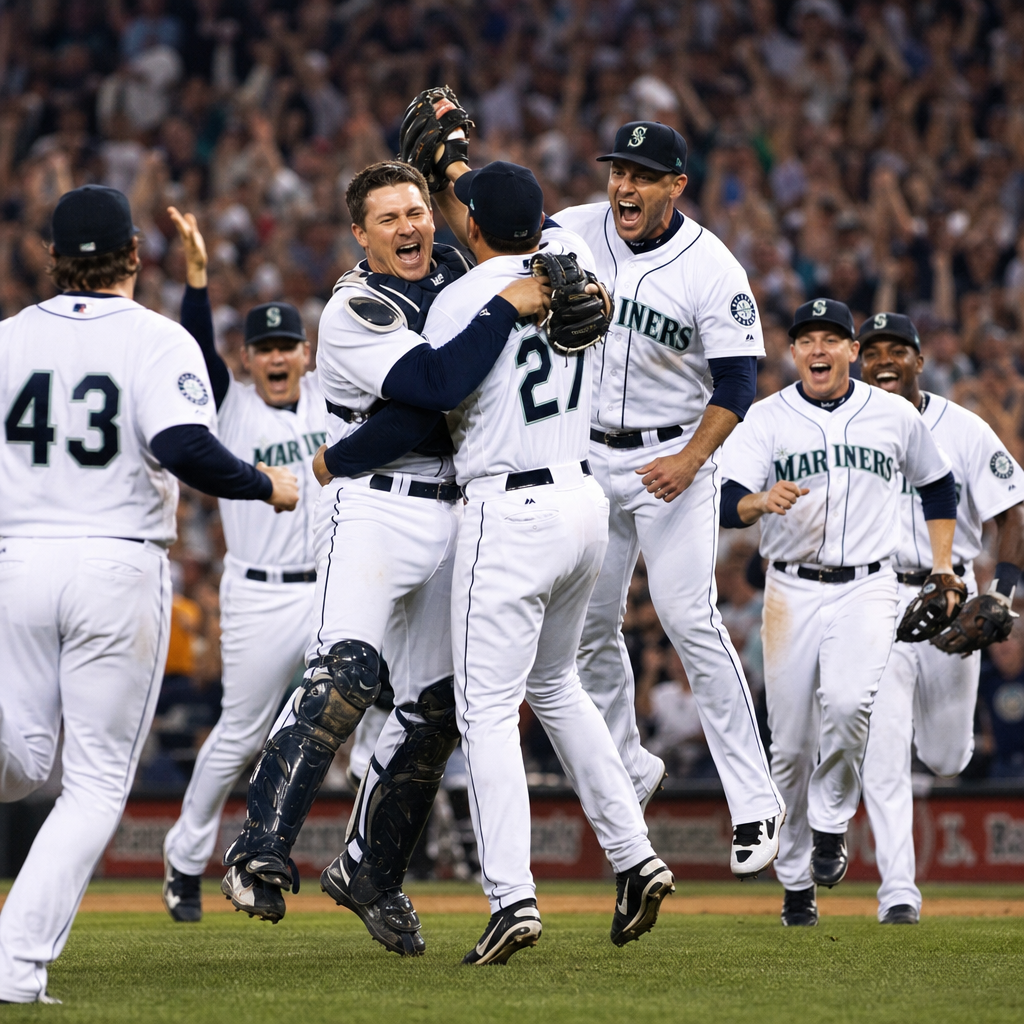
The 2001 Seattle Mariners won 116 games, tying the major league record, and they did it in a season framed by turbulence, skepticism, and a level of organizational discipline that still rewards close study. Any article about the 2001 Seattle Mariners’ record season has to start with the apparent contradiction at its center: this was a club that lost Alex Rodriguez to free agency after 2000, played under the cloud of ownership disputes and relocation anxieties from the previous decade, and still produced one of the most efficient regular seasons in baseball history. The Mariners did not rely on one overwhelming slugger or one unhittable rotation ace. They won through balance, health, defense, bullpen depth, lineup continuity, and a front office that assembled a roster with very few dead spots.
That matters because record seasons are often misunderstood. Fans remember the final total, the stars, and the postseason disappointment against the Yankees, but the real lesson is how a team sustains excellence over 162 games. In baseball terms, run differential, on-base percentage, situational bullpen usage, and defensive range all matter more over six months than any single headline. The 2001 Mariners are especially useful as a hub topic within miscellaneous scandals and controversies because their success unfolded alongside larger conversations about payroll, stadium politics, star departures, media pressure, and the thin line between a cleanly run club and a supposedly charmed one. There was no defining scandal attached to Seattle’s season, yet controversy hovered around expectations, fairness, and whether a team could truly improve after losing a future Hall of Fame shortstop.
From my perspective reviewing historic roster construction and game logs, the 2001 Mariners hold up because nearly every move had a baseball rationale. Manager Lou Piniella directed a veteran club that understood the strike zone and converted balls in play into outs. General manager Pat Gillick and his staff added impact without chasing glamour, bringing in Ichiro Suzuki from Japan and Bret Boone from Atlanta, then trusting role players such as Mark McLemore, David Bell, Charles Gipson, and Stan Javier to support the everyday core. Edgar Martinez remained the lineup’s intellectual center, John Olerud gave elite first-base defense and on-base skill, and Mike Cameron replaced a massive portion of Rodriguez’s all-around value with speed, center-field range, and timely power.
Defining the season clearly helps. Seattle’s 116-46 record tied the 1906 Chicago Cubs for the most wins in modern major league history, though the Mariners played in a very different offensive environment and against a deeper talent pool. They scored 927 runs and allowed 627, a plus-300 run differential that reflected real dominance rather than luck in close games alone. They led the American League West comfortably and spent much of the year turning ordinary series into demonstrations of depth. If you want to understand why the 2001 Seattle Mariners’ record season happened, you need to examine roster design, player development, tactical management, statistical performance, and the off-field context that sharpened the club rather than breaking it.
How Seattle Rebuilt After Losing Alex Rodriguez
The first reason for the Mariners’ success was that they refused to make Rodriguez’s departure the whole story. Rodriguez signed a 10-year, $252 million contract with Texas after the 2000 season, creating the kind of public relations shock that often sends a franchise into emotional overreaction. Seattle did the opposite. Instead of using one expensive replacement, the club spread value across several positions. Ichiro arrived from the Orix BlueWave with elite bat-to-ball skills, top-tier speed, and a throwing arm that immediately changed how opponents ran the bases. Boone posted the best season of his career at second base, hitting 37 home runs with 141 runs batted in. Cameron, acquired from Cincinnati in the deal that sent Ken Griffey Jr. away before 2000, gave the Mariners premium defense and 25 home runs in 2001.
This was not merely a case of everyone unexpectedly peaking at once. Seattle targeted skills that age well over a full season: contact, defense, athletic range, and relief reliability. Olerud had a .401 on-base percentage. Martinez posted a .423 on-base percentage at age 38. Boone combined power with durability. Ichiro hit .350, won both Rookie of the Year and Most Valuable Player, and scored 127 runs. The front office understood a simple but important truth: replacing a superstar is easier when the rest of the roster stops leaking value. Many clubs carry two or three lineup holes and then wonder why a star cannot carry them. The Mariners carried competence nearly everywhere.
There was also a psychological component. Seattle had endured years of national discussion about whether stars would stay, whether the market could support a contender, and whether the franchise could truly be stable. By 2001, Safeco Field had provided a modern home, but expectations were still uneasy. Inside that environment, the Mariners turned a potentially destabilizing loss into a clarifying event. Players have often said veteran teams become dangerous when roles are obvious. In Seattle, roles were obvious by April.
The Lineup Was Relentless, Not Top Heavy
A common mistake is assuming the Mariners won because Ichiro carried everything. He was transformative, but the offense worked because pitchers had no easy pockets. Seattle did not lead the American League in home runs, yet it consistently built innings. The club finished near the top of the league in batting average and on-base skill, and it pressured defenses with contact. Martinez still controlled at-bats with uncommon precision. Olerud gave left-handed balance and gap power. Boone punished mistakes. Cameron stretched singles into doubles and covered enough ground in center that his offensive streakiness never erased his value. Even role players mattered. Bell played steady third base and chipped in 20 home runs. McLemore posted a .391 on-base percentage in a super-utility role.
What made the lineup especially hard to navigate was sequencing. Ichiro set the table, but he also created chaos through infield hits, steals, and first-to-third reads. Pitchers worked from the stretch early, middle infielders shaded for speed, and outfielders felt pressure to charge softly hit balls. That changed the geometry of innings for Boone and Martinez behind him. Seattle also struck out less than many power-heavy clubs of the era, which increased pressure on opponents to convert every chance cleanly. Over a long season, forcing defenders to execute repeatedly becomes a competitive weapon.
| Key 2001 Mariners Contributor | Primary Value | Why It Mattered |
|---|---|---|
| Ichiro Suzuki | Contact, speed, right field defense | Created constant baserunner pressure and saved runs with range and arm strength |
| Bret Boone | Middle-infield power | Turned lineup traffic into crooked numbers with extra-base impact |
| Edgar Martinez | On-base percentage, plate discipline | Extended innings and punished pitchers who fell behind in the count |
| John Olerud | First-base defense, OBP | Converted difficult throws into outs and maintained lineup stability |
| Mike Cameron | Center-field range, power-speed blend | Saved runs in the field while replacing star-level production in aggregate |
| Kazuhiro Sasaki | Late-inning relief | Protected narrow leads and shortened games for the rotation |
In plain terms, Seattle’s offense was difficult because it never asked one player to solve every problem. Opponents could pitch around a hitter occasionally, but they could not relax for long. That is one reason the team won 63 of 81 home games and 53 on the road. The attack traveled because it was based on repeatable skills rather than one park-specific advantage.
Pitching Depth and Run Prevention Drove the Win Total
When a team wins 116 games, people usually look first at offense. In Seattle’s case, run prevention was just as important. Freddy Garcia, Jamie Moyer, Aaron Sele, Paul Abbott, and John Halama formed a rotation without a classic Cy Young favorite, yet it gave Piniella dependable innings and allowed the bullpen to be deployed on schedule. Moyer’s style captured the broader Mariners identity. He did not overpower hitters. He changed speeds, moved the ball, disrupted timing, and trusted the defense. Garcia provided the closest thing to a frontline power arm, finishing 18-6. Abbott won 17 games, a reminder that a strong team context can elevate a pitcher who fills the zone and avoids disaster innings.
The bullpen was disciplined and layered. Sasaki handled the ninth inning and saved 45 games despite missing time late in the year. Arthur Rhodes was dominant as a setup left-hander, allowing very little hard contact. Jeff Nelson gave experienced right-handed relief. What stands out in retrospect is not simply the save totals but the efficiency of bullpen roles. Seattle often entered the seventh inning with a lead because the offense generated early support and the rotation avoided blowups. That let Piniella manage from structure rather than panic.
Defense completed the formula. Ichiro and Cameron covered substantial outfield territory. Olerud was among the best receiving first basemen of his era. Boone and Bell were steady on the infield dirt. Good defensive clubs make pitching staffs look calmer because more balls become outs before innings spiral. Seattle allowed the fewest runs in the American League not because every pitcher had overwhelming stuff, but because the team supported them with positioning, reliability, and athleticism.
Lou Piniella, Clubhouse Culture, and the Absence of Internal Drama
Another overlooked factor behind the 2001 Seattle Mariners’ record season was that the team stayed remarkably free of self-inflicted controversy. That does not mean the club existed in a vacuum. Every elite team faces slumps, media narratives, and ego management. What separated Seattle was its resistance to turning ordinary friction into public drama. Piniella, who could be fiery and demanding, managed a veteran group that accepted blunt accountability. Martinez led by example rather than volume. Olerud was famously calm. Moyer set a professional tone. Ichiro arrived with immense pressure and instantly performed, which removed the temptation for a prolonged cultural adjustment story.
I have seen many strong rosters underperform because unresolved status questions become daily distractions. Seattle avoided that trap. Boone’s career year could have produced resentment if teammates thought it unsustainable or selfish; instead, it fit the club’s collective momentum. Ichiro’s celebrity could have overwhelmed a less stable room; instead, veterans let performance settle the hierarchy quickly. The result was a season in which the baseball itself stayed central. That is rare, and it matters more than fans sometimes realize.
This helps explain why the Mariners became a reference point in broader baseball conversations. They represented organizational coherence at a time when many contenders still built around one or two marquee names and accepted weak spots elsewhere. Seattle showed that a club can withstand controversy at the edges when the center is stable.
The Postseason Letdown and What It Really Means
No honest assessment of the 2001 Mariners is complete without addressing October. Seattle swept Cleveland in the Division Series, then lost to the Yankees in five games in the American League Championship Series. For critics, that result reduced the 116 wins to a trivia answer. That interpretation is wrong. Postseason baseball is high variance by design. Short series compress outcomes, magnify bullpen matchups, and reward timely performance more than six-month superiority. The Mariners’ regular season remains historically significant because 162 games reveal team quality better than five.
Still, the ALCS exposed real limits. Seattle’s offense, built on depth and pressure, did not always have the singular intimidation factor that can erase mistakes against elite October pitching. The Yankees also had more established postseason confidence and received major contributions from stars accustomed to that stage. This is not a knock on Seattle so much as a reminder that great regular-season teams are not guaranteed championships. The 2001 Mariners belong in the same analytical conversation as the 1998 Yankees and 1906 Cubs for regular-season dominance, but not in the same championship tier.
That distinction actually strengthens the season’s value as a case study. It shows how baseball success should be measured on multiple levels: roster construction, consistency, adaptability, and championship conversion. Seattle aced the first three. The final step proved elusive.
Why the 2001 Mariners Still Matter
The 2001 Seattle Mariners still matter because they offer a clear blueprint for sustainable winning that goes beyond nostalgia. Build around on-base skill, athletic defense, bullpen clarity, and lineup depth. Replace departing stars with multiple sources of value rather than one symbolic signing. Create a clubhouse where roles are understood and public noise stays outside the daily work. Recognize that a record season can emerge from disciplined planning more often than from spectacle.
They also matter within the broader landscape of miscellaneous controversies because their season sits near several fault lines in baseball history: international player evaluation, superstar contracts, market size anxiety, and the difference between public perception and front-office reality. Ichiro’s arrival challenged lazy assumptions about how Japanese position players would translate. Rodriguez’s exit tested whether Seattle could survive a payroll gap. The franchise’s earlier instability remained part of the backdrop. Yet the club answered every question with performance.
The lasting takeaway is simple. The Mariners won 116 games because they were complete, prepared, and relentlessly efficient. Their season was not a miracle and not a fluke. It was the product of smart roster design, veteran leadership, strong defense, and consistent execution over six months. If you are exploring baseball’s most instructive teams, start here, then follow the threads into Seattle’s roster moves, Ichiro’s adaptation, Boone’s breakout, and the postseason debate that still shadows this club. The record season remains one of the best examples of how a team can turn uncertainty into historic success.
Frequently Asked Questions
How did the 2001 Seattle Mariners win 116 games after losing Alex Rodriguez?
The most remarkable part of the 2001 Mariners’ season is that it followed the departure of Alex Rodriguez, one of the best players in baseball. On the surface, losing a superstar of that caliber should have created a major setback. Instead, Seattle responded by becoming deeper, more balanced, and in many ways more efficient. Rather than trying to replace Rodriguez with one player, the Mariners redistributed value across the roster. Ichiro Suzuki arrived from Japan and immediately transformed the lineup with elite contact hitting, speed, defense, and daily pressure on opposing pitchers. Bret Boone delivered the best offensive season of his career. Edgar Martinez remained one of the game’s most disciplined hitters, while John Olerud, Mike Cameron, Dan Wilson, and Mark McLemore gave the club quality at-bats and dependable defense.
What made this team special was not simply talent, but fit. The Mariners excelled at run prevention, situational execution, and avoiding weaknesses that opponents could exploit over a long season. They did not rely on one overwhelming slugger or one dominant starter to carry them. Instead, they won with lineup depth, excellent defense, smart baserunning, and a bullpen that consistently protected leads. In that sense, Rodriguez’s departure forced the organization to lean fully into a team-oriented construction. The result was a roster with fewer obvious headlines than some other great clubs, but almost no soft spots. Over 162 games, that kind of balance can be devastatingly effective, and in 2001 it was.
Who were the most important players behind the Mariners’ record-tying season?
Several players were central to Seattle’s success, and their contributions came in different forms. Ichiro Suzuki was the defining newcomer and one of the season’s biggest stories in all of baseball. He won both the American League MVP and Rookie of the Year awards, an extraordinary achievement that reflected how completely he changed games. Ichiro hit for average, put constant pressure on defenses, stole bases efficiently, covered ground in right field, and added a throwing arm that discouraged extra bases. He gave Seattle an identity built around speed, precision, and relentless contact.
Bret Boone was just as important in the middle of the order. His power surge gave the Mariners needed thump and prevented the lineup from becoming too dependent on singles and movement. Edgar Martinez continued to anchor the offense with patience and professionalism, setting the tone for the club’s offensive approach. John Olerud brought on-base skill, gap power, and elite defense at first base, while Mike Cameron replaced much of the athleticism and outfield value the team needed after the offseason changes. Defensively, Cameron was especially significant, helping turn the Mariners into one of the league’s best run-prevention teams.
On the pitching side, Freddy Garcia, Jamie Moyer, and Aaron Sele gave the rotation stability, while the bullpen repeatedly converted close games into wins. Kazuhiro Sasaki was the proven finisher at the back end, and the relief corps as a whole reflected Seattle’s broader strength: dependable execution. This was not a roster driven by one singular force. It was a team in which stars, veterans, role players, and pitchers all reinforced one another. That collective structure is a major reason the Mariners could sustain excellence over the entire season rather than peaking only in stretches.
What made the 2001 Mariners so effective beyond raw talent?
The 2001 Mariners are a classic example of a team whose greatness becomes even clearer when you look beyond star power. Their success rested on organizational discipline, roster coherence, and an unusually consistent brand of baseball. They defended well, ran the bases intelligently, made pitchers work, and rarely gave away outs. Those habits do not always dominate highlight reels, but over 162 games they can separate an excellent club from a historic one. Seattle repeatedly won the small battles inside games, which meant they were often in position to capitalize late.
Another major factor was versatility. The Mariners could beat opponents in different ways depending on the matchup. They could pressure defenses with contact and speed, manufacture runs when needed, or hit enough extra-base damage to change a game quickly. They also prevented runs at a high level because their defenders converted balls in play into outs and their pitchers generally avoided long periods of instability. Even when they were not overwhelming in one category on a given day, they were rarely sloppy. That consistency created a kind of daily reliability that can be hard for opponents to counter.
Clubhouse professionalism also mattered. Veteran leadership from players such as Edgar Martinez, John Olerud, Dan Wilson, and Jamie Moyer helped set a calm, prepared tone. This was a team that appeared to understand itself. It did not play with desperation or confusion, even though the broader franchise had experienced uncertainty in prior years. Instead, the Mariners functioned with the confidence of a club that trusted its routines and its structure. That trust allowed them to keep winning without dramatic swings in identity. Their season was not built on chaos or emotional surges; it was built on disciplined repetition at a remarkably high level.
How did off-field turbulence and skepticism shape the Mariners’ 2001 season?
The Mariners’ record season becomes even more impressive when placed in the context of the franchise’s recent history. During the previous decade, Seattle had lived through ownership instability, public funding battles, and real anxieties about whether baseball would remain in the city. Even after the club’s late-1990s success, there was no guarantee of long-term comfort or continuity. Then, after the 2000 season, Alex Rodriguez left in free agency, fueling the idea that Seattle might be vulnerable to a step backward. Around the game, many viewed the Mariners as a good team, but not necessarily one poised to make history.
That environment helped shape the 2001 club in an important way: it pushed the organization toward resilience rather than dependency. The Mariners could not afford to build their identity around one player, one transaction, or one emotional storyline. They needed a full system of competence. The front office, coaching staff, and player leadership all contributed to a structure in which expectations remained high despite the noise surrounding the franchise. In practical terms, that meant strong preparation, clear roles, and a roster built to withstand pressure without fracturing.
Skepticism also gave the team a kind of sharpness. Seattle did not enter 2001 with the glamour of a defending champion or the singular drama of a superstar-centered club. Instead, the Mariners had to prove, day after day, that they were more than the sum of their parts. As the wins accumulated, what initially looked surprising began to look inevitable. Their season became a lesson in how stable organizations can convert uncertainty into focus. Rather than allowing outside turbulence to define them, the Mariners used structure and execution to create one of the most authoritative regular seasons in baseball history.
Why is the 2001 Mariners season still studied and remembered today?
The 2001 Mariners remain a point of fascination because their season sits at the intersection of history, contradiction, and baseball theory. On the historical level, winning 116 games is rare territory; Seattle tied the major league single-season record, matching the 1906 Chicago Cubs. Any team that reaches that total automatically enters the sport’s permanent conversation. But the Mariners are remembered for more than the number. They are studied because they challenge simplistic ideas about how great teams are supposed to look. They did not fit the standard image of a dynasty built around a single transcendent superstar or a postseason title run. They were a machine of balance, efficiency, and relentless competence.
Analytically, the team rewards close attention because it demonstrates how many different ingredients can combine into historic success. The Mariners were excellent at converting roster depth into real wins. They paired offense with defense, star performances with role-player steadiness, and veteran leadership with tactical flexibility. They also show how a club can respond productively to major change. Instead of collapsing after losing Rodriguez, Seattle reorganized itself in a way that made the entire roster stronger and more coherent. For fans, writers, and historians, that makes the season especially rich: it is not just a story about greatness, but about adaptation.
The season is also remembered with a measure of poignancy because it did not end in a World Series title. That fact has kept the 2001 Mariners in debate for years. Were they one of the greatest regular-season teams ever? Absolutely. Does the absence of a championship complicate their legacy? Inevitably. Yet that tension is part of what keeps the team relevant. The Mariners’ 116 wins stand as proof that a season can be historically significant even without the final trophy. Their story continues to resonate because it captures something essential about baseball itself: over a long season, excellence can take many forms, and not all of them fit the most familiar script.