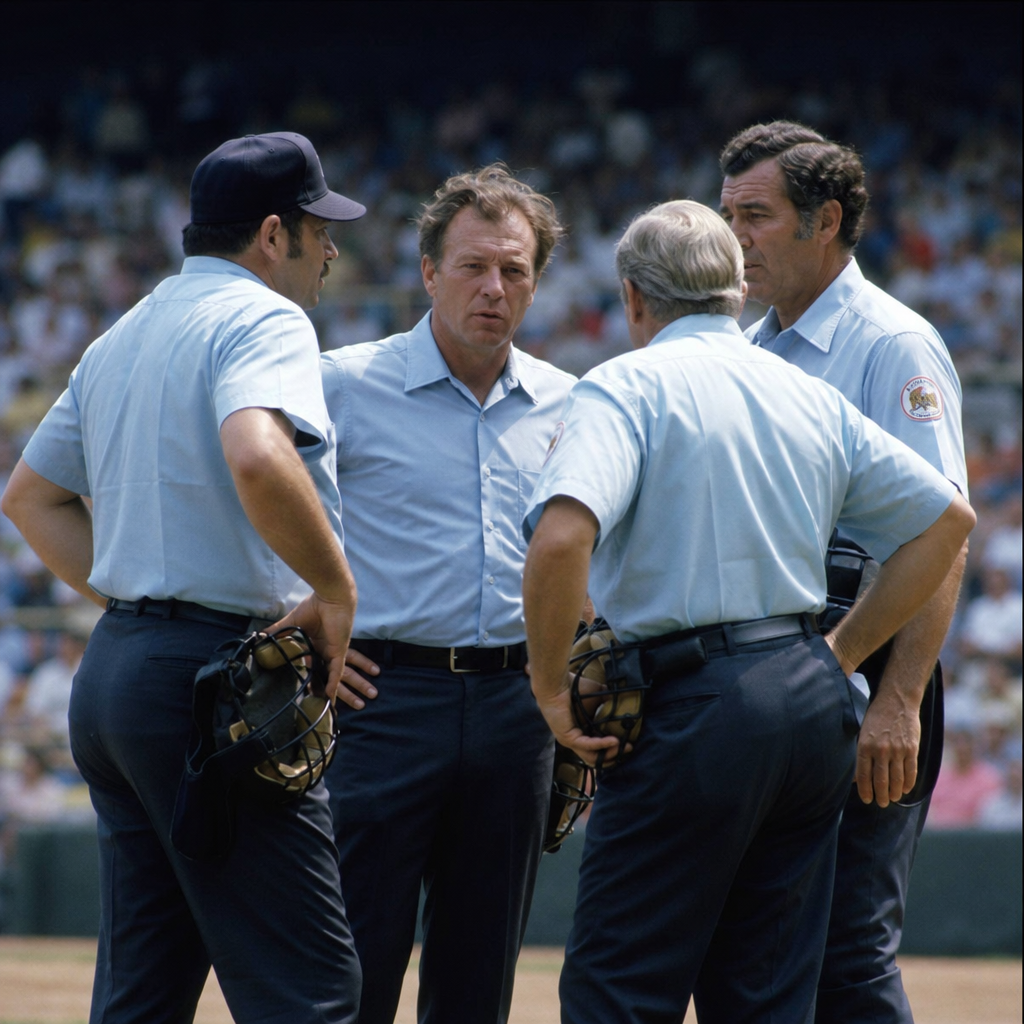
The 1972 umpire strike remains one of the clearest examples of how labor disputes in baseball can reshape the sport far beyond the picket line. At first glance, the conflict looked narrow: major league umpires wanted better pay, stronger benefits, and more professional respect from American League president Joe Cronin and National League president Chub Feeney. In practice, the strike exposed a larger truth about baseball scandals and controversies: many of the game’s defining flashpoints are not only about players, owners, or on-field cheating, but also about governance, power, and the people responsible for enforcing the rules. For a hub article on miscellaneous controversies, the 1972 umpire strike is an ideal anchor because it connects labor history, league politics, competitive integrity, media perception, and fan trust.
In baseball, an umpire strike is a work stoppage by the officials assigned to regulate games, apply the Official Baseball Rules, and maintain order on the field. Labor disputes in baseball arise when one side of the industry, whether players, umpires, coaches, front-office employees, or support staff, uses collective pressure to improve working conditions or resist management demands. The 1972 dispute mattered because umpires occupied a peculiar position. They were essential to every game, highly visible, heavily criticized, and historically underprotected. When they withdrew their labor late in the regular season, Major League Baseball was forced to improvise with replacement crews, exposing the difficulty of preserving legitimacy without experienced officials.
I have found that when people discuss baseball controversies, they often jump immediately to gambling, sign stealing, corked bats, steroids, or owner collusion. Those subjects deserve their place, but the miscellaneous category matters because it captures controversies that do not fit neatly into a single moral box. The 1972 umpire strike belongs there. It was not a cheating scandal, yet it raised questions about fairness. It was not a game-fixing plot, yet it tested public confidence in outcomes. It was not a lockout by club owners, yet it affected standings, strategy, and postseason races. Understanding it helps readers understand how baseball’s infrastructure can become controversial even when no one is accused of breaking the game for personal gain.
The strike also arrived during a transformative era. In the early 1970s, labor consciousness in baseball was rising. The Major League Baseball Players Association under Marvin Miller was changing the economics of the sport, and other baseball workers were watching closely. Umpires, long treated as interchangeable functionaries, increasingly viewed themselves as skilled professionals whose judgment, travel demands, and public pressure justified stronger bargaining power. That shift made the 1972 strike more than a payroll disagreement. It became part of the broader history of workplace rights in professional sports, and it set patterns that later labor disputes in baseball would follow, including public messaging battles, temporary replacement labor, and arguments over whether preserving the schedule justified a hard line from management.
What Happened in the 1972 Umpire Strike
The 1972 umpire strike began on September 1, when major league umpires walked off the job after negotiations failed. The umpires were represented by the Major League Umpires Association, and their complaints centered on salary, pension arrangements, expenses, and general treatment. At the time, major league umpires were not paid at a level that matched the importance of their assignments. Their work required constant travel, careful rules knowledge, emotional control under pressure, and the ability to manage players and managers in hostile environments. Yet league leadership had been slow to modernize compensation and employment standards.
Because the regular season was nearing its end, the timing amplified the stakes. Pennant races in both leagues were active, and every late-season game carried extra weight. Rather than suspend play, baseball brought in replacement umpires. These replacements came from minor leagues, colleges, and other baseball backgrounds, but they lacked the collective major league experience of the striking crews. That distinction mattered. Calling balls and strikes is only one part of umpiring. Positioning, crew communication, game control, ejection judgment, and interpretation of unusual plays all improve with repetition at the highest level. Fans saw immediately that the replacements were operating under unusual strain.
The strike lasted thirteen days and ended on September 13 after a settlement. During that stretch, games continued, but controversy followed the replacement crews. Managers argued more aggressively, players tested boundaries, and newspapers covered blown calls with unusual intensity. The mere presence of substitute officials altered the atmosphere. Even when calls were correct, confidence was lower. This is a recurring feature of officiating disputes across sports: trust depends not only on technical correctness, but on perceived authority. The 1972 episode showed that baseball could stage games without its regular umpires, but staging games and preserving institutional legitimacy were not the same thing.
Why the Umpires Walked Out
The direct causes of the strike were economic and professional. Umpires wanted salary increases, better pension contributions, and reimbursement structures that reflected the realities of major league travel. They also wanted a clearer voice in how they were managed. In that era, league presidents held substantial disciplinary and administrative power over umpires, including assignments and oversight. Many officials believed that structure left them vulnerable and undervalued. If a player could gain representation and negotiate as a professional, umpires reasoned, the same principle should apply to those charged with enforcing the rules.
Another cause was status. Baseball culture had long expected umpires to absorb abuse quietly while maintaining perfect composure. They were central to every contest but rarely treated as central employees. I have always considered this one of the hidden pressures behind officiating labor disputes: money is usually the headline, but professional dignity often supplies the emotional force. In 1972, umpires were saying that major league games depended on their specialized judgment and that baseball needed to recognize that dependence formally, not just rhetorically.
The wider labor climate mattered too. The early 1970s were a time when collective bargaining was becoming more assertive throughout professional sports. The MLBPA had already shown that disciplined labor organization could move entrenched institutions. Umpires did not possess the same leverage as star players, but they occupied a strategically sensitive role. Every scheduled game required them, and their absence forced management to choose between concession and improvisation. Baseball chose improvisation first, but the disruption demonstrated why the umpires believed a strike could work.
How Replacement Umpires Affected Games
Replacement umpires were the central operational story of the dispute. Baseball’s decision to continue games preserved ticket revenue, broadcasting commitments, and the appearance of stability, but it also created immediate quality-control problems. Experienced major league players are remarkably adept at identifying uncertainty in an umpire. They notice inconsistent strike zones, hesitation on checked swings, awkward positioning on steals, and indecision on infield fly situations. Once players detect that uncertainty, they push harder on borderline calls, and managers become more willing to argue from the dugout steps.
That dynamic matters because baseball officiating is cumulative. A single missed call can be absorbed. A pattern of tentative mechanics can shape an entire series. In late-season races, even minor shifts in strike-zone consistency can influence pitcher usage, batter approach, and game tempo. This is why the 1972 umpire strike became more than a labor note in the transaction log. It threatened the perception that all clubs were competing under the same enforcement standards. Competitive integrity in baseball depends on the stable application of rules, and replacement crews made that stability harder to maintain.
| Issue | Regular Major League Umpires | Replacement Umpires in 1972 |
|---|---|---|
| Experience level | Extensive work with major league speed, positioning, and crew systems | Varied backgrounds, often less exposure to major league pace and pressure |
| Authority with players | Established reputations and known disciplinary presence | Lower perceived authority, encouraging more challenges from benches |
| Rule interpretation | Shared habits built through repeated top-level assignments | Less standardized game management across crews |
| Public confidence | Criticized often, but accepted as legitimate officials | Viewed as temporary substitutes, raising doubts about fairness |
Some observers argued that baseball had no practical alternative. Cancelling games in September would have created scheduling chaos, gate losses, and possible disputes over standings. That argument is reasonable, but it has limits. Keeping games on the field solved a short-term business problem while creating a long-term credibility problem. The lesson is not that replacements can never function; rather, it is that officiating is a high-skill labor category whose absence cannot be neutralized simply by finding available bodies in uniform.
The Strike in the Broader History of Baseball Labor Disputes
The 1972 umpire strike is often overshadowed by larger baseball labor disputes, especially the 1972 players’ strike, the 1981 players’ strike, the 1990 lockout, and the 1994–95 strike that canceled the World Series. Yet its importance is distinct. Player strikes usually focus attention on payroll systems, free agency, salary arbitration, or service time. The umpire strike focused attention on the governance layer of baseball. It reminded the public that the sport relies on many classes of workers whose labor is indispensable even if they are less famous than players.
This makes the event especially useful in a miscellaneous controversies hub. Baseball’s controversial history is not only a chain of headline scandals but also a sequence of structural disputes that exposed fault lines in the industry. Owners versus players is the familiar frame. The 1972 umpire strike adds league officials versus field officials, showing that authority itself can be contested inside the sport. In later years, similar themes appeared whenever MLB faced criticism over replay procedures, umpire evaluations, collective bargaining rights, or discipline for public comments by officials.
It also helped normalize the idea that baseball workers outside the clubhouse could organize effectively. That precedent mattered. Once one group demonstrates that the game cannot function smoothly without its labor, management must either institutionalize negotiation or accept periodic crises. Baseball eventually moved toward more formalized labor relationships with umpires, though not without later conflict. The strike’s legacy, then, lies less in the specific dollar figures of the settlement and more in the recognition that officiating is specialized labor with bargaining power.
Why the 1972 Umpire Strike Still Matters Today
The strike still matters because nearly every modern debate about umpiring echoes issues exposed in 1972. Fans now discuss strike-zone consistency through pitch-tracking systems such as Statcast, Hawk-Eye, and public scorecards. Broadcasters show graphical overlays that make missed calls visible in real time. Replay review has changed how fans think about correctness, while proposals for automated ball-strike systems have raised fresh questions about the role of human judgment. Beneath all of that technology sits the same foundational issue: baseball depends on trained officials, and disputes over how they are compensated, evaluated, and respected affect the quality of the sport.
The episode also offers a practical framework for understanding other miscellaneous baseball controversies. Consider disputes over pine tar enforcement, collisions before the home-plate rule change, foreign-substance crackdowns, pace-of-play directives, and replay review administration. In each case, controversy expands when the public believes rules are applied inconsistently or when the officials enforcing them seem unsupported by league leadership. The 1972 strike showed that the labor conditions of umpires are not separate from on-field fairness. They are one of its prerequisites.
For readers exploring scandals and controversies in baseball, the main takeaway is simple. Not every damaging controversy involves corruption or deception. Sometimes the destabilizing event is a labor conflict that reveals how fragile the sport’s legitimacy can be when essential workers are undervalued. The 1972 umpire strike stands as a compact case study in power, professionalism, and trust. It explains why baseball’s miscellaneous controversies deserve serious attention and why the people calling the game have always mattered more than their traditional invisibility suggests. If you want to understand baseball beyond box scores and myths, start tracing the disputes that shaped who controlled the field, then follow those connections through the rest of this controversy hub.
Frequently Asked Questions
What caused the 1972 umpire strike?
The 1972 umpire strike was driven by a mix of economic concerns and professional frustrations that had been building for years. On the surface, the dispute centered on salary increases, pension protections, expense allowances, and better working conditions. Major league umpires believed they were being asked to carry out one of the most visible and demanding jobs in professional sports without compensation or benefits that reflected their importance to the game. They also wanted a stronger voice in how their employment was structured and a clearer sense of job security within a system still dominated by league presidents and baseball executives.
Just as important was the issue of respect. Umpires felt they were treated as replaceable functionaries rather than as skilled professionals essential to maintaining order, fairness, and credibility on the field. Their tensions with American League president Joe Cronin and National League president Chub Feeney reflected a broader labor-management imbalance in baseball at the time. The strike happened in an era when players, officials, and other workers across sports were increasingly willing to organize and demand formal recognition of their value. So while the immediate trigger involved pay and benefits, the deeper cause was a struggle over authority, dignity, and the right of umpires to be treated as labor with leverage rather than as silent enforcers of someone else’s rules.
How did the strike affect Major League Baseball during the 1972 season?
The strike had an immediate and highly visible effect because it disrupted the beginning of the regular season, putting baseball in the uncomfortable position of staging meaningful games without its regular umpiring crews. Major League Baseball responded by using replacement umpires, including lower-level officials and others pressed into service to keep the schedule moving. That decision preserved the appearance of continuity, but it also highlighted how difficult it was to replicate the judgment, mechanics, and game-management skills of experienced major league umpires. Fans, players, managers, and reporters quickly noticed the difference.
Games officiated by replacements often carried an added layer of tension. Close calls drew even more scrutiny than usual, and every disputed decision became part of a larger conversation about legitimacy. Baseball is a sport built on fine margins: the strike zone, force plays, checked swings, safe-or-out calls, and ejections all depend on authority that participants accept, even when they disagree. When that authority is weakened, the sport’s structure starts to wobble. The 1972 strike showed that labor disputes do not simply happen in front offices or negotiating rooms; they can alter the rhythm of competition itself. In that sense, the strike became a practical demonstration of how dependent baseball is on institutional trust, not just on talent and tradition.
Why is the 1972 umpire strike considered significant in baseball labor history?
The strike is significant because it expanded the public understanding of who holds power in baseball and how labor conflict can affect the sport beyond players and owners. Most casual fans tend to associate baseball labor history with player strikes, salary battles, free agency, or ownership lockouts. The 1972 umpire strike reminded the public that umpires are workers too, and that they occupy a critical place in the game’s labor ecosystem. Their walkout demonstrated that baseball’s operation depends on more than athletes and executives; it also depends on a trained workforce whose authority gives the rules practical meaning.
It also marked an important moment in the professionalization of umpiring. By pushing for better compensation, benefits, and recognition, umpires were effectively arguing that their role should be treated as a serious career rather than a loosely managed assignment. That matters historically because labor disputes often force institutions to clarify what kinds of work they truly value. In baseball’s case, the strike exposed a contradiction: the league expected umpires to perform at the highest possible level under pressure, while resisting demands that would formalize their standing as respected professionals. The conflict therefore stands as a useful case study in the broader history of labor disputes in baseball, where clashes over money often overlap with deeper issues of status, control, and legitimacy.
What did the strike reveal about baseball scandals and controversies more broadly?
One of the most revealing aspects of the 1972 umpire strike is that it showed how baseball controversies are often about governance as much as they are about rule-breaking or dramatic incidents on the field. When people hear the phrase “baseball scandals and controversies,” they often think of gambling, cheating, sign stealing, or explosive arguments between players and managers. But the umpire strike demonstrated that some of the sport’s defining flashpoints grow out of unresolved structural tensions: who has authority, who gets heard, whose labor is valued, and how the game balances tradition with modern employment realities.
In that sense, the strike belongs in the same larger conversation as many other moments of baseball unrest. It was not scandalous because of criminal behavior or competitive corruption; it was controversial because it exposed the sport’s internal power dynamics in public. The conflict showed that baseball’s image of order and continuity can be fragile when the people responsible for enforcing its rules feel underpaid, underprotected, and underappreciated. That is why the strike still matters. It teaches that controversy in baseball is not always about a single bad act. Sometimes it comes from institutions failing to evolve, and from labor groups forcing the sport to confront problems it would rather keep out of sight.
What was the long-term legacy of the 1972 umpire strike?
The long-term legacy of the 1972 umpire strike lies in how it helped redefine the place of umpires within professional baseball. Even though the immediate dispute focused on practical employment terms, its broader effect was to reinforce the idea that umpires were organized professionals with collective interests and real bargaining power. That alone was a meaningful shift. The strike showed that the game could not simply assume uninterrupted compliance from officials whose work was central to competitive integrity. Once that reality became public, it was harder for baseball to treat umpire labor concerns as minor administrative issues.
The strike also left a cultural legacy. It encouraged fans and historians to view officiating not just as an invisible background function, but as part of the sport’s institutional foundation. Modern conversations about umpire accountability, working conditions, union representation, replay review, and the pressures placed on officials all exist in a historical line that runs through moments like 1972. The strike did not solve every problem, and tensions between leagues and umpires would continue in later years. Still, it stands as an important turning point because it made one fact impossible to ignore: when baseball’s labor relationships break down, the consequences reach far beyond the negotiating table and directly shape how the sport is played, perceived, and remembered.