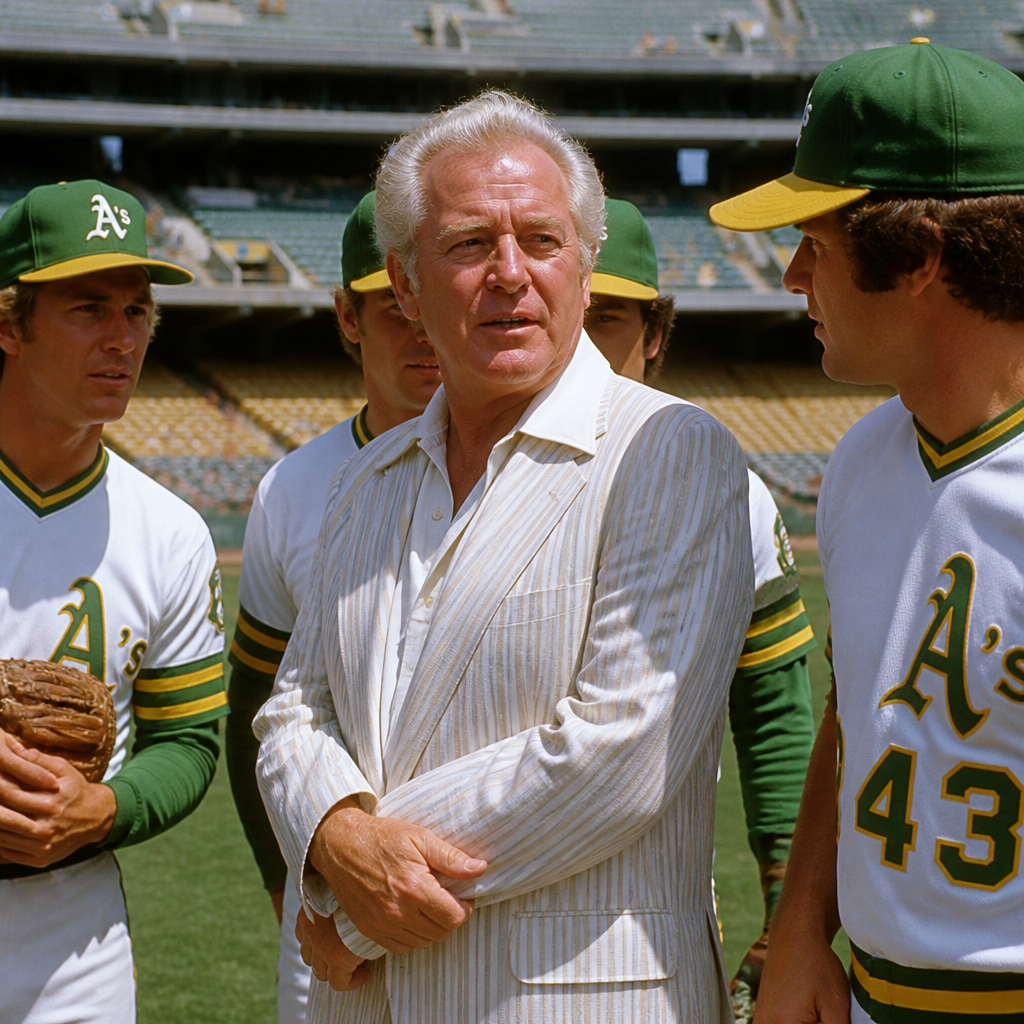
The 1971-1975 Oakland Athletics stand as one of baseball’s defining dynasties, a team that won three straight World Series while reshaping how owners, executives, and fans understood roster building, clubhouse management, and the business of winning. In baseball, a dynasty is not simply a champion that peaks for one October; it is a club that sustains elite performance across seasons, survives internal conflict, and repeatedly defeats the best teams of its era. The Athletics of this period did exactly that. From 1971 through 1975, they reached five consecutive American League Championship Series, won five straight division titles, and captured the World Series in 1972, 1973, and 1974. Those achievements place them alongside the Yankees of the late 1940s and 1950s, the Big Red Machine, and later modern powers whenever dynasties and great teams are discussed.
This team matters because its success was never neat or conventional. Owner Charlie Finley built contenders through aggressive scouting, opportunistic trades, and relentless cost control, then watched his own methods create both a powerhouse and a powder keg. He identified undervalued talent before that phrase became common front-office language. He invested in speed, defense, strike-throwing pitching, and roster versatility. He embraced showmanship with bright uniforms, mustaches, and promotional flair, turning the club into a national curiosity while it became a championship machine. At the same time, he fought with players, challenged managers, and treated payroll as a battleground. The result was a club that won despite constant friction, making Oakland a central case study in how baseball dynasties are assembled, tested, and eventually broken apart.
As a hub for dynasties and great teams, this article covers the Athletics from several angles: the roster Finley assembled, the strategic choices behind that roster, the postseason path from 1971 to 1975, and the legacy those teams left across baseball history. Key figures included Reggie Jackson, Catfish Hunter, Vida Blue, Rollie Fingers, Joe Rudi, Bert Campaneris, Sal Bando, Gene Tenace, and manager Dick Williams, later succeeded by Alvin Dark. Their run was not a fluke built on one superstar. It was a complete baseball ecosystem, and understanding it helps explain what every championship core needs: talent identification, enough pitching depth to survive October, players who can handle pressure, and an organizational plan that fits the competitive environment of its time.
Charlie Finley’s blueprint: talent, control, and calculated disruption
Charlie Finley did not build the Athletics the way polished corporate ownership groups often do now, but he built them with a clear baseball logic. After purchasing the franchise when it was still in Kansas City, he committed to accumulating young, controllable talent through scouting and player development. By the time the club settled in Oakland, that pipeline had produced the spine of a champion. Campaneris gave the lineup speed and infield range. Bando brought stability and on-base skill. Rudi developed into a complete left fielder. Jackson became the middle-order force every dynasty needs. On the mound, Blue, Hunter, Ken Holtzman, Blue Moon Odom, and later Fingers created unusual depth for the era.
Finley’s genius was paired with constant interference. In my experience studying successful clubs, ownership meddling usually weakens decision-making, yet Oakland became the rare counterexample for a time because Finley’s instincts about player value were often correct. He was willing to challenge convention on bullpen use, platoons, and roster churn. He also understood presentation. The white shoes, green and gold uniforms, and facial-hair culture made the A’s marketable long before baseball widely embraced personality as an asset. That mattered in Oakland, where the team needed attention in a region with multiple sports options. Still, the same owner who found talent also alienated it. His refusal to pay market value and his habit of public conflict planted the seeds of the dynasty’s breakup even while the championships were being won.
The roster architecture of a three-peat champion
The best way to understand the 1971-1975 Athletics is to see how balanced they were. They did not lead with only power, only pitching, or only speed. They checked nearly every championship box. Reggie Jackson was the headliner, but this was not a one-man team. Bando was a disciplined third baseman and quiet clubhouse anchor. Campaneris was one of the era’s best shortstops, pressuring defenses with contact and baserunning. Rudi and Tenace lengthened the lineup. Tenace, especially, represented hidden value; his plate discipline and power were more important than traditional batting average suggested, and his four-home-run World Series in 1972 changed the public understanding of his worth.
Pitching made the dynasty durable. Hunter offered command, efficiency, and postseason poise. Blue supplied overpowering stuff at his peak, winning the 1971 American League MVP and Cy Young Award after going 24-8 with a 1.82 ERA. Holtzman, acquired from the Cubs before the 1972 season, gave Oakland another top-level starter and threw no-hitters in both leagues during his career. Fingers anchored the bullpen with his mustache, sidearm delivery, and uncommon workload. In an era before modern closer usage, he routinely entered tough spots before the ninth inning, recorded multi-inning saves, and neutralized rallies when games were actually on the line.
| Core strength | Key Athletics examples | Why it mattered in October |
|---|---|---|
| Frontline pitching | Catfish Hunter, Vida Blue, Ken Holtzman | Short series reward teams with multiple high-end starters |
| Bullpen leverage | Rollie Fingers, Darold Knowles | Close postseason games often turn before the ninth inning |
| Two-way position value | Joe Rudi, Bert Campaneris, Sal Bando | Defense and situational hitting prevent single-point failure |
| Middle-order power | Reggie Jackson, Gene Tenace | One swing can decide low-scoring playoff games |
| Roster edge through depth | Blue Moon Odom, Bill North, Claudell Washington | Dynasties survive injuries, slumps, and matchup shifts |
This construction mirrors what many great teams share across eras. The 1927 Yankees had star concentration, the 1970s Reds had offensive depth, and the late-1990s Yankees had role clarity and bullpen structure. Oakland’s version combined all three principles in a grittier package. They were often compared to more glamorous clubs, but they kept winning because they could adapt. They could beat opponents 8-6 with home runs, or 3-2 behind pitching and defense. In dynasties and great teams, versatility is not a luxury. It is the trait that keeps a contender alive when one obvious path to victory disappears.
From contender to dynasty: the 1971 breakthrough and 1972 title
The 1971 season was the turning point because it proved the Athletics were no longer merely talented; they were ready to contend at the top of the league. Oakland won 101 games and the American League West, then lost the ALCS to the Baltimore Orioles, a more seasoned October team. That defeat exposed two truths. First, the A’s had enough talent to reach the sport’s highest tier. Second, talent alone would not carry them through postseason baseball, where defense, bullpen decisions, and emotional discipline are magnified.
They answered in 1972. Finley’s trade for Holtzman added vital rotation depth, and the club again won the division. The ALCS against Detroit was tense and physical, remembered for Jackson’s stolen-base injury in Game 5 and a near-fight involving Campaneris in the World Series. In the Fall Classic, Oakland beat the Cincinnati Reds in seven games. Tenace, not Jackson, became the surprise offensive hero, homering four times and winning Series MVP. That result is one reason the Athletics remain essential to any broad discussion of great teams. Championship clubs are rarely only about stars performing as expected; they are also about secondary pieces being strong enough to seize a series when attention shifts elsewhere.
The 1972 title also demonstrated managerial value. Dick Williams was demanding, sharp, and often at odds with Finley, but he understood urgency and accountability. His teams played hard, defended well, and handled matchup baseball better than many rivals. When people ask what separates a champion from a talented underachiever, I often point to clubs like these A’s. They had conflict, yes, but they also had standards. Williams did not need harmony to extract performance. He needed clarity, and for a while Oakland had it.
Winning through chaos: the 1973 and 1974 championships
If 1972 made Oakland a champion, 1973 and 1974 made it a dynasty. Repeating in baseball is exceptionally difficult because the sport’s long season exposes weaknesses and invites randomness in short playoff series. The Athletics repeated anyway, and they did so while dealing with injuries, clubhouse disputes, and escalating battles with Finley. In 1973 they won another division title, beat Baltimore in the ALCS, and faced the New York Mets in the World Series. Jackson was injured, which could have crippled many teams. Instead, Oakland relied on depth, pitching, and timely hitting. They won in seven games, with Fingers earning Series MVP after appearing in multiple high-pressure spots.
The 1974 season may be the clearest proof of the club’s resilience. Williams had resigned after the 1973 championship because his relationship with Finley had become untenable. Alvin Dark took over and guided another first-place finish. Oakland then defeated the Orioles again in the ALCS and beat the Los Angeles Dodgers in five games in the World Series. Hunter was brilliant, Jackson supplied power, and the club showed the calm of a team that understood exactly how October had to be played. The A’s did not need ideal circumstances. They needed meaningful outs from trusted players, and they got them.
What stands out in both championships is how often Oakland won close games by controlling leverage moments. Fingers and Knowles extinguished rallies. Campaneris and Bando converted difficult infield chances. Rudi made high-value defensive plays in left. Jackson, for all the attention on his personality, accepted the burden of being the feared bat. This is how great teams separate from very good ones. They stack enough competent decisions that pressure moves to the opponent.
Why the dynasty ended despite a 1975 division title
The Athletics remained excellent in 1975, winning 98 games and a fifth straight division title, but the dynasty effectively ended that October when they lost the ALCS to the Boston Red Sox. The reasons were structural, not mysterious. Hunter had left after the 1974 season when Finley’s mishandling of an annuity payment voided his contract, leading to one of the most important free agency cases in baseball history. Jackson and Finley were openly feuding. Blue’s relationship with management had been strained for years, including contract disputes and his 1972 holdout. The reserve clause era was weakening, salaries were rising, and Finley’s low-pay model was colliding with a changing labor market.
Dynasties usually end in one of three ways: age, injury, or economics. Oakland’s core still had enough ability to contend, so economics and organizational fracture mattered most. Finley had built a champion by squeezing value from a young roster, but once those players became expensive stars, he resisted the costs of keeping them together. By the later 1970s, Jackson, Hunter, Rudi, Fingers, and others were gone. The A’s became a lesson in championship windows before that term was popular. A front office can identify talent and still fail to sustain a dynasty if ownership will not convert baseball value into payroll commitment.
The lasting legacy of the 1971-1975 Oakland Athletics
The legacy of these Athletics reaches beyond their three straight titles. They proved that dynasties and great teams can come from outside the sport’s glamour markets if the roster is built with conviction and enough depth. They influenced how later clubs thought about relief pitching, postseason roster balance, and the hidden value of players whose contributions exceeded traditional headlines. They also foreshadowed modern baseball labor battles. Hunter’s exit and the eventual dismantling of the roster helped accelerate the end of owner control over star careers, changing team building across every franchise.
For baseball history, the simplest takeaway is this: Charlie Finley built a three-peat champion by combining elite scouting, bold transactions, unconventional branding, and a roster designed to win multiple styles of game. The same habits that created the dynasty also destabilized it, because talent recognition without talent retention has a hard ceiling. Even so, from 1971 through 1975 the Oakland Athletics were the standard for competitive toughness. If you are exploring famous baseball teams or comparing the greatest dynasties, this club belongs near the center of the conversation. Study how the A’s were assembled, how they won under pressure, and why they broke apart. Few teams explain the full life cycle of a baseball powerhouse more clearly.
Frequently Asked Questions
What made the 1971-1975 Oakland Athletics a true baseball dynasty rather than just a team with a short championship run?
The 1971-1975 Oakland Athletics qualify as a true dynasty because they combined sustained regular-season excellence with repeated postseason success at the highest level. This was not a club that caught lightning in a bottle for one October. Oakland won the American League West in five straight seasons from 1971 through 1975 and captured three consecutive World Series titles from 1972 through 1974, a feat that remains one of the most difficult accomplishments in modern baseball history. In an era before expanded playoffs created more paths to a title, teams had to survive a long season, finish first, then immediately defeat another elite club in the League Championship Series before even reaching the World Series. The Athletics did that over and over again.
What makes their run even more impressive is that it came despite constant internal friction. Owner Charlie Finley was brilliant, innovative, and deeply controlling, but he was also a source of instability. The clubhouse featured strong personalities, disputes over money, and frequent tension between players, management, and ownership. Most dynasties are remembered for continuity and harmony; the Oakland A’s won in spite of discord. That ability to absorb conflict and still perform is part of what elevates them from champion to dynasty.
They also had the roster substance that dynasties require. The Athletics were built around elite starting pitching, Gold Glove-level defense, speed, power, and a core of stars who could change games in multiple ways. Reggie Jackson provided middle-of-the-order thunder, Catfish Hunter anchored the rotation, Rollie Fingers stabilized the late innings, and players like Sal Bando, Joe Rudi, Bert Campaneris, Gene Tenace, and Vida Blue gave the team balance and toughness. When historians look at dynasties, they look for sustained superiority, star power, adaptability, and championship results. Oakland checked every box.
How did Charlie Finley build the Oakland Athletics into a three-peat World Series champion?
Charlie Finley built the Athletics through a mix of sharp talent evaluation, aggressive owner involvement, and a willingness to challenge baseball convention. He did not operate like a passive owner. Finley treated roster construction, branding, player acquisition, and clubhouse management as areas where he could directly shape outcomes. While that approach often created tension, it also helped produce one of the strongest rosters in baseball. He invested in scouting and player development, accumulated young talent, and understood that if a small-market or nontraditional franchise wanted to compete with richer clubs, it had to be smarter and bolder.
One of Finley’s great strengths was identifying and retaining a critical mass of impact players at the same time. The A’s had frontline pitching, defensive excellence up the middle, and enough offensive depth to survive slumps and injuries. The roster was not carried by one superstar; it was a layered, complete team. Finley’s front office environment, while unconventional, produced a pipeline of players who fit a winning model: athletic, versatile, confident, and capable of thriving under pressure. He also embraced colorful presentation, from the team’s uniforms to publicity tactics, helping create a distinct identity that made the Athletics visible and memorable.
At the same time, Finley’s role in building the dynasty is inseparable from his contradictions. He was ahead of his time in understanding baseball as both competition and business, but his battles with players over salaries and authority often threatened to undermine what he had created. In that sense, the Athletics became champions not just because Finley assembled talent, but because the talent level was so overwhelming that it could withstand his management style. His genius was real, but so was the chaos. The dynasty emerged from both forces at once: smart roster building and relentless internal pressure.
Who were the most important players on those championship Oakland Athletics teams?
The core of the 1971-1975 Athletics was remarkably deep, but several figures stand out as central to the dynasty. Reggie Jackson was the most famous star, and for good reason. He brought elite power, swagger, and game-changing presence to the lineup. Jackson was capable of altering a series with one swing, and he gave the Athletics a national profile that matched their on-field success. Sal Bando, meanwhile, was the steady captain-type presence of the infield, a highly reliable third baseman and middle-of-the-order contributor whose leadership was essential on a volatile team.
On the mound, Catfish Hunter and Vida Blue were foundational. Hunter offered durability, command, and big-game credibility, serving as the kind of ace every dynasty needs. Blue, one of the most electric pitchers of his era, gave Oakland overwhelming stuff and star-level dominance. Ken Holtzman was another major piece, often overshadowed nationally but hugely important to the team’s ability to win divisions and control postseason matchups. In the bullpen, Rollie Fingers became a defining weapon. His mustache became iconic, but his value was much deeper than image. Fingers delivered stability, toughness, and late-game excellence in an era when relief pitching was taking on greater strategic importance.
The position-player group beyond Jackson and Bando was equally critical. Joe Rudi was one of the best all-around outfielders in baseball, combining offense with exceptional defense. Bert Campaneris brought speed, range, and energy at shortstop, helping define Oakland’s athletic identity. Gene Tenace played a major role in the postseason, especially with his surprising power output in key moments, and catcher Ray Fosse contributed defensive intelligence and staff management. What made the Athletics special was that their stars were supported by players who fit together seamlessly. It was not just talent in isolation; it was talent in structure, with nearly every major role filled by someone capable of impacting winning at a championship level.
How did the Athletics manage to keep winning despite so much internal conflict and clubhouse tension?
This is one of the most fascinating parts of the Oakland Athletics story. On paper, the team’s personality clashes, labor disputes, and owner-player tensions should have fractured the dynasty long before it reached three straight championships. Instead, the Athletics turned conflict into a strange kind of competitive fuel. Many of the players did not need to like one another—or like Charlie Finley—to align around the goal of winning. In fact, the team often seemed to unite most clearly when challenged from the outside, especially by ownership pressure, media criticism, or the expectations that came with being defending champions.
The roster was also mature enough to compartmentalize. Veteran leaders and established stars understood the difference between personal disputes and professional standards. When the games started, the Athletics had enough pride, ability, and baseball intelligence to function at a championship level. Their pitching depth gave them consistency, their defense prevented slippage, and their lineup had enough timely power to win close postseason games. In practical terms, they were built on baseball fundamentals strong enough to survive emotional instability.
There is also a broader historical point here: not every great team is harmonious. The A’s challenge the romantic idea that dynasties must be unified families. Sometimes great teams are forged through intensity, ego, and confrontation, provided there is enough talent and enough shared purpose. The Athletics had both. Their internal friction was real, but so was their belief that they were tougher than everyone else. That edge mattered in October, when games became tighter, margins became thinner, and emotional resilience became as important as physical skill.
Why does the 1971-1975 Oakland Athletics dynasty still matter in baseball history today?
The Oakland Athletics of this era still matter because they changed how people think about team building, ownership influence, and the relationship between talent and culture. Their success showed that a franchise did not have to follow the traditional image of baseball respectability to dominate the sport. They were flashy, confrontational, unconventional, and undeniably effective. In that sense, they anticipated later eras in which innovation, branding, strong executive vision, and roster efficiency became central parts of winning.
The dynasty also sits at an important turning point in baseball’s business history. Charlie Finley was deeply involved in the economic side of the game, and the Athletics rose just as labor tensions and free agency were beginning to reshape the sport. That makes the team historically significant beyond its championships. It was a champion in the final phase of one baseball order and a preview of the next. The struggles over salaries, control, and player movement that surrounded Oakland were not side stories; they were part of a larger transformation happening across Major League Baseball.
Finally, the Athletics remain relevant because their three-peat is so rare. Repeating as champion is hard in any sport; winning three straight titles in baseball requires elite depth, durability, timing, and mental toughness over multiple years. The A’s did it while dealing with injuries, pressure, rival contenders, and constant internal noise. That combination of excellence and adversity makes them one of the most compelling champions in sports history. For fans, historians, and anyone interested in how dynasties are really built, the 1971-1975 Oakland Athletics are still a model, a warning, and a legend all at once.