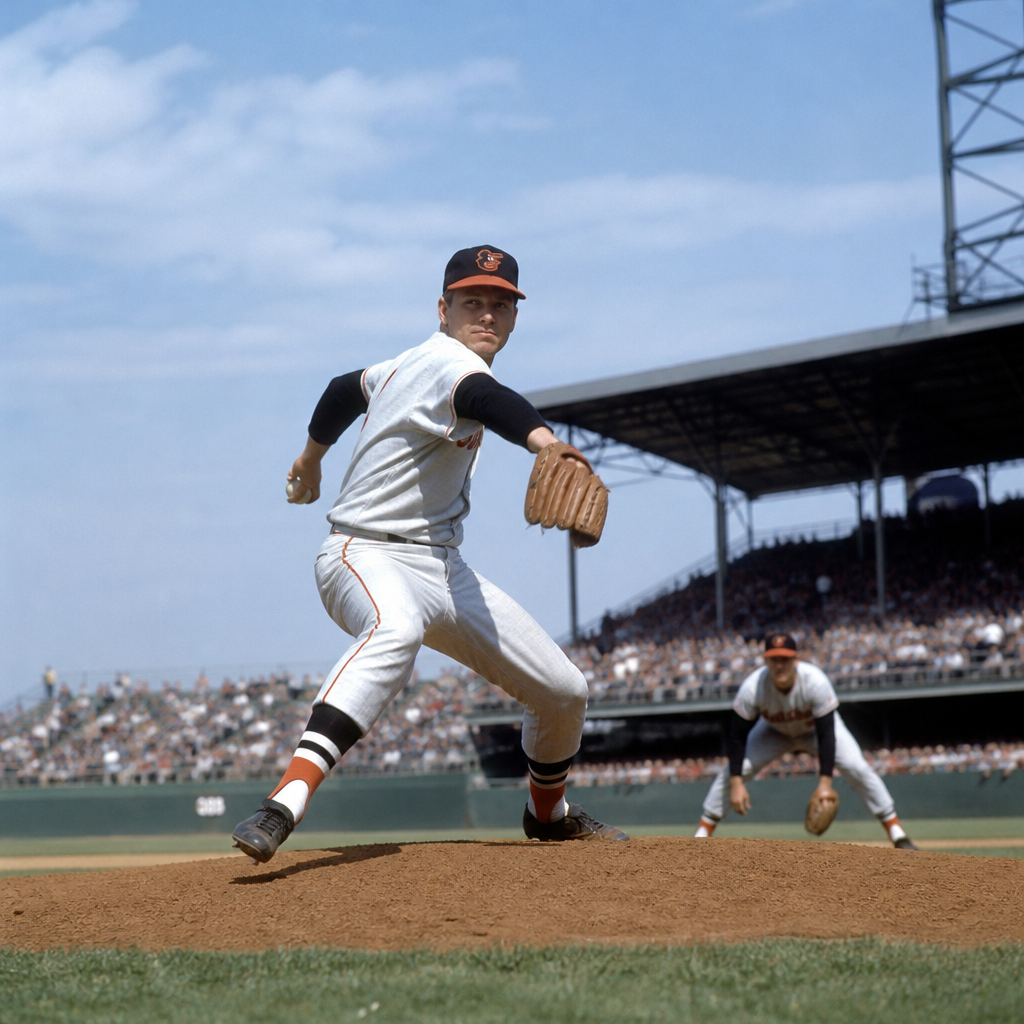
The 1966-1971 Baltimore Orioles represent one of baseball’s clearest examples of how an organization can turn a repeatable philosophy into sustained winning. During those six seasons, Baltimore won four American League pennants, captured two World Series titles, and established a standard for pitching, defense, player development, and tactical discipline that still shapes conversations about great teams. When people refer to the “Oriole Way,” they mean more than smart fundamentals. They mean a complete baseball operating system: scouting that valued baseball intelligence, instruction that emphasized footwork and situational awareness, and roster construction built around run prevention first.
This era matters because dynasties are often remembered through star power alone, yet the Orioles proved that durable excellence comes from alignment between front office, coaching staff, and players. The club had stars, certainly, from Frank Robinson and Brooks Robinson to Jim Palmer and Boog Powell. But the larger story is organizational coherence. Baltimore consistently converted batted balls into outs, limited free baserunners, and controlled game tempo. In plain terms, they made opponents string together multiple difficult events to score, which is the hardest way to win baseball games over a full season.
Between 1966 and 1971, the Orioles won at least 97 games four times, topped 100 wins twice, and produced one of the greatest single-season pitching displays ever in 1971, when four starters won 20 games. Those achievements did not happen by accident or luck. They came from a model that blended elite talent with standardization. On clubs I have studied in detail and used as teaching examples, few are easier to explain and harder to replicate. Baltimore’s process was simple to describe, demanding to execute, and devastating when fully synchronized.
As a hub for dynasties and great teams, this article uses the Orioles as a central case study in what separates a merely talented roster from a true baseball machine. The key terms are straightforward. A dynasty is a team that sustains championship-level performance across several seasons. Run prevention is the combined effect of pitching, defense, throwing, positioning, and game management. Development pipeline refers to the system that prepares players in the minors to fit major league demands quickly. The Orioles excelled in all three areas at once, which is why their peak deserves close study.
Why the 1966-1971 Orioles belong among baseball’s great dynasties
Baltimore’s claim starts with outcomes. The Orioles won the World Series in 1966 and 1970, won the American League pennant again in 1969 and 1971, and reached the postseason four times in six years in an era with no divisional series and no wild card. Finishing first then required dominating an entire league over 162 games. There was no safety net. If a great team had a bad week in September, its season ended. That context matters when comparing older dynasties to modern contenders.
The 1966 club announced itself with authority. Baltimore swept the Los Angeles Dodgers in the World Series, shutting out a lineup led by Willie Davis, Ron Fairly, and John Roseboro, while also silencing the aura of Sandy Koufax and Don Drysdale. The Orioles pitched three straight shutouts after dropping Game 1’s first inning run, then received Frank Robinson’s transformative middle-of-the-order force and Brooks Robinson’s elite infield support. The sweep was not a fluke upset. It was a statement that the franchise had reached full competitive maturity.
The 1969 team may have been even stronger over 162 games, winning 109 contests before losing a famous World Series upset to the Miracle Mets. Baltimore outscored opponents by 262 runs that year, an enormous margin. In modern analytical terms, that differential usually points to a champion-level true talent team. They were not exposed as fraudulent; they were beaten in a short series by a hot opponent featuring great pitching and strong defense of its own. Great teams can lose postseason coin flips. Dynasties are judged by the total arc, not one shock ending.
Then came the 1970 title and the 1971 pennant, which solidified the run. The 1970 Orioles beat the Reds in five games, and the 1971 club won 101 games before falling to Pittsburgh in a seven-game World Series. Across the six-year window, Baltimore paired volume with consistency. They did not rely on one transcendent season surrounded by mediocrity. They built an annual contender through institutional habits.
The Oriole Way: how organization-wide teaching created repeatable excellence
The phrase “Oriole Way” is sometimes used loosely, but in this period it referred to concrete instruction. In Baltimore’s system, players learned to hit the cutoff man, back up every throw, turn two with clean footwork, bunt when game state required it, and think one pitch ahead. This was not cosmetic discipline. It reduced extra bases, prevented innings from spiraling, and gave pitchers confidence to attack the strike zone. Earl Weaver became the era’s iconic manager, but the developmental roots stretched through the franchise’s teaching apparatus, influenced by instructors such as Cal Ripken Sr. and a farm system that prized detail.
One reason the model worked is that it translated cleanly from the minors to the majors. A young infielder arriving in Baltimore already understood relay responsibilities and positioning expectations. A pitcher knew that quick innings came from trusting the gloves behind him rather than nibbling. Today, organizations talk about alignment and shared language. The Orioles were doing that decades earlier. Everyone from scouts to coaches evaluated players through a common lens: can this player execute winning baseball under pressure?
Another strength was selectivity. The Orioles did not confuse athleticism with baseball utility. They sought players who could make efficient decisions, repeat mechanics, and handle responsibility. That is why their teams often looked calm. The game moved quickly for them because they had rehearsed the details. In my experience reviewing championship clubs, this is the hidden separator. Talent wins moments; preparation wins six months.
| Season | Wins | Result | Signature Strength |
|---|---|---|---|
| 1966 | 97 | World Series champion | Power, defense, shutdown pitching |
| 1969 | 109 | AL champion | Run differential, roster depth |
| 1970 | 108 | World Series champion | Balanced lineup and elite fielding |
| 1971 | 101 | AL champion | Four 20-game winners |
Pitching at the center: Palmer, McNally, Cuellar, Dobson, and the run prevention engine
The Orioles’ identity began with pitching that attacked hitters relentlessly. Jim Palmer supplied ace-level quality with a high leg kick, excellent command, and unusual composure. Mike Cuellar brought deception and movement from the left side. Dave McNally gave the staff another durable left-hander who could work deep into games. Pat Dobson completed the famous 1971 quartet of 20-game winners. Critics sometimes dismiss pitcher win totals, and rightly so in many contexts, but here the statistic reflects something real: Baltimore starters consistently worked into the late innings while receiving enough support from defense and lineup to convert quality starts into victories.
The staff’s effectiveness rested on strike throwing and contact management. These pitchers were not all overwhelming strikeout artists by modern standards. Instead, they changed speeds, located to both sides, and leveraged exceptional defense. In 1970, Palmer posted a 2.71 ERA; Cuellar and McNally both won 24 games; and the club allowed the fewest runs in the league. In 1971, the four 20-game winners became a defining baseball milestone precisely because it reflected both durability and organizational function.
There is also an important strategic point. Because the Orioles trusted their fielders, they avoided the walk that extends innings and raises pitch counts. The defense converted routine and difficult chances at a high rate, so the staff could challenge hitters early. This created shorter innings, preserved bullpen usage, and stabilized the team over the long schedule. Teams that preach efficiency today are chasing a similar effect, even if they describe it through different metrics such as WHIP, first-pitch strike rate, and innings per start.
Baltimore’s run prevention engine was therefore cumulative. Good pitchers became better because they operated in front of great defenders. Great defenders looked even better because pitchers induced playable contact. Catchers guided plans that fit both personnel and park conditions. Memorial Stadium rewarded clubs that understood angles, caroms, and positioning, and the Orioles understood their environment deeply.
Defense as a competitive weapon, led by Brooks Robinson and Mark Belanger
If one player symbolizes the peak Orioles more than any other, it may be Brooks Robinson. At third base, Robinson combined reaction time, anticipation, body control, and arm accuracy at a level that changed games. His performance in the 1970 World Series remains one of the clearest visual records of defensive dominance on baseball’s biggest stage. He did not merely make highlight plays. He erased hard-hit balls that most teams count as singles or doubles, which changed innings, pitch counts, and strategy.
Mark Belanger gave Baltimore similar value at shortstop. He was not a middle-order hitter, but his range, hands, internal clock, and positioning made him indispensable. The Orioles understood a truth that some teams ignored for years: a glove-first shortstop can be central to a championship roster if the rest of the lineup supplies enough offense. Belanger and Robinson formed an infield spine that narrowed opponents’ margins dramatically.
Defense extended beyond the left side. Paul Blair patrolled center field with elite reads and closing speed. Boog Powell was steady at first. The club’s relay work and outfield throwing were routinely crisp. This matters because strong team defense is not just about spectacular range. It is also about preventing the extra 90 feet. Baltimore made opponents earn every base.
Modern fielding metrics were not available then, but contemporary accounts, awards, and game footage align with the conclusion that Baltimore converted defense into real runs saved at an exceptional level. When evaluating great teams across eras, that matters as much as home run totals. A lineup can slump for a week. Clean defense travels every day.
Offense that fit the model: Frank Robinson, Boog Powell, and situational pressure
Calling these Orioles a defense-and-pitching dynasty should not obscure the offense. Frank Robinson’s arrival before the 1966 season changed the franchise immediately. He won the Triple Crown that year, leading the league in batting average, home runs, and runs batted in, while also bringing edge and accountability. Baltimore’s lineup did not need to lead the league in every category to be dangerous. It needed enough impact bats to capitalize once the pitchers and defense had suppressed scoring on the other side.
Boog Powell supplied left-handed power and won the 1970 American League Most Valuable Player Award. Don Buford set the table. Brooks Robinson contributed timely offense in addition to his glove. The lineup’s strength was sequencing and pressure. Baltimore could hit for power, move runners when needed, and exploit mistakes. Under Weaver, the club became associated with the three-run homer, but that phrase oversimplifies his strategy. Weaver valued outs as precious and preferred waiting for extra-base damage over giving away opportunities unnecessarily.
The offense also benefited from stability. Players knew their roles, and the team did not ask everyone to be everything. On great clubs, role clarity reduces noise. Table setters get on base, middle-order hitters drive the ball, and complementary bats extend innings. The Orioles were rarely chaotic at the plate. They played with a plan.
Leadership, roster construction, and what other great teams can learn
No dynasty functions without leadership that connects philosophy to daily standards. Harry Dalton’s front office decisions, Weaver’s tactical confidence, and veteran clubhouse examples formed that bridge. The Frank Robinson trade with Cincinnati remains one of baseball history’s most consequential acquisitions. It gave Baltimore an MVP-caliber star and sharpened the entire roster’s competitive seriousness. At the same time, the organization resisted the temptation to chase glamour over fit. It preferred players whose strengths reinforced the team’s run prevention core.
That lesson travels well across baseball history. The strongest great teams usually share three characteristics: a clear identity, depth that protects against injuries or slumps, and development systems that replace contributors without changing the style of play. The late-1960s and early-1970s Orioles check every box. They are therefore an ideal hub example for the wider study of dynasties and great teams, alongside clubs remembered for offense, innovation, or star concentration. Baltimore shows that championships can be built from precision as much as spectacle.
There were limitations. The Orioles did not win every World Series they reached, and some critics argue that one more title would have cemented even broader popular recognition. That is fair. Yet judging them by rings alone misses the point. Their sustained excellence in a one-pennant-per-league format is itself evidence of greatness. They were hard to outplay because they were hard to surprise, hard to rattle, and hard to exploit.
The 1966-1971 Baltimore Orioles stand at the peak of the Oriole Way because every layer of the enterprise pointed in the same direction. They developed intelligent players, trusted strike-throwing pitchers, defended with unusual precision, and generated enough offense from stars and role players to turn close games into routine wins. That combination produced four pennants, two championships, and one of the strongest six-year runs any baseball team has assembled.
For anyone exploring famous baseball teams and the broader question of what creates a dynasty, Baltimore offers a model that remains strikingly modern. Prevention mattered as much as production. Fit mattered as much as fame. Teaching mattered as much as talent. If you want to understand why some teams become eras instead of seasons, start with these Orioles, then follow the thread into other great clubs that built lasting advantage through identity, depth, and disciplined execution.
Frequently Asked Questions
What made the 1966-1971 Baltimore Orioles so dominant compared with other teams of the era?
The Orioles were dominant because they paired elite talent with a clearly defined, organization-wide baseball philosophy that was applied with unusual consistency. From 1966 through 1971, Baltimore did not rely on one superstar carrying the club for a brief peak. Instead, the team won through a repeatable formula: deep and durable pitching, airtight defense, intelligent situational play, and a player development system that prepared talent to contribute in exactly the way the club wanted. That combination is a major reason the Orioles won four American League pennants in six seasons and captured World Series championships in 1966 and 1970.
What separated Baltimore from many rivals was balance. The Orioles had front-line pitching with arms such as Jim Palmer, Dave McNally, Mike Cuellar, and Pat Dobson by the end of the period, but they also converted balls in play into outs at an elite rate because their defense was so fundamentally sound. Brooks Robinson became the most visible symbol of that standard at third base, but the entire club reflected the same principles: proper positioning, quick decision-making, clean execution, and an expectation that mistakes would be minimized. In an era before modern analytics were publicly discussed, Baltimore excelled at many of the things current front offices still value: run prevention, roster depth, adaptability, and consistency over 162 games.
The Orioles also played with a tactical discipline that gave them an edge over time. They threw to the right bases, cut off extra bases, worked counts intelligently, and generally avoided beating themselves. That may sound simple, but over six seasons it became a competitive weapon. Their success was not accidental or fleeting. It was the result of an organization that knew exactly how it wanted the game played and had the coaching, leadership, and talent pipeline to make that vision real year after year.
What exactly was the “Oriole Way,” and why has it remained so influential in baseball history?
The “Oriole Way” was the Orioles’ organizational blueprint for producing winning baseball, and it extended far beyond generic talk about hustle or fundamentals. At its core, it was a structured approach to player development and game execution. Young players throughout the system were taught the same methods, expectations, and baseball instincts, so when they reached the major leagues, they already understood how Baltimore wanted the game played. It was not just about having good players; it was about teaching players to fit into a larger, efficient system.
This philosophy emphasized crisp defense, intelligent baserunning, situational awareness, strong pitching habits, and relentless attention to detail. In practical terms, that meant outfielders hitting cutoff men properly, infielders understanding angles and clock management, pitchers fielding their position, and players making the fundamentally correct play even under pressure. The Orioles became known for reducing avoidable mistakes, and that discipline often made them look steadier and more prepared than opponents in big moments.
The reason the “Oriole Way” has remained influential is that it offered a model for sustainable success. It showed that great organizations do not simply assemble talent; they create systems that teach, reinforce, and multiply it. Baltimore’s methods influenced coaches, scouts, and executives across the sport, especially because the results were so visible during this six-year run. When historians and fans discuss the greatest baseball dynasties or mini-dynasties, the Orioles of this era are often cited not just for their championships, but for proving that an organizational identity can become a competitive advantage in itself.
How important were pitching and defense to the Orioles’ success during this period?
Pitching and defense were the foundation of everything Baltimore accomplished from 1966 to 1971. The team’s identity began with run prevention, and few clubs in baseball history have embodied that principle so completely over a multi-year span. The Orioles consistently featured starters who worked deep into games, attacked hitters, limited damage, and trusted the defense behind them. That trust mattered because Baltimore’s fielders regularly turned difficult plays into routine outs and routine plays into nearly automatic ones.
On the mound, the Orioles had remarkable stability. Jim Palmer emerged as one of the defining pitchers of his generation, while Dave McNally and Mike Cuellar gave the club outstanding left-handed quality and durability. By 1971, Pat Dobson helped make Baltimore famous for having four 20-game winners, a statistic that reflected both individual excellence and the overall strength of the team structure around them. These pitchers did not operate in isolation. They benefited from a defense that helped control innings, erased baserunners, and reduced the extra outs that can unravel even great staffs.
Defensively, Brooks Robinson became the era’s iconic figure, especially after his legendary performance in the 1970 World Series. But the Orioles’ run prevention machine was bigger than one player. The club emphasized positioning, anticipation, arm strength, communication, and execution at every spot on the field. Their outfield play, relay throws, and infield reliability fit seamlessly with the pitching staff’s approach. In many ways, Baltimore demonstrated a timeless truth: dominant pitching becomes even more powerful when paired with elite defense, and elite defense becomes even more valuable when a staff consistently keeps the ball in playable areas. The Orioles mastered that partnership better than almost anyone.
Who were the key players and leaders behind the Orioles’ 1966-1971 run?
Several stars drove the Orioles’ success, but the team’s greatness came from the way those players complemented each other. Brooks Robinson was perhaps the club’s most recognizable symbol. His defense at third base helped define the era, and his all-around excellence gave Baltimore a stabilizing force in both the lineup and the field. Frank Robinson, acquired before the 1966 season, transformed the club immediately with his power, intensity, and leadership. His MVP season in 1966 helped push Baltimore to a championship and changed the trajectory of the franchise.
On the pitching side, Jim Palmer became one of the central figures of the dynasty. His poise, command, and long-term excellence made him a cornerstone. Dave McNally and Mike Cuellar were equally vital in sustaining Baltimore’s rotation strength, and by the early 1970s Pat Dobson had added more high-end reliability. Behind the plate, Andy Etchebarren contributed to the club’s defensive identity and pitching management, while Boog Powell supplied major offensive production and a steady middle-of-the-order presence. Players such as Paul Blair also played critical roles, especially with elite defense in center field that strengthened the Orioles’ overall run-prevention system.
Leadership mattered just as much as talent. Manager Earl Weaver, who took over during this broader era of Orioles success, became one of baseball’s most influential strategic minds. Although he is often remembered for his sharp personality and preference for the three-run homer, Weaver also inherited and reinforced a deeply disciplined baseball culture. The front office and scouting apparatus deserve credit as well, because the Orioles’ success was built through smart acquisition, development, and instruction. This was a roster full of stars, but it was also an organization full of teachers, planners, and decision-makers who knew how to sustain excellence.
Why do the 1966-1971 Orioles still matter when discussing the greatest teams and baseball organizations ever?
The Orioles still matter because they represent one of the clearest examples of sustained excellence rooted in a coherent organizational identity. Many great teams win with overwhelming talent for a short burst. Baltimore did something more instructive and, in some ways, more impressive: it created a durable method of winning that held up over multiple seasons, against changing opponents, and under postseason pressure. Four pennants in six years is an extraordinary accomplishment on its own. Adding two World Series titles and a lasting baseball philosophy elevates the Orioles into a different historical category.
They also remain relevant because modern baseball still values many of the same principles they executed so well. Today’s teams may frame those ideas through analytics, player optimization, and process language, but the core goals are familiar: prevent runs, develop players consistently, create defensive value, and establish a system that can outlast any one roster cycle. The Orioles of this era showed that championship-level baseball is often built as much through preparation and structure as through highlight-reel moments.
Finally, the 1966-1971 Orioles endure because they passed the eye test and the historical test at the same time. They were not just efficient; they were memorable. Brooks Robinson’s defense, Frank Robinson’s power, the rotation’s durability, and the club’s overall polish gave this team a distinct identity that fans and historians still recognize instantly. When people talk about the best-run organizations or the purest examples of fundamentals at the highest level, these Orioles are always part of the conversation. Their legacy is not simply that they won. It is that they showed how winning could be taught, repeated, and institutionalized.