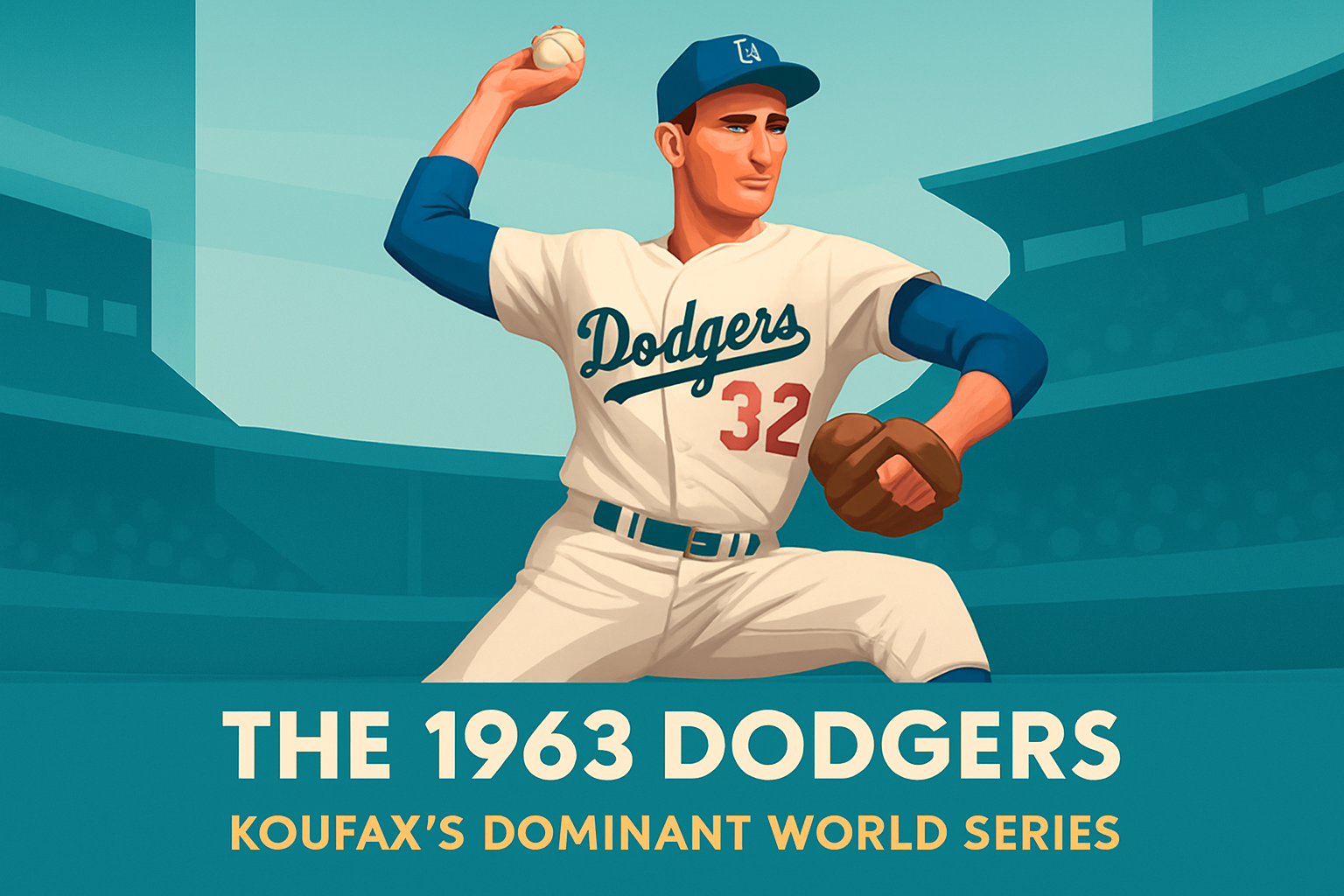
Introduction to the 1963 Los Angeles Dodgers
The 1963 Los Angeles Dodgers stand as a testament to remarkable sports prowess and teamwork, particularly exemplified during the World Series that year. At the heart of their success was a legendary figure, Sandy Koufax, whose unparalleled pitching secured his place in baseball history and enshrined that Dodgers team in the annals of sporting greatness.
In baseball, the World Series represents the pinnacle event where the champion of Major League Baseball (MLB) is decided. For the 1963 Dodgers, winning the World Series wasn’t just about victory; it was a demonstration of mastery and a showcase of one man’s extraordinary ability on the mound. Sandy Koufax not only left batters baffled and swinging at air but also inspired future generations of pitchers.
The importance of the 1963 Dodgers and Koufax’s achievements lies in their enduring legacy, influencing baseball strategies, players’ training, and fan culture. Understanding the strategies, skills, and teamwork that led to the 1963 Dodgers’ triumph provides valuable insights into discipline and resilience. As we delve deeper into how the Dodgers claimed their victory, we’ll explore the elements that made their World Series campaign so unforgettable.
The Path to the World Series
The 1963 Los Angeles Dodgers did not stumble upon their success by chance. The journey to the World Series was meticulously crafted through season-long dedication and strategy. Throughout the regular season, the Dodgers displayed a balanced blend of batting strength, defensive might, and pitching prowess, epitomized by their impressive roster.
The Dodgers clinched the National League pennant with a record of 99-63, finishing six games ahead of their closest competitors. Their season highlighted consistency, teamwork, and the strategic use of their top players. The contributions from prominent players such as Don Drysdale and Maury Wills were vital, yet it was Sandy Koufax’s exceptional performance that set them apart.
Koufax’s regular-season dominance set the stage for the World Series. He finished the year with a 25-5 record, an astounding 1.88 ERA, and a remarkable 306 strikeouts. His ability to control the game was evident, striking fear into opposing hitters and rallying his team towards a common goal.
World Series Game One: Setting the Tone
The 1963 World Series saw the Dodgers face off against the New York Yankees, themselves an iconic franchise with a history laden with championships. The series began at Yankee Stadium, and Sandy Koufax was chosen to start Game One. It was a decision that paid immediate dividends.
Koufax delivered a stunning performance, striking out 15 batters and setting a new record for strikeouts in a World Series game. His fastball was nearly unhittable, and his curveball left batters guessing. The Dodgers capitalized on Koufax’s dominance, winning the game 5-2. This victory laid the foundation for the series and showed the Yankees that the Dodgers were not mere challengers but formidable opponents.
In that game, key plays by Dodgers players further augmented Koufax’s brilliance. Home runs from veterans such as Tommy Davis and Frank Howard provided a cushion of support. Team synergy and Koufax’s dominance made Game One both a statement of intent and a harbinger of the Dodger’s eventual dominance in the series.
Game Two and Game Three: Keeping Up the Momentum
The Dodgers carried their energy and strategic game plan into Game Two. Once again playing on enemy turf, the Dodgers were led by pitcher Johnny Podres. His performance maintained the momentum created by Koufax, guiding the Dodgers to a 4-1 win and solidifying their grip on the series.
Back in Los Angeles for Game Three, the Dodgers showcased their depth in pitching. Don Drysdale took the mound, combining with the defensive might of the team to keep the Yankees at bay. Drysdale delivered a masterclass in pitching, leading the team to a 1-0 victory. The Dodgers’ ability to leverage different talents across the team became a hallmark of their World Series success.
Games Two and Three reinforced the narrative of the Dodgers as a cohesive unit, with Koufax setting the standard and others rising to match that excellence. The contributions from every player emphasized a collective effort that was fundamental in overcoming one of baseball’s most storied franchises.
| Game | Location | Dodgers Score | Yankees Score | Winning Pitcher |
|---|---|---|---|---|
| Game 1 | New York | 5 | 2 | Sandy Koufax |
| Game 2 | New York | 4 | 1 | Johnny Podres |
| Game 3 | Los Angeles | 1 | 0 | Don Drysdale |
| Game 4 | Los Angeles | 2 | 1 | Sandy Koufax |
Game Four: Completing the Sweep
With a commanding 3-0 series lead, the Dodgers aimed to complete the sweep in Game Four, again on home turf in Los Angeles. Returning to the mound was Sandy Koufax, the hero of Game One, who was set to demonstrate once more why he was considered one of baseball’s greatest pitchers.
Koufax did not disappoint. His performance was a paragon of resilience and skill, as he executed his pitches with precision, leading the Dodgers to a 2-1 victory. The Yankees struggled against his delivery, unable to mount a meaningful challenge. The Dodgers’ offense, with timely hits from teammates like Willie Davis, complemented Koufax’s effort to seal the win.
With this victory, the Dodgers claimed the 1963 World Series title. Koufax, delivering yet another stellar performance, was rightly named the Most Valuable Player of the series. His innings were akin to a calculated dance, where each move was meticulously executed to secure dominance over rival batters.
Legacy of the 1963 Dodgers and Koufax’s Influence
The triumph of the 1963 Dodgers and the singular influence of Sandy Koufax reverberate through baseball history. Koufax’s methodical approach and mental resilience became a teaching tool for pitchers who aspired to emulate his craft. The team’s approach to cohesiveness and strategic play offer lessons on teamwork that extend beyond sports.
Koufax’s legacy extends to establishing benchmarks for excellence in pitching. Coaches and players draw inspiration from his focus, where he maintained peak performance under immense pressure. This World Series solidified Koufax as a titan in baseball, concluding with an indelible impact on how the game is played.
The overall impact of the 1963 World Series goes beyond win-loss records. It highlights an era where individual brilliance met collective effort, making for one of the most spectacular displays of sportsmanship and skill. Upcoming generations of teams often refer back to the methods and strategies employed by the Dodgers during this series, seeking to capture that magic in their own quests for greatness.
Conclusion: Reflecting on the Dodgers’ Achievement
The 1963 Dodgers, underlined by Sandy Koufax’s unmatched World Series performance, represent a zenith of baseball excellence. Their journey through the season, cohesive team efforts, and stunning victory in sweeping the Yankees in the World Series stand as a monumental achievement in sports history.
The lessons from that year extend far beyond baseball diamonds, affecting how we view teamwork, perseverance, and strategic excellence. The Dodgers’ triumph teaches us about harnessing individual talents for collective success, a philosophy applicable in countless endeavors.
As fans, players, or appreciators of sports, the story of the 1963 Dodgers invites us to reflect on what can be achieved through initial ambition transformed into discipline and craft perfected under pressure. It’s an invitation to admire, emulate, and ultimately craft our destiny in our own fields.
For readers inspired by this iconic moment in sports history, consider diving deeper into the teachings and strategies that led to the Dodgers’ memorable victory. Analyze the games, study the players, and draw lessons that are applicable in any context where excellence is the goal. The story of the 1963 Dodgers is a timeless reminder that history is made not just by winning but by how the game was played.
Frequently Asked Questions
1. What made the 1963 Los Angeles Dodgers such a remarkable team?
The 1963 Los Angeles Dodgers were a standout team due to their exceptional blend of talent, teamwork, and strategic play. They were particularly noteworthy because of their extraordinary pitching rotation, especially the presence of Sandy Koufax, who delivered arguably one of the most dominating performances in World Series history. The team’s dedication and cohesive spirit enabled them to excel throughout the season, culminating in a lopsided World Series victory over the New York Yankees. This Dodgers squad managed not only to overpower their opponents with their pitching but also complemented it with solid defense and timely hitting, creating a well-rounded and formidable baseball club.
2. Why is Sandy Koufax’s performance in the 1963 World Series so legendary?
Koufax’s 1963 World Series performance is often hailed as one of the most impressive by a pitcher in the annals of baseball. During the series, he started in Games 1 and 4, both of which the Dodgers won, enabling them to sweep the Yankees in four games. In Game 1, Koufax struck out an incredible 15 Yankees, setting a new World Series record at that time for a single game. By the end of the series, he had racked up 23 strikeouts over 18 innings, showcasing his dominant command and control. His almost unhittable fastball and devastating curveball kept a powerful Yankees lineup largely at bay, underscoring his reputation as one of the greatest pitchers in the game’s history. These performances, under immense pressure, helped solidify his legacy and played a key role in the Dodgers’ title-winning campaign.
3. How did the Dodgers’ performance in the 1963 World Series impact their legacy?
The Dodgers’ crushing victory over the New York Yankees in the 1963 World Series had a significant impact on their legacy. It not only highlighted their baseball supremacy during that era but also marked the first time they had swept the Yankees in a World Series, which in itself was historic given New York’s dominant reputation. This victory paved the way for the Dodgers to establish themselves as a dominant force in baseball in the 1960s. It also enhanced the team’s reputation for excellent pitching and solidified the status of their stars, particularly Sandy Koufax, who became a national icon. Moreover, the 1963 triumph set a standard for subsequent Dodgers teams with its demonstration of teamwork and skill, contributing to the long-standing prestige and popularity of the franchise.
4. What was the strategic approach of the Dodgers during the 1963 World Series?
The 1963 Dodgers approached the World Series with a strategy rooted in leveraging their formidable pitching staff, led by Sandy Koufax, Don Drysdale, and Johnny Podres. Their game plan focused intensely on out-pitching the opposition while capitalizing on timely hitting to score necessary runs. Manager Walter Alston expertly navigated his rotation to maximize their effectiveness, especially Koufax, whose performance was central to the strategy. The team prioritized strong defensive play to complement their pitchers, minimizing the opponents’ scoring opportunities. Offensively, while they did not boast the most powerful lineup, the Dodgers were effective in manufacturing runs through situational hitting and intelligent base running, which kept pressure on the Yankees’ defense and pitching staff. This comprehensive approach allowed them to gain a decisive edge in the series, leading to their sweeping victory.
5. What were some challenges the Dodgers faced during the 1963 season, and how did they overcome them?
The Dodgers faced several challenges during the 1963 baseball season that required resilience and adaptability. Maintaining consistent performance over a grueling regular season posed a significant test, as they had to preserve the health and effectiveness of their pitching aces, such as Sandy Koufax, who often dealt with injuries. Despite these challenges, Koufax displayed tenacity and perseverance, pitching through pain to deliver critical performances. Furthermore, there were periods during the regular season where offensive production struggled, necessitating adjustments in strategy to manufacture runs more effectively. Manager Walter Alston played a pivotal role in steering the team through rough patches, utilizing the depth of his roster and adeptly managing the rotation and bullpen to mitigate fatigue. The Dodgers’ ability to rally together, making strategic adjustments and relying on their pitching depth, defined their season and set the stage for their World Series triumph against the Yankees.