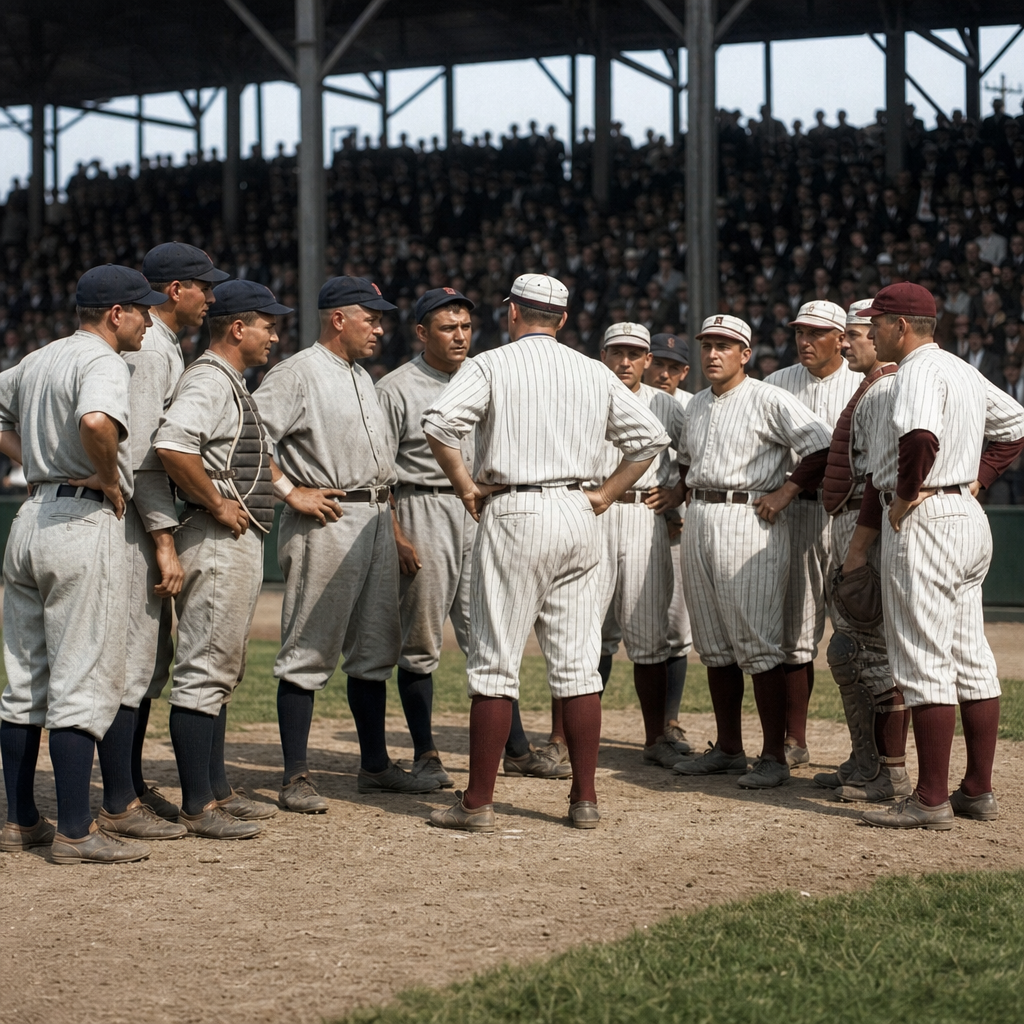
The 1914 Federal League War was baseball’s first sustained challenge to the National and American Leagues, and it reshaped the business of the sport long before the Black Sox scandal or later labor fights captured public attention. In practical terms, the conflict began when the upstart Federal League, founded as a minor circuit in 1913, declared itself a major league for 1914 and openly battled organized baseball for players, markets, press attention, and legal legitimacy. The word “war” was not rhetorical. Owners raided rosters, salaries doubled for some stars, injunctions flew through the courts, and fans in several cities suddenly had three clubs competing for loyalty. I have spent years working through newspaper files, club records, and legal summaries from this period, and the central lesson is clear: the Federal League exposed the fragility of the sport’s power structure at the very moment baseball liked to present itself as stable, orderly, and permanent.
To understand why this episode matters, it helps to define the key terms. “Organized baseball” meant the tightly coordinated system led by the National League and American League, bound together through the National Agreement and supported by the reserve clause, which tied players to clubs even after contracts expired. A “major league” in 1914 was not simply a matter of skill; it was also a claim to equal standing, independent scheduling, first-rate ballparks, and national recognition. The Federal League challenged all of that at once. It placed clubs in Chicago, St. Louis, Baltimore, Brooklyn, Pittsburgh, Buffalo, Indianapolis, and Kansas City, then marketed itself as a freer alternative for players and a fresh option for fans tired of entrenched owners.
This story sits naturally within a broader scandals and controversies framework because the dispute revealed the coercive labor practices, backroom negotiations, territorial protection, and courtroom maneuvering that underpinned early professional baseball. While the Federal League did not produce a gambling conspiracy, it raised a different kind of ethical question: who controlled the game, and by what right? That question echoed through every salary bid, every contract jump, and every antitrust filing. As a hub for miscellaneous baseball controversies, the Federal League War is especially useful because it links to later debates over player mobility, league monopolies, franchise relocation, and the Supreme Court’s unusual treatment of baseball under antitrust law. Its importance lies not only in who won or lost, but in what the fight revealed.
How the Federal League became a real threat
The Federal League was initially easy for established owners to dismiss. In 1913 it operated as a minor league, and many observers assumed it would remain a regional curiosity. That changed when league backers, including oil, manufacturing, and local business interests, committed serious capital and announced major league ambitions for 1914. Their strategy was straightforward: place clubs in important population centers, build or improve parks, and sign recognizable talent quickly enough to create credibility before organized baseball could respond. This was not fantasy. In Chicago, the league placed the Chi-Feds in a city already split between the Cubs and White Sox. In St. Louis, the Terriers targeted one of baseball’s strongest markets. In Baltimore and Brooklyn, the new league challenged eastern territory directly.
The Federal League became dangerous because it attacked the reserve system at its weakest point: player dissatisfaction. Ballplayers had long resented contractual control, salary cuts, and the limited ability to choose employers. Federal League executives offered multi-year deals, signing bonuses, and, just as important, respect. Joe Tinker, already famous as part of the Cubs’ Tinker-to-Evers-to-Chance combination, jumped to manage and play for Chicago. Mordecai Brown signed. So did Three Finger Brown’s contemporaries, veterans such as Chief Bender, and later stars including Benny Kauff, who became one of the league’s biggest attractions. Some men were established major leaguers, others were near-major talent blocked by roster politics, but together they gave the circuit instant legitimacy in the eyes of paying customers.
Owners in the two established leagues recognized the danger immediately because this was not merely player poaching. The Federal League forced bidding competition in a labor market previously controlled by the reserve clause. Salaries rose as clubs fought to retain talent. Contracts once presented on take-it-or-leave-it terms suddenly became negotiable. In my review of period coverage, the sharpest fear expressed by established executives was not that the Federal League would field better teams, but that it would permanently break their control over payroll and roster rights. For a business built on restrained labor costs, that possibility was existential.
Players, salaries, and the reserve clause
The clearest way to understand the Federal League War is to look at what it did for players. Before 1914, organized baseball relied on the reserve clause to bind players to clubs indefinitely through renewals and blacklist pressure. A player could hold out, retire, or accept an assignment, but genuine free negotiation barely existed. The Federal League did not abolish all owner control, yet it created a temporary open market. That shift had immediate financial effects and long-term symbolic power.
Many players used the new league for leverage even if they never joined it. Others jumped outright and forced court tests over contract enforcement. The organized leagues sought injunctions, arguing that signed players could not legally perform elsewhere. Results were mixed, and the uncertainty itself favored the challengers. If a court refused swift enforcement, the player could suit up for the Federal League and generate gate receipts while litigation dragged on. Even when organized baseball eventually prevailed in a specific case, the practical damage had often already been done.
| Issue | Established Leagues | Federal League | Why It Mattered |
|---|---|---|---|
| Player contracts | Reserve clause renewals and club control | New deals with freer negotiation | Players gained leverage and cash |
| Salary levels | Compressed by limited competition | Often raised by bidding wars | Labor costs increased across baseball |
| Roster access | Veterans and blocked prospects constrained | More openings and rapid promotion | Expanded employment opportunities |
| Legal posture | Used injunctions and contract claims | Challenged enforceability and monopoly power | Turned labor disputes into public controversy |
A famous example of the reserve-clause fight involved Hal Chase and other players whose movements and contract status became public dramas. Not every jump succeeded cleanly, and not every Federal League contract was honored without dispute. The league also signed players past their peak, which critics used against it. Yet that criticism misses the larger point. By paying market rates to any recognizable talent it could secure, the league proved that the old labor order survived less because it was fair than because it faced no real competition. Once competition appeared, the price of baseball labor changed overnight.
This mattered beyond 1914 and 1915. Later fights involving the Players’ Fraternity, the postwar labor climate, and eventual free agency all rested on the same underlying question: could a club reserve a player’s services indefinitely without a true competitive market? The Federal League did not solve that problem, but it exposed it unmistakably.
City battles, attendance, and public perception
The Federal League also challenged organized baseball city by city, which is why the war felt so immediate to fans. In Chicago, the Chi-Feds competed in a market already saturated with major league identities, yet they drew enough support to be taken seriously and later became the Whales. In St. Louis, the Terriers exploited dissatisfaction with the Browns and benefited from a strong baseball culture. In Baltimore, the league found one of its most loyal followings, showing that cities excluded from the American and National League power structure could sustain major league ambitions. That Baltimore base became central later when peace negotiations left local supporters feeling betrayed.
Attendance figures varied by city, and the Federal League was not a universal success at the gate. Still, the mere fact that it survived two seasons while fielding competitive rosters was a rebuke to established claims that only the existing duopoly could support top-level baseball. Ballpark construction underscored that point. The league did not simply rent temporary fields everywhere; in several cities it invested in serious facilities. Weeghman Park in Chicago, built for the Federal League club, outlived the league itself and eventually became Wrigley Field after the Cubs moved in. Few physical reminders of baseball controversy are as enduring as that.
Public perception was complicated. Some newspapers treated the Federal League as a reckless outlaw operation. Others welcomed it as overdue competition against arrogant magnates. Fans tended to be practical. If the baseball was good, the stars recognizable, and the tickets affordable, they attended. The war therefore became a referendum on the sport’s business model. Owners wanted loyalty to institutions; many customers simply wanted better value and a fair shot for their city. That gap between official rhetoric and consumer behavior is a recurring feature of baseball controversies, from franchise moves to blackout rules and stadium financing fights.
The courtroom fight and the antitrust legacy
Although the fiercest phase of the Federal League War occurred in 1914 and 1915, its most famous legal consequence emerged after the league collapsed. Peace terms in late 1915 absorbed some owners and compensated others, but not everyone accepted settlement. The Baltimore club, feeling frozen out while rivals in Chicago and St. Louis received better treatment, pursued legal action against organized baseball. That dispute eventually became Federal Baseball Club of Baltimore v. National League, decided by the Supreme Court in 1922.
Justice Oliver Wendell Holmes Jr. wrote that professional baseball exhibitions were not interstate commerce in the relevant antitrust sense, even though teams traveled across state lines. The ruling created baseball’s anomalous antitrust exemption, one of the strangest and most criticized doctrines in American sports law. Later cases, including Toolson v. New York Yankees in 1953 and Flood v. Kuhn in 1972, left that exemption largely intact while openly acknowledging its inconsistency. In other words, the legal aftershock of the Federal League War lasted far longer than the league itself.
The importance of this legal history cannot be overstated. Without the Federal League’s collapse and Baltimore’s lawsuit, baseball might not have received the judicial protection that later reinforced owner control. That exemption affected franchise location, minor league relations, labor leverage, and the overall structure of the game for decades. It is one reason the Federal League belongs in any serious discussion of baseball controversies. The conflict was not merely a failed business venture. It helped generate a legal shield that shaped the economics of the sport until modern collective bargaining and congressional scrutiny changed the landscape.
Why the league failed and what survived
The Federal League failed for a mix of reasons: uneven capitalization, expensive salary competition, weak positions in some crowded markets, and the difficulty of sustaining a three-league battle without unified patience among owners. Not all backers had the same tolerance for losses. Some wanted quick peace, others wanted total recognition, and that split mattered. Organized baseball, despite internal rivalries, had deeper institutional roots, stronger press relationships, and greater confidence that time favored incumbents. Once settlement talks advanced after the 1915 season, the Federal League’s collective front broke.
Yet it would be wrong to call the venture meaningless. Several of its ideas and effects survived. It normalized the notion that players could defect for better terms. It showed that major league baseball markets were broader than the existing map suggested. It left behind ballparks, executives, and legal precedents. Most importantly, it exposed the contradiction at the heart of early baseball governance: the sport celebrated open competition on the field while restricting it off the field. Every later controversy involving owners, players, territories, or courts repeated some version of that contradiction.
As a miscellaneous hub topic, the 1914 Federal League War connects naturally to articles on the reserve clause, antitrust exemption, franchise geography, player rights, and owner collusion. It also serves as a reminder that baseball’s most consequential controversies are not always the ones with the most dramatic headlines. Sometimes the defining scandal is structural. The Federal League challenged who could own opportunity in baseball, and the answer, at least for a generation, favored the established powers. If you are exploring the sport’s hidden fault lines, this is the place to keep digging.
Frequently Asked Questions
What was the Federal League, and why did its 1914 challenge matter so much?
The Federal League began in 1913 as a minor league, but its leaders quickly decided that simply existing on the margins of organized baseball would not be enough. For 1914, they declared themselves a major league and moved directly against the established National and American Leagues. That decision mattered because it created the first serious, sustained challenge to the two-league system that had come to dominate professional baseball. Instead of accepting the existing hierarchy, the Federal League tried to compete head-to-head for star players, prime cities, gate revenue, media attention, and public legitimacy.
What made the challenge especially important was that it exposed the fragile business foundations of early twentieth-century baseball. The National and American Leagues looked stable from the outside, but the Federal League proved that players could be lured away with better salaries, that fans in major markets might support a rival club, and that the sport’s power structure was not as secure as owners claimed. The conflict also forced baseball executives to think in modern business terms: franchise placement, contract enforcement, antitrust exposure, and the cost of internal competition. In that sense, the Federal League did more than create a temporary disturbance. It revealed that organized baseball was a contested industry, not an untouchable institution.
Why was the conflict called a “war” between the Federal League and organized baseball?
The term “war” was not just journalistic exaggeration. The struggle truly operated like a business war, with both sides fighting on multiple fronts at once. The Federal League raided player rosters by offering higher salaries and more favorable contract terms. The established leagues retaliated by defending reserve-clause claims, pressuring players, and trying to deny the newcomer access to the credibility that came with recognized major league status. Owners competed for stadium sites, franchise markets, and favorable newspaper coverage, all while attempting to shape public opinion about which league represented “real” major league baseball.
The conflict also extended into the legal and political arena. The Federal League challenged the authority of organized baseball and questioned the fairness of its labor system. Established owners, meanwhile, used their influence and existing networks to isolate the newcomer wherever possible. This was not a brief skirmish over a few contracts; it was a sustained campaign over who would control the sport’s future. Calling it a war captures the scale of the confrontation, the money involved, and the fact that both sides understood the stakes as existential. If the Federal League succeeded, the entire structure of professional baseball might have been permanently altered.
How did the Federal League compete for players, and what did that reveal about baseball labor conditions in 1914?
The Federal League’s most direct weapon was money. It offered players higher salaries, signing bonuses, and in some cases the chance to escape the restrictive power that existing clubs held through baseball’s reserve system. Under that system, players had very little freedom to move on their own terms. Once a club held contractual rights to a player, his bargaining leverage was sharply limited. The Federal League recognized that dissatisfaction and used it as an opening. By presenting itself as a true major league rather than a minor alternative, it gave players a plausible reason to jump to a rival circuit.
This competition exposed just how constrained players were under organized baseball. Many athletes were not simply choosing between equal employers; they were deciding whether to challenge an entrenched system that expected loyalty while limiting mobility. The Federal League did not create player unrest, but it made that unrest visible. Players suddenly had leverage, however briefly, because a rival employer existed. Salaries rose, established owners were forced to negotiate more aggressively, and the old assumption that players had no meaningful alternatives came under pressure.
Even though the Federal League itself was short-lived, its challenge highlighted a central truth about baseball labor: whenever players have competing buyers for their talent, their position improves. That lesson would echo far beyond 1914. Later labor disputes and free-agency battles are often treated as modern developments, but the Federal League war showed very early that control over player movement and compensation was one of the sport’s deepest fault lines.
Did the Federal League actually succeed, or was it ultimately a failure?
The most accurate answer is that it failed in a narrow institutional sense but succeeded in a broader historical one. As a league, the Federal League did not survive. It could not sustain the financial pressure of competing with the two established majors, and the conflict ended with settlements that largely preserved the National and American Leagues as the dominant powers in professional baseball. By that measure, the upstart league lost the war for long-term control of the sport.
But judging it only by survival misses its real impact. The Federal League forced organized baseball to spend heavily, defend itself publicly, and confront legal vulnerabilities. It disrupted the player market, challenged the reserve-clause order, and demonstrated that the sport’s business structure could be attacked from outside. Some owners received compensation or were absorbed into other arrangements, and the established leagues emerged more aware of the need to protect territory, coordinate strategy, and reduce the chance of future insurgencies.
In historical terms, the Federal League succeeded because it changed the conversation about who held power in baseball. It revealed that league status was not merely a natural ranking but something asserted through capital, influence, and legal maneuvering. It also laid groundwork for future legal battles, including the famous antitrust questions that would follow. So while the Federal League disappeared, the issues it raised did not. Its legacy lived on in the business and labor debates that continued to define baseball for decades.
How did the 1914 Federal League War reshape baseball’s future?
The 1914 conflict reshaped baseball by showing that the sport’s biggest battles were not only played on the field. It pushed owners, players, and observers to recognize baseball as a modern business with vulnerable structures and competing interests. The established leagues had to respond to the possibility that rival organizations could challenge their monopoly over talent and markets. That realization strengthened their determination to act collectively, defend contracts more aggressively, and protect franchise geography with greater discipline.
The war also helped establish a pattern that would repeat throughout baseball history: labor tension becomes most visible when players have an alternative source of leverage. The Federal League’s assault on the reserve system did not destroy that system, but it exposed its dependence on the absence of competition. That is a crucial insight for understanding later episodes in baseball history, from legal challenges to owner-player confrontations in the free-agency era. Long before those later disputes became famous, the Federal League had already demonstrated the basic economics of baseball labor power.
Just as importantly, the conflict enlarged the historical timeline of baseball controversy. Many casual accounts jump from the early growth of the major leagues to the Black Sox scandal or later union fights, but the Federal League war belongs near the center of that story. It was baseball’s first major challenge in a sustained, organized sense, and it forced the sport to define what counted as a major league, who controlled opportunity, and how far established power could go to defend itself. In that way, the Federal League war was not a side note. It was an early turning point in the struggle over baseball’s identity, governance, and business future.