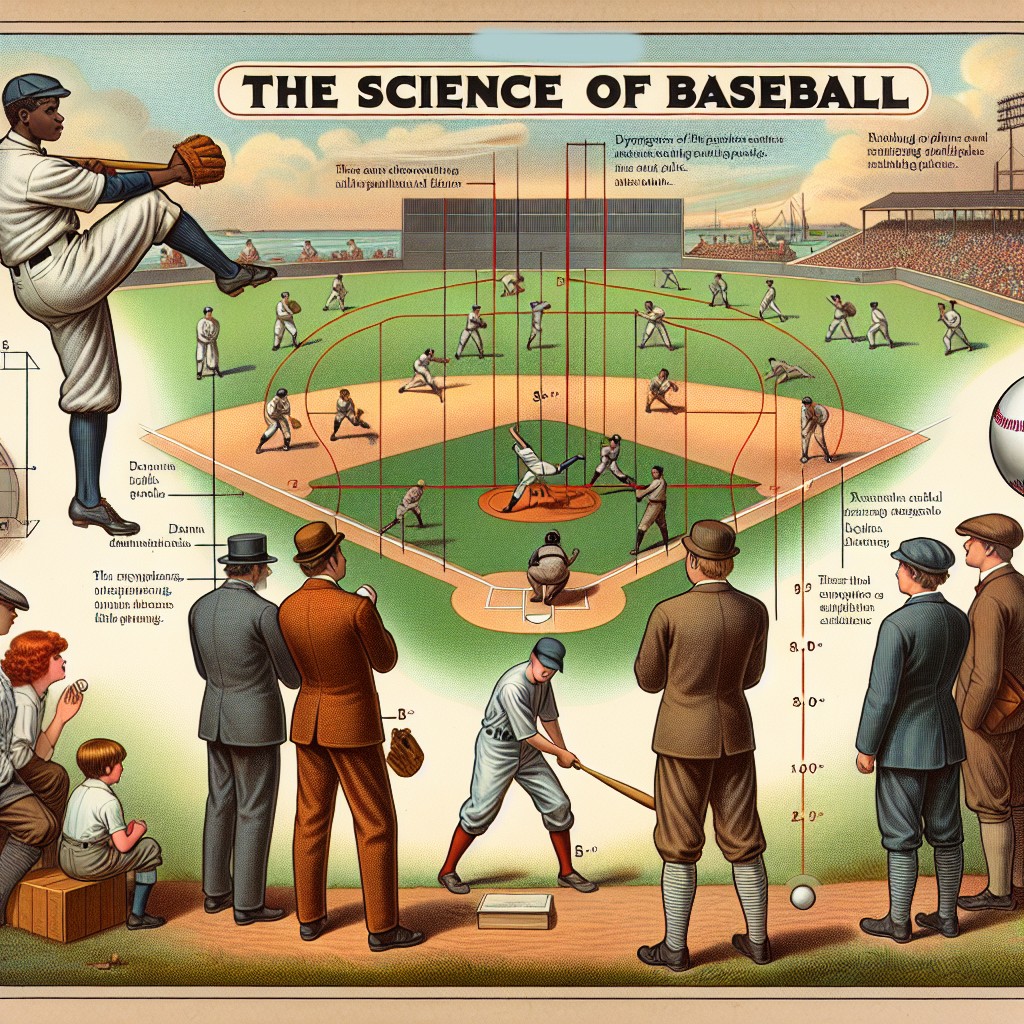
The captivating world of baseball, commonly dubbed America’s favorite pastime, has a rich history that’s as complex as it is fascinating. At its core, the game melds athletic prowess with strategic thinking, a binding duo that demands an appreciation for the science behind its every move. From the origins of the sport in the mid-19th century to the foundational pillars established through early understandings, baseball stands as a testament to human ingenuity and passion.
The sport itself is embedded in a unique matrix of tradition and evolution. Although modern baseball appears as a well-oiled machine, it was not always as it is today. A deeper dive into its early days uncovers a timeline dotted with ingenuity, scientific inquiry, and relentless refinement. How did early pioneers break down the complexities of the sport? What methods or tools did they employ to refine the sport into the phenomenon it is today? Each turn in this narrative brings us closer to understanding how early comprehension of baseball has come to shape the game we intently watch today.
A Game Takes Shape: Early Rules and Regulations
For any sport to gain recognition and organized status, it requires a set of standardized rules and regulations. The genesis of baseball’s early rules can be traced back to the mid-1800s. Prior to this period, variants of baseball such as rounders and cricket were popular. However, it wasn’t until Alexander Cartwright formulated the Knickerbocker Rules in 1845 that baseball began to separate itself from its sporting cousins. These rules marked the sport’s definitive departure from its more rudimentary predecessors and steered it toward a formal structure.
These early regulations covered essential elements such as the diamond-shaped infield, the three-out innings, and the concept of foul territory. What’s striking about these foundational principles is their lasting impact. Despite various modifications over the ensuing centuries, the constitutive elements remain largely unaltered. The standardization of these rules not only helped to shape the game within the context of the sport itself but also attracted a wide audience that appreciated the balance of structure and spontaneity.
These early regulations laid the groundwork for aspects like strategic batting and base-running, positioning the game as a sport requiring keen intellect alongside physical skill. By formalizing the rules, pioneers like Cartwright birthed a new way of understanding baseball—one that harmonized athleticism with mental acuity.
The Birth of Statistics: Quantifying Performance
Without the rich data sets and complex algorithms we boast of today, early baseball enthusiasts and administrators still sought methods to quantify and understand player performance. This led to the inception of baseball statistics, a practice that would forever change the landscape of the sport. Statistician Henry Chadwick is often credited with pioneering the use of stats to evaluate and compare players. His introduction of batting averages, earned run averages, and box scores provided an empirical basis for assessing player contributions and strategy effectiveness.
The practice of recording these statistics during games became routine in the 19th century, offering deeper insights into elements such as team composition and player trends. Consequently, this quantification enabled teams to craft informed strategies tailored to specific strengths and weaknesses, offering a new dimension to how the game was played and managed. The early adoption of statistics wasn’t just about tracking wins and losses; it was about creating a more profound understanding of both individual and team efficiency.
Henry Chadwick’s innovations set the stage for the explosion of sabermetrics we see today. Rooted in passionate inquiry and a desire for empirical understanding, these early forms of statistical analysis established a new lens through which the game could be understood, critiqued, and ultimately enjoyed.
Equipment Evolution: The Science Behind the Gear
One often overlooked yet vital aspect of early baseball is the evolution of its equipment. The makeshift gear that saw the game through its nascent stages has undergone monumental transformations, each driven by the quest for enhanced performance and safety. Initially, baseballs were handmade, varying in size, stitching patterns, and materials, which created inconsistencies in gameplay.
The exhaustive process of standardizing equipment can be traced back to early manufacturers like H.P. Harwood & Sons, who began producing baseballs in bulk with consistent specifications. Similarly, the introduction of more uniform and sturdy bats played a crucial role in enhancing the game’s fairness and quality. These early advancements were not mere refinements but significant steps toward making baseball a sport of precision and skill rather than sheer luck.
The scientific journey extended to player safety as well. The introduction of protective gear like the catcher’s mask and padded gloves mitigated the risks facing players, allowing them to play more fiercely and innovatively. Innovations in equipment underpinned the sport’s growing sophistication, laying the foundation for the technological advancements that continue to shape baseball.
Training and Fitness: Physical Preparation in Early Baseball
Baseball is as much about physical endurance as it is about mental strategy. In the early days, the importance of physical conditioning became increasingly recognized, particularly as the sport grew more competitive. Players began to employ rudimentary forms of training, focusing on strength, stamina, and agility. Unlike today’s highly structured regimens, early training methods were relatively unsystematic but laid the groundwork for the advanced techniques seen in contemporary baseball.
The early pioneers understood that honing athletic abilities required more than casual practice. They adopted exercises ranging from calisthenics to weightlifting, each aimed at improving specific performance areas such as throwing speed or batting power. The gradual professionalization of baseball teams further underscored the need for structured training, elevating the game from a leisurely activity to a physically demanding sport.
Various anecdotes from the period highlight the inventive and sometimes extreme measures taken by players to enhance their abilities. Joe Base, an early baseball athlete, was known for his rigorous exercising routines that included sprinting up hills and lifting heavy stones. The influence of such legends extended beyond their immediate teams, ushering in a new era where physical conditioning gained prominence.
Scientific Inquiry in Gameplay: The Role of Strategy
By the late 19th century, a more analytical approach to gameplay began to unfold. Managers and players increasingly relied on strategic maneuvers grounded in scientific principles to outwit opponents. One such early adopter of a scientific approach to baseball was John McGraw, a player and manager known for his tactical acumen. McGraw’s focus on base-stealing techniques, pitcher-batter matchups, and defensive shifts were rudimentary forms of what we now refer to as “game theory” in sports.
These early strategies often drew from disciplines such as psychology and mathematics, fostering a deeper comprehension of situational advantages. McGraw, along with other tacticians of his time, transformed the game from a series of isolated plays into a more interconnected sequence of strategic actions. The focus shifted to probabilistic thinking, assessing not only the immediate outcomes of plays but also their long-term impacts on the game’s flow.
This strategic evolution rendered baseball a more intellectually stimulating sport, one where understanding probabilities and psychological tactics became as crucial as physical skill. The “inside baseball” tactics and the notion of playing “small ball” illustrate the depth and thoughtfulness that began to permeate the sport. The integration of such profound strategies laid a robust foundation for modern baseball’s analytical approach.
Early Heroes and Their Impact
While rule-makers, statisticians, and tacticians played their roles, the sport’s true allure lies in the legendary players who brought baseball to life. Figures like Cy Young, Ty Cobb, and Honus Wagner became the yardsticks against which future generations would be measured. Their remarkable skills and influence extended beyond the diamond, raising the sport to unprecedented heights.
Cy Young, with his extraordinary pitching prowess, became synonymous with excellence in baseball. He is the namesake of the prestigious Cy Young Award, an accolade that still commemorates the sport’s finest pitchers. Ty Cobb’s intense competitiveness and sheer willpower made him a standout in the early 20th century, while Honus Wagner’s multifaceted skills led him to be considered one of the greatest all-around players in baseball history.
These early legends not only demonstrated mastery over the physical and strategic aspects of the game but also became cultural icons, drawing attention and admiration to the sport. Their impact ensured that the early sciences of baseball—be it statistical analysis, strategic gameplay, or advanced training—would not remain confined to elitist circles. Instead, these elements became embedded in the wider public consciousness, driving various generations to appreciate and further develop the game.
Concluding Reflections
The early history of baseball is a tapestry woven from threads of scientific inquiry, evolving regulations, strategic depth, and legendary performances. As the sport has journeyed from its nascent stages to its current form, each milestone represents an amalgamation of understanding, innovation, and passion. Figures such as Alexander Cartwright and Henry Chadwick were more than mere participants; they were visionaries who infused the sport with characteristics that endure to this day.
The modern game stands on the shoulders of these early developments, a complex and eloquent dance that continues to enthrall millions worldwide. The standardized rules, statistical foundations, strategic gameplay, and legendary figures have shaped baseball into a multifaceted sport revered for its intricate blend of science and art. By understanding this rich history, we not only appreciate the sport more profoundly but also recognize the enduring spirit of innovation and inquiry that continues to drive it forward.
Frequently Asked Questions
1. How did early scientific understanding impact baseball strategies?
Baseball, from its inception in the mid-19th century, has always been a brainy sport that entails more than just muscle. Early scientific understanding played a pivotal role in shaping strategic approaches to the game. Initially, players and coaches intuitively understood that factors like aerodynamics, force, and projectile paths could influence performance. As these became more formalized concepts, thanks to the scientific boom of that era, teams started to strategize more effectively.
For instance, understanding the trajectory of a baseball based on how it was pitched allowed batters to anticipate and react better. The analysis of momentum and velocity eventually informed how pitchers could master their throws to outsmart batters. The science behind these aspects of the game resulted in strategies like the curveball, utilizing an understanding of spin and air pressure, which became strategic mainstays. Thus, early comprehension of scientific principles not only helped refine player technique but also birthed whole new dimensions of strategic gameplay.
2. What role does physics play in the modern game of baseball?
Physics is at the heart of baseball, governing everything from the motion of the ball to the swing of the bat. When we dive into the physics of baseball, we’re exploring concepts like Newton’s Laws of Motion, which describe how the ball travels with impacts from the bat and when pitched. Modern technology allows players and coaches to analyze these movements through advanced metrics and tools for performance enhancement.
Analyzing bat speed, ball exit velocity, and launch angle all involve principles of physics. The balance and transfer of kinetic energy during a swing or the influence of forces such as drag and lift on a pitched or hit ball are essential considerations for teams. Notably, the study of biomechanics — how a player’s body moves — helps in optimizing performance while minimizing injury risk. Today’s game relies heavily on this applied physics knowledge, leveraging it for superior gameplay and tactical advantage.
3. How did the scientific approach change training techniques in baseball?
In the early years, training in baseball was a mix of skill practice and general fitness. However, as our understanding of science deepened, a more scientific approach revolutionized training techniques. The application of knowledge from areas such as exercise physiology and biomechanics has been instrumental in refining training regimens, emphasizing efficiency and effectiveness.
Strategies now include tailored workouts that focus on muscle groups vital to baseball actions. Moreover, understanding muscle fatigue and recovery time has informed how players train and schedule their routines to prevent burnout and reduce the risk of injuries. Technology now plays a crucial role, with devices like high-speed cameras and motion-capture systems allowing real-time analysis and adjustments. The shift towards scientifically backed training methods has dramatically improved player performance and extended career longevity in the sport.
4. How did early baseball innovations influence equipment design?
The innovation within baseball equipment, much influenced by a growing scientific outlook, has been substantial since the game’s beginnings. Early equipment like gloves and bats were rudimentary, with minimal variation in design. As scientific understanding advanced, so too did the precision in equipment design. For instance, bats evolved from heavy, solid wood to incorporate lighter, more resilient materials with intentional design changes such as the diameter and shape optimizing hitting performance.
Gloves transitioned from being merely protective to enhancing a player’s catching ability, crafted with materials that maximize flexibility and grip. This evolution wasn’t arbitrary; it stemmed from applying knowledge about materials science and human ergonomics. Today, every piece of equipment from helmets to cleats is subject to rigorous scientific testing to enhance player performance while ensuring safety. Thus, science drastically influenced baseball’s technological trajectory by applying innovations to equipment design.
5. In what ways did the early study of psychology impact baseball’s development?
Psychology, even in its more nascent forms, has always played a part in competitive sports, and baseball is no exception. The early informal study of psychology within baseball circles centered around understanding player morale, wit, and the mental aspects of performance. This psychology laid the groundwork for future emphasis on mental agility alongside physical talent.
Understanding team dynamics, motivation, pressure handling, and focus have always been crucial elements respected in baseball strategies. The psychological edge often determined the outcome in close contests. Over time, as psychology matured as a field, more strategies were incorporated to boost mental resilience, including visualization techniques and cognitive behavioral strategies. Mental training is now an accepted part of player development, underscoring that the brain is as vital a tool as bat or gloves — a recognition traced back to those earliest understandings.