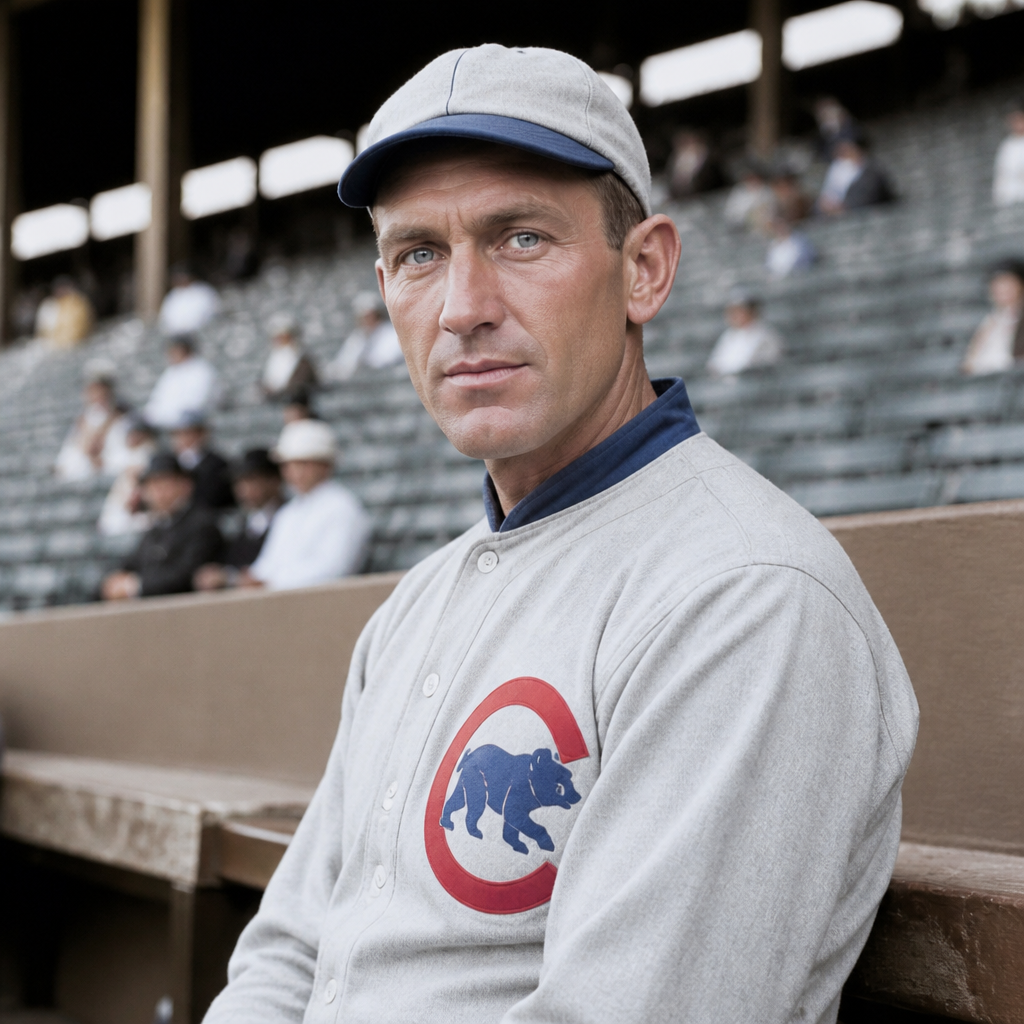
Frank Chance stands at the center of the Chicago Cubs’ first great dynasty, a player-manager whose toughness, baseball intelligence, and relentless standards helped define one of the most successful clubs the game has ever seen. In any serious set of player profiles about legendary players, Chance deserves more than a passing mention, because his career connects individual excellence, clubhouse leadership, tactical innovation, and franchise identity in a way few stars ever have. He was not simply part of a winning era. He was one of its chief architects.
To understand why Frank Chance matters, it helps to define the role he filled. Chance was a first baseman, but that label is too narrow. He also served as on-field strategist, emotional tone-setter, and eventually manager while still an active player. In early twentieth-century baseball, a player-manager carried responsibilities that modern stars rarely face, from directing lineups and in-game tactics to shaping discipline and maintaining trust inside a rough, physically demanding sport. Chance handled all of that while producing at an elite level himself, which is why his place in Cubs history remains so secure.
His importance also becomes clearer when viewed through the famous “Tinker to Evers to Chance” combination, one of baseball’s most enduring phrases. The poem made all three men immortal, yet it sometimes obscures Chance’s full profile. He was more than the receiving end of double plays. He was the club’s captain, a patient hitter in the dead-ball era, a dangerous baserunner, and a leader whose standards helped turn talent into championships. Between 1906 and 1910, Chicago won four National League pennants and two World Series titles, a run built on pitching, defense, speed, and execution. Chance influenced every one of those elements.
This article serves as a hub within the broader Legendary Players topic by showing how to evaluate Chance from multiple angles: statistical production, leadership value, historical context, and lasting legacy. It also points toward the wider practice of building player profiles that do more than list achievements. The best profiles explain what a player actually did, how he fit his era, and why later generations still study him. Frank Chance is an ideal subject for that approach because his résumé rewards close reading. His numbers are strong, his era was distinctive, and his impact reaches beyond the box score into the larger story of the Cubs as a franchise.
Frank Chance’s rise from reserve to cornerstone
Frank Chance was born in 1876 in Fresno, California, and reached the major leagues with the Chicago Orphans, the club that would soon become the Cubs. His path was not the tidy march of a can’t-miss prodigy. He played catcher and outfield early, then settled at first base, where his reflexes, sure hands, and understanding of infield play made him especially valuable. That flexibility mattered in an era when rosters were smaller, travel was harder, and positional durability could shape a season. Chance earned his place by proving useful in multiple ways before becoming indispensable.
By the early 1900s, he had developed into one of the National League’s most complete players. He did not look like a stereotypical slugger, and in the dead-ball era that was not the job description anyway. Teams won by getting on base, taking extra bases, bunting with purpose, putting pressure on fielders, and avoiding mistakes. Chance excelled at those tasks. He controlled the strike zone unusually well for his time, got hit by pitches at remarkable rates, and consistently posted strong on-base percentages. Those habits translated directly into run creation, even when league-wide scoring conditions were modest.
When I evaluate historic player profiles, I look first for evidence that a player dominated the style of game his era demanded rather than one imported from another era’s expectations. Chance passes that test easily. He led the National League in on-base percentage in 1903 and 1904, and his best seasons compare favorably with many more famous stars once context is applied. According to Baseball-Reference, Chance finished with a .394 career on-base percentage and 47.7 WAR, exceptional marks for a first baseman whose prime was shortened by injury. Those numbers are not decorative trivia. They show a player creating value at an elite rate while also carrying unusual leadership burdens.
What made Chance an elite player in the dead-ball era
Chance’s offensive value started with plate discipline. Modern fans often assume early baseball was all bunting and bat control, but selective hitters held enormous value because free baserunners were precious. Chance regularly worked counts, refused poor pitches, and forced opponents into mistakes. He led the league in times hit by pitch five times, a statistic that reflected both fearlessness and tactical awareness. Crowding the plate was dangerous business when pitchers worked inside without modern protective equipment, yet Chance used that edge to help Chicago manufacture offense.
His speed added another dimension. Chance stole more than 400 bases in his career, and unlike inflated modern raw totals that can come with low efficiency, his thefts came in a strategic environment where every out mattered intensely. He was not stealing for spectacle. He was advancing into scoring position for contact hitters and testing defensive composure. In that era, one extra base could decide an entire series. Chance understood leverage before analysts gave it a formal vocabulary.
Defensively, first base was more demanding than many modern observers realize. Gloves were primitive, fields were rough, and throws from infielders were less consistent. A first baseman had to save errors, complete double plays, apply tags in traffic, and remain alert on bunts and rundowns. Chance built a reputation as one of the game’s best at the position because he combined soft hands with quick decision-making. Teammates trusted him to finish plays cleanly, and that trust made the entire infield more aggressive.
| Trait | Why It Mattered | Chance’s Edge |
|---|---|---|
| On-base skill | Dead-ball teams relied on constant traffic, not home runs | League-leading on-base percentages and frequent hit by pitches |
| Baserunning | Extra bases often determined low-scoring games | More than 400 career steals with strong game awareness |
| First-base defense | Infield errors were common on poor surfaces | Reliable hands and smart positioning stabilized the defense |
| Durability under contact | Physical play was routine and painful | Played aggressively until injuries finally limited his prime |
| Game management | Strategy had to adjust pitch by pitch | Directed lineups and tactics while still producing as a player |
That blend explains why Chance remained so effective. He was not a one-tool player benefiting from a short peak. He contributed through every phase the Cubs prioritized: reaching base, moving runners, defending soundly, and making sharp choices under pressure. When building comprehensive player profiles, this is the model worth following. Instead of reducing value to one famous phrase or one statistic, examine how a player helped his team win according to the real demands of his time.
The player-manager who shaped the Cubs’ first dynasty
Chance became Chicago’s manager in 1905, and the timing was pivotal. The roster included major talent, especially Mordecai “Three Finger” Brown, Joe Tinker, Johnny Evers, and a deep pitching staff, but talent alone does not create a dynasty. A dynasty requires standards, tactical coherence, and accountability over multiple seasons. Chance provided all three. Under his direction, the Cubs won 116 games in 1906, still one of the greatest regular seasons in major league history, then captured World Series titles in 1907 and 1908.
Managing while playing is difficult to overstate. A modern manager has coaches, analytics departments, video systems, training staffs, and front-office support. Chance worked in a far leaner environment. He had to assess pitchers, set defensive alignments, monitor player fatigue, control clubhouse friction, and respond instantly during games, all while taking his own at-bats and fielding his own position. Contemporary accounts consistently portray him as forceful, demanding, and deeply respected. He was not soft with veterans, and he was not sentimental about execution. Players knew the standard every day.
The Cubs’ success under Chance was not accidental or random. Chicago prevented runs at an elite level because the club was built around pitching depth and airtight defense. It also created pressure offensively through baserunning, bunting, contact quality, and patience. That style required collective buy-in. A roster cannot execute that many details over six months unless the manager insists on them relentlessly. Chance did. He understood that dead-ball baseball punished careless teams and rewarded clubs that treated each small advantage seriously.
One useful way to see his influence is through consistency. From 1906 through 1910, the Cubs won 116, 107, 99, 104, and 104 games. Sustained excellence on that scale does not happen because one star gets hot. It comes from a system that players understand and repeat. Chance was central to that system. When later historians discuss the Cubs’ first dynasty, they should treat him not as a colorful footnote, but as the field general who converted a talented roster into a disciplined machine.
Tinker, Evers, and Chance: beyond the poem
“Tinker to Evers to Chance” remains one of baseball’s most famous lines, taken from Franklin P. Adams’s 1910 poem “Baseball’s Sad Lexicon.” The phrase captures the despair of opponents watching the Cubs’ middle infield and first baseman complete double plays with ruthless regularity. It is memorable because it sounds musical, but its endurance sometimes narrows public memory. Tinker, Evers, and Chance were not merely a literary trio. They were the core defensive unit of a powerhouse club, and Chance’s role was essential.
At first base, Chance completed the chain. Tinker’s arm and Evers’s instincts mattered, but the play was not over until Chance handled the throw, kept his footwork, and secured the out. In an age of uneven infields and less forgiving gloves, that final step required concentration and technique. Moreover, Chance’s defensive communication helped coordinate bunt coverage, pickoff attempts, and positioning. He was not a passive target. He was an active organizer.
The trio also illustrates a broader lesson for player profiles: famous narratives can be useful entry points, but they are rarely complete explanations. The poem made Chance immortal to casual fans; the record shows he deserved fame on far broader grounds. He was the best hitter of the three, the most significant leader, and the one who carried managerial responsibility. If a hub page on legendary player profiles has a core purpose, it is this: move beyond shorthand and recover the full dimensions of greatness.
How injuries, temperament, and context shaped his legacy
Chance’s career was brilliant, but it was not effortless and it was not endless. He absorbed constant punishment, especially from hit by pitches and the general violence of early baseball. He also suffered significant injuries, including beanings and other physical setbacks that reduced his playing time in later seasons. By modern standards, many of those injuries would have triggered longer recovery plans and better protective measures. In Chance’s era, players often pushed through pain because the culture and economics of the game left little alternative.
His temperament could cut both ways. The same intensity that made him a formidable leader also contributed to conflict. That is common in baseball history. Strong clubhouses often revolve around demanding figures who create order but not universal warmth. Chance was respected more than adored, and that distinction matters. Effective leadership in professional sports is not always gentle. It is often measured by standards enforced, habits formed, and results sustained.
Context matters too. First basemen from the dead-ball era can be underrated because their offensive environments look modest beside later sluggers. Chance did not compile 500 home runs, and he was never going to. That was not the game he played. His greatness rests in context-adjusted production, superior all-around play, and direct impact on winning. The Hall of Fame recognized that when Chance was inducted in 1946. His plaque honors not just a player, but a foundational figure in championship baseball.
Why Frank Chance remains essential in Cubs history and player profiles
Frank Chance remains essential because he represents the fullest version of what a legendary player profile should capture: performance, role, era, and influence. For Cubs history, he is inseparable from the franchise’s first dynasty, the stretch that established Chicago as the National League’s standard bearer. For baseball history, he demonstrates how leadership and tactical intelligence can elevate already strong rosters into enduring champions. And for readers exploring legendary players, he offers a reminder that greatness is not always loud. Sometimes it looks like plate discipline, clean footwork, hard decisions, and daily accountability.
If you are building out a deeper understanding of classic baseball figures, use Chance as a benchmark. Ask how a player fit his era, what responsibilities he carried, whether he improved teammates, and how often his choices translated into wins. Those questions lead to richer conclusions than highlight-based memory alone. Frank Chance answers them convincingly. He was a premier on-base threat, an aggressive baserunner, a first-rate first baseman, and the commanding player-manager of one of baseball’s greatest teams.
The simplest takeaway is also the strongest: Frank Chance was the peerless leader of the Cubs’ first dynasty because he combined elite play with elite control of the game around him. That combination is rare in any era. Explore the related player profiles in this Legendary Players hub with that same standard in mind, and the larger history of baseball becomes clearer, sharper, and far more rewarding.
Frequently Asked Questions
Why is Frank Chance considered such a central figure in the Chicago Cubs’ first dynasty?
Frank Chance is considered a central figure in the Cubs’ first dynasty because his influence reached far beyond his own statistics. He was a standout first baseman, but just as importantly, he was the emotional engine, strategic organizer, and on-field authority of one of baseball’s greatest early twentieth-century powers. The Cubs teams associated with Chance were not merely good clubs on a short hot streak; they were a sustained force, winning pennants and setting a standard for consistency, discipline, and winning baseball. Chance helped shape that identity every day.
What makes his role so important is that he connected performance and leadership in a rare way. As player-manager, he did not lead from a distance. He was in the lineup, involved in every inning, and responsible for making tactical decisions while also setting the clubhouse tone. That gave his leadership unusual immediacy. Teammates saw the same demanding standards in his own play that he expected from everyone else. He embodied the hard-edged, efficient, fundamentally sharp style that defined those Cubs clubs.
He also became one of the most visible representatives of the famous “Tinker to Evers to Chance” infield combination, which symbolized the Cubs’ defensive precision and baseball intelligence. But reducing him to that famous phrase undersells him. Chance was a complete baseball leader whose value came from toughness, consistency, strategic understanding, and a refusal to accept sloppy play. In the story of the Cubs’ first dynasty, he was not just one star among many. He was one of the clearest reasons that dynasty became a dynasty at all.
How good was Frank Chance as a player, apart from his reputation as a leader and manager?
Chance was an excellent player in his own right, and that part of his legacy deserves real attention. Because he is often remembered for leadership and for his place in baseball folklore, modern readers can miss how productive and respected he was on the field. He was a high-level first baseman in an era when offense, bunting, base running, and situational execution were valued differently than they are today. Within that environment, Chance stood out for his ability to get on base, pressure defenses, run the bases aggressively, and contribute to winning in multiple ways.
One of the strongest parts of his offensive profile was plate discipline. He had a sharp eye, drew walks, and consistently found ways to reach base, which was enormously valuable in dead-ball era baseball where every baserunner mattered. He was not a slugger in the modern sense, but that was not the standard by which elite players of his era were judged. Instead, he excelled by creating opportunities, extending innings, and playing a smart, controlled style that fit championship baseball perfectly.
Defensively, he was also a major asset. First base in that era demanded sure hands, awareness, and the ability to work smoothly with an aggressive infield. Chance helped anchor one of the game’s most famous defensive units, and his reliability mattered in close, low-scoring games. Add in his reputation for grit and physical courage, and it becomes clear that his value was substantial even before his managerial impact is considered. In short, Chance was not just a leader who happened to play. He was a genuinely accomplished star whose own performance strengthened the Cubs’ dominance.
What made Frank Chance an effective player-manager during the Cubs’ championship era?
Frank Chance was effective as a player-manager because he combined tactical intelligence with personal authority. In baseball’s early years, the player-manager role demanded a very unusual skill set. A man had to contribute physically on the field, understand the rhythms of the game in real time, make strategic decisions without modern support staffs, and maintain order inside a clubhouse filled with strong personalities. Chance excelled in that environment because he understood both the technical and human sides of leadership.
Strategically, he had a strong feel for pressure baseball. He understood how to manufacture runs, position defenders, exploit opponents’ mistakes, and emphasize details that mattered in tightly contested games. Those Cubs teams were known for crisp execution, and that does not happen by accident. It comes from leadership that reinforces fundamentals constantly and creates accountability around them. Chance was especially well-suited to that kind of baseball mind-set.
Just as important, he had credibility. Players tend to respond best to leaders who clearly live by the standards they enforce, and Chance did exactly that. He was known for toughness and intensity, and he demanded sharp, winning baseball from his teammates because he demanded it from himself. That made his authority feel earned rather than imposed. He could challenge players, push them hard, and still command respect because his own effort was never in question.
His effectiveness also came from his ability to shape a culture. Great teams are built on habits, and Chance made sure the Cubs developed habits of preparedness, focus, and resilience. He helped create a club identity that was hard, smart, and relentless. That cultural influence is one reason his managerial legacy remains so significant. He did not simply fill out a lineup card. He built and maintained the standards of a baseball powerhouse.
How does Frank Chance fit into the legacy of “Tinker to Evers to Chance”?
Frank Chance’s place in the “Tinker to Evers to Chance” legacy is both obvious and deeper than many people realize. The famous phrase made him part of one of baseball’s most enduring cultural references, linking his name forever with shortstop Joe Tinker and second baseman Johnny Evers. On the surface, that phrase celebrates a smooth double-play combination and the defensive brilliance of the Cubs’ infield. It captures the precision and rhythm of championship baseball in a memorable way.
But Chance’s role in that trio was not simply ceremonial or poetic. As the first baseman receiving throws and helping complete those plays, he was essential to the infield’s effectiveness. A double-play combination is only as reliable as its timing, communication, and execution, and Chance’s steadiness at first base was a key part of that machine. He gave the Cubs a dependable target, strong defensive instincts, and a veteran presence that helped organize the field.
There is also a broader symbolic value to his place in that phrase. “Tinker to Evers to Chance” has survived because it represents more than one play; it represents an era of Cubs excellence. Chance, in particular, helps connect the slogan to the larger reality of team construction, leadership, and winning. He was not merely the last name in a famous line. He was the player-manager, clubhouse standard-setter, and one of the leading personalities behind the success that made the phrase meaningful in the first place.
So while popular memory often treats the trio as a neat bit of baseball nostalgia, Chance’s actual contribution was much larger. He gave that famous combination stability, authority, and championship context. His legacy within “Tinker to Evers to Chance” is not just about one defensive sequence. It is about helping turn a talented infield into the signature unit of a baseball dynasty.
Why does Frank Chance still matter in discussions of legendary players and Cubs history today?
Frank Chance still matters because he represents a rare blend of individual quality, leadership importance, and franchise-defining impact. When historians and fans talk about legendary players, they often separate personal greatness from team context. Chance resists that separation. His career is meaningful not only because he played well, but because he shaped what one of baseball’s most dominant teams looked like, how it behaved, and how it won. That makes him especially important in any serious discussion of Cubs history.
He also matters because he reflects an older form of baseball greatness that can be overlooked in modern conversations. Today, fans often focus on home runs, highlight-reel offense, and quantifiable star power. Chance came from a game that emphasized pressure, execution, discipline, and tactical sharpness. His strengths—on-base ability, defensive reliability, aggressive intelligence, and command presence—were central to winning in his era. Understanding his value helps modern readers understand how baseball excellence has taken different forms across time.
For the Cubs specifically, Chance remains one of the foundational figures in franchise identity. Before later generations of stars and heartbreaks shaped the public story of the team, there was Chance helping lead a juggernaut. He stands near the beginning of the Cubs’ grand historical self-image: proud, tough, smart, and capable of dominating the sport. That is why he deserves more than a brief mention in player profiles. He is not a side character in team history. He is one of the architects of what the Cubs first became.
In the end, Frank Chance still matters because his legacy brings together nearly everything baseball history values: performance, toughness, intelligence, influence, and winning. He is a reminder that some of the game’s greatest figures changed outcomes not only with their bats and gloves, but with their standards, presence, and ability to turn talent into a lasting championship culture.