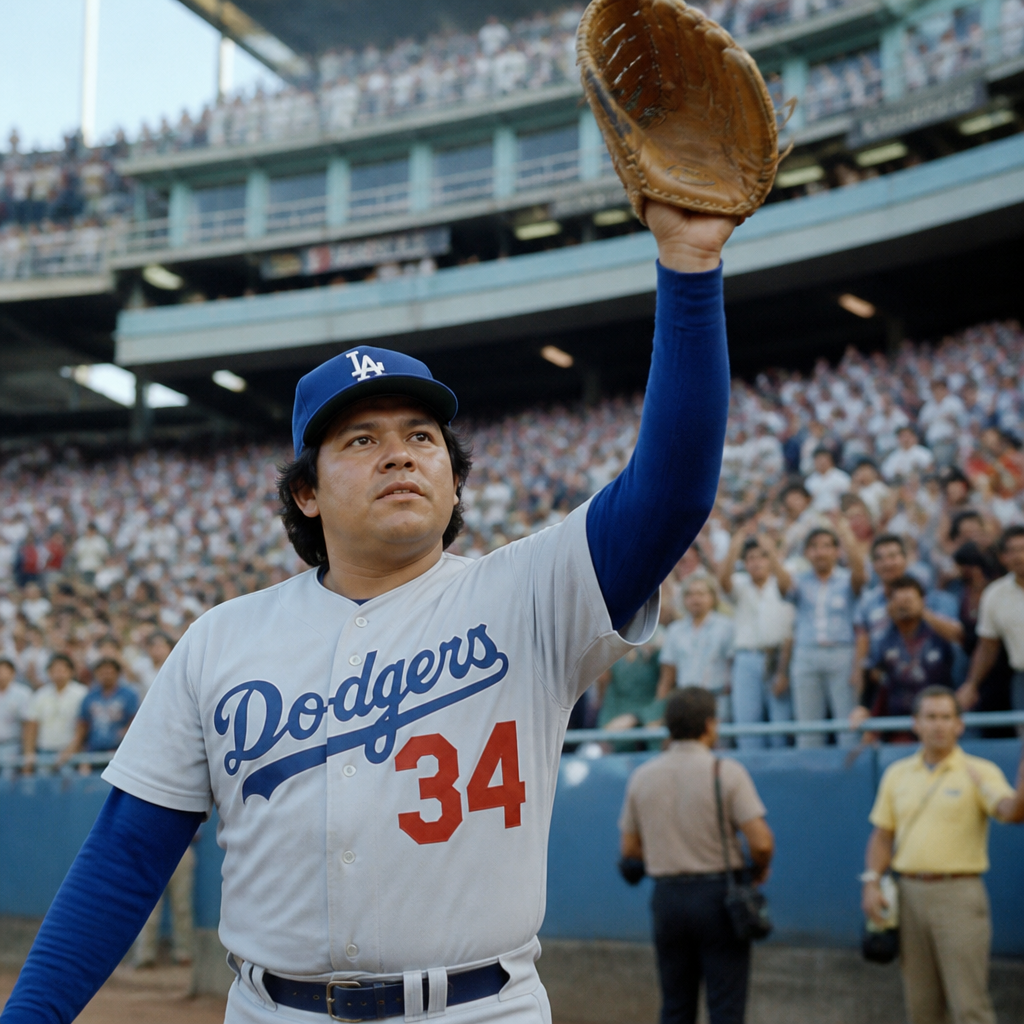
Fernando Valenzuela remains one of baseball’s most consequential player profiles because his rise changed how a city, a franchise, and an entire fan base understood who belonged at the center of the game. A left-handed pitcher from Etchohuaquila, Sonora, Valenzuela became the face of “Fernandomania” in 1981, a phenomenon that blended elite performance, cultural pride, and national attention unlike anything Major League Baseball had seen. In Los Angeles, his success did more than fill Dodger Stadium. It connected Mexican and Mexican American communities to a club that had long carried prestige, but had not yet forged a bond this immediate, emotional, and durable.
Any strong player profile must do three things: define the athlete’s on-field value, explain the historical context around that value, and show what lasted after the peak years ended. Valenzuela excels in all three categories. On the field, he was a workhorse with a distinctive screwball, remarkable poise, and the rare ability to dominate from the first day the spotlight found him. In context, he emerged at a moment when broadcast television, Spanish-language media, and demographic change in Southern California could amplify every start. In legacy, he became a baseball icon whose importance reaches beyond wins, innings, and awards.
This article serves as a hub for the broader “Legendary Players” coverage by treating Valenzuela as both a singular subject and a model for how to evaluate other player profiles. The key terms matter. “Fernandomania” refers to the sustained wave of attention, attendance, media coverage, and devotion that followed his breakout. A “player profile” is a full-spectrum assessment of skill set, career arc, historical significance, and community impact. Understanding Fernando Valenzuela matters because he did not simply pitch brilliantly. He changed the Dodgers’ relationship with Los Angeles and helped prove that baseball stardom could carry deep bicultural meaning.
How Fernando Valenzuela Became a Star
Valenzuela signed with the Dodgers after beginning his professional path in the Mexican League system, where scouts noticed both his maturity and the action on his pitches. He debuted with Los Angeles late in 1980, but 1981 is the season that made him a legend. Called into the starting rotation to open the year, he responded with a run that still reads like baseball folklore: shutouts, complete games, and an ease under pressure that seemed out of step with his age. He started 8-0 with five shutouts and a microscopic earned run average, turning every outing into a civic event.
What made this surge resonate so powerfully was the way performance and identity reinforced each other. He was not a marketing creation propped up by one good month. He was overpowering major league hitters with command, deception, and fearlessness. Crowds arrived early just to watch him warm up. Spanish-language broadcasts gained added urgency. Families that had followed baseball casually suddenly organized entire weekends around his starts. In my experience studying landmark athlete-brand connections, very few stars have ever aligned competitive excellence and cultural symbolism this cleanly, this quickly, and this authentically.
The accolades confirmed the eye test. In the strike-shortened 1981 season, Valenzuela won both the National League Cy Young Award and Rookie of the Year Award, a combination that remains extraordinarily rare. He also helped the Dodgers win the World Series. Those facts are central to any player profile because they remove ambiguity. Fernandomania was not just media excitement. It was rooted in elite outcomes against the strongest competition in the sport. When a pitcher wins the league’s top pitching honor and top rookie honor in the same season, the profile moves from promising to historically significant.
The Pitch Mix, Mechanics, and Competitive Edge
Valenzuela’s repertoire was built around command, movement, and unpredictability rather than sheer velocity. His screwball became his signature pitch, moving away from right-handed hitters and disrupting timing because it looked hittable before veering off the barrel. He complemented it with a fastball, curveball, and changeup, but the screwball defined the confrontation. Hitters had to prepare for a shape and feel they saw less often than sliders or splitters. That rarity mattered. Pitch design was not discussed in modern terms then, yet Valenzuela already represented a truth teams now quantify constantly: unusual movement profiles create decision-making stress.
His delivery added another layer. The famous upward glance toward the sky during his windup gave him a memorable silhouette, but the more important detail was deception. He hid the ball well, repeated his mechanics effectively, and maintained composure even when pitch counts rose. Durability became one of his trademarks. From 1981 through 1987, he regularly shouldered heavy workloads that modern rotations almost never ask of starters. That depended on efficient mechanics, competitive confidence, and the ability to pitch through lineups multiple times without becoming predictable.
There were tradeoffs, and a balanced player profile should state them clearly. High innings totals can elevate greatness, but they can also strain a pitcher’s shoulder and elbow. Valenzuela’s workload was enormous by today’s standards, and his later-career fluctuations cannot be separated from that burden. Even so, his prime demonstrates how command artists with one truly elite weapon can dominate without fitting the prototype of the hardest thrower on the field. He succeeded because hitters rarely got comfortable. Every count felt tilted by movement, angles, and conviction.
What Fernandomania Meant in Los Angeles and Beyond
Fernandomania was bigger than a hot streak because it changed baseball consumption patterns. Attendance surged on his start days. Merchandise moved rapidly. Local television and radio coverage expanded. Crucially, the Dodgers’ connection to Latino audiences deepened in a measurable, lasting way. Los Angeles already had a large Mexican and Mexican American population, but Valenzuela gave many fans a direct personal anchor inside the franchise. He was not adjacent to the community; he reflected it. That distinction explains why his popularity endured long after the first wave of novelty passed.
His impact extended into Mexico, where his success became a source of national pride and a practical demonstration that Mexican pitchers could become frontline stars in the majors. Young players did not just see representation. They saw excellence validated at the highest level. Broadcasters, newspaper editors, and baseball organizers understood the commercial value immediately, but the human meaning mattered more. Families followed box scores across borders. Children copied his motion in neighborhood fields. For many fans, Valenzuela made Major League Baseball feel less distant and more participatory.
| Area of impact | How Valenzuela changed it | Why it lasted |
|---|---|---|
| Dodgers attendance | Start days became major events that drew casual and devoted fans alike | He created new habits and multigenerational loyalty |
| Spanish-language media | Broadcast interest and audience attention intensified around every outing | Teams saw sustained value in serving bilingual and Spanish-speaking fans |
| Mexican baseball identity | He proved a Mexican-born pitcher could headline a major league franchise | His success became a reference point for future players and scouts |
| Player legacy standards | He showed star power can come from cultural connection as well as statistics | Modern player profiles now routinely include community impact |
The lesson for any hub covering legendary player profiles is straightforward: greatness is not only an individual achievement. Sometimes a player changes the emotional map of a sport. Valenzuela did that in Los Angeles, where the Dodgers became more fully identified with the city’s Mexican heritage, and in Mexico, where his starts offered proof that baseball ambition could stretch all the way to the center of a major league stage.
Career Arc, Awards, and Place in Dodgers History
After the 1981 breakthrough, Valenzuela remained an accomplished and productive pitcher for years. He was selected to multiple All-Star teams, won a Silver Slugger, and authored a no-hitter on June 29, 1990, against the St. Louis Cardinals, a signature moment that reinforced his lasting command of big occasions. His prime included seasons of 20, 21, and 24 complete games, totals that underscore just how different his role was from that of the modern starter. By the end of his major league career, he had compiled 173 wins and more than 2,000 strikeouts, numbers that reflect substantial longevity as well as peak brilliance.
Within Dodgers history, Valenzuela belongs in any serious conversation about the franchise’s most influential pitchers. Sandy Koufax remains the gold standard for peak dominance, while Don Drysdale, Orel Hershiser, and Clayton Kershaw occupy other elite tiers for different reasons. Valenzuela’s place is secured not only by performance but by social and cultural consequence. Few pitchers have ever meant more to the identity of the team while also carrying a postseason-caliber workload. That combination makes him unique even in a franchise rich with pitching legends.
His later years included stops beyond Los Angeles, and no honest profile should hide the fact that his career had phases of decline and reinvention. Yet that complexity strengthens rather than weakens the full portrait. Legendary players are not defined only by uninterrupted dominance. They are defined by what they accomplished, how long they mattered, and what remained when the peak passed. In Valenzuela’s case, the answer is substantial on every front: elite awards, memorable moments, durable fan attachment, and a legacy the Dodgers eventually honored permanently.
Why Fernando Valenzuela Still Matters in Player Profiles Today
Valenzuela remains essential reading for anyone studying player profiles because he illustrates how to evaluate baseball history completely. Start with the statistics and awards, because they establish legitimacy. Add the scouting lens, because his screwball, deception, and stamina explain how he produced those results. Then widen the frame to include media, migration, civic identity, and fandom. Once all those pieces are visible together, Fernandomania stops looking like a catchy nickname and starts reading as one of the defining sports stories of twentieth-century Los Angeles.
His influence also informs current conversations about international pathways into Major League Baseball. Today, teams build academies, global scouting departments, biomechanics programs, and cross-border marketing strategies with far more sophistication than in the early 1980s. Even so, the core principle remains the same: when a franchise recognizes and authentically supports the communities reflected in its players, the connection can transform the business and the culture of the team. Valenzuela was not an abstract case study. He was the proof.
For readers exploring the broader “Legendary Players” topic, Valenzuela is a foundational hub subject because his story intersects with pitching development, Dodgers history, Mexican baseball, athlete identity, and sports marketing without being reducible to any one of them. The main takeaway is simple. Fernando Valenzuela became a legend because he won at the highest level and because those wins carried meaning far beyond the mound. If you want to understand how one player can unite performance, symbolism, and lasting civic memory, start with Fernandomania, then continue through the rest of the player profiles in this series.
Frequently Asked Questions
Why was Fernando Valenzuela such an important figure in baseball history?
Fernando Valenzuela mattered because he changed baseball on several levels at once. On the field, he was an outstanding left-handed pitcher with unusual poise, command, and a distinctive delivery that made him instantly recognizable. His rookie-season breakthrough with the Los Angeles Dodgers in 1981 was not just impressive by normal standards; it was electric. He opened the year with a remarkable run of dominant starts, quickly becoming one of the biggest stories in American sports. That immediate excellence gave fans a reason to pay attention, but it was the meaning of his success that made his impact historic.
Valenzuela became a rare athlete whose popularity stretched far beyond the game itself. For many Mexican and Mexican American fans, especially in Los Angeles, he represented visibility, pride, and belonging at the highest level of a sport that had not often placed them at its center. He was not simply a successful player who happened to be from Mexico; he became a symbol of connection between communities, generations, and identities. In that sense, his career helped reshape how baseball understood its audience and who could be its most celebrated stars. His importance comes from the fact that he was both a brilliant performer and a cultural force, and very few players in any era can claim to have been both so fully.
What exactly was “Fernandomania,” and why did it become such a major phenomenon?
“Fernandomania” was the explosion of excitement that surrounded Fernando Valenzuela during his emergence with the Dodgers in 1981, but calling it a simple hot streak understates what it became. It started with performance. Valenzuela burst onto the scene with a series of dominant outings that made him impossible to ignore. Fans were captivated by his calm presence, screwball, endurance, and ability to beat elite competition despite being young and relatively unknown. Every start felt like an event, and his games drew huge attention from local fans, national media, and international audiences.
What turned that excitement into a true phenomenon was the way his rise intersected with culture and place. Los Angeles was already a city deeply shaped by Mexican and Mexican American communities, and Valenzuela’s success gave many fans a powerful sense of identification with the Dodgers. He was not a distant celebrity; he felt like someone who represented people who had often been overlooked in mainstream sports storytelling. Attendance surged, Spanish-language coverage expanded, and his starts became communal experiences for families who saw in him something larger than baseball. Fernandomania was therefore about dominance on the mound, but it was also about recognition, pride, and the emotional force of seeing a player connect an entire city to a broader Mexican identity.
How did Fernando Valenzuela strengthen the bond between Los Angeles and Mexico?
Valenzuela strengthened that bond by becoming a shared point of admiration and emotional investment for fans on both sides of the border. In Los Angeles, a city with deep Mexican roots and one of the largest Mexican-origin populations in the United States, his success gave many people a stronger sense that the Dodgers reflected the community in a more direct and meaningful way. He did not merely attract attention from existing baseball fans; he brought in families, first-time spectators, and communities who felt newly seen by the franchise. That helped turn the Dodgers into something bigger than a team for many supporters. They became a cultural home as well as a sports institution.
In Mexico, Valenzuela’s rise carried enormous symbolic weight because it demonstrated that a pitcher from Sonora could become one of the most talked-about athletes in Major League Baseball. He expanded the imagination of what was possible for Mexican players and gave fans in Mexico a direct emotional stake in the sport’s biggest stage. Media coverage, fan interest, and cross-border attention all grew around him. In practical terms, he helped MLB understand the importance of Spanish-speaking audiences and the value of building authentic relationships with Mexican and Mexican American fans. In emotional terms, he served as a bridge: a star whose success belonged to Los Angeles and Mexico at the same time.
What made Fernando Valenzuela so effective as a pitcher?
Valenzuela was effective because he combined deception, intelligence, composure, and durability in a way that made hitters uncomfortable from multiple angles. As a left-hander, he already offered a different look, but his style made him even more difficult to solve. He was famous for his screwball, a pitch that moved in unusual ways and disrupted timing, especially when paired with his fastball and other off-speed offerings. Hitters often struggled not only with the movement of the ball but with the rhythm of his delivery and his ability to change speeds while still attacking the strike zone.
Another key part of his effectiveness was his mound presence. Valenzuela did not pitch like someone overwhelmed by spotlight or pressure. He worked with confidence, handled big moments well, and seemed comfortable carrying a heavy workload. That reliability helped make him a true staff anchor during his best years. He also understood how to pitch, not just how to throw. He could read situations, adjust to hitters, and compete deep into games. His success was not built solely on overpowering velocity; it came from craft, command, fearlessness, and the ability to make elite hitters swing at pitches they did not want to chase or misread pitches they thought they understood.
What is Fernando Valenzuela’s lasting legacy today?
Fernando Valenzuela’s legacy endures because he left behind both baseball achievements and a cultural blueprint. As a player, he earned lasting respect for his accomplishments, his role in the Dodgers’ success, and the unforgettable peak that made him one of the defining stars of the 1980s. But his deeper legacy lies in how he changed the relationship between a franchise and its fans. He helped show that a team’s identity is shaped not just by wins and losses, but by who feels represented when they watch. In Los Angeles, that mattered enormously, and it continues to matter today.
His influence can also be seen in the broader acceptance and celebration of Latino stars in Major League Baseball. While he was not alone in opening doors, he was one of the most visible and transformative examples of what happens when extraordinary talent meets a community ready to embrace it. For many fans, especially Mexican and Mexican American families, Valenzuela remains a symbol of pride, excellence, and connection across generations. His story still resonates because it is about more than sports fame. It is about belonging, visibility, and the rare athlete who made millions of people feel that baseball was speaking to them directly.