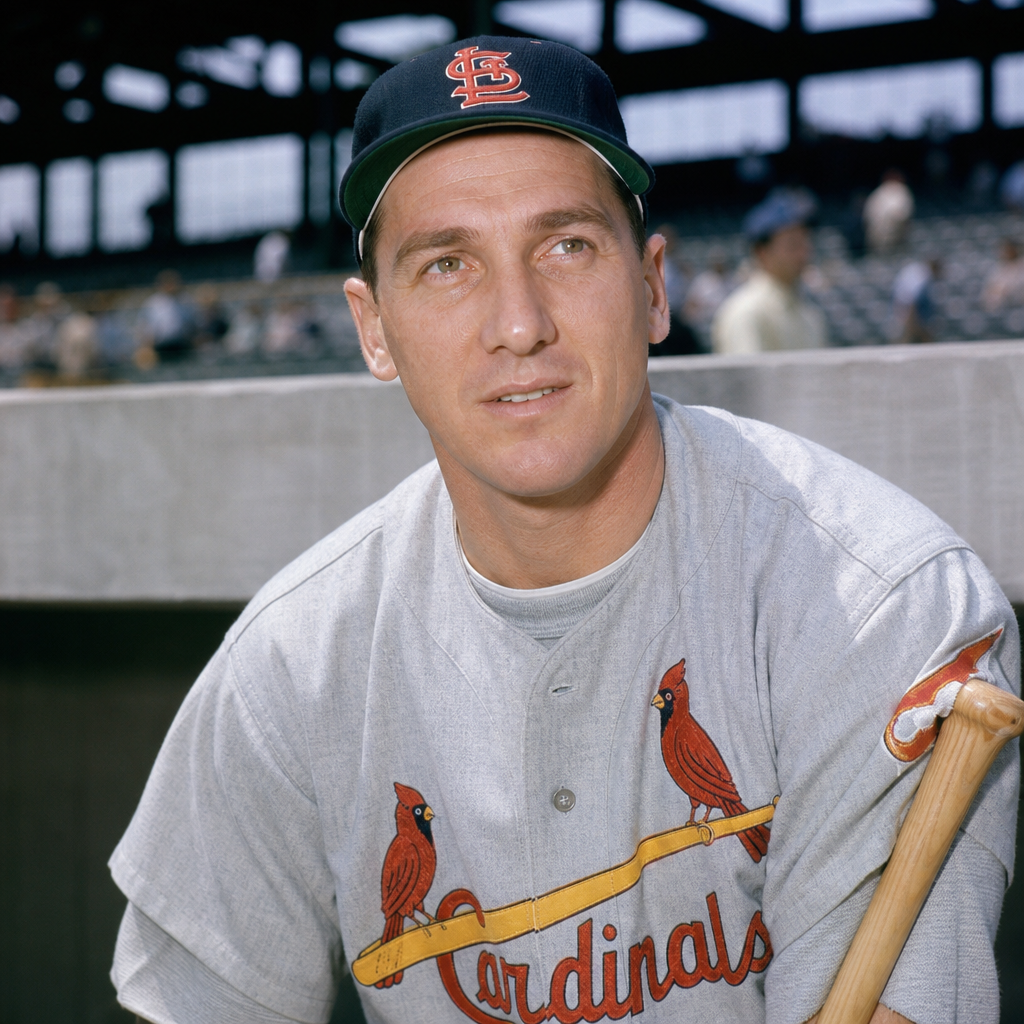
Enos Slaughter stands among the most complete right fielders in baseball history, remembered for the Mad Dash in the 1946 World Series, respected for wartime service that interrupted his prime, and admired for a 19-year major league career defined by toughness, consistency, and championship impact. A player profile of Slaughter must do more than retell one famous sprint from first base to home. It should explain who he was, how he played, why his era mattered, and where his legacy fits within the broader history of legendary players. In that sense, Slaughter is an ideal hub subject within player profiles: his story touches hitting, defense, baserunning, military service, pennant races, Hall of Fame debates, and the culture of baseball in the 1930s, 1940s, and 1950s.
Born Enos Bradsher Slaughter on April 27, 1916, in Roxboro, North Carolina, he became a cornerstone of the St. Louis Cardinals and later contributed to the New York Yankees, Kansas City Athletics, and Milwaukee Braves. He played in the majors from 1938 to 1959, with three full seasons lost to military service during World War II. His profile matters because it answers several enduring baseball questions directly: What made Slaughter great? Was he only famous for one play? How did wartime service affect his numbers? Why did contemporaries regard him as one of the fiercest competitors of his generation? The factual record is strong. Slaughter was a ten-time All-Star, a World Series hero, a .300 career hitter, and a Hall of Famer elected in 1985.
Key terms help frame his place in baseball history. The Mad Dash refers to Slaughter’s decisive run from first base on Harry Walker’s hit in Game 7 of the 1946 World Series, when he scored the winning run against Boston. Wartime service refers to his U.S. Army duty from 1943 through 1945, years that likely cost him substantial counting statistics during what should have been peak seasons. A player profile, especially within a legendary players hub, means a full-spectrum evaluation: biography, skills, context, achievements, controversies, and lasting influence. Slaughter’s case rewards that approach because he was not a novelty act or a one-season star. He was durable, productive, and central to winning clubs over two decades.
I have always found that when reviewing older players, the most common mistake is imposing modern categories without understanding period context. Slaughter played before integration reshaped league depth, before expansion diluted rosters, before free agency transformed team construction, and during wartime shortages that altered lineups across baseball. Yet his performance still holds up under close inspection. He finished with 2,383 hits, 169 home runs, 1,304 runs batted in, a .300 batting average, and a .384 on-base percentage. Those totals are not accidental. They reflect plate discipline, line-drive contact, situational hitting, and unusual intensity on the bases and in the field. To understand Enos Slaughter, you have to see both the production and the persona.
Early life, rise to the majors, and Cardinals breakthrough
Slaughter grew up in rural North Carolina and developed a reputation for hard play long before reaching professional baseball. He signed with the St. Louis Cardinals organization in the mid-1930s, when the franchise had already built a national identity around aggressive, high-pressure baseball. That environment fit him perfectly. The Cardinals of that period valued hustle, line drives, quick reads on the bases, and emotional edge. Slaughter arrived in the majors in 1938 and almost immediately looked like he belonged, batting .276 as a rookie while showing the all-around athleticism that managers crave in corner outfielders.
His first great season came in 1939, when he hit .320 and established himself as a key Cardinals regular. By 1941 he had become one of the National League’s best hitters, batting .311 with 13 home runs and 101 runs batted in. The next year he was even better, hitting .318 and helping St. Louis win the 1942 World Series over the Yankees. Contemporary accounts consistently emphasized not just his statistics but his relentless style. Slaughter ran hard on routine grounders, challenged outfield arms, and played with a visible edge that energized teammates and irritated opponents.
One useful way to understand his breakthrough is to compare tools with role. Slaughter was not a towering power hitter in the mold of Hank Greenberg or a pure speed specialist like some leadoff threats of his time. He was a complete right fielder. He hit for average, reached base, drove runners in, and took extra bases through instinct as much as speed. The Cardinals deployed him where his competitiveness mattered most: in the middle of the order and in critical moments. By age 26, he had already played on pennant-contending clubs and proven he could carry meaningful offensive responsibility.
Wartime service and the prime years baseball lost
From 1943 through 1945, Slaughter served in the U.S. Army during World War II. For any accurate Enos Slaughter player profile, this is not a side note. It is central to evaluating his career. He lost three full major league seasons between ages 27 and 29, a range that often represents a hitter’s absolute prime. Many Hall of Fame discussions turn on counting totals, and Slaughter’s numbers would almost certainly be higher had he remained in uniform on the field rather than in military service. That absence also changed pennant races, team continuity, and the shape of his personal record book.
Estimating what he lost requires caution, but the exercise is still instructive. Based on his production in surrounding seasons, adding three years of even conservative output could plausibly have pushed him beyond 2,800 hits, 1,500 runs batted in, and perhaps 200 home runs. Those are not inflated fantasies; they are reasonable projections grounded in his prewar and postwar consistency. Wartime service affected many stars, from Ted Williams to Bob Feller, and Slaughter belongs in that same conversation whenever baseball historians evaluate interrupted careers.
His return in 1946 underscored how little of his competitive fire had faded. Players often come back from military duty needing long adjustment periods. Slaughter came back to hit .300, make the All-Star team, and help lead St. Louis to a championship. That response tells you something important about his makeup. He was not a player whose game depended on one narrow physical tool vulnerable to interruption. His game rested on instincts, preparation, balance at the plate, and an uncompromising approach to each play.
The Mad Dash and why one play became baseball folklore
The Mad Dash is the play most fans know, and it deserves the attention because it captures Slaughter’s style in a single sequence. In Game 7 of the 1946 World Series against the Boston Red Sox, with the score tied in the eighth inning, Slaughter was on first base when Harry Walker lined a ball to left-center field. Slaughter never hesitated. He rounded second aggressively, kept going around third, and scored standing up on a relay that arrived late and offline. St. Louis won 4-3, and the play entered baseball mythology.
Why did it matter so much? First, the moment was enormous: Game 7 of the World Series, late innings, championship on the line. Second, the run was not simply a burst of speed. It was a triumph of anticipation, route efficiency, and pressure. Slaughter broke hard from first, read the outfield angle, and forced Boston’s defense to execute perfectly. It did not. Third, the play reinforced his existing reputation. If a slower, passive player had scored on a defensive mistake, the run might be remembered as a breakdown by Boston. Because Slaughter did it, the story became one of nerve and relentless intent.
There has long been debate about whether Boston shortstop Johnny Pesky hesitated on the relay throw. That discussion persists because famous plays invite blame assignments. But focusing only on the relay misses the core point. Slaughter created the possibility through instant commitment. Defenders under pressure make slower decisions when a runner applies maximum stress. In scouting language, he forced the play to speed up. That is what elite baserunners do. The Mad Dash was not luck. It was a signature example of a player imposing his style on the sport’s biggest stage.
How Enos Slaughter actually played: hitting, fielding, and baserunning
Slaughter’s reputation for hustle can overshadow the technical quality of his game, so a good player profile should state plainly what he did well. At the plate, he was an excellent contact hitter with strike-zone judgment. His .384 career on-base percentage is especially notable for his era. He could pull the ball, use the gaps, and hit with runners aboard. He recorded seven seasons batting .300 or better and drove in 100 or more runs five times. He was not merely productive in one category; he contributed across the offensive line.
Defensively, he spent most of his career in right field and handled the position with reliability. His arm was respected, his reads were strong, and he played shallower than many corner outfielders because he trusted his first step. In historical discussions, he is rarely introduced as a defensive revolutionary, but that should not diminish the quality of his work. On winning teams, steady outfield defense matters because it prevents innings from extending and supports aggressive pitchers who pitch to contact. Slaughter gave managers confidence on both routine and pressure plays.
On the bases, his defining trait was decisiveness. He was not the league’s stolen-base leader, but he was among the smartest runners in baseball. He took extra bases with timing and conviction, not recklessness. Watching descriptions from contemporaries, you see the same themes repeatedly: headlong effort, pressure, concentration, and refusal to coast. Those qualities sound intangible, but they show up in outcomes. Teams gain real value from first-to-third advances, sacrifice fly reads, and forcing hurried relays. Slaughter created that value for years.
| Category | Career mark | Why it matters |
|---|---|---|
| Seasons in MLB | 19 | Shows exceptional longevity across multiple eras and teams |
| Hits | 2,383 | Confirms sustained contact skill and lineup reliability |
| Batting average | .300 | Benchmark of high-level offensive consistency |
| On-base percentage | .384 | Highlights plate discipline beyond batting average |
| Runs batted in | 1,304 | Reflects middle-of-the-order production on contenders |
| All-Star selections | 10 | Demonstrates peer and league-wide recognition |
| World Series titles | 4 | Connects individual quality to championship impact |
Postwar excellence, later teams, and championship longevity
After returning from the war, Slaughter resumed producing at an elite level. He hit .300 in 1946, .300 again in 1947, and .321 in 1949. In 1949 he finished with 168 hits, 12 home runs, and 86 runs batted in, then followed with another strong campaign in 1950. Even as younger stars emerged, he remained relevant because his game aged well. Players who depend exclusively on bat speed or foot speed often decline sharply. Slaughter’s profile—contact, judgment, positioning, and urgency—gave him a broader base for longevity.
He stayed with St. Louis through 1953 before moving to the New York Yankees, where he contributed to another championship club in 1956. That stint matters because it shows how contenders viewed him late in his career: not as a ceremonial veteran, but as a useful, battle-tested player who could still help a title run. He later played for the Kansas City Athletics and Milwaukee Braves, extending his major league service into 1959. Few outfielders from his generation combined early stardom, wartime interruption, postwar rebound, and late-career usefulness so effectively.
Longevity should not be mistaken for hanging on. Slaughter remained playable because he understood game situations better than many younger, more physically gifted players. I have seen this pattern often when evaluating long careers: the veterans who last are usually the ones who control at-bats, know where to position themselves, and avoid mental mistakes. Slaughter fit that model. His final seasons added to his total value and broadened his historical footprint beyond one franchise and one defining October moment.
Hall of Fame case, legacy, and place among legendary player profiles
Slaughter was elected to the National Baseball Hall of Fame in 1985 by the Veterans Committee, a route that has sometimes led casual fans to underestimate him. That would be a mistake. His candidacy rests on substance: a .300 average, 2,383 hits, 10 All-Star selections, four World Series titles, major wartime service, and a durable reputation as one of baseball’s fiercest competitors. If you adjust for the three lost seasons, his resume looks even stronger by traditional standards. More importantly, he was a player opponents remembered because he changed games in ways the box score did not always fully capture.
His legacy is also bound up with the identity of the Cardinals. St. Louis teams of that era prized pressure baseball, and Slaughter embodied it as clearly as almost any player in franchise history. For a sub-pillar hub on player profiles within legendary players, he functions as a bridge figure. His story connects biographies to larger themes: how war reshaped careers, how postseason moments can define reputations, how all-around players age, and how baseball history should weigh context as seriously as totals.
Enos Slaughter should be remembered not only for the Mad Dash but for the habits that made it possible: immediate reads, fearless commitment, and sustained excellence over 19 major league seasons. He was a championship right fielder, a decorated veteran, and a player whose career rewards deeper study. Explore the related player profiles in this series to compare Slaughter’s legacy with other baseball greats and to see how context turns statistics into history.
Frequently Asked Questions
Who was Enos Slaughter, and why is he considered one of baseball’s most important right fielders?
Enos Slaughter was one of the defining National League stars of the 1940s and 1950s, a hard-nosed right fielder whose reputation rested on far more than one famous World Series play. He built a 19-year major league career through a combination of durability, competitive intensity, line-drive hitting, smart baserunning, and dependable all-around play. Best known for his long run with the St. Louis Cardinals, Slaughter became a central figure on winning clubs and earned recognition as one of the era’s most complete players. He was not simply a power hitter or a glove-first outfielder; he was a player who contributed in every phase of the game and did so over an unusually long period.
What makes Slaughter especially significant is how well he represented the style of baseball played in his era. He excelled in a time when aggressiveness, contact hitting, situational awareness, and physical toughness were prized traits. He consistently hit for average, drove in runs, handled pressure well, and played with relentless energy. His Hall of Fame legacy comes from the full body of work: multiple All-Star selections, championship contributions, strong offensive production over many seasons, and a reputation as a player opponents never took lightly. When historians rank great right fielders, Slaughter belongs in the conversation because his impact stretched across winning, longevity, and the gritty style that defined mid-century major league baseball.
What exactly was the “Mad Dash,” and why has it become such a lasting part of baseball history?
The “Mad Dash” refers to the most famous play of Enos Slaughter’s career, which occurred in Game 7 of the 1946 World Series between the St. Louis Cardinals and the Boston Red Sox. In the eighth inning, with the score tied, Slaughter was on first base when Harry Walker hit a line drive into the outfield. Slaughter broke hard from first, rounded second aggressively, and kept going all the way home. Boston’s relay throw failed to cut him down, and Slaughter scored the go-ahead run in what became the decisive moment of the game. The Cardinals won the World Series, and the image of Slaughter charging around the bases became one of the signature plays in postseason history.
The reason the play has lasted so powerfully in baseball memory is that it captured Slaughter’s identity perfectly. It was not luck or recklessness; it was instinct, pressure, daring, and total commitment. He forced the defense to execute under stress, and when they did not do so cleanly, he turned a routine advancement into a championship-winning run. The play also symbolizes an older brand of baseball in which hustle and bold decision-making could define the biggest moments. Even people who know only one thing about Enos Slaughter usually know the Mad Dash, but that play matters most when viewed as a window into the kind of player he was every day: alert, fearless, and always pushing the game forward.
How did Enos Slaughter’s wartime service affect his career and legacy?
Slaughter’s wartime service is a major part of understanding both his career totals and his historical standing. Like many players of his generation, he lost valuable prime seasons to military service during World War II. Those were years in which he likely would have added substantially to his hit totals, counting stats, and résumé. Because baseball careers are often judged by cumulative numbers, that interruption matters. It almost certainly kept his already impressive career statistics from becoming even more overwhelming. In a purely statistical sense, the war cost him time he could never recover.
At the same time, that interruption adds depth to his legacy rather than diminishing it. Slaughter returned from service and resumed his career at a high level, which reinforced his image as a resilient and disciplined competitor. Many players found it difficult to regain rhythm after years away from the game, yet Slaughter remained an impact player and continued to contribute to pennant races and championships. His story therefore reflects something larger than baseball: a generation of athletes whose careers were shaped by global events and whose achievements must be evaluated in that context. When people assess Enos Slaughter fairly, they do not just see what he accomplished on paper; they also see what he sacrificed, what he overcame, and how strongly he reestablished himself once he returned.
What kind of player was Enos Slaughter beyond the famous World Series moment?
Beyond the Mad Dash, Slaughter was the kind of player managers loved because he helped teams win in repeatable, practical ways. Offensively, he was known for making consistent contact, hitting for a strong average, and producing in run-scoring situations. He was capable of driving the ball, but his value was not limited to home run power. He could advance runners, keep innings alive, and deliver quality at-bats over the course of a long season. He also ran the bases with unusual aggression and intelligence, constantly looking for extra ninety feet and pressuring opposing defenses into mistakes.
Defensively, Slaughter was a reliable right fielder with a strong understanding of positioning and game flow. He fit the profile of an old-school complete player: tough, fundamentally sound, durable, and highly competitive. Teammates and opponents alike respected his edge. He played with visible intensity and demanded a great deal from himself, which made him a natural fit for the hard-driving Cardinals clubs of his era. That is why any serious profile of Slaughter has to go beyond one highlight. His greatness came from accumulation as much as flash—season after season of quality play, emotional toughness, and meaningful contributions in games that mattered.
How should Enos Slaughter’s legacy be viewed in the broader history of Major League Baseball?
Enos Slaughter’s legacy should be viewed as the legacy of a championship-caliber star whose career connects several important themes in baseball history: pre- and postwar baseball, the culture of the St. Louis Cardinals, and the value of complete all-around play. He may not always be the first name mentioned among the most famous outfielders of all time, but that often says more about changing public memory than it does about his actual standing. Slaughter played in a highly competitive era, starred for pennant-winning teams, delivered one of the sport’s most iconic World Series moments, and maintained his quality over nearly two decades in the majors. That combination gives him a secure place in the game’s historical record.
His legacy also reminds modern fans that greatness does not always look the same from one era to another. Slaughter’s value was built on consistency, pressure baseball, leadership through toughness, and doing many things well rather than one thing spectacularly. In that sense, he stands as an excellent example of a Hall of Fame player whose full importance becomes clearer when you place him in context. He was not just a symbol of the Mad Dash. He was a wartime generation ballplayer, a cornerstone of winning clubs, and one of the most respected right fielders of his time. That broader view is the one that best explains why Enos Slaughter still matters in baseball history today.