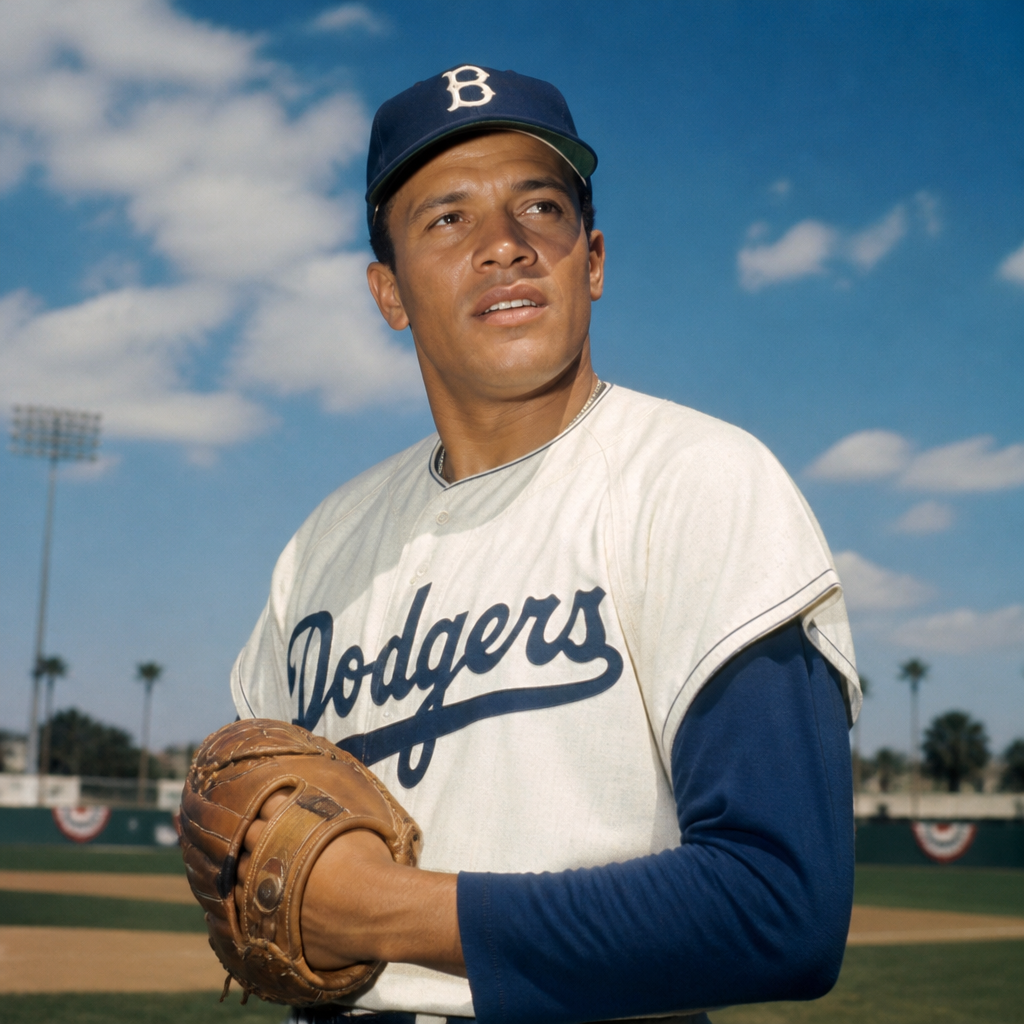
Don Newcombe stands as one of baseball’s most important player profiles because his career joins three stories that define the modern game: elite pitching, award-winning all-around value, and the difficult progress of integration in the major leagues. Any serious look at legendary players has to include him, not only for what he accomplished with the Brooklyn and Los Angeles Dodgers, but for how fully his career captures the pressures, possibilities, and contradictions of baseball in the late 1940s and 1950s. When I have built player profile hubs for historic teams and eras, Newcombe is always a central figure because he connects performance, personality, race, and team history more clearly than almost any pitcher of his generation.
Born in Madison, New Jersey, in 1926, Donald Newcombe reached the majors in 1949 after pitching in the Negro leagues and the Dodgers’ system. He became one of the first Black star pitchers in Major League Baseball after the color barrier fell, following Jackie Robinson and arriving alongside pioneers such as Roy Campanella. A player profile of Newcombe needs a few key definitions up front. A pitcher’s greatness can be measured through wins, earned run average, innings, strikeouts, postseason results, and context-adjusted metrics such as ERA+, which compares a pitcher to the league after accounting for ballpark and scoring environment. Value can also be captured through awards and durability. Integration-era pioneer refers to players who did not just appear after segregation weakened, but actively bore the social and professional strain of changing the sport while competing at the highest level.
That is why Newcombe matters. He was not merely a symbolic figure placed into history because of timing. He was dominant. He won Rookie of the Year in 1949, helped the Dodgers contend year after year, captured the National League Most Valuable Player Award and the first Cy Young Award in 1956, and did it while handling a starter’s workload that would be extraordinary even by the standards of the 1950s. He also hit well enough to be a real contributor at the plate, another detail that sharpens the picture of his value. For readers exploring legendary players through player profiles, Newcombe serves as a hub figure: studying him leads naturally to Jackie Robinson, Roy Campanella, Duke Snider, Pee Wee Reese, Carl Erskine, and the broader Dodgers machine built by Branch Rickey and later sustained in Los Angeles. His story is a performance study and a history lesson at the same time.
This article covers Don Newcombe comprehensively as a player profile hub. It examines his rise, his pitching style, his peak seasons, his offensive ability, his place in Dodgers history, the racial barriers he faced, and the complicated way his legacy should be understood today. By the end, the core question is answered directly: why does Don Newcombe remain a legendary player? Because he combined frontline results with uncommon resilience and helped redefine what a Black ace could be in the major leagues.
Early life, Negro leagues path, and Dodgers breakthrough
Newcombe’s baseball education began before he threw a major league pitch. He starred in high school athletics in New Jersey, served in the military during World War II, and pitched for the Newark Eagles of the Negro National League. That Negro leagues experience matters in any accurate player profile because it shaped his competitiveness and introduced him to baseball under conditions far harsher than those faced by white prospects in organized ball. Travel was harder, resources were thinner, and opportunities were constrained by discrimination. Yet the Negro leagues also sharpened players quickly. They played often, adapted constantly, and learned to perform under pressure in hostile environments.
The Dodgers signed Newcombe as Branch Rickey expanded the organization’s integration efforts. Rickey’s strategy is often discussed through Jackie Robinson alone, but Newcombe’s arrival shows that the Dodgers were trying to change roster construction, not just make one headline move. After time in the minors, where abuse from crowds and resistance from opponents were routine, Newcombe debuted in 1949 and immediately looked like a top-level major league starter. He went 17-8 with a 3.17 ERA, threw 247 innings, completed 16 games, and won the inaugural Rookie of the Year Award. Those numbers are not impressive only because he was a rookie; they are impressive in any context. A modern comparison would be a first-year starter arriving as a clear number one or number two arm on a pennant contender.
What I find especially striking when reviewing his transition is how little easing-in there was. The Dodgers needed innings, and Newcombe supplied them. Managers in that era asked starters to work deep into games, control the running game, field their position, and help themselves at the plate. Newcombe met all of those demands at once. His breakthrough also had symbolic weight. Robinson had broken the barrier as an everyday position player. Campanella became a star catcher. Newcombe proved a Black pitcher could be trusted with the baseball every fourth day in pennant races, a challenge that racist assumptions had specifically tried to deny.
What made Don Newcombe a great pitcher
At his best, Newcombe was a power pitcher with command, poise, and stamina. Contemporary accounts describe a heavy fastball, a sharp curve, and the physical presence to intimidate hitters before the ball even left his hand. He stood 6-foot-4 and over 200 pounds, a large frame for the period, and he used that size efficiently. He was not simply throwing hard; he was driving downhill, creating angle, and forcing weak contact. His mechanics allowed him to hold velocity deep into games, which mattered enormously in an era when complete games were not occasional bonuses but expected outcomes from top starters.
One reason his profile has aged well is that his style translates to modern evaluation. He was durable, missed bats, limited runs, and could work huge inning totals without losing effectiveness. Across ten major league seasons, he posted a 149-90 record with a 3.56 ERA. ERA alone does not tell the full story because league offense and ballpark conditions varied, so ERA+ is useful here: Newcombe finished with a career 112 ERA+, meaning he was 12 percent better than league average across a long career. At his peak he was much better than that baseline suggests. He had multiple seasons in which he was clearly among the National League’s best pitchers and one season, 1956, when he was the best by almost any practical measure available at the time.
Another underappreciated point is his control of game tempo. Veteran catchers and managers consistently valued pitchers who kept fielders engaged, worked efficiently, and prevented innings from unraveling after one mistake. Newcombe excelled there. He attacked hitters, trusted his stuff, and often turned lineups over without wasting pitches. Modern pitch-count culture can obscure how valuable that rhythm was. In the 1950s, efficiency was not a side benefit; it was a survival skill for a staff anchor expected to finish what he started.
The peak years and the 1956 MVP-Cy Young season
Newcombe’s peak can be traced through several outstanding seasons, but 1956 is the centerpiece of any serious article about Don Newcombe. That year he went 27-7 with a 3.06 ERA over 268 innings, completed 18 games, threw five shutouts, and led the Dodgers to another pennant. He won the National League MVP Award and the first Cy Young Award, which at the time recognized the best pitcher in all of Major League Baseball, not one in each league. Winning both honors confirms how overwhelming his value looked to contemporaries. He was not viewed as merely the best pitcher on a strong club; he was considered the league’s most indispensable player.
| Season | Team | W-L | ERA | Innings | Notable honor |
|---|---|---|---|---|---|
| 1949 | Brooklyn Dodgers | 17-8 | 3.17 | 247.0 | Rookie of the Year |
| 1951 | Brooklyn Dodgers | 20-9 | 3.70 | 279.2 | All-Star level season |
| 1955 | Brooklyn Dodgers | 20-5 | 3.20 | 233.1 | Key arm on World Series champions |
| 1956 | Brooklyn Dodgers | 27-7 | 3.06 | 268.0 | MVP and Cy Young |
The seasons around that peak matter too. In 1951 he won 20 games. In 1955 he went 20-5 for the only Brooklyn Dodgers team to win a World Series. Even though his postseason record was disappointing, judging his regular-season excellence requires keeping the full sample in view. Pitchers do not control run support, bullpen decisions, or every bounce in a short series. Over the long schedule, Newcombe repeatedly proved he could be the rotation’s backbone for a championship-level club.
When people ask what made 1956 special beyond the win total, the answer is workload plus quality. Twenty-seven wins alone can reflect team strength, but pairing them with 268 innings, a low ERA, and leadership on a pennant winner shows true dominance. In practical terms, Newcombe saved the bullpen, stabilized losing streaks, and gave Brooklyn a major advantage every time he started. That is what an MVP pitcher looks like.
More than a pitcher: hitting, athleticism, and complete value
Newcombe was one of the best-hitting pitchers ever, and that is not trivia. It is part of his total player profile. He finished his career with a .271 batting average, 15 home runs, and 108 runs batted in. For comparison, many pitchers from any era struggle to contribute even replacement-level offense. Newcombe was good enough with the bat that opponents had to treat the bottom of the order differently. He could drive in runners, extend innings, and reduce the cost of letting him bat deep into games.
That offensive ability mattered even more under National League rules before the designated hitter. Managers had to decide whether to pinch-hit for starters in close games, and a pitcher who could handle the bat earned longer leashes. Newcombe’s all-around athleticism also showed in his fielding and baserunning instincts. In older scouting language, he looked like a ballplayer rather than a specialist. Today we might call that roster efficiency: one player delivering ace-level innings and useful offense in the same lineup spot.
This complete value helps explain why his 1956 MVP case was so strong. Voters were not just rewarding pitching wins. They were seeing a player who affected the game in multiple dimensions and did so for a first-place team. When building player profiles as hub pages, these details matter because they point readers toward broader themes: two-way contribution, pitcher offense before the DH, and the strategic differences between baseball then and now.
Integration, pressure, and the cost of pioneering
Any honest account of Don Newcombe must address the racial climate in which he played. Integration was not a simple success story that ended once a player reached the majors. Newcombe faced segregated housing, hostile fans, uneven treatment on the road, and the constant expectation that any mistake would reflect on more than himself. Black players in that era lived under dual pressure: perform well enough to keep jobs that many people thought they should never have received, and maintain composure while absorbing insults and exclusions that would derail most people.
Newcombe’s significance as an integration-era pioneer rests partly on role. A Black ace challenged a specific set of racist ideas. For decades, decision-makers had claimed Black players lacked the temperament to pitch, especially in pressure situations that required strategy, leadership, and control. Those claims were false, and Newcombe disproved them on the field. Every complete game, every pennant race start, and every award-winning season confronted the prejudice embedded in roster building and media narratives.
There were also personal costs. Like many players of his era, Newcombe battled alcohol misuse, and he spoke later in life about the damage it caused. That does not diminish his legacy; it deepens it. The strain on pioneering Black athletes was immense, and pretending otherwise sanitizes history. In his later years, Newcombe became an important mentor within the Dodgers organization, working in community relations and counseling players dealing with substance abuse and life stress. That second act matters because it shows leadership beyond the box score.
Legacy within the Dodgers, baseball history, and player profile research
Within Dodgers history, Newcombe belongs in the inner ring of postwar stars. Robinson transformed the sport, Campanella became one of the greatest catchers ever, Snider anchored the lineup, and Newcombe gave the club an ace who could carry innings and credibility. He was central to Brooklyn’s identity and remained significant after the franchise moved to Los Angeles. The Dodgers have long treated him as a foundational figure, and that institutional memory is deserved.
For baseball history more broadly, Newcombe’s legacy sits at the intersection of excellence and unfinished recognition. He is sometimes overshadowed in national memory by Robinson’s singular place in civil rights history and by Sandy Koufax’s later dominance with the Dodgers. But player profile work should correct that compression. Newcombe was not a supporting character. He was a major star, a genuine award-season giant, and a barrier-breaking pitcher whose success expanded what teams believed possible.
If you are using this page as a hub under Legendary Players, Newcombe is an ideal bridge subject. From here, readers can move to profiles on Robinson and Campanella for the integration story, to Dodgers dynasty articles for team context, to award history through the MVP and Cy Young, and to comparative pitcher studies involving Warren Spahn, Robin Roberts, Early Wynn, and Whitey Ford. That is the mark of a strong hub player profile: one career opening multiple paths into baseball history while remaining compelling on its own.
Don Newcombe deserves to be remembered as a pitching great, an MVP winner, and an integration-era pioneer because each label is fully earned by the record. He arrived from the Negro leagues and the Dodgers pipeline ready to win immediately, produced ace-level seasons for pennant contenders, and reached a 1956 peak few pitchers in any era can match. He added uncommon offensive value, handled huge workloads, and helped force the sport to confront its own prejudices by excelling in one of its most demanding roles.
The main benefit of studying Newcombe through a comprehensive player profile is clarity. His career shows that baseball greatness is rarely one-dimensional. Performance matters, but so do context, burden, opportunity, and influence. Newcombe’s statistics establish his quality. His awards confirm his standing among contemporaries. His experience as a Black star pitcher in the first decade after integration explains why his legacy extends beyond numbers alone.
For anyone building a deeper understanding of legendary players, start with Don Newcombe and keep going outward. Use his career as a gateway to the Dodgers’ golden age, the realities of integration, and the standards that define a true ace. If you are mapping the essential player profiles in baseball history, make sure Newcombe is near the top of the list.
Frequently Asked Questions
Why is Don Newcombe considered such an important figure in baseball history?
Don Newcombe is important because his career sits at the intersection of talent, achievement, and social change. He was not simply a successful pitcher for the Brooklyn and Los Angeles Dodgers; he was one of the central players of baseball’s integration era and one of the most gifted all-around competitors of his generation. When historians and fans look back at the postwar game, Newcombe stands out because his story reflects what baseball was becoming: more diverse, more modern, and more nationally relevant, but also still burdened by deep racial tensions and unequal treatment.
On the field, Newcombe brought rare size, power, and athleticism to the mound. He won at a high level, handled heavy workloads, and helped anchor strong Dodgers clubs during one of the franchise’s most memorable periods. Off the field, he was part of the first wave of Black stars to enter Major League Baseball after the color barrier was broken, and that meant every success came with pressure that many of his white peers did not have to carry. He represented excellence under scrutiny. That combination is why his legacy matters so much. He was a great player in a baseball sense, but he was also a symbol of a transforming sport trying to live up to its own ideals.
What made Don Newcombe such a great pitcher during his prime?
Newcombe’s greatness came from a blend of physical gifts, competitive toughness, and complete command of the game’s demands. He was a big, durable right-hander with the kind of presence that immediately affected a game. He could throw with authority, challenge hitters aggressively, and work deep into games at a time when frontline starters were expected to carry enormous responsibility. He was not a one-dimensional power arm. What separated him from many hard throwers was his poise, his ability to adjust, and his understanding of how to attack lineups over the course of nine innings.
He also contributed in ways that went beyond pitching results alone. Newcombe was known as an outstanding hitting pitcher, which increased his value in the pre-designated hitter era. That matters more than many modern readers realize. In his day, a pitcher who could help at the plate, move runners, and even drive in runs gave his team a meaningful advantage. Newcombe did that while also serving as a top starter, which made him one of the most complete players in the league. His prime years showed not just excellence, but all-around impact. He could dominate from the mound and still help win games with his bat, a combination that made him unusually valuable even among star pitchers.
Why is Don Newcombe’s MVP award such a significant part of his legacy?
Newcombe’s Most Valuable Player Award is one of the clearest signs of how completely he influenced winning at his peak. Pitchers do not always win MVP honors, especially in eras filled with everyday position-player stars, so the award signals that Newcombe was viewed not merely as an excellent starter but as one of the single most important players in the entire league. It recognized the full scope of his contribution: elite pitching, innings, leadership, consistency, and added offensive value. In other words, he was not just accumulating victories; he was shaping the identity and success of his team.
The significance of the award is even greater when placed in historical context. Newcombe earned that honor during a period when Black players still faced open prejudice, extra scrutiny, and fewer margins for failure. To rise above those barriers and be acknowledged as the league’s most valuable player gave his achievement a deeper resonance. It showed that his performance was so strong it demanded recognition despite the era’s inequities. For that reason, the MVP is not just a trophy in his biography. It is a marker of dominance, validation, and historical weight. It confirms that Newcombe was not only present in a changing game, but central to it.
How did Don Newcombe’s career reflect the challenges of baseball’s integration era?
Newcombe’s career reflected the integration era because he lived its tensions in real time. He entered the majors in the wake of Jackie Robinson’s debut, when the official barrier had been broken but the culture of the sport had not suddenly become fair or welcoming. Black players still dealt with segregated accommodations, hostile crowds, unequal treatment, and constant pressure to prove that they belonged. Newcombe had to perform at a high level while also navigating a professional world that judged him through a racial lens in ways white players rarely experienced.
What makes his story especially powerful is that he was not a marginal figure or a symbolic presence. He was a star. That meant his experiences helped define how the public understood Black excellence in the major leagues. Every strong season challenged old prejudices. Every visible struggle took place under a harsher spotlight. His career therefore captures both the possibilities and the contradictions of integration. Baseball was opening, but it was not equal. Opportunity existed, but so did daily injustice. Newcombe’s success did not erase those realities; it revealed how much strength and resilience were required to overcome them. That is why his career remains essential to any serious discussion of how integration changed the game and how incomplete that progress could be.
What is Don Newcombe’s lasting legacy with the Dodgers and in the broader story of baseball?
Newcombe’s lasting legacy with the Dodgers is that of a franchise cornerstone during one of its defining eras. He helped give the Brooklyn Dodgers, and later the Los Angeles Dodgers, a dominant presence on the mound and a player whose excellence matched the team’s rising stature. In a period full of iconic Dodgers personalities and landmark moments, Newcombe belongs securely among the most important names. He was a major reason the club could compete at the highest level, and his individual brilliance added depth to a team remembered for both great baseball and historic significance.
In the broader story of baseball, his legacy extends beyond wins, awards, and statistics. Newcombe represents the kind of player who forces a wider understanding of greatness. He was an outstanding pitcher, an MVP-level performer, and a Black star whose career unfolded during a period of major social transition. That combination gives his story unusual reach. He matters to fans interested in performance, to historians studying integration, and to anyone trying to understand how sports can reflect larger national struggles. His place in baseball history endures because he embodied achievement under pressure. He was not just one of the best pitchers of his time; he was one of the clearest examples of how talent, dignity, and historical circumstance can converge in a single career.