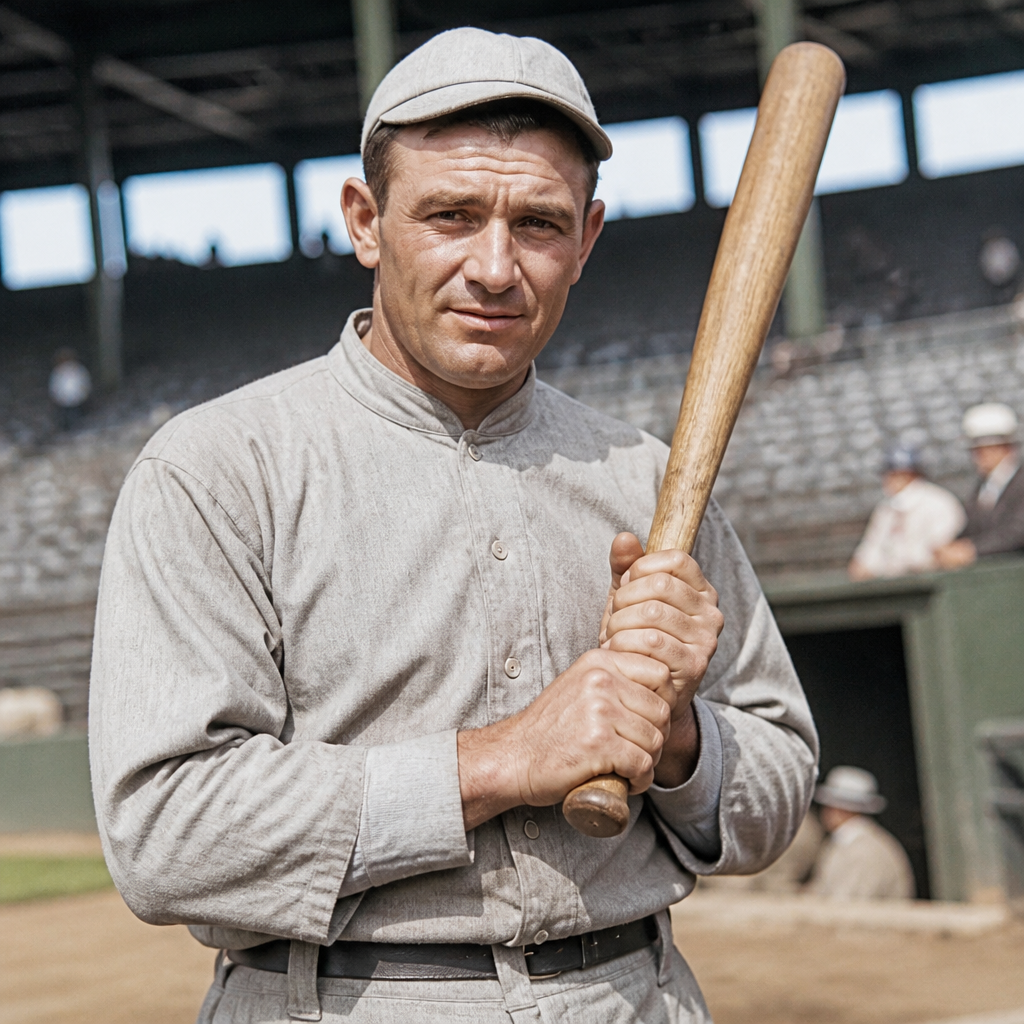
Ed Delahanty stands near the center of any serious discussion of baseball’s first great hitters, yet modern fans often know his name only in passing. Born in 1867, starring in the 1890s, and dead by 1903 under circumstances still debated, Delahanty bridged baseball’s rough early decades and the more documented era that followed. Nicknamed “Big Ed,” he combined size, bat control, power, and daring baserunning in a way that made him one of the game’s defining offensive players. For a player profile hub under Legendary Players, his career offers exactly what this subject should cover: statistical excellence, historical context, style of play, influence on later stars, and the challenge of judging nineteenth-century greatness fairly.
A player profile, at its best, does more than list teams and batting averages. It explains who a player was, what conditions he played under, how his league worked, why his numbers matter, and what parts of the legend withstand close inspection. Delahanty rewards that treatment. I have spent years working through early baseball records, Sporting Life reports, league summaries, and modern databases such as Baseball-Reference, and Delahanty repeatedly emerges as one of the most complete offensive forces of his generation. He hit for average, reached base, drove the ball with authority, stole bases aggressively, and produced season after season even while the sport itself was unstable.
That matters because early baseball can be easy to flatten into trivia. The uniforms look antique, the photos are grainy, and the rules shifted enough that many readers assume the numbers are impossible to compare. Some caution is necessary, but dismissal is a mistake. Delahanty played in major leagues recognized by historians and by Major League Baseball’s statistical record. He faced top professional competition, traveled hard schedules, and performed at an elite level for more than a decade. When discussing legendary players, his profile belongs near the front of the conversation, not tucked away as a curiosity from a distant era.
Understanding Ed Delahanty also helps define a broader standard for player profiles. The most useful profiles answer direct questions: How good was he? What made him different? Where does he rank among his peers? What limits the record? Why should a current fan care? Delahanty scores well on every point. He finished with a .346 career batting average, won batting titles, topped 100 runs and 100 RBI repeatedly, and once hit over .400 for a full season. He did this in a volatile era that rewarded offense but still demanded consistency. His story is not only about greatness; it is also about how greatness is remembered.
Early life, entry into professional baseball, and rise with Philadelphia
Edward James Delahanty was born in Cleveland, Ohio, and came from a remarkably athletic family; several of his brothers also reached the majors. He began in an era when professional baseball remained regionally rooted and organizational structures were less stable than fans know today. That context matters. Players moved between leagues, contracts were contested, and the competitive map shifted quickly. Delahanty first appeared in the majors with the Philadelphia Quakers, later the Phillies, in 1888. By the early 1890s he had become the centerpiece of one of baseball’s most dangerous lineups.
Philadelphia was an ideal stage for him. The club played in the National League during the high-offense 1890s, and Delahanty’s right-handed stroke fit both the period and the park. Contemporary accounts describe line drives to every field, tremendous strength through contact, and unusual calm against pitchers. He was listed around six-foot-one and roughly 170 to 190 pounds depending on the source, a substantial build for the time, which helped explain the nickname “Big Ed.” More important than size was balance. He did not swing wildly for effect; he hit hard because he squared the ball consistently.
His rise was steady rather than accidental. By 1892 he batted .306. In 1893, when the pitching distance changed from 50 feet to 60 feet 6 inches, offense across the sport jumped, but Delahanty was not merely a beneficiary of looser conditions. He adjusted better than most elite hitters and began producing superstar seasons. In 1894 he hit .407, one of the finest performances of the century, while collecting extra-base hits in volume. Through the middle of the decade he became synonymous with run creation, not just batting average. That distinction is crucial when evaluating legendary players from any era.
What made Big Ed an elite hitter
Delahanty was great because his offensive game had no obvious weakness. Many nineteenth-century stars were identified mainly by one standout trait: speed, bunting, slap hitting, or gap power. Delahanty brought several tools together. He hit for average because he controlled the barrel and used the full field. He slugged because he drove balls into spacious outfields and punished mistakes. He reached base at a high rate because pitchers could not work around him easily in an age with inconsistent defensive support and less specialized relief pitching.
His statistical record shows that balance clearly. He finished his career with a .346 batting average, a figure that still ranks among the best in major league history. He posted on-base percentages over .400 in multiple seasons and slugging percentages that place him among the era’s leaders. In 1899 he hit .410 for Philadelphia, becoming one of the rare players to clear the .400 mark in a full major league campaign. He also recorded four straight seasons from 1897 through 1900 with at least a .392 average, an astonishing level of sustained excellence no matter how lively the period’s conditions were.
Delahanty’s power requires special emphasis because modern readers often underestimate what “power” meant before the home run became central strategy. Parks were larger, balls were less uniform, and many hard-hit drives became triples rather than homers. Delahanty led the league in doubles and triples, and his isolated power compared strongly with his peers. He was not a dead-ball punch hitter trapped in a hitter’s era; he was an impact striker of the baseball. If he had played in a later environment with tighter ballparks and livelier equipment, his home run totals likely would have looked much larger.
He was also productive under pressure. Reports from the time repeatedly place him in the middle of rallies, extending innings with hard contact rather than merely waiting for mistakes. Because RBI were only officially tracked beginning in 1920, some nineteenth-century run production gets discussed imprecisely, but retrospective accounting confirms his middle-order value. Delahanty crossed 100 runs many times and drove in more than 100 on multiple occasions according to reconstructed records. In plain terms, if men were on base, he changed the scoreboard.
| Measure | Why it matters | Delahanty example |
|---|---|---|
| Batting average | Shows how often he turned plate appearances into hits | .346 career average |
| Peak average | Captures highest seasonal hitting level | .410 in 1899 |
| Extra-base impact | Separates hard contact from simple singles accumulation | League-leading doubles and triples seasons |
| Sustained peak | Measures whether success lasted beyond one great year | .392 or better from 1897 to 1900 |
| Run production | Reflects middle-of-order value | Repeated 100-run and 100-RBI level output |
Best seasons, signature achievements, and place among peers
The strongest way to understand Delahanty is to place his best years beside the stars around him. The 1890s featured Hall of Fame-caliber hitters including Hugh Duffy, Dan Brouthers, Billy Hamilton, Sam Thompson, and Jesse Burkett. Delahanty belongs in that company comfortably, and in some respects stands above it because of the combination of peak and durability. His 1894 season is often the first one cited, and rightly so: a .407 average, major run production, and relentless extra-base hitting. Yet his later seasons may be even more impressive because they prove 1894 was not a one-year explosion.
From 1897 through 1900, Delahanty was astonishingly consistent. He hit .392, .369, .410, and .383 in those four seasons, all while remaining a central offensive force. Very few major leaguers in any era can produce that kind of rolling excellence. Even among all-time great right-handed hitters, the stretch compares well because it mixes average, slugging, and durability. In 1899, he amassed 238 hits, one of the biggest totals of the nineteenth century. He also won batting titles and regularly finished near the top of league leaderboards in total bases, extra-base hits, and runs scored.
His move to the Washington Senators in the American League before the 1902 season is another revealing chapter. Some stars fade after changing clubs or leagues. Delahanty did not. He hit .376 in 1902 and remained among the best bats in the league, showing that his skill set translated beyond Philadelphia’s environment. That point matters for rankings. When a hitter thrives after leaving his original context, confidence in the quality of the talent rises. Delahanty was not a park illusion or a single-league specialist. He was simply one of the best hitters alive.
Measured by modern value statistics, he remains elite. His career OPS+ sits far above league average, adjusting for era and ballpark. His Wins Above Replacement total places him among the stronger position players of the nineteenth century, even with a career cut short by death at age thirty-five. Those metrics are not perfect for early baseball, especially because defensive and baserunning records can be incomplete, but they support what contemporary observers already believed. Delahanty was a franchise-level player, a yearly MVP-caliber presence before the award existed, and an obvious Hall of Famer once formal honors caught up with the sport’s past.
Style of play, weaknesses, and the challenge of evaluating nineteenth-century stars
Delahanty’s player profile becomes more credible when it includes the tradeoffs. He was not flawless. Defensively, he was usually an outfielder and not celebrated as a transformational glove. His athleticism was real, but his value came primarily from his bat. Accounts from the time also suggest inconsistency in discipline off the field, especially involving alcohol, which intersects with the final tragic chapter of his life. Ignoring those issues would make the profile thinner and less trustworthy. Great players are easier to understand when strengths and limitations are both named clearly.
As a baserunner, however, he offered more than the stereotype of a lumbering slugger. Stolen base records from the era should be handled carefully because tactics differed, but Delahanty was aggressive and smart underway. He took extra bases and pressured outfield defenses that had more ground to cover than modern alignments. In that sense he resembled later all-around stars more than one-dimensional mashers. He could hit a liner into the gap, turn it into three bases, and score quickly because nineteenth-century baseball rewarded continuous movement after contact.
Evaluating his era presents a real methodological challenge. League quality was major league quality, but conditions differed sharply from modern baseball: rough fields, changing baseballs, inconsistent scoring practices, and strategic norms built less around strikeouts and home runs. The answer is not to dismiss the era or to pretend all environments are identical. The sound approach is to compare Delahanty first to his own peers, then use adjusted metrics and context to translate his performance. By that standard, he remains elite. He dominated the competition available to him and did so for long enough that random fluctuation cannot explain the record.
That is why Delahanty belongs in any comprehensive player profile hub. He teaches readers how to think historically without losing the plain truth. The plain truth is simple: he was one of baseball’s greatest early hitters, a complete offensive force, and a star whose reputation is supported by both contemporary testimony and modern analysis.
Death, legacy, Hall of Fame status, and why Delahanty still matters
Delahanty’s death is one of baseball history’s most haunting episodes. In July 1903, after being removed from a train near the Niagara River, he plunged from the International Railway Bridge and died. Whether the fall resulted from accident, confusion, intoxication, or self-harm has never been resolved conclusively. The uncertainty has helped keep his story alive, but it should not overshadow the career itself. Too often, players from early baseball are remembered for dramatic endings instead of sustained excellence. With Delahanty, the baseball record deserves top billing.
His legacy is secure. He was elected to the Hall of Fame in 1945, recognition that placed him among the foundational stars of the professional game. Historians and analysts continue to cite him when discussing the best hitters before Ty Cobb, Honus Wagner, and the live-ball sluggers reshaped public memory. He also matters because he broadens the map of baseball greatness. The sport did not begin in 1920 or 1947. Its standards of excellence were being set decades earlier, and Delahanty was one of the players who established them.
For readers exploring Legendary Players through player profiles, Delahanty is an ideal hub subject because his career connects so many themes: the growth of the major leagues, the interpretation of old statistics, the definition of offensive dominance, and the role of biography in sports history. He was more than a high average. He was durable, feared, adaptable, and central to winning baseball. Start with his numbers, then study the context, and the conclusion holds. Ed Delahanty belongs among the greatest hitters of baseball’s early age. Use his profile as a guidepost, then keep exploring the players who built the game’s first legends.
Frequently Asked Questions
Who was Ed Delahanty, and why is he considered one of baseball’s earliest great hitters?
Ed Delahanty was one of the most dominant offensive players of nineteenth-century baseball and a central figure in any serious history of the sport’s early stars. Born in 1867, he rose to prominence during the 1890s, a period when professional baseball was still developing its identity, rules, and statistical record. Nicknamed “Big Ed,” Delahanty stood out not only because of his physical presence but because of the complete nature of his offensive game. He hit for average, drove the ball with unusual authority for his era, ran the bases aggressively, and consistently produced at a level few of his contemporaries could match.
What makes Delahanty especially important is that he helped define what an elite hitter looked like before the live-ball era, before modern media coverage, and before many fans had access to detailed daily reporting. He was not simply a good player in a primitive game; he was a transformative offensive force even when judged against the best of his own time. He regularly posted extraordinary batting averages and was one of the rare stars whose name carried weight across league lines and changing baseball structures. In that sense, Delahanty stands at the intersection of baseball’s rough, chaotic beginnings and the more organized game that followed, making him a foundational figure in the sport’s offensive history.
What made Ed Delahanty such a special hitter compared with other stars of his era?
Delahanty’s greatness came from a blend of traits that was unusually advanced for the time. He was not a one-dimensional batsman who relied only on contact or only on brute strength. Instead, he combined exceptional bat control with the ability to hit the ball hard to all fields, giving him a broader offensive profile than many nineteenth-century players. His size helped earn him the nickname “Big Ed,” but his success was not just about being bigger than his opponents. He had refined feel at the plate, could adjust to pitchers, and understood how to turn contact into consistent production.
His statistical record supports that reputation. Delahanty hit over .400 multiple times, an achievement that remains extraordinary in any era. He was also a strong extra-base hitter, which matters because it shows he was doing more than slapping singles into open spaces. He generated impact offense in a game environment that could be unpredictable, with uneven fields, evolving equipment, and less standardized conditions than modern players experience. On top of that, he was an aggressive baserunner, meaning his value did not stop once he reached base. He pressured defenses, took extra bases, and contributed to scoring in multiple ways. That complete package is why historians do not merely remember Delahanty as a productive old-time player; they view him as one of the earliest truly elite all-around hitters in baseball history.
How should fans understand Ed Delahanty’s place in baseball history today?
Modern fans should see Delahanty as more than a trivia answer or a colorful figure from baseball’s distant past. He belongs in the conversation about the sport’s first tier of offensive legends, particularly when discussing how greatness looked before twentieth-century baseball became fully documented and commercialized. Because he played before radio broadcasts, before film coverage became common, and before statistical analysis reached anything like its modern form, Delahanty’s reputation can be overshadowed by later stars whose careers are easier to visualize and compare. Even so, his performance record is strong enough that he remains impossible to ignore in a serious historical ranking of early hitters.
His importance also lies in timing. Delahanty played during a transitional period, when baseball was moving from a looser, rougher professional environment into something more stable and recognizable. That means he serves as a bridge between the game’s earliest decades and the better-preserved era that followed. For readers trying to understand the lineage of offensive greatness in baseball, Delahanty helps connect nineteenth-century hitting excellence to the later stars who became household names. He deserves to be remembered not just because he was early, but because he was great by any standard that values consistent dominance, versatility, and influence on how offensive play was understood.
Why is Ed Delahanty’s death still discussed so often in accounts of his life and career?
Delahanty’s death remains a major part of his story because it was sudden, tragic, and surrounded by uncertainty. He died in 1903 under circumstances that have never been fully settled, and that unresolved ending has naturally drawn generations of attention. In baseball history, dramatic and mysterious deaths often become inseparable from a player’s legacy, especially when the player was as prominent as Delahanty. The fact that he died relatively young, not long after building one of the most impressive offensive résumés of his era, has only deepened public fascination.
At the same time, it is important not to let the mystery overshadow the player. While the circumstances of his death are historically significant and understandably compelling, they should be viewed as the final chapter of a much larger story rather than the entire story itself. Delahanty’s baseball career is what first made him important: his hitting, his larger-than-life reputation, and his role in shaping early offensive standards. The enduring debate around his death adds a layer of human drama, but his place in baseball history was secured by what he accomplished on the field long before that final, controversial moment.
Why don’t more modern baseball fans know Ed Delahanty as well as later legends?
One major reason is distance. Delahanty played in the 1890s, which places him far outside the living memory of even the oldest generations of fans. Unlike stars from later eras, he left behind relatively little visual material, and the media ecosystem of his time could not preserve daily narratives in the way radio, television, and digital archives do now. As a result, his achievements can feel abstract to modern audiences, even though they were remarkable. Fans are often more familiar with players whose careers produced iconic images, famous calls, and extensive film footage, while Delahanty’s greatness survives mostly through written history and statistical record.
Another factor is that early baseball itself can be misunderstood. Some fans assume nineteenth-century accomplishments were less meaningful because the game was still evolving, but that view misses the point. Greatness is measured in part by how much a player separates himself from his own competition, and Delahanty did exactly that. He was not merely compiling numbers in an unformed sport; he was establishing a standard for offensive excellence. As baseball history becomes more accessible and more fans take interest in the roots of the game, Delahanty’s reputation continues to strengthen. For readers of a player profile like this one, he is worth knowing not just as an early star, but as one of the clearest examples of how dominant a hitter could be even in baseball’s formative years.