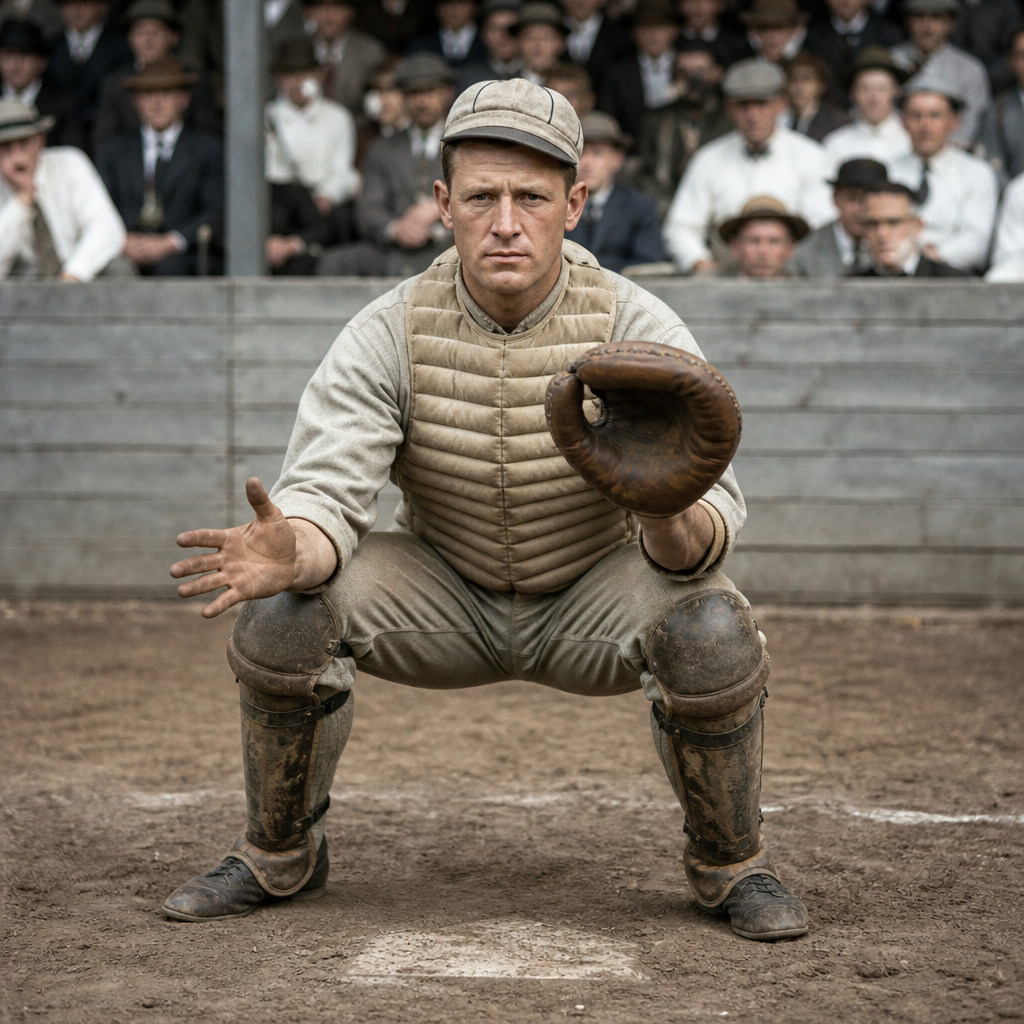
James Laurent “Deacon” White stands at the center of any serious study of player profiles from baseball’s formative professional era, because his career connects the sport’s rough amateur roots, the first stable major leagues, and the evolution of nearly every demanding position on the diamond. In a Legendary Players hub, White matters not simply as a famous nineteenth-century name, but as a model for how to evaluate early professionals whose value cannot be captured by modern highlight reels or incomplete box scores. A barehanded catcher, prolific hitter, durable infielder, and respected clubhouse presence, White built a resume that began before the National League existed and extended long enough to influence how later generations understood toughness, versatility, and baseball intelligence.
Calling him a barehanded catcher is more than a colorful label. In White’s era, catchers worked without the substantial masks, chest protectors, and padded mitts that later became standard, while pitchers threw from a flatter delivery and field conditions remained uneven. The position demanded pain tolerance, reflexes, courage, and strategic awareness. White met those demands while also producing at the plate, leading leagues in key offensive categories, handling elite pitchers, and moving successfully to third base when the physical cost of catching became too high. That combination makes him essential in any broad guide to player profiles, especially for readers tracing how baseball’s earliest stars actually created professional standards through repeated performance rather than publicity.
This article serves as a hub by using White’s story to frame the larger questions that define player profiles: how to compare eras, which statistics matter, how league context changes interpretation, and why reputation must be tested against documented achievement. I have found that early-baseball biographies become much clearer when anchored in role, environment, and contemporaneous judgment. White excels under that method. He starred in the National Association and National League, caught for powerhouse clubs, won batting titles, scored runs in volume, and earned admiration from historians who later pushed successfully for his Hall of Fame recognition. Understanding Deacon White means understanding how the first professional leagues produced stars before modern equipment, modern scheduling, and modern recordkeeping existed.
Who Deacon White Was and Why Historians Rate Him So Highly
Born in 1847 in Caton, New York, Deacon White emerged from the pre-modern baseball world in which top players often moved between clubs, rules were still settling, and professionalization carried social stigma. His nickname “Deacon” reflected his serious demeanor, and contemporary accounts consistently described him as reliable, intelligent, and disciplined. Those descriptions matter because nineteenth-century newspaper coverage often emphasized character as part of player valuation, particularly for men expected to lead teammates through travel strain, uneven pay, and constant physical punishment.
White’s career reached the major level in the National Association, generally recognized as the first professional major league, beginning in 1871. He then continued into the National League, founded in 1876, and remained productive deep into the 1880s. Across those seasons he played catcher, third base, and some outfield, proving he was not a single-skill specialist but a foundational all-around player. Historians rate him highly because he excelled in multiple competitive contexts: as an offensive force during baseball’s offensive-heavy early years, as a defensive workhorse at the game’s most punishing position, and as a veteran capable of adapting as rules and team structures changed.
Recognition came slowly because White played so long ago that many casual fans knew his name only dimly, if at all. Yet advanced historical research, including work by Bill James and nineteenth-century specialists, restored his stature. His election to the Baseball Hall of Fame by the Veterans Committee in 2013 reflected a broader correction in how the sport remembers its pioneers. White was not honored merely for being early; he was honored because he was genuinely great within his competitive environment.
White’s Place in Baseball’s Earliest Professional Leagues
To understand White, readers need to understand the leagues he played in. The National Association of Professional Base Ball Players, operating from 1871 through 1875, was loose by later standards. Schedules varied, franchise stability was weak, and governance often lacked teeth. Still, the league featured many of the best players in the country, and excellence there counts. White starred for the Cleveland Forest Citys and then the Boston Red Stockings, one of the era’s dominant clubs. Playing for Boston put him alongside figures such as Albert Spalding and Ross Barnes, and it placed him in pennant races that helped define early professional legitimacy.
When the National League replaced the National Association in 1876, the sport gained a more centralized structure, though not immediate modern order. White adapted smoothly, which is one of the strongest arguments for his quality. Players who dominate only one unstable environment can be hard to place historically. White hit and handled responsibilities in both leagues, demonstrating that his production was portable. He later played for Cincinnati, Buffalo, and Detroit, remaining relevant as clubs, travel demands, and styles of play evolved.
His league context also explains why player profiles from this era require nuance. Schedules were shorter, pitchers and batters operated under changing rules, and defenses used equipment far inferior to what even semiprofessional players would later enjoy. White’s value therefore rests not on one familiar headline number but on sustained standing among peers. In season after season, he was known, feared, and counted on. That is the core test for nineteenth-century greatness.
What Made Deacon White an Exceptional Barehanded Catcher
White’s reputation begins behind the plate. Catching barehanded in the 1870s and early 1880s was brutal work. Foul tips split fingers, direct catches bruised palms, and repeated crouching on rough fields taxed knees and backs. Masks were introduced in the mid-1870s, but protective gear developed slowly, and many players resisted changes. White spent years receiving pitches and securing outs under conditions that would be nearly unrecognizable to modern fans.
From my perspective evaluating old catcher records, the key point is not romantic toughness for its own sake. The real issue is scarcity. Very few players could catch regularly, hit well, and stay useful over time. White did all three. He worked with pitching staffs when the catcher’s tactical role was growing, called games through observation and memory, and helped convert a physically hazardous defensive assignment into a position where smart, durable athletes could create competitive advantage.
He was also strong at limiting the hidden costs of chaos. Passed balls and misplays in his era could unravel innings quickly because fields were rough and gloves provided little margin for error. Contemporary praise for White consistently emphasized steadiness. Even where exact defensive metrics are incomplete, repeated reports from newspapers and historians align: he was trusted, exceptionally hard to replace, and central to winning clubs. That is the language of a star catcher in any century.
Offensive Production: Batting Titles, Run Creation, and Context
White was not merely surviving the catcher’s workload; he was producing like a middle-of-the-order star. He won batting championships, including a .387 mark in 1875 in the National Association and a .348 average in 1877 in the National League. Those titles matter because they came in different leagues and at different points in his career. He also led in runs batted in during seasons when official RBI accounting was reconstructed later, and he regularly ranked near the top in total bases, extra-base hits, and runs scored.
Statistics from nineteenth-century baseball need context, but White’s record holds up under contextual reading. Offense was generally high in some early seasons, yet league-leading production still signals dominance relative to peers. He was not compiling empty averages on weak clubs. He hit for contenders and championship-level teams, often in pressure environments where the best players faced one another repeatedly. Historians also note that he was especially dangerous as a line-drive hitter with gap power in an age when inside-the-park extra-base hits were common and speed, placement, and aggressiveness mattered as much as over-the-fence power.
| Category | Why It Matters | White’s Historical Significance |
|---|---|---|
| Batting titles | Measures league-leading contact and consistency | Won titles in both the National Association and National League |
| Runs scored | Shows on-base skill and lineup importance | Regularly ranked among elite offensive catalysts |
| RBIs | Captures run-producing value in key spots | Recognized as one of the era’s dependable producers |
| Versatility | Increases roster value across long seasons | Shifted from catcher to third base without losing impact |
| Longevity | Tests whether performance survives change | Remained productive across multiple league phases |
One useful way to profile White is to ask a simple question: did he create runs at a star level while carrying unusual defensive burdens? The answer is yes. That dual value is why modern historians place him comfortably among the best players of his generation rather than merely among its memorable personalities.
Versatility, Durability, and the Move to Third Base
Many early catchers burned out quickly. White did not, largely because he adapted. As the physical punishment of catching accumulated, he shifted more often to third base, where his strong hands, instincts, and arm played well. That transition matters because it preserved his bat and extended his career. Great player profiles often turn on adaptation, and White’s is one of the clearest early examples.
At third base in the nineteenth century, reaction time was critical. Infields were rough, bunting and chopping the ball were common tactics, and fielders had less protective equipment than later generations. White’s ability to handle the position reinforced the view that he was a true baseball thinker, not simply a tough catcher surviving on grit. He read hops, positioned himself intelligently, and continued to contribute on clubs that needed veteran reliability.
Durability also requires proper framing. White did not play 162-game seasons, but his era imposed other hardships: long rail travel, inconsistent medical care, primitive conditioning standards, and financial instability that could pull players in and out of the game. Remaining a standout through that environment is a major achievement. When comparing player profiles across baseball history, durability should be measured against the risks of the time, and White grades extremely well by that standard.
How to Evaluate Deacon White in Modern Terms
Modern readers often ask whether White would still look impressive if judged with current analytical tools. The best answer is that while nineteenth-century data has gaps, the available evidence strongly supports his elite status. Baseball-Reference credits him with high career value, and era-adjusted measures such as OPS+ help show that his offense was not merely a product of inflated scoring conditions. He was substantially better than league average while handling demanding defensive assignments, which is exactly the combination analysts prize today.
It is also important to avoid false precision. Defensive metrics for White’s era are not as complete or as stable as modern Statcast-informed measures. We should not pretend otherwise. But uncertainty cuts both ways. If anything, incomplete records may understate the wear he absorbed and the tactical importance he carried. Contemporary testimony, team success, positional scarcity, and cross-league production all support the same conclusion: White was one of the premier all-around players of the 1870s and an important veteran into the 1880s.
For a player profile hub, his case teaches a broader lesson. The right way to evaluate early stars is to blend statistical reconstruction, league context, role difficulty, and contemporary reputation. Lean on only one of those, and the picture becomes distorted. Use all four, and White emerges clearly as a foundational great.
Legacy, Hall of Fame Recognition, and Why White Still Matters
White’s post-career legacy illustrates how baseball memory works. Because film does not exist for his prime and surviving records from the 1870s are uneven, he slipped from mainstream conversation for decades. Yet among dedicated historians, he never disappeared. Researchers kept returning to the same facts: he was one of the best hitters of the first major leagues, one of their toughest and most capable catchers, a successful infielder, and a respected figure on winning clubs. Eventually, that body of evidence proved too strong to ignore, and the Hall of Fame corrected the omission.
His legacy also reaches beyond his own plaque. White helps modern readers understand that professional baseball was built by players who operated without modern safety, labor structure, or media machinery. They established competitive norms through performance under hardship. In that sense, White is not a curiosity from a sepia-toned past. He is a central case study in baseball professionalism itself.
For anyone exploring Legendary Players through the lens of player profiles, Deacon White provides an ideal starting point. He combines historical importance, measurable production, positional difficulty, and narrative depth. Study White, and the earliest pro leagues stop looking like a foggy prelude and start looking like what they were: the first stage on which baseball stars proved what sustained excellence meant. If you are building your understanding of baseball’s greatest figures, make White one of the first names on your list, then follow his career outward to the teams, rivals, and rule changes that shaped the entire sport.
Frequently Asked Questions
Who was Deacon White, and why is he so important in early professional baseball history?
Deacon White was one of the defining figures of baseball’s earliest professional era, a player whose career helps explain how the game evolved from loosely organized amateur competition into a more structured major league sport. Born James Laurent White, he played in the decades when baseball was still inventing its standards, its positions, and even many of its expectations for professional players. That alone makes him historically significant, but White’s importance goes much deeper than simply being present at the beginning.
He starred during a period when the sport was physically harsher, strategically different, and far less standardized than modern baseball. White caught games with minimal protective equipment, handled rough pitching under rules that differed sharply from today’s game, and also excelled at other demanding positions as teams adapted to changing rosters and tactics. In that sense, he was not just a good player in an old league; he was an all-around foundational professional whose skill set reflected the game’s unfinished and experimental character.
White is also important because he bridges several baseball worlds at once. He connects the National Association, often viewed as the first professional major league, to the early National League years that helped stabilize top-level baseball. He played alongside and against many of the era’s best-known pioneers, which places him at the center of the sport’s first great competitive networks. For historians, that makes him a key reference point when comparing talent, durability, and influence across baseball’s earliest generations.
Perhaps most importantly, White forces modern readers to rethink how greatness should be measured. His value cannot be understood through television highlights, modern catcher’s gear, or contemporary statistical habits alone. Instead, his legacy rests on context: elite play under primitive conditions, adaptability across roles, and sustained excellence while the sport itself was still taking shape. That is why Deacon White remains essential to any serious discussion of legendary players from baseball’s formative professional age.
Why was Deacon White known as a “barehanded catcher,” and what does that reveal about his talent?
Calling Deacon White a “barehanded catcher” points directly to one of the most demanding realities of nineteenth-century baseball: catchers did their work before modern protective equipment became standard. White played in a time when gloves were either rudimentary or not regularly used in the way fans now associate with the position, and catchers often worked much farther back from the batter than modern backstops do. Even so, the job was punishing, dangerous, and intensely skilled. A catcher had to absorb foul tips, handle unpredictable pitches, field bunts and pop-ups under difficult conditions, and maintain command of the game without the protection that later generations took for granted.
This reputation reveals a great deal about White’s toughness, but it should not be reduced to toughness alone. Enduring pain was part of the role, yet surviving at the position for any length of time required hand strength, reflexes, anticipation, balance, and remarkable concentration. Early baseballs were not as uniformly manufactured as those used in modern leagues, field conditions were uneven, and pitchers and batters operated under rules that were still developing. A catcher in that environment had to adjust constantly, and White’s success suggests a player of unusual intelligence and technical competence.
His barehanded reputation also underscores how different catching was in his era. Today, the position is evaluated through framing metrics, pitch sequencing, game-calling language, and advanced defensive data. In White’s day, the catcher’s challenge was more elemental and arguably more brutal: receive difficult pitches, prevent chaos, and remain physically capable of playing day after day. That White became one of the standout names of the era while doing this speaks volumes about his quality.
For modern readers, the phrase “barehanded catcher” serves as a shortcut into the larger truth of White’s career. It reminds us that he excelled at one of baseball’s hardest jobs when the position demanded extraordinary courage and adaptability. It also helps explain why historians continue to regard him with such respect: he was not merely an early catcher, but one of the players who defined what elite catching looked like before the game had developed the tools that would make the position even remotely safer.
What positions did Deacon White play, and how did his versatility shape his legacy?
Although Deacon White is most famously associated with catching, his career was not limited to one role, and that versatility is a major part of his historical significance. Like many top players of the nineteenth century, White moved among positions as team needs, league structures, and baseball strategy evolved. In addition to catcher, he spent substantial time at third base and contributed elsewhere on the field as needed. This was not unusual in his era, but White’s ability to remain effective while shifting responsibilities says a great deal about his athleticism and baseball intelligence.
Versatility mattered differently in early professional baseball than it does today. Modern players usually develop within highly specialized systems, and elite defenders often spend most of their careers mastering one position. White played in a period when roster construction was looser, season-to-season continuity was less certain, and strategic experimentation was common. Teams needed reliable professionals who could adapt, and White’s capacity to do so helped make him especially valuable. He was the kind of player a club could build around not only because he performed well, but because he could stabilize multiple areas of the lineup and defense.
His move from the physically punishing role of catcher to infield work also helps illustrate the arc of a long nineteenth-century career. Catching in that era took a tremendous toll, and shifting to another demanding position could extend a player’s usefulness while preserving his bat and experience. White’s success outside of catcher strengthens the case that his greatness was not a product of one narrow specialty. He was a complete ballplayer whose contributions translated across the diamond.
This versatility shapes his legacy by making him more than a symbol of old-time endurance. It presents him as a sophisticated early professional who succeeded in multiple baseball environments. For historians trying to evaluate players from baseball’s first major leagues, that kind of adaptability is a powerful indicator of quality. White’s legacy is therefore not just that he caught barehanded, but that he excelled wherever the evolving game asked him to play.
How should modern fans evaluate Deacon White’s accomplishments when statistics and footage from his era are limited?
Modern fans should begin by accepting that evaluating Deacon White requires a different method than evaluating a twentieth- or twenty-first-century star. There is no film archive full of defensive highlights, no complete set of modern advanced metrics, and no easy one-number summary that can capture his full value. Instead, White must be judged through a combination of surviving statistics, league context, contemporary accounts, positional difficulty, durability, and the broader historical environment in which he played.
The first step is to recognize that raw numbers from the nineteenth century can be misleading if removed from context. Offensive conditions varied widely, rules changed, equipment differed, and league quality was still stabilizing. A batting total, defensive record, or run-production figure cannot simply be dropped into a modern comparison chart. What matters more is how White performed relative to his peers and how consistently he remained an impact player across changing competitive conditions. By that standard, he stands out as one of the era’s most respected and accomplished professionals.
Contemporary reputation also matters more for players like White than it might for modern stars, because eyewitness testimony filled in what statistics could not fully measure. Writers, fellow players, and later historians repeatedly identified him as a standout talent and a central figure of early professional baseball. While old newspaper praise should never be accepted uncritically, broad and durable respect from multiple sources is meaningful, especially when it aligns with the available record of his performance and longevity.
Position must also be factored in carefully. Catching under nineteenth-century conditions imposed enormous physical and tactical demands, and White’s excellence there deserves extra weight. So does his ability to contribute elsewhere in the field. A modern fan trying to assess him fairly should ask not whether his game looked like today’s stars, but whether he dominated the version of baseball that existed in his own time. The answer is yes. When judged relative to era, competition, and role, Deacon White emerges not as a curiosity from the sport’s distant past, but as a genuine all-time great of baseball’s foundational decades.
Why does Deacon White still matter in conversations about Hall of Fame history and baseball’s legendary players?
Deacon White still matters because Hall of Fame history is not only about honoring the most familiar names, but about preserving the full story of how baseball became what it is. Early professionals are often the easiest stars to overlook because their careers unfolded before modern media, before stable statistical systems, and before the game’s mythology hardened around later generations. White’s place in those conversations reminds fans and historians that baseball’s first great players helped invent the standards by which later legends would be judged.
His significance in Hall of Fame discussions comes from both performance and representation. On performance alone, White was one of the standout players of baseball’s earliest professional decades, contributing at elite levels while handling some of the sport’s toughest assignments. On a broader historical level, he represents a class of pioneering players whose greatness can disappear if the sport values only modern visibility. Recognizing White helps correct that imbalance and expands the Hall of Fame conversation beyond the most easily market