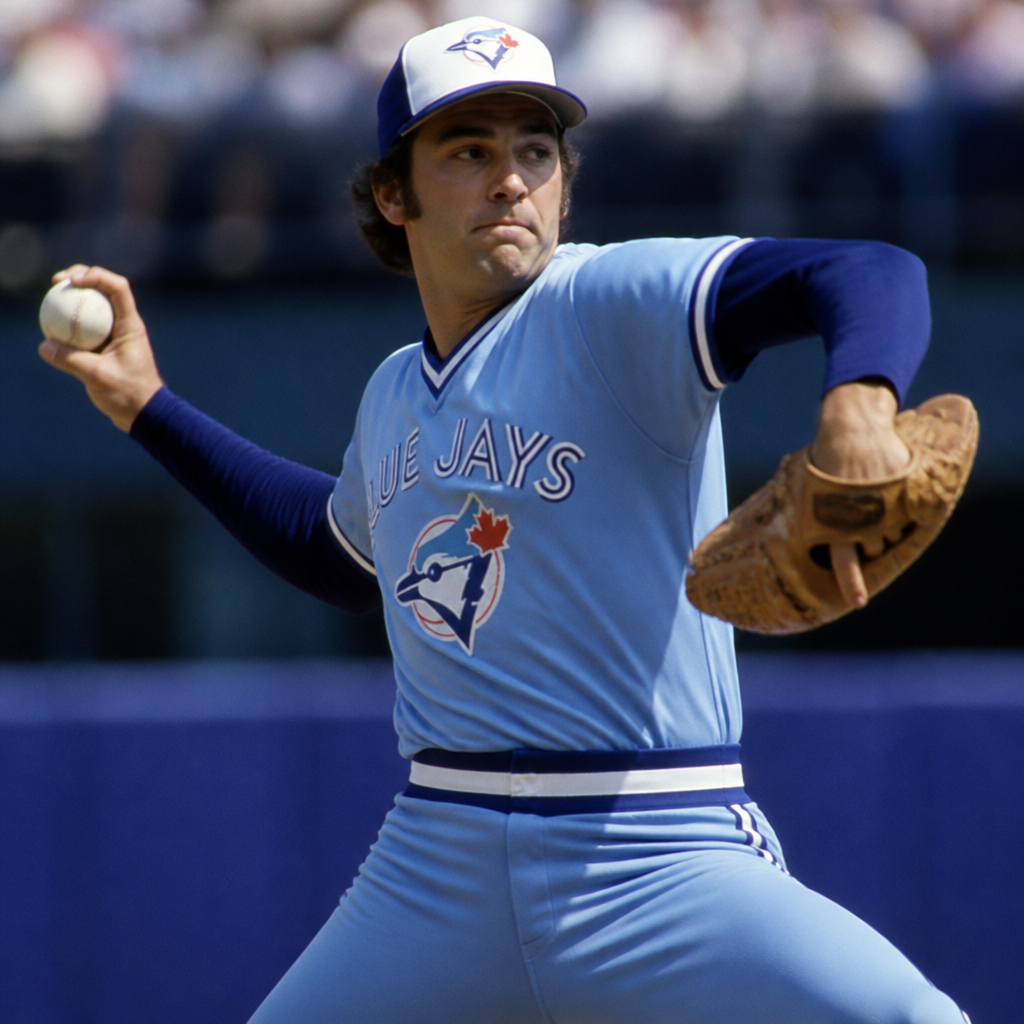
Dave Stieb stands at the center of any serious discussion about the Toronto Blue Jays’ formative years because he was the club’s first true ace, its most dominant homegrown pitching force, and the pitcher who gave a young expansion franchise credibility. In player profiles, an ace is more than the best arm on a roster; he is the starter trusted to stop losing streaks, carry heavy workloads, and face elite lineups without excuses. A near no-hitter is exactly what it sounds like, but in Stieb’s case the phrase became part of baseball lore, because he took heartbreaking one-hit or last-out losses into the ninth inning again and again before finally finishing the job. His devastating slider, thrown with late tilt and conviction, gave him the out pitch that separated good starts from overpowering ones.
This player profile matters because Stieb’s career explains how Toronto evolved from expansion afterthought to contender. He arrived before the franchise had a winning identity, and he helped create one through volume, durability, and relentless competitiveness. From my perspective studying old game logs, broadcasts, and era-adjusted pitching records, Stieb’s case also reveals how easily greatness can be overlooked when it happens outside New York or Los Angeles. He pitched in the American League East during a brutal period, often against deep lineups in hitter-friendly environments, yet he still produced seasons that compare favorably with better-publicized contemporaries. For a Legendary Players hub, Stieb is not just a chapter in Blue Jays history. He is the standard by which every Toronto starter is measured.
Understanding Stieb requires a few core terms. Earned run average measures runs charged to a pitcher per nine innings, but it can hide context. ERA+ adjusts for league and park conditions, with 100 as average; Stieb’s career mark of 122 shows he was consistently better than his environment. WAR, or Wins Above Replacement, estimates total value relative to a readily available player, and Stieb’s Baseball-Reference total places him among the most valuable pitchers of the 1980s. Complete games and shutouts mattered more in his era than they do now, and Stieb excelled there too, routinely working deep into games. When people ask why his reputation has grown over time, the answer is simple: modern analysis has caught up to what Toronto fans saw live.
How Dave Stieb Became Toronto’s First Ace
Born in Santa Ana, California, Dave Stieb did not enter professional baseball with the celebrity attached to many future stars. The Blue Jays selected him in the fifth round of the 1978 draft after he had played both baseball and basketball at Southern Illinois University. Toronto was still building scouting networks, player development systems, and organizational habits, so identifying and developing a frontline starter so early in franchise history was significant. Stieb reached the majors in 1979, only the team’s third season, and by 1980 he was clearly more than a promising arm. He was becoming the pitcher managers planned around and opponents respected.
The transition from useful starter to staff ace happened quickly because Stieb combined several traits that travel well across eras. He attacked the strike zone, handled innings, fielded his position well, and rarely looked intimidated by established stars. In 1980 he made the American League All-Star team, a major statement for both player and franchise. By 1981 and 1982 he was piling up innings while posting strong run prevention in a division that included the Yankees, Brewers, Orioles, and Red Sox. Toronto still lacked roster depth, but when Stieb took the mound the game’s geometry changed. The Blue Jays were no longer simply hoping to compete; they expected to.
What made him Toronto’s first ace was not one award or one headline season. It was repetition. From 1980 through 1990, Stieb was the constant. He led by example rather than theatrics, and teammates understood that his standards were exacting. He did not pitch with detached calm; he pitched with visible edge. That competitiveness fit the city and the club. When the Blue Jays rose into contention in the mid-1980s, winning the 1985 division title and staying relevant through the decade, Stieb’s workload anchored the climb. Every serious player profile in the franchise’s history starts here because the role he defined did not exist before he arrived.
The Pitch Mix: Fastball Command and a Devastating Slider
Stieb’s signature weapon was his slider, but reducing him to one pitch misses why hitters struggled so much. At his best, he paired a lively fastball with command to both sides of the plate, then used the slider as the finishing strike. He also mixed a curveball and changeup enough to disrupt timing, yet the slider drove the scouting report. Catchers and opponents described sharp late movement, and the pitch played up because his delivery sold fastball intent. Hitters would commit early, then watch the ball dart away from the barrel or dive under a bat path built for harder, straighter contact.
From a mechanics standpoint, the slider worked because Stieb repeated his arm slot and threw with conviction. Many pitchers cast breaking balls, tipping them through slower arm speed or altered release. Stieb generally did not. The result was a pitch that looked hittable until it was not. Against right-handed hitters, he could start it on the outer third and let it disappear off the plate. Against left-handers, he could back-foot it or front-door versions when ahead in the count. Modern pitch tracking was unavailable in his prime, but the outcomes tell the story: weak contact, late swings, and a large number of strikeouts relative to his era.
His approach also reflected old-school starter logic that still holds up under modern analysis. He was not chasing strikeouts on every pitch. He was creating uncomfortable at-bats, forcing hitters into defensive swings, and extending dominance across nine innings when needed. That matters when evaluating player profiles because pure stuff alone does not make an ace. Sequencing, stamina, and adjustment do. Stieb could open a game with fastball authority, show the curve enough to change eye level, and then weaponize the slider when leverage rose. If a lineup sat on the breaker, he beat them with command. If they geared up for the fastball, the slider ended the argument.
The Near No-Hitters That Defined His Myth
No part of Stieb’s legacy is more emotionally vivid than the string of near no-hitters that slipped away at the final moment. In 1988 and 1989, he carried multiple no-hit bids into the ninth inning with two outs, only to lose them on the last batter or one of the final swings. These were not routine one-hitters; they were theater. Fans can still recite the names. On September 24, 1988, against Cleveland, he lost a no-hitter with two outs in the ninth. On September 30, 1988, against the Yankees, the same thing happened. On August 4, 1989, against Texas, again he was one out away. For most pitchers, one such heartbreak would define a career memory. Stieb endured several.
The repeated cruelty created a strange public image. Instead of being discussed first as one of baseball’s best pitchers, he became the answer to a trivia question about almost-history. That was unfair, but it also contributed to his mystique. He was clearly good enough to dominate lineups for eight and two-thirds innings, often with little margin for error, yet baseball’s random edge kept denying him the clean ending. Analysts today would frame those games as proof of sustained elite process rather than failure. A bloop single or a seeing-eye grounder after twenty-six outs does not invalidate the previous excellence. If anything, it magnifies how hard no-hitters are to complete.
Then came September 2, 1990. Facing the Cleveland Indians, Stieb finally completed the task, throwing the only no-hitter in Blue Jays history until later generations added their own entries. The emotional release mattered because it closed a narrative loop that had followed him for years. More importantly, it reminded observers that the near misses had not been flukes. They were evidence of a pitcher with overpowering command, competitive stamina, and the ability to maintain stuff deep into games. In a hub covering player profiles, this is a useful lesson: defining moments attract attention, but repeated brushes with greatness often tell you more about the player than the final box score does.
Peak Value, Awards, and How Good He Really Was
Stieb’s prime was stronger than many casual fans realize. Between 1980 and 1990, he made seven All-Star teams, led the American League in ERA in 1985, threw frequently over 250 innings in an era when that burden still belonged to top starters, and finished high in Cy Young voting multiple times. He never won the Cy Young Award, but award voting in the 1980s often leaned on pitcher wins, team record, and conventional narratives more than the full quality of run prevention and workload. That context is critical. A pitcher can perform at an award-winning level and still go home empty-handed if his team scores poorly in his starts or if another candidate has flashier win totals.
Advanced metrics strengthen Stieb’s case. Baseball-Reference WAR rates him as one of the most valuable pitchers of the decade, and historical studies by analysts at FanGraphs and other outlets regularly place him near the top of 1980s starters when park and league conditions are adjusted. He pitched in a high-offense environment, especially in the AL East, and still maintained strong rate statistics. In practical terms, that means he was not thriving in a soft schedule or an unusually friendly run-scoring context. He was surviving, and often dominating, against lineups loaded with Hall of Fame and All-Star caliber hitters.
| Measure | Why It Matters | What It Says About Stieb |
|---|---|---|
| ERA+ | Adjusts ERA for ballpark and league scoring | 122 career mark shows sustained above-average excellence |
| Innings pitched | Reflects durability and trust | Worked ace-level volume across Toronto’s rise |
| All-Star selections | Captures peer and league recognition | Seven selections confirmed his decade-long standing |
| WAR | Estimates total value beyond wins | Ranks among the most valuable pitchers of the 1980s |
When I compare Stieb with better-known peers, the strongest conclusion is that he was underrated, not marginal. He belongs in the conversation with the top American League starters of his era, even if he lacked a trophy shelf matching his talent. That distinction matters for any Legendary Players page because player profiles should separate reputation from value. Stieb’s value was immense. Toronto did not merely have a good pitcher. It had one of the decade’s defining arms.
Leading the Blue Jays from Expansion Team to Contender
Franchise context is essential to Stieb’s profile. The Blue Jays debuted in 1977 and spent their early seasons doing what expansion clubs usually do: losing, experimenting, and trying to identify which players could anchor a future winner. By the early 1980s, under manager Bobby Cox and then others, Toronto began turning athleticism and improved development into something sturdier. Stieb was the rotation’s center. His starts set competitive expectations for a roster that was still learning how to win over six months instead of six games.
By 1985, when the Blue Jays won the American League East, Stieb was no longer just a talented survivor on a rebuilding team. He was the established ace of a legitimate contender. That club featured stars like George Bell, Lloyd Moseby, Jesse Barfield, Tony Fernández, and Willie Upshaw, but the pitching identity started with Stieb. He delivered 265 innings, a 2.48 ERA, and one of the best seasons by any Blue Jays pitcher to that point. Toronto came within one game of the World Series in the ALCS against Kansas City. The ending was painful, yet the broader truth remained: the franchise had arrived, and Stieb was central to the arrival.
His leadership style was intense rather than polished. He expected precise defense, sharp preparation, and accountability. That approach can wear on people, but on young clubs it can also establish standards that matter later. Toronto’s later championship rotations in the early 1990s were built differently, with additions like Jack Morris, Dave Stewart, and Juan Guzmán, but they inherited a franchise that already understood what top-of-rotation pitching looked like. Stieb gave the organization that blueprint first. In any comprehensive player profile hub, that institutional impact should count alongside statistics because stars shape habits, not just standings.
Legacy, Hall of Fame Debate, and Why Modern Fans Should Revisit Him
Stieb’s post-career reputation has undergone a deserved correction. For years, Hall of Fame discussions treated him as very good but not historic, in part because he lacked 300 wins, a Cy Young Award, or a long postseason résumé as a central figure. Those benchmarks once dominated pitcher evaluation. Modern analysis is more precise. It asks how much value a player created relative to his environment, how strong his peak was, and whether his best seasons were truly elite. By those standards, Stieb looks much stronger. He has become a favorite example of a pitcher whose greatness was partially hidden by old voting habits and market visibility.
That does not mean the Hall case is simple. His career totals were trimmed by injuries and decline in the early 1990s, and he did not compile the headline milestones that sway many voters. Reasonable people can disagree on where his résumé ranks among borderline candidates. But the more important point for readers exploring Legendary Players is that Hall debates should not be the only filter for historical importance. Stieb is unquestionably one of the most important players in Blue Jays history, one of the best pitchers of the 1980s, and a model for how deeper evaluation can challenge surface narratives.
Modern fans should revisit him because his career answers several useful baseball questions at once. What does an ace look like on a rising franchise? How does one pitch, in this case a devastating slider, alter a hitter’s entire decision tree? Why do near no-hitters capture the imagination so powerfully? And how often do great players become underrated simply because their dominance does not fit the easiest story? Watch the old highlights, read the era-adjusted numbers, and explore the rest of this Player Profiles hub to place Stieb among the game’s most compelling stars. Once you do, Toronto’s first ace becomes impossible to underrate.
Frequently Asked Questions
Why is Dave Stieb considered the Toronto Blue Jays’ first true ace?
Dave Stieb is considered the Toronto Blue Jays’ first true ace because he gave the franchise something every young club desperately needs: a pitcher who could reliably lead the staff, absorb pressure, and compete like a frontline star against the best teams in baseball. In the formative years of an expansion organization, that kind of player does more than pile up statistics. He establishes standards. Stieb was the starter Toronto could hand the ball to when the club needed to halt a skid, match up with elite opposing pitchers, and prove it belonged on the same field as more established teams.
What separated Stieb from simply being the Blue Jays’ best pitcher was the totality of his role. He handled demanding workloads, worked deep into games, and routinely faced difficult assignments. He was not protected from tough lineups or carefully sheltered from high-leverage situations. He was expected to set the tone. For a franchise still building its identity, that mattered enormously. He became the pitcher who made Toronto look credible before the club fully matured into a contender.
His status as the Blue Jays’ first ace also reflects how dominant he was within the context of his era. He was not merely good compared with his own teammates; he was respected across the league. That distinction is important. An ace is measured not just by internal team value but by how he stacks up against baseball’s broader pitching landscape. Stieb earned that level of respect through performance, consistency, and the unmistakable feeling that when he was on the mound, Toronto had a legitimate chance against anyone.
What made Dave Stieb’s slider so devastating?
Dave Stieb’s slider was devastating because it combined late movement, sharp break, and complete conviction from the pitcher throwing it. Great sliders are not just difficult to hit because they move; they are difficult to recognize, difficult to track, and difficult to square up before the batter realizes the ball is no longer where it first appeared to be. Stieb’s version of the pitch had that kind of attacking quality. It looked competitive coming out of his hand, then veered away from barrels and into locations that generated weak contact, empty swings, and frustration.
The pitch also worked because Stieb trusted it. That confidence matters. Some pitchers use a breaking ball as a change-of-pace offering, but Stieb’s slider functioned as a true weapon. He could turn to it in key counts, against strong hitters, and in moments when he needed a put-away pitch. Hitters could know it was coming and still struggle to do much with it. That is usually the clearest sign of a special breaking ball: anticipation does not guarantee success.
Just as important, the slider fit the rest of his approach. Stieb was not surviving on trickery alone. He attacked hitters with a competitive edge and the willingness to challenge them. When a pitcher establishes that mentality, his best secondary pitch becomes even more dangerous because hitters cannot simply sit back and react comfortably. They have to prepare for a broader attack pattern. In Stieb’s case, the slider became central to his identity, helping define him as a powerfully effective, no-nonsense ace whose stuff could control at-bats and alter games.
Why are Dave Stieb’s near no-hitters such a memorable part of his legacy?
Dave Stieb’s near no-hitters are so memorable because they captured both his brilliance and the cruel unpredictability of baseball. A no-hitter sits in a rare category of achievement, and coming within one or two outs of completing one creates a special kind of drama. In Stieb’s case, those close calls became unforgettable because they happened more than once, often ending in emotionally jarring fashion. Each bid reinforced how overpowering he could be, while each late hit added a layer of heartbreak that made the story even more compelling over time.
These games matter to his legacy because they are vivid proof of his dominance. You do not repeatedly get to the edge of a no-hitter by accident. Reaching that point requires command, stamina, confidence, and the ability to maintain focus through rising tension. Even though the final line in those near misses fell short of perfection, the performances themselves showcased Stieb at his absolute peak. They remain some of the clearest examples of how completely he could control a game.
There is also a larger emotional reason those near no-hitters endure in baseball memory. Fans tend to remember not only triumph but also tension, suspense, and near-tragedy. Stieb’s repeated brushes with history gave his career a dramatic thread that people still talk about decades later. Rather than diminishing him, those near misses added texture to his story. They highlighted both how close he came to a singular achievement and how often he pitched at a level worthy of one. In that sense, the near no-hitters became part of the mythology surrounding Toronto’s first ace.
How important was Dave Stieb to the Blue Jays during the franchise’s early years?
Dave Stieb was enormously important to the Blue Jays during their early years because he represented stability, excellence, and ambition at a time when expansion teams often struggle for identity. New franchises are usually defined first by their growing pains, but a pitcher like Stieb changes that conversation. He gave Toronto a player around whom credibility could form. Instead of being seen only as a developing club, the Blue Jays had a genuine standout who demanded league-wide respect and showed that high-end talent was already in place.
His importance went beyond the mound, even though that is where his value was most visible. Every fifth day, he gave the team a different energy. Teammates knew they had a chance to win. Opponents knew they would have to earn everything. Fans had someone they could rally around as a symbol of the franchise’s potential. For a young organization still trying to establish trust with its market and confidence within its clubhouse, that kind of impact is significant. Stieb helped create belief before championships or sustained contention arrived.
He also helped shape expectations for what top-tier pitching in Toronto should look like. Future success is easier to imagine when a franchise has already seen one of its own perform like a star. Stieb became that standard. His workload, competitiveness, and ability to deliver against strong competition set a model for excellence. That is why his role in Blue Jays history remains foundational. He was not just a very good pitcher on an early roster; he was one of the key reasons the franchise matured from expansion novelty into serious baseball operation.
How should fans remember Dave Stieb in the broader history of baseball and Blue Jays baseball?
Fans should remember Dave Stieb as one of the defining figures in Blue Jays history and as a pitcher whose value is even clearer when viewed through a modern lens. In Toronto’s story, he belongs among the franchise’s most essential players because he established what greatness looked like before the team reached its later heights. He was the bridge between the Blue Jays’ uncertain beginnings and their emergence as a respected contender. That alone secures his place in team history.
In broader baseball terms, Stieb deserves recognition as more than a local favorite or a good pitcher on an improving team. He was a genuine top-of-the-rotation force whose performance level often matched or exceeded that of more publicized contemporaries. Because he pitched in an era when some forms of pitcher evaluation were less commonly discussed by mainstream audiences, parts of his excellence were not always fully appreciated in real time. As later analysis has revisited his career, many observers have come to see him as one of the standout pitchers of his generation, not simply a strong arm on a regional club.
Perhaps the best way to remember him is as a complete baseball character: dominant, durable, intense, and dramatic. He had the ace’s burden of carrying a young team, the wipeout slider that defined his style, and the unforgettable near no-hitters that added tension and mystique to his career arc. That combination makes him memorable in a way that ordinary success does not. For Blue Jays fans, he was the first pitcher who truly made the franchise feel formidable. For baseball fans more generally, he remains an example of how greatness can be both obvious on the field and underappreciated in the historical conversation until later generations take a closer look.