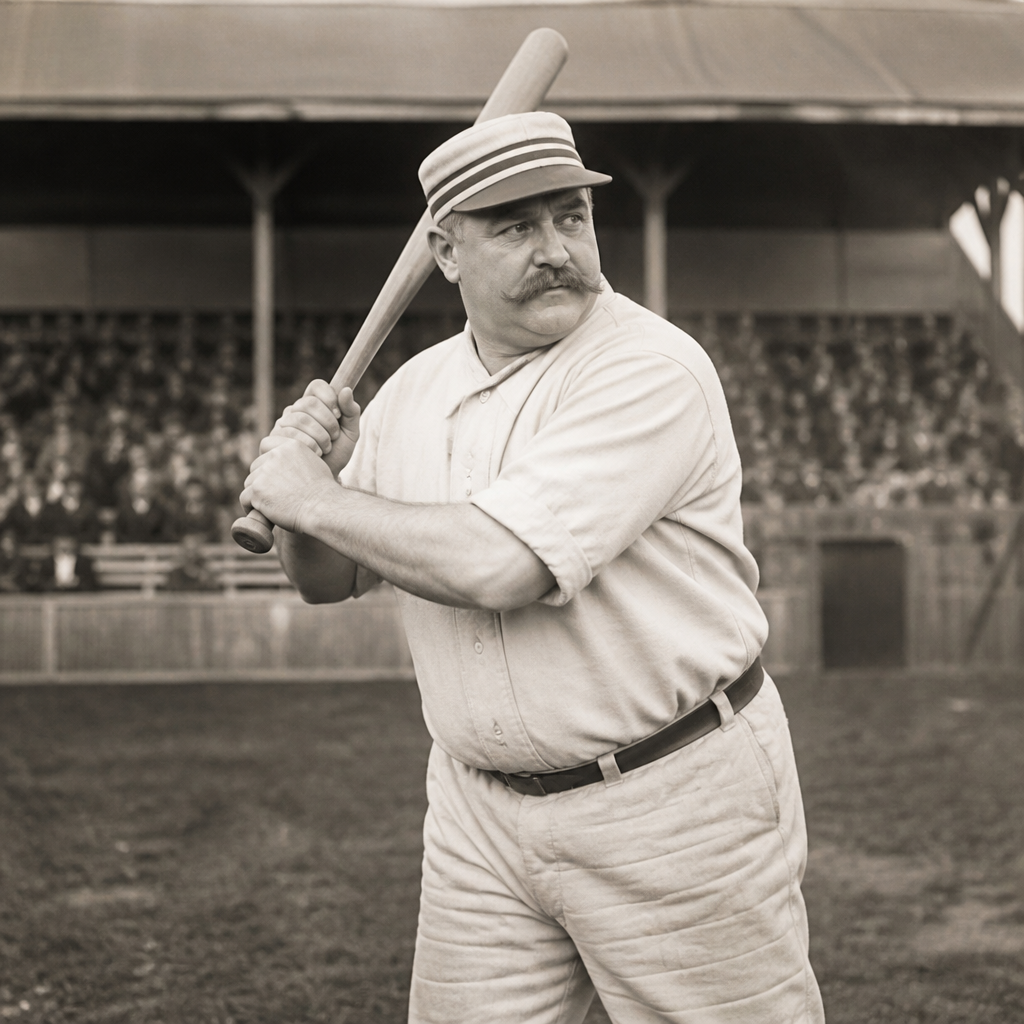
Dan Brouthers was baseball’s first great power hitter, a left-handed first baseman whose dominance in the 1880s showed what run production looked like before the home run became the sport’s defining spectacle. In any serious discussion of Player Profiles within the Legendary Players landscape, Brouthers belongs near the front because he bridges baseball’s formative decades and the modern idea of offensive greatness. He did not pile up towering home run totals in the Babe Ruth sense; instead, he overwhelmed pitchers with batting average, extra-base authority, plate discipline by nineteenth-century standards, and a level of consistency that forced contemporaries to redesign expectations for what a star batter could be.
A player profile is more than a biography. It is a structured study of a player’s era, role, statistical record, playing style, team context, and long-term influence. When I build baseball player profiles, especially for nineteenth-century stars, the challenge is separating myth from evidence. Records from the National League, the old American Association, and the Players’ League can look unfamiliar to modern readers because rules changed constantly, schedules varied, and scoring practices were less standardized than today. That context matters with Brouthers because his greatness becomes clearer, not weaker, when you understand the environment he played in.
Brouthers, born in 1858 in Sylvan Lake, New York, played in the major leagues from 1879 through 1904, though his prime came from the early 1880s into the early 1890s. He starred for Buffalo, Detroit, Brooklyn, Baltimore, and Louisville, winning batting titles, leading leagues in slugging, and helping championship-level clubs. Baseball-Reference credits him with a .342 career batting average, a .423 on-base percentage, and a .520 slugging percentage, extraordinary marks for any era. His 1887 season, when he hit .338 with 14 home runs, reflected not just isolated power but total offensive control in a game built around contact, speed, and gap hitting.
This hub article covers Player Profiles through Brouthers’s example: how to evaluate historical players, which numbers matter, why era context changes interpretation, and what made this nineteenth-century slugger so influential. If you want one central page that explains how legendary player profiles should be read, Brouthers is an ideal anchor. His career asks the right questions: How do you compare players across eras? What does power mean in dead-ball-adjacent conditions? Which traits translate beyond statistics? Answer those well, and you understand not only Dan Brouthers, but the entire craft of profiling baseball legends.
Why Dan Brouthers Matters in Player Profiles
Dan Brouthers matters because he gives historians and fans a clean case study in identifying greatness before modern media, modern ballparks, and modern offensive patterns. Many casual readers know nineteenth-century names like Cap Anson or King Kelly, but Brouthers often gets less attention than his production warrants. That gap makes him valuable in a Player Profiles hub. He represents the kind of player whose reputation needs rebuilding through evidence.
At first base, Brouthers combined size, strength, and advanced hitting judgment in ways that stood out dramatically. Contemporary reports regularly emphasized the violence of his line drives and the fear he created when runners were on base. He was listed around six feet two inches and over two hundred pounds, a massive frame for his time. In an era when many hitters chopped down on the ball or focused on placement, Brouthers drove it with intent. That is why historians frequently describe him as the nineteenth century’s closest precursor to the modern slugger.
For a hub page on Player Profiles, his example also teaches methodology. A complete profile should cover biography, physical tools, primary position, key seasons, league conditions, awards or pennants, signature skills, and legacy. It should also explain limitations. For Brouthers, one limitation is that defensive metrics from his era are incomplete and often unreliable by current standards. Another is that league quality fluctuated because rival circuits emerged and collapsed. A strong profile does not hide those issues; it explains how to work around them.
Career Timeline and Team Context
Brouthers debuted with Troy in 1879, but his stardom began with the Buffalo Bisons of the National League. By 1881 he was one of the game’s most dangerous hitters, and from 1882 through 1890 he was routinely among baseball’s offensive leaders. He later played for the Detroit Wolverines, Brooklyn Bridegrooms, and other clubs during a period when player movement reflected both financial instability and aggressive league competition. Those team changes were not signs of decline. In many cases, they showed how badly clubs wanted an elite middle-of-the-order force.
His Detroit years are especially important. The Wolverines won the 1887 National League pennant, and Brouthers was central to that title run. Detroit’s lineup also featured Hall of Fame talent such as Sam Thompson, Ned Hanlon, and Hardy Richardson, giving Brouthers support but also proving he could thrive among other stars rather than merely carry weak teams. Later, with Brooklyn, he remained a premier hitter as the franchise evolved into one of the sport’s major powers.
League context shaped his numbers. The pitching distance, the rules on balls and strikes, overhand pitching legality, and equipment quality all changed during his career. For example, early pitching was delivered from shorter distances, yet pitchers also worked under constraints that made dominant velocity and spin less decisive than they became later. Fielding gloves were primitive, fields were uneven, and official scoring could be generous. These conditions affected everyone, which is why relative dominance is the fairest measurement. Brouthers was not just excellent; he was repeatedly far better than his peers.
How to Read Brouthers’s Numbers
Traditional counting stats only tell part of the story, so a useful player profile has to combine raw totals with rate statistics and league-adjusted measures. Brouthers finished with 2,296 hits, 106 home runs, 1,296 runs batted in, and 527 doubles. Those totals are impressive, but his rate production is what truly separates him. He won five batting titles and led his league in slugging percentage multiple times. His OPS+ is commonly listed at 170, meaning he created offense at a rate 70 percent better than league average after adjusting for park and era. That is inner-circle production by any standard.
One reason the home run total can mislead modern readers is that nineteenth-century ballparks, rules, and strategic norms did not encourage over-the-fence hitting the way twentieth-century baseball did. Slugging then often meant doubles, triples, and brutally hard line drives that split outfielders on rough grass. Brouthers excelled at exactly that kind of damage. He topped 100 runs scored seven times and drove in runs in environments where lineup protection and scoring opportunities varied widely from season to season.
| Profile Element | What It Shows for Brouthers | Why It Matters |
|---|---|---|
| Batting Average (.342) | Elite contact and sustained run creation | Shows he was not a one-dimensional power hitter |
| Slugging Percentage (.520) | Exceptional extra-base authority for his era | Best single shorthand for his offensive identity |
| OPS+ (170) | Dominance relative to league conditions | Helps compare him across eras |
| Batting Titles (5) | Repeated seasonal excellence | Confirms that peak value lasted, not flashed |
| Teams and Leagues | Success across changing competitive environments | Strengthens the case that his skills were portable |
When profiling legendary players, I also look for category overlap. The best hitters usually appear near the top of several leaderboards at once. Brouthers did that consistently: average, slugging, total bases, doubles, runs, and run production. That pattern is more persuasive than any one isolated number because it shows a complete offensive engine, not a stat-line quirk.
Playing Style: Power Before the Home Run Age
Brouthers earned the label slugger because he hit the ball harder than most of his contemporaries, not because he approached offense the way a modern launch-angle hitter would. Reports from the period describe him as patient enough to wait for pitches he could drive, yet aggressive once he got them. He used a long, forceful swing, and his size allowed him to generate carry uncommon for the 1880s. This is a crucial distinction for Player Profiles: power is era-specific. In Brouthers’s day, a hitter who terrorized gaps and alleys could be just as destructive as a later home run king.
He was also more athletic than stereotypes about early first basemen suggest. Though first base was his defensive home, he ran well enough in his younger years to stretch hits and score frequently. Unlike some nineteenth-century stars whose value was tied heavily to bunting, stealing, or tactical placement, Brouthers imposed himself by force. Pitchers knew he could erase mistakes. Fielders knew shallow positioning was dangerous. Managers knew building an offense around his bat was rational strategy.
That style influenced how future stars were understood. When later historians searched for pre-Ruth examples of offensive intimidation, Brouthers was an obvious reference point. He demonstrated that baseball had room for physically imposing hitters long before the live-ball era transformed roster construction.
Peak Seasons and Signature Achievements
Brouthers’s peak was long enough that choosing one defining season is difficult, which is usually a sign of true greatness. In 1883 he hit .374 and led the National League in several offensive categories. In 1886 he batted .370 with a .470 on-base percentage and a .581 slugging percentage, marks that would stand out in almost any century. In 1887, during Detroit’s pennant season, he remained the lineup anchor while the club captured the league title and then defeated St. Louis in a postseason series recognized by many historians as an early world championship.
Another landmark came in 1892 with Brooklyn, when he won a batting title at age thirty-four and proved his offensive game aged well. That matters in player profiling because late-career performance helps identify skills rooted in approach rather than only physical advantage. Brouthers did not survive on declining reflexes and reputation; he kept hitting because his eye, timing, and strike-zone command remained elite.
His Hall of Fame induction by the Veterans Committee in 1945 confirmed what statistical re-evaluation later reinforced. Even if his name is less familiar to casual fans, his record sits comfortably alongside the greatest hitters of baseball’s first half-century.
How Brouthers Compares With Other Legendary Players
Comparisons give Player Profiles practical value because readers rarely study one legend in isolation. Among nineteenth-century hitters, Brouthers compares favorably with Cap Anson, Roger Connor, Sam Thompson, and Buck Ewing. Anson had longevity and fame, Connor had home run symbolism, Thompson had massive run production, and Ewing offered broader defensive value. Brouthers’s case rests on pure offensive dominance. If the question is who was the most devastating hitter of the 1880s at his best and over sustained stretches, Brouthers is in the first sentence of the answer.
Compared with later sluggers, direct stat matching is misleading, but adjusted metrics narrow the gap. A 170 OPS+ places him in rare company, near many better-known twentieth-century stars. The lesson for this hub page is simple: great player profiles do not force false equivalencies, but they do translate value. Brouthers was to his environment what a franchise-altering cleanup hitter is to a contender today.
That is also why internal topic coverage around Player Profiles should branch naturally from him to related subjects: nineteenth-century offense, first basemen in baseball history, pre-Ruth sluggers, Hall of Fame debates, and era-adjusted hitting analysis. Brouthers is not an obscure side path. He is a strong hub subject because he connects so many important baseball conversations.
Legacy, Historical Challenges, and What Modern Fans Should Remember
Brouthers’s legacy suffers mainly from chronology. He played before film preserved swings, before national radio built legends, and before the home run became baseball’s easiest story to sell. Yet the historical record is strong enough to support firm conclusions. He was one of the best hitters of the nineteenth century, one of the most accomplished first basemen in early major league history, and one of the clearest examples of pre-modern slugging excellence.
There are challenges in presenting him accurately. Newspaper accounts from the era can be colorful but inconsistent. Season lengths differed. Rule changes complicate direct comparisons. Even so, the broad consensus from modern research tools such as Baseball-Reference, FanGraphs historical leaderboards, SABR biographies, and Hall of Fame archives is remarkably stable: Brouthers was elite by both contemporary testimony and retrospective analysis.
Modern fans should remember him not as a trivia answer, but as a blueprint for how to read baseball history intelligently. Start with context, then evaluate production against peers, then look for repeated excellence across different clubs and conditions. By that standard, Dan Brouthers was not merely good for his time. He was one of the players who defined what greatness looked like before home runs ruled baseball.
That is the central takeaway for this Player Profiles hub. The best profiles explain who a player was, how he played, why his numbers matter, and where he belongs in the larger history of the sport. Brouthers checks every box. Explore related Legendary Players profiles with the same lens, and the game’s early eras become far clearer, richer, and more connected to modern baseball than they first appear.
Frequently Asked Questions
Who was Dan Brouthers, and why is he considered such an important early baseball star?
Dan Brouthers was one of the most dominant hitters of the 19th century and is widely regarded as baseball’s first truly great power bat. A left-handed first baseman who starred primarily in the 1880s, he played during a period when the sport was still defining itself, long before the home run became the central symbol of offensive greatness. What made Brouthers stand out was not simply that he hit the ball hard, but that he overwhelmed his era with a level of run production that forced contemporaries and later historians to view him as something more than just another early standout. He was an offensive force in a game that looked very different from the modern version, and that difference is exactly why his achievements matter.
In the broader conversation about legendary player profiles, Brouthers occupies an important place because he connects baseball’s formative decades to later ideas of star-level hitting. He showed that dominance at the plate could define a player’s legacy even in an age when fences, equipment, rules, and strategy did not encourage home run totals in the way later eras would. His greatness came through batting average, extra-base power, consistency, and sheer offensive pressure. In that sense, Brouthers helped establish the template for what people would later recognize as elite middle-of-the-order production. He may not be as famous to casual fans today as sluggers from the 20th century, but within baseball history, he remains a foundational figure in understanding what offensive excellence looked like before the long ball ruled the sport.
Why is Dan Brouthers often described as baseball’s first great power hitter?
Brouthers earns that description because he brought a kind of offensive force that was rare and intimidating in his time. In the 19th century, “power” did not mean 40 or 50 home runs, because the game simply was not structured to produce those numbers. Ballparks were different, baseballs were different, field conditions were rougher, and the style of play emphasized contact, placement, and aggressive baserunning more than over-the-fence hitting. Within that environment, a player who consistently drove the ball for extra bases and produced runs at an exceptional rate stood out in much the same way a modern slugger does today. Brouthers was that player.
His reputation comes from how thoroughly he dominated opposing pitchers and how clearly his offensive profile separated him from many of his peers. He was not just a high-average hitter, though he certainly was that. He also punished mistakes, hit for tremendous total bases, and maintained elite production season after season. When historians call him baseball’s first great power hitter, they are recognizing that he represented the earliest major example of a player whose offensive value came from forceful, game-changing contact rather than simply speed or bat control. He proved that a hitter could be the central engine of an offense even before home runs became the sport’s headline statistic. That is why his career feels so important in the long evolution from early baseball to the age of iconic sluggers.
How should fans evaluate Brouthers’ achievements if he did not hit home runs like later legends?
The best way to evaluate Brouthers is to compare him to his own era rather than to sluggers from radically different periods. Looking only at raw home run totals would miss the point entirely, because the offensive environment of 19th-century baseball did not reward or even reliably allow for modern-style home run accumulation. Instead, fans should focus on how much better Brouthers was than the players around him and how completely he excelled within the conditions of his time. That means looking at batting average, slugging strength relative to the era, extra-base hitting, run creation, and sustained league-leading performance.
This kind of era-aware evaluation is essential for any fair historical comparison. Brouthers was dominant in ways that translated directly to winning games, even if the visual form of that dominance differs from what modern audiences are used to seeing. He generated offense in a game built around putting the ball in play, taking extra bases, and capitalizing on every opening. His production was not decorative; it was foundational. In many respects, the right comparison is not whether he hit like Babe Ruth, but whether he controlled his offensive landscape the way later all-time hitters controlled theirs. By that standard, Brouthers ranks extremely high. He belongs in the conversation because he was one of the earliest players to show what it looked like when a lineup could revolve around one overwhelming bat.
What made Brouthers especially valuable among the legendary players of baseball’s early years?
Brouthers’ value came from a combination of consistency, peak dominance, and historical timing. Plenty of early stars had strong seasons, but Brouthers built a reputation through repeated excellence and by shaping how people thought about offensive stardom in the first place. He was not merely a productive player in an unstable era; he was one of the defining hitters of that era. His left-handed bat gave lineups a reliable centerpiece, and his presence at first base added another layer of dependability to his teams. When people study legendary players from baseball’s earliest decades, they are not just looking for famous names; they are looking for figures who changed the standard. Brouthers fits that description very well.
He is also valuable historically because he serves as a bridge figure. Baseball in the 1880s was still evolving in structure, strategy, and public identity, and Brouthers stands out as a player whose offensive brilliance feels recognizable even across that distance. Modern fans can understand what made him dangerous because the core idea is still familiar: he hit with authority, produced runs, and forced opponents to game-plan around him. That makes him one of the most accessible greats from the 19th century, even if the numbers require context. In the landscape of legendary player profiles, Brouthers deserves to be near the front because he demonstrates that offensive superstardom did not begin with the home run boom of the 20th century. It was already taking shape in his bat.
Why does Dan Brouthers still matter in conversations about baseball history today?
Brouthers still matters because he helps explain the long arc of baseball’s offensive evolution. If fans jump straight from the sport’s earliest days to the age of Ruth, Gehrig, or later home run icons, they miss an essential chapter in how hitting greatness developed. Brouthers represents that missing chapter. He shows that before home runs became the defining spectacle, there were already hitters capable of dominating games with authority, consistency, and run-producing excellence. His career reminds us that the concept of the feared slugger existed before the sport’s most famous power records were ever imagined.
He also matters because baseball history is strongest when it recognizes greatness across eras instead of confining it to whatever style happens to be most familiar today. Brouthers is a prime example of why historical context is so important. His legacy challenges fans to think beyond raw totals and appreciate relative dominance, innovation, and influence. In doing so, he broadens the story of what a legendary player can look like. Rather than treating 19th-century stars as distant curiosities, studying Brouthers allows fans to see them as real competitive giants whose achievements laid the groundwork for the stars who followed. That is why he remains such a significant figure in any serious discussion of early baseball excellence.