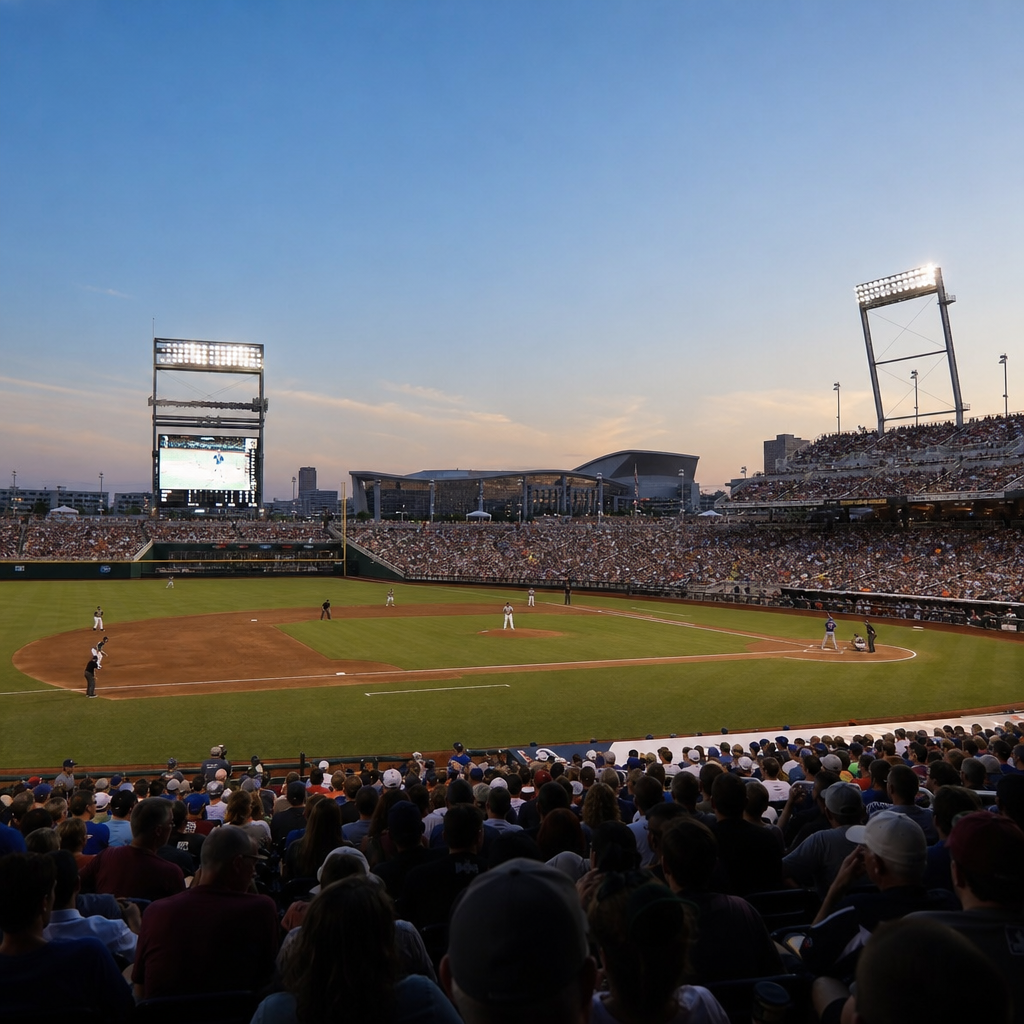
The College World Series is the defining championship event in college baseball, a tournament that blends regional identity, player development, school tradition, and some of the sport’s most unforgettable moments into one annual showcase. In practical terms, the College World Series, often shortened to CWS, is the final stage of the NCAA Division I baseball championship, where eight teams meet after surviving regionals and super regionals. In historical terms, it is much more than a bracket. It is a record of how amateur baseball in the United States evolved, how universities built national brands through spring sports, and how Omaha became one of the most durable host-city partnerships in American athletics.
When I look at the event from a historical perspective, the first thing that stands out is continuity. Rules have changed, ballparks have changed, scholarship structures have changed, and television has transformed exposure, yet the central appeal has remained constant: high-stakes baseball played by athletes who are good enough to reach professional organizations but still deeply tied to school identity. That tension matters. Unlike the minor leagues, where player movement is constant and affiliations shift, college baseball gives fans continuity of roster, coaching style, and rivalry. Unlike most regular-season college sports weekends, the College World Series compresses pressure into a short, nationally visible window, which is why the event has produced so many iconic games and future major leaguers.
This article serves as a broad hub for the miscellaneous side of the “Minor Leagues and College Baseball” landscape. That means covering the tournament’s origin, format, major dynasties, landmark venues, cultural significance, pipeline to professional baseball, and the practical reasons fans, researchers, and students of the sport still study its history. To understand college baseball in America, you have to understand the College World Series. It is where scouting and school pride meet, where regional powerhouses validate decades of investment, and where the history of amateur baseball becomes visible in a single event that continues to shape the sport’s future.
Origins and Early Growth of the College World Series
The College World Series began in 1947, when the NCAA sought a national championship format that could elevate college baseball in the same way its basketball tournament had begun to elevate college hoops. The first event was held in Kalamazoo, Michigan, and California defeated Yale in a best-of-three final. In 1948 the tournament moved to Wichita, Kansas, before finding its long-term identity in Omaha, Nebraska, starting in 1950. That move proved foundational. Omaha was centrally located, supportive, and willing to turn the tournament into a civic event rather than simply a hosted bracket. Few championships in college sports have benefited more from geographic and political stability.
The early years also revealed a central truth about college baseball: regional imbalance would define the sport. Programs from warmer climates, especially on the West Coast and later in the South, had obvious structural advantages. They could practice outdoors more consistently, build deeper schedules, and attract recruits interested in year-round development. In the 1950s and 1960s, schools such as USC, Arizona State, and California set the competitive tone. Their success was not accidental. They invested earlier, scheduled better competition, and treated baseball as a serious varsity enterprise when many schools in colder climates still struggled with facilities and limited spring preparation.
Another important feature of the early College World Series was the link between coaching identity and institutional prestige. Rod Dedeaux at USC is the clearest example. His program became the gold standard for player development, fundamentals, and postseason execution. Once the CWS became a repeat destination for certain schools, recruiting changed. Talented high school players increasingly viewed specific programs as direct pathways to national relevance and professional scouting attention. That feedback loop helped transform the event from a championship into a developmental proving ground.
How the Tournament Format Evolved
The tournament most fans recognize today is the result of several decades of adjustments. The modern road to Omaha begins with a 64-team NCAA tournament field, followed by 16 regional hosts, eight super regionals, and then the eight-team College World Series. But that layered format did not exist in the early decades. The NCAA gradually expanded the field as college baseball itself expanded in depth, television value, and geographic reach. Each round added a useful filter. Regionals reward roster depth. Super regionals test frontline pitching and game-planning. Omaha exposes every weakness because the field is strong from top to bottom.
From a historical perspective, format changes matter because they alter what “best team” means. In a smaller field, traditional powers could reach the final stage with less resistance. In the modern structure, a national seed can be eliminated at home in a regional by one poor start, one bullpen collapse, or one lineup that gets hot for forty-eight hours. I have seen excellent teams dominate their conference, earn a top seed, and still fail to reach Omaha because college baseball’s short series volatility is real. That unpredictability is not a flaw. It is part of what has made the event compelling.
The championship series has also evolved. The current best-of-three finals reward depth and reduce the chance that one off night determines the title. At the same time, the bracketed stage before the finals retains the tension that has always defined Omaha baseball. Teams must manage rotations carefully, preserve leverage relievers, and adapt quickly to opponents they may not have seen all season. In pure baseball terms, the CWS demands tactical flexibility. Coaches who succeed there usually combine disciplined roster construction with an ability to make aggressive in-tournament decisions.
Dynasties, Power Conferences, and Shifting Competitive Balance
No historical perspective is complete without acknowledging dynasties. USC remains the benchmark, with 12 national championships, including an extraordinary run of five straight titles from 1970 through 1974. That record is one of the most difficult in college sports to imagine being matched. The Trojans dominated in an era when coaching continuity, regional recruiting strength, and a less crowded national field amplified sustained excellence. Arizona State, Texas, LSU, and Miami later built their own national identities, while programs such as Cal State Fullerton, Stanford, South Carolina, and Oregon State demonstrated that there are multiple models for winning in Omaha.
The balance of power has shifted over time, especially toward the SEC and ACC, because infrastructure changed. Dedicated baseball facilities, indoor training spaces, nutrition programs, analytics support, and expanding staff resources all gave wealthier athletic departments an edge. The SEC in particular turned baseball into a major revenue and brand sport. LSU’s atmosphere at Alex Box Stadium, Mississippi State’s crowds at Dudy Noble Field, Arkansas at Baum-Walker Stadium, and Florida’s player development model show how serious the sport has become. Omaha now often reflects that investment. It is not unusual for half or more of the field to come from the SEC or ACC pipeline.
That does not mean the sport lacks mobility. Coastal Carolina’s 2016 title was a reminder that a well-built mid-major can still navigate the bracket and win the whole event. Oral Roberts’ 2023 run to Omaha showed how veteran rosters, strike-throwing, and offensive execution can disrupt conventional expectations. College baseball remains more open than football because roster sizes, scholarship limits, and the randomness of short series leave room for challengers. Historically, that blend of hierarchy and surprise has been central to the College World Series’ appeal.
| Program | Historical Significance | Defining Strength |
|---|---|---|
| USC | Most national titles; set the early standard for Omaha dominance | Dynastic coaching and elite recruiting |
| Texas | Long-term consistency across eras and formats | Institutional investment and pitching depth |
| LSU | Helped modernize the event’s national profile | Fan support, facilities, and pro-level talent |
| Miami | National power built outside the traditional football spotlight | Speed, athleticism, and player development |
| Oregon State | Proof that a cold-weather school can build a durable winner | Roster continuity and disciplined execution |
Omaha, Rosenblatt, and Charles Schwab Field
Omaha’s place in College World Series history deserves its own section because the city is inseparable from the event’s identity. For decades, Johnny Rosenblatt Stadium was the symbolic home of college baseball. Opened in 1948 and associated with the CWS from 1950 until 2010, Rosenblatt gave the event a recognizable stage: broad outfield spaces, summer heat, wind patterns that changed games, and a local culture that treated visiting fan bases as annual guests. Rosenblatt was not just a ballpark. It was a ritual space, the kind of venue where family traditions formed and school lore gained physical texture.
When the tournament moved to TD Ameritrade Park in 2011, now Charles Schwab Field Omaha, there was understandable concern that the event would lose some of its character. Instead, the new park eventually developed its own identity. It offered cleaner sightlines, upgraded player amenities, and stronger infrastructure for television and large-scale attendance. The dimensions and park effects initially depressed offense, leading to debates about whether the stadium favored certain roster constructions, particularly power arms and gap-oriented lineups. Over time, teams adjusted, and fans did too. The lesson was historical as much as practical: iconic events can survive venue changes when the host city, fan commitment, and institutional memory remain intact.
Omaha also matters because it transformed neutral-site baseball into a destination event. Many championships are watched. The College World Series is attended as a pilgrimage. Fans travel not only to support a team but to participate in a broader culture of tailgates, memorabilia, public practices, and intergenerational storytelling. That atmosphere distinguishes the event from minor league baseball, where local continuity is strong but leaguewide championship identity is weaker. In Omaha, the city itself acts like a curator of the sport’s memory.
Players, Coaches, and the Professional Pipeline
The College World Series has long functioned as a showcase for future professional talent. Names such as Dave Winfield, Robin Ventura, Will Clark, Barry Larkin, Buster Posey, Gerrit Cole, Stephen Strasburg, and Adley Rutschman all connect college baseball history to the major leagues, even when their Omaha experiences differed. Some players used the event to confirm first-round status. Others built national reputations there before developing further in pro ball. Scouts value the CWS because it places premium athletes in pressure environments against advanced competition, with wood-bat summer performance and analytical data providing additional context.
Coaches are equally important to the historical record. Rod Dedeaux, Augie Garrido, Skip Bertman, Ray Tanner, Pat Casey, and Jim Schlossnagle each influenced the sport beyond win totals. They shaped recruiting territories, tactical norms, staff organization, and expectations for what a college program should look like. In my experience around the game, the best college coaches are part tactician, part CEO, part teacher, and part roster architect. Omaha tests all of those skills. A coach must manage pitchers without overuse, handle media pressure, keep veteran players loose, and make lineup decisions under national scrutiny.
The professional pipeline is also why the CWS belongs in any broad discussion of “Minor Leagues and College Baseball.” For decades, elite amateur players chose between signing professionally out of high school or attending college. MLB’s draft rules, bonus pools, and development philosophies have shifted that balance several times. Today, college programs often serve as advanced development hubs, producing players who enter pro ball older, stronger, and more data-literate. The College World Series is the public-facing proof of that pipeline at work.
Cultural Legacy, Media Growth, and Why the History Still Matters
The cultural importance of the College World Series rests on more than championships. It has become a shared language for college baseball fans, much the way Omaha itself stands in for achievement. Saying a program “got to Omaha” means it reached the sport’s inner circle, even if it did not win the title. That shorthand reveals how powerful the event’s symbolism has become. The CWS confers legitimacy on programs, energizes donor bases, influences recruiting, and can redefine how a university sees its baseball future.
Media exposure accelerated that effect. ESPN’s long relationship with college baseball expanded the audience, standardized storytelling, and made player recognition possible beyond local markets. Advanced metrics, TrackMan data, and video platforms have since deepened analysis, allowing fans to understand pitch shapes, exit velocity, defensive positioning, and matchup strategy with a sophistication that barely existed a generation ago. Yet the essence of the event remains accessible. A fan does not need a data background to appreciate a complete game, a late defensive substitution, or a two-out rally in Omaha.
Historically, the College World Series matters because it captures the ongoing negotiation between amateur tradition and professional ambition. It preserves school songs, rivalries, and alumni identity while serving as an audition stage for the next level. It reveals how geography, money, coaching, and facilities shape competitive outcomes, but it also leaves room for improbable runs that keep the sport honest. If you want to understand college baseball’s past and where the game is heading, start with the College World Series, then keep exploring the wider network of programs, players, and stories connected to it across this subtopic hub.
Frequently Asked Questions
What is the College World Series, and why is it so important in college baseball history?
The College World Series, commonly called the CWS, is the final and most celebrated stage of the NCAA Division I baseball championship. Each year, eight teams advance to this round only after navigating the pressure of regionals and super regionals, making Omaha the ultimate proving ground in the college game. On the surface, it is a championship tournament. Historically, however, it represents far more than a bracket or a final weekend of competition. The event has become the central stage where college baseball’s traditions, power programs, breakthrough teams, and unforgettable performances are permanently woven into the sport’s identity.
Its importance comes from the way it captures everything that makes college baseball distinct. The CWS brings together regional fan bases, school pride, coaching legacies, and future professional talent in one concentrated setting. For many programs, simply reaching Omaha marks a defining chapter in school history. For others, winning there cements dynasty status. Over time, the College World Series has served as the benchmark by which eras, teams, and players are remembered. When fans discuss the history of college baseball, they are often really discussing what happened at the CWS, because that is where the sport’s biggest moments are most visible and most enduring.
How did the College World Series begin, and how has the tournament evolved over time?
The College World Series began in 1947 as the NCAA sought to establish a true national championship format for college baseball. In its earliest years, the event was much smaller and less commercially visible than it is today, but the foundation was already there: a postseason designed to identify the best team in the country through direct competition. Over the decades, the tournament format expanded and became more sophisticated as college baseball itself grew in popularity, organization, and national reach. What started as a comparatively modest championship developed into a major annual event with national television coverage, dedicated fan travel, and a permanent place on the sports calendar.
One of the most important developments in its history was the event’s long-term association with Omaha, Nebraska, which helped transform the CWS from a championship into a destination. That consistency gave the series a unique identity few college events can match. Fans, players, and coaches came to view Omaha as sacred ground in the sport. The structure of the NCAA tournament also evolved, with regionals and super regionals creating a more dramatic path to the final eight-team field. As the level of play improved and national recruiting widened the talent base, the CWS became more competitive and more representative of the sport’s growth. Today, it reflects both continuity and change: a historic event that still honors tradition while adapting to the modern era of college athletics.
Why is Omaha so closely associated with the College World Series?
Omaha is inseparable from the history and culture of the College World Series because the city has hosted the event for generations and embraced it as more than just a temporary sporting attraction. That long-standing relationship gave the CWS a sense of place that is unusually powerful in college sports. While many championship events rotate between sites, the College World Series built its legacy in one city, allowing traditions, memories, and fan rituals to accumulate year after year. As a result, Omaha is not just where the games are played; it has become part of the event’s mythology.
The city’s role matters because location shapes memory. Fans remember famous home runs, dramatic pitching performances, and championship celebrations not only by opponent and year, but by their connection to Omaha itself. For players and coaches, “getting to Omaha” became shorthand for reaching the sport’s highest level. That phrase carries emotional weight because it reflects decades of history, not just one tournament run. Omaha’s hospitality, local enthusiasm, and annual commitment helped turn the CWS into a pilgrimage for college baseball supporters. In historical perspective, the city gave the series a stable home, and that stability helped the event build one of the richest traditions in all of NCAA competition.
What makes the College World Series different from other NCAA championships?
The College World Series stands apart because it combines the intensity of a national championship with the rhythm, emotion, and storytelling unique to baseball. Unlike single-game elimination events that can feel abrupt, the CWS format allows narratives to unfold over several days. Teams must manage pitching depth, lineup adjustments, momentum swings, and the psychological challenge of surviving against elite competition. That structure often reveals more about a team’s character than a one-night title game can. It rewards not just star power, but resilience, roster balance, coaching decisions, and the ability to respond under pressure.
It is also different because of the way tradition and atmosphere interact. College baseball carries strong regional identities, and the CWS gathers those identities into one shared space. Fans travel in large numbers, school histories are placed side by side, and every game feels connected to something larger than the immediate result. The event often showcases future Major League talent, but it remains deeply rooted in the college experience, where emotion, school pride, and legacy matter just as much as professional projection. That combination gives the CWS a distinctive feel: part championship, part reunion of the sport’s culture, and part annual retelling of college baseball history in real time.
How has the College World Series shaped the legacy of programs, coaches, and players?
The College World Series has had a profound effect on how programs, coaches, and players are remembered because success in Omaha carries a level of prestige that ordinary winning does not. A strong regular season can earn respect, but a deep CWS run creates history. For programs, reaching or winning the College World Series can elevate national reputation, strengthen recruiting, energize alumni support, and define entire eras of athletic identity. Certain schools are considered college baseball powers precisely because of what they accomplished on this stage. Omaha appearances become milestones, and championships become foundational parts of institutional tradition.
For coaches, the CWS often serves as the ultimate measure of leadership and long-term impact. Coaches who consistently guide teams to Omaha are remembered not only for tactical success, but for building cultures capable of handling the pressure of the postseason. For players, the event can be transformational. A standout performance at the College World Series can turn a great college season into a lasting legacy, introducing a player to a national audience and securing a place in the sport’s historical memory. Some are remembered for dominant pitching starts, others for clutch hitting or defensive brilliance, but all are linked by the fact that their defining moments came when the stakes were highest. That is why the CWS remains so central to college baseball history: it does not just crown champions, it creates legends.