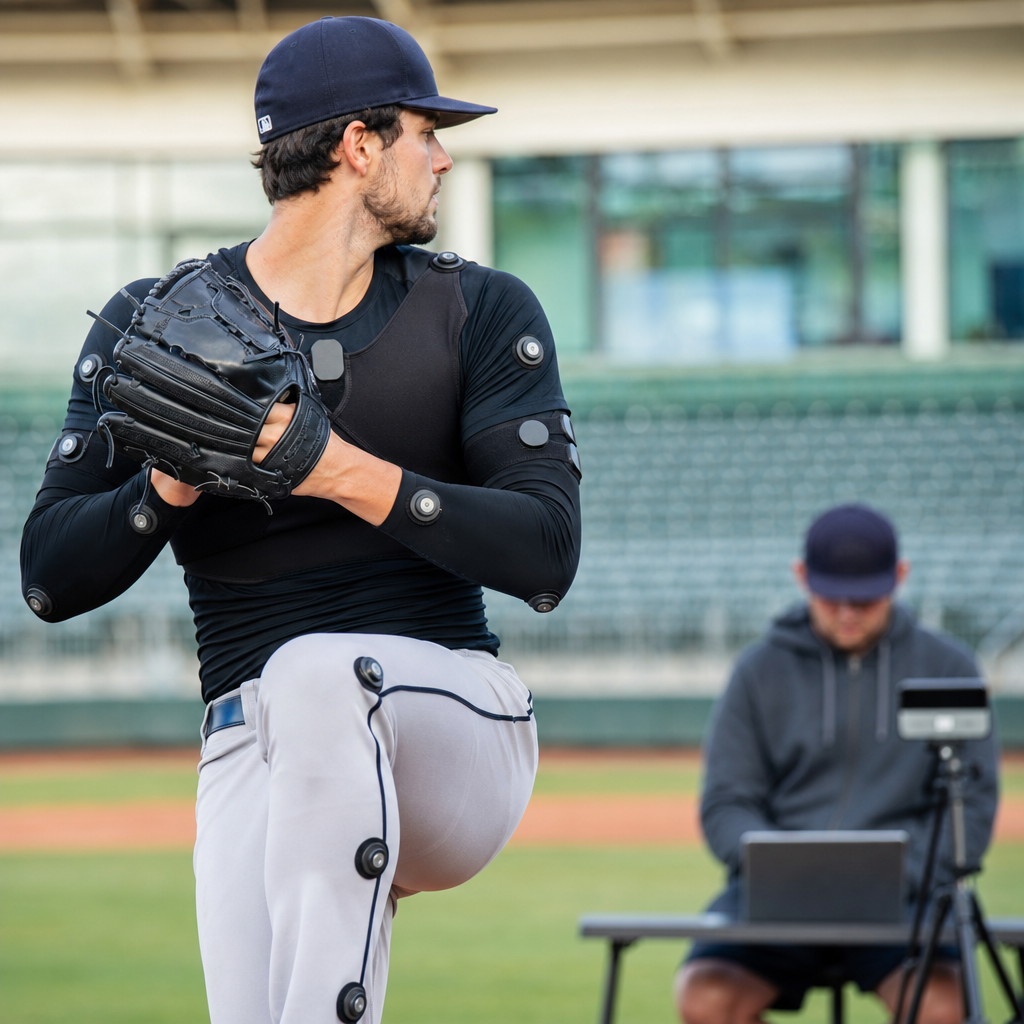
Biometrics in baseball is no longer a futuristic concept reserved for elite labs; it is a practical system of measuring the body to improve player health, sharpen performance, and guide decisions across a long professional season. In baseball, biometrics refers to physiological and biomechanical data points such as heart rate variability, sleep quantity, workload, arm stress, movement efficiency, hydration status, and recovery markers gathered through wearables, force plates, motion-capture systems, and medical testing. Teams use that information to answer urgent questions: Is a pitcher carrying hidden fatigue? Is a hitter’s lower-half power declining? Is an injured player actually ready to return, or merely feeling better? Those questions matter because baseball is built on repetition. A starting pitcher may throw thousands of pitches in training and competition over a year, and position players absorb daily strain through sprinting, rotational swings, travel, and inconsistent sleep. Small changes in readiness can alter velocity, bat speed, command, and injury risk. I have seen organizations move from subjective check-ins and clipboard notes to integrated dashboards that connect training, medicine, biomechanics, and coaching. The shift is significant because the sport’s biggest competitive edge often comes not from one dramatic breakthrough, but from preventing one avoidable injury, preserving one mile per hour of fastball velocity, or recovering one extra percentage point of rotational power in August. As a hub topic within innovations and changes in baseball, biometrics sits at the center of modern player development because it connects technology, sports science, scouting, and medical operations.
For fans, coaches, and front-office leaders, the importance of biometrics is straightforward: healthier players stay on the field longer, and available players create more wins. Major League Baseball’s schedule is unforgiving, with 162 games, frequent travel, heat exposure, and uneven recovery windows. Traditional evaluation tools such as batting average, ERA, radar-gun readings, and visual scouting remain useful, but they reveal outcomes after the fact. Biometrics helps explain why those outcomes are changing. A drop in vertical jump on force plates may indicate neuromuscular fatigue before velocity falls. Reduced shoulder external rotation can warn of elevated pitching stress before pain appears. Poor overnight recovery scores combined with travel and dehydration can explain why reaction time and swing decisions slip during a road trip. This topic also matters because baseball development now begins far earlier than the major leagues. Colleges, private labs, and even advanced high school programs use markerless motion capture, wearable sleeves, and recovery monitoring to manage workload and identify efficient movement patterns. The result is a new development ecosystem in which player health and performance are treated as linked variables rather than separate departments. Understanding biometrics is essential for anyone following deep dives into specific innovations in baseball, because nearly every modern change—from pitch design to return-to-play planning—now depends on better measurement of the athlete behind the stats.
What baseball biometrics actually measures
Baseball biometrics combines internal load, external load, and movement quality. Internal load describes how the body responds to work, often measured through heart rate, heart rate variability, respiratory rate, blood markers, and subjective wellness surveys. External load tracks the work performed: pitch counts, high-intensity throws, sprint distance, acceleration, deceleration, and gym volume. Movement quality evaluates how efficiently an athlete produces force and absorbs stress through tools such as force plates, inertial sensors, and 3D motion capture. In practice, teams rarely rely on one metric. They build athlete profiles that compare current data against an individual baseline. That distinction is critical because a useful biometrics program is not about finding one universal number. It is about identifying meaningful deviation for a specific athlete.
For pitchers, common biometric priorities include elbow torque estimates, shoulder range of motion, arm speed, trunk rotation timing, lower-body force production, and recovery markers after outings. Motus-style sleeve data has popularized public discussion of arm stress, although clubs generally pair wearable estimates with high-speed video and motion-capture analysis rather than trusting one device in isolation. For hitters, bat speed, on-plane efficiency, pelvic rotation, ground-force production, visual tracking, and fatigue resistance are key measures. Catchers present another layer because squat volume, pop-time mechanics, and cumulative lower-back and hip stress must be monitored across dense game schedules. Even baserunning now benefits from biometrics through GPS-style movement tracking, sprint asymmetry detection, and hamstring risk monitoring.
How teams collect and use the data
Modern baseball organizations gather data in the clubhouse, weight room, training room, bullpen, batting cage, and game environment. Force plates from companies such as VALD can measure countermovement jumps, asymmetries, and force-time curves in minutes. Marker-based and markerless motion-capture systems can break down pitching and hitting mechanics frame by frame. Wearables track sleep, readiness, heart rate, and movement trends. Ultrasound, manual range-of-motion testing, and dynamometry add clinical context. The best operations standardize collection times so that comparisons are valid. If one player jumps on force plates every morning after breakfast and another tests randomly after lifting, the data will be noisy and less actionable.
Use cases vary by department. Strength staffs use biometrics to adjust lifting loads and recovery plans. Athletic trainers use it to monitor soreness, tissue tolerance, and progression after injury. Biomechanists look for mechanical inefficiencies tied to stress or performance loss. Pitching and hitting coaches use outputs to support cueing, not replace instruction. Front offices increasingly use readiness and availability data in roster planning, especially when deciding whether a player can handle short rest, back-to-back appearances, or a rehabilitation assignment. The practical lesson is that biometrics has value only when translated into decisions. A dashboard full of red and green indicators means little unless staff members agree on thresholds and interventions.
| Tool or method | What it measures | Baseball use case |
|---|---|---|
| Force plates | Jump height, force asymmetry, rate of force development | Detect fatigue, guide lower-body training, monitor return to play |
| Motion capture | Joint angles, sequencing, velocity transfer | Refine pitching mechanics and hitting kinematics |
| Wearable recovery trackers | Sleep, heart rate variability, resting heart rate | Adjust travel recovery and daily workload |
| Arm sleeves and sensors | Throw volume, arm speed, estimated stress | Monitor bullpen and long-toss load |
| Dynamometers and ROM testing | Strength and mobility deficits | Screen injury risk and rehab progress |
Injury prevention and workload management
The clearest promise of biometrics in baseball is injury prevention, especially for pitchers. Shoulder and elbow injuries remain costly despite improved training and surgery. The challenge is that pain is a late signal. By the time a pitcher reports discomfort, workload tolerance may already be exceeded. Biometrics helps teams catch earlier warning signs through changes in recovery, mechanics, and output. A pitcher whose shoulder internal rotation drops, whose jump profile flattens, and whose arm slot changes may need a modified bullpen, extra recovery work, or even skipped competition. None of those signals guarantees injury, but together they can support smarter decision-making.
Workload management has become more sophisticated than simple pitch counts. Teams now distinguish between game pitches, high-intent throws, weighted-ball sessions, flat-ground work, and stress created by mechanics. A 25-pitch bullpen is not equal for every athlete. One pitcher may produce the same intent and arm speed as in a game; another may use it as light touch-and-feel work. Biometrics allows staff to individualize limits. This is especially useful for younger pitchers transitioning from amateur baseball, where seasonal volume is often poorly tracked. In player development, I have seen the most effective models combine objective load monitoring with coach observation and athlete feedback rather than treating technology as infallible.
Performance gains at the plate and on the mound
Biometrics improves performance because baseball skill depends on efficient force transfer. On the mound, velocity and command are not generated by the arm alone. They emerge from sequencing: ground force through the legs, pelvic rotation, trunk acceleration, scapular mechanics, and wrist position at release. Motion capture can reveal whether a pitcher is leaking energy through poor lead-leg blocking or mistimed trunk rotation. Force-plate data can show whether lower-body power is trending down over a series of starts. Those insights let coaches build targeted interventions, such as improving hip-shoulder separation, adjusting mound drills, or altering between-start lifting.
At the plate, the same logic applies. Hitters who produce elite bat speed typically create force from the ground and transfer it through a stable but dynamic kinetic chain. Biometrics can identify whether a hitter’s rotational acceleration drops when fatigued, whether asymmetry affects swing decisions, or whether visual fatigue contributes to late reactions against velocity. Bat sensors and high-speed cameras are useful, but they become far more valuable when paired with physical testing. If a hitter’s bat speed declines in the sixth game of a road trip and the athlete also shows reduced sleep and lower countermovement jump output, the issue may be recovery rather than mechanics. That distinction prevents coaches from chasing technical fixes for physiological problems.
Rehabilitation, return to play, and roster value
Rehabilitation is where biometrics often delivers the most measurable organizational value. Return-to-play decisions used to rely heavily on symptom reports, basic strength tests, and visual confidence. Those elements still matter, but they are not enough. After an oblique strain, a hitter may feel good in batting practice yet still lack the rotational force and deceleration control required for full competition. After ulnar collateral ligament surgery, a pitcher may regain velocity in short bursts while still showing mechanical compensation or poor recovery patterns between throwing days. Objective markers give medical and performance staffs a clearer basis for progression.
A strong return-to-play model uses criteria, not dates. That means an athlete advances when specific benchmarks are met: force production within a defined range of baseline, acceptable asymmetry levels, restored range of motion, stable mechanics under game-like intensity, and normal recovery responses after workload exposure. This approach protects both player health and roster value. Baseball contracts can involve tens or hundreds of millions of dollars, and even at lower levels, a missed season can derail development. Biometrics reduces uncertainty, though it never eliminates it. The best clubs treat return to play as a layered decision involving doctors, trainers, strength coaches, biomechanists, and the athlete.
Limits, ethics, and what the future looks like
Biometrics is powerful, but it has limits that responsible baseball organizations must respect. First, data quality matters. Consumer wearables can be useful for trends, yet they are not always validated to the same standard as laboratory tools. Second, context matters. A low recovery score may reflect travel stress, alcohol intake, illness, or simply a noisy reading. Third, privacy matters. Physiological data is personal, and players need clarity about who sees it, how it is stored, and whether it could affect contract decisions. Trust is foundational. When players think data will be used against them, compliance drops and the system weakens.
The future of biometrics in baseball will be defined by integration, not gadget accumulation. Expect tighter links between biomechanics, medical imaging, sleep science, nutrition, and in-game performance models. Markerless systems are making high-quality motion analysis more accessible. Computer vision can already estimate movement patterns from standard video in ways that would have required specialized lab setups a few years ago. Artificial intelligence will improve pattern recognition, but human interpretation will remain essential because baseball players are not identical machines. The winning organizations will be those that combine precise measurement with practical coaching and honest communication.
Biometrics in baseball matters because it turns hidden physical signals into useful decisions. It helps teams protect pitchers, keep hitters strong through long seasons, and make smarter calls on training, workload, and rehabilitation. More importantly, it shifts the sport from reactive care to proactive management. Instead of waiting for pain, velocity loss, or performance collapse, teams can look for earlier indicators and respond with targeted adjustments. That is why biometrics has become a central hub within deep dives into specific innovations in baseball: it touches player development, medical strategy, roster planning, and competitive advantage all at once.
The key takeaway is not that technology replaces coaching or experience. It is that better measurement supports better judgment. The most effective baseball programs use biometrics to ask sharper questions, confirm or challenge assumptions, and individualize plans for each athlete. Tools such as force plates, motion capture, recovery wearables, and mobility testing are valuable because they reveal patterns that the eye alone can miss. Still, their usefulness depends on disciplined collection, validated interpretation, and player trust. Used well, biometrics can extend careers, improve availability, and unlock performance gains that traditional box-score analysis cannot fully explain.
As you explore innovations and changes in baseball, treat biometrics as a foundation topic rather than a niche trend. It connects directly to pitch design, training methods, injury prevention, and return-to-play systems across every level of the sport. If you are building out this sub-pillar hub, the next step is simple: dive deeper into the individual technologies, case studies, and team workflows that turn raw data into on-field results.
Frequently Asked Questions
What does biometrics in baseball actually include?
Biometrics in baseball includes a wide range of physiological and biomechanical measurements used to understand how a player’s body is responding to training, competition, travel, and recovery. On the physiological side, teams often track data such as heart rate, heart rate variability, sleep duration and quality, hydration status, body composition, fatigue markers, and overall workload tolerance. On the biomechanical side, they measure how the athlete moves, including joint angles, stride patterns, rotational efficiency, force production, arm stress, bat speed, and movement asymmetries that may signal elevated injury risk or declining performance.
These insights are gathered through tools like wearable sensors, GPS-style workload trackers, force plates, motion-capture systems, smart recovery devices, and regular performance testing. In baseball, where the season is long and physical wear accumulates slowly, biometrics helps teams move beyond guesswork. Instead of relying only on how a player says he feels or how he looked in yesterday’s game, coaches and performance staff can use objective data to make better decisions about throwing volume, training intensity, rest schedules, recovery plans, and return-to-play timelines.
How do biometrics help prevent injuries in baseball players?
Injury prevention is one of the most valuable uses of biometrics in baseball because the sport creates repetitive stress over months of games, practices, travel, and individualized training. Pitchers in particular place enormous strain on the elbow and shoulder, while position players deal with sprint load, rotational force, lower-body fatigue, and overuse patterns that may not be obvious until something goes wrong. Biometrics can identify subtle warning signs before they become serious problems. For example, changes in arm speed, force output, landing mechanics, recovery scores, sleep quality, or heart rate variability can suggest that a player is not adapting well to his workload.
When that information is monitored consistently, teams can intervene earlier. A player might need a lighter bullpen session, modified weight-room work, more recovery time, extra hydration support, or adjustments to mechanics that reduce unnecessary stress. Biometrics does not eliminate injuries, and it should never be treated as a perfect predictor, but it does improve the odds of catching risk patterns sooner. In a sport where small physical changes can lead to major performance drops or long absences, that early visibility can be extremely important.
Can biometrics improve on-field performance, or is it mainly about health?
Biometrics absolutely supports performance, not just health. The most effective baseball organizations use biometric data to connect player readiness with skill execution. If a hitter’s movement efficiency improves, force production increases, and recovery markers stay strong, that may translate into better bat speed, more consistent timing, and higher quality contact. If a pitcher’s lower-body power, mechanics, and recovery profile are optimized, he may hold velocity deeper into games and maintain command more consistently over the season.
The value comes from personalization. Not every player responds to training in the same way, and biometrics helps identify what works best for each individual. One player may benefit from more explosive work, another from reduced volume and better sleep support, and another from mechanical refinement based on motion-capture data. This allows teams to tailor development plans instead of applying the same formula to everyone. Over time, that can lead to more sustainable performance gains, fewer slumps caused by fatigue, and better decision-making around when a player is truly ready to perform at his highest level.
What kinds of technology are teams using to collect biometric data?
Modern baseball teams use a growing ecosystem of technologies to collect biometric data throughout training, games, and recovery. Wearable devices are among the most visible tools, tracking things like heart rate, sleep, workload, and movement. Force plates are widely used to measure how well a player produces and absorbs force, which can reveal fatigue, power output changes, and lower-body asymmetries. Motion-capture systems provide a detailed look at how a pitcher throws or how a hitter swings, breaking movement into precise biomechanical components that coaches and specialists can analyze.
Teams may also use high-speed cameras, smart compression and recovery devices, hydration testing, neuromuscular assessments, and strength diagnostics to build a fuller picture of athlete readiness. The real advantage is not any single device by itself. It is the ability to combine multiple data streams and interpret them in context. A drop in performance means more when paired with poor sleep, elevated workload, and reduced force output. The best programs do not just collect more data; they organize it in a way that helps coaches, trainers, and medical staff make practical decisions that benefit the player.
Are there privacy or ethical concerns with biometrics in baseball?
Yes, privacy and ethics are major issues in the use of biometrics in baseball, and they are becoming more important as teams gain access to deeper and more continuous forms of player data. Biometric information can reveal sensitive details about an athlete’s health, recovery, habits, and physical limitations. That raises important questions about who owns the data, who is allowed to see it, how long it is stored, and whether it could influence contract negotiations, roster decisions, or perceptions about durability. Players may understandably worry that data intended to help them could also be used against them if not handled responsibly.
That is why trust, transparency, and consent matter so much. Players should understand what is being collected, why it is being collected, and how it will be used. Teams need clear policies for data access, storage, security, and communication. Ethical biometric programs focus on supporting player well-being and development rather than using surveillance as a management tool. When implemented correctly, biometrics can strengthen collaboration between players and organizations. When implemented poorly, it can create suspicion and resistance. The future of biometrics in baseball will depend not only on better technology, but also on better standards for privacy, fairness, and player rights.